Can You Pour Boiling Water Down a Frozen Drain?
Yes, but only for metal drain lines or a trapped sink drain you can confirm is metal. Never pour boiling water into PVC, ABS, or a drain you suspect is cracked, loosely glued, or already backed up. Bad calls can warp plastic, split fittings, and turn a freeze into a leak behind a wall. This guide tells you when heat helps, when it does nothing, and what to try first.
Boiling water and drain safety: when does it help?
Boiling water can help only when the blockage is likely ice or grease and the drain assembly can tolerate a fast temperature jump. The core issue is not heat level alone; it is whether the pipe, trap, fittings, and fixture can handle thermal shock without softening, cracking, or separating.
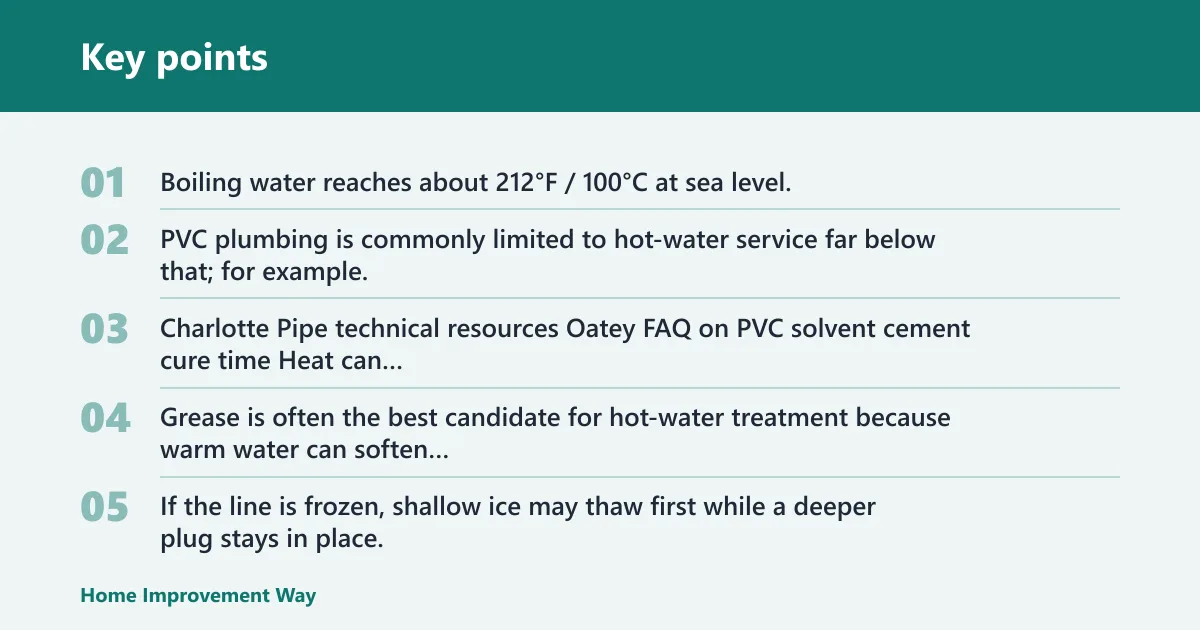
Boiling water reaches about 212°F / 100°C at sea level. PVC plumbing is commonly limited to hot-water service far below that; for example, Charlotte Pipe’s technical guidance for PVC DWV is based on lower operating temperatures, and solvent-cement systems also require compatible materials and curing before use. Charlotte Pipe technical resources Oatey FAQ on PVC solvent cement cure time
What can boiling water do to ice and grease?
Heat can melt ice and loosen grease, but it is not a universal clog remover. Grease is often the best candidate for hot-water treatment because warm water can soften it enough to move, while hair, soap scum, and solid debris usually need mechanical removal rather than more heat. If the line is frozen, shallow ice may thaw first while a deeper plug stays in place. frozen drain
Why does fixture material matter as much as pipe material?
A pipe can be metal while the sink, tub, trap, or outlet fitting is not. Porcelain sinks and tubs can crack from sudden heat, and rubber or plastic joints can fail even when the main run is copper, cast iron, or galvanized steel. That makes the visible pipe only part of the decision.
General plumbing guidance from manufacturers also cautions that many plastic components are not intended for direct boiling-water exposure. For example, Charlotte Pipe and similar manufacturers emphasize material-specific temperature limits and compatibility across fittings, pipe, and cemented joints. Charlotte Pipe technical resources Watts plumbing resources
Why can sudden heat fail at joints and traps?
Thermal shock is the main risk. A fast temperature swing can stress glued joints, rubber seals, and older corrosion-prone connections, especially where a metal section meets a plastic section or a trap connects to a fixture. The pipe body may survive while the weak link fails first.
Mixed-material plumbing is common enough that the safest assumption is caution unless every visible and hidden component is confirmed. A metal run can still include a PVC branch, a plastic trap adapter, or a rubber coupling that is less tolerant of direct boiling water than the pipe itself.
Drain heat decision table: what is safe, risky, or no?
Use this table as a quick screen before you pour anything. Confirm the pipe and fixture materials first if you are not sure, and treat hidden couplings or adapters as part of the system, not an afterthought.
| Pipe material | Fixture material | Blockage type | Recommended water temperature | Failure risk |
|---|---|---|---|---|
| Copper | Metal sink or tub fittings | Grease clog or suspected ice in a short accessible run | Very hot water; avoid a direct boiling blast | Low to moderate, mainly at joints and traps |
| Cast iron | Metal fixtures and metal trap parts | Grease clog or frozen drainpipe | Very hot water; staged pours only | Low to moderate; watch for old seals and corroded joints |
| Galvanized steel | Metal fixtures | Grease clog or shallow freeze | Very hot water; staged pours only | Moderate; corroded joints can fail |
| PVC | Porcelain sink or tub, or plastic trap parts | Any blockage, including ice | Hot tap water only; avoid boiling water | High; PVC is not suitable for direct boiling-water exposure and solvent-cemented joints may be vulnerable |
| ABS | Plastic or porcelain fixtures | Any blockage, including ice | Hot tap water only; direct boiling water is risky | Moderate to high; brief hot-water exposure may be tolerated better than PVC, but boiling is still not a safe default |
| Mixed metal with rubber/plastic joints | Porcelain, composite, or metal fixture | Grease clog or suspected ice | Very hot tap water first; no direct boil unless every component is confirmed metal-rated | Moderate to high; the joint is usually the weak point |
| Metal pipe with mixed-material repair section | Any fixture | Any blockage, including ice | Hot tap water only unless repair parts are verified | Moderate to high; hidden plastic or rubber parts can fail first |
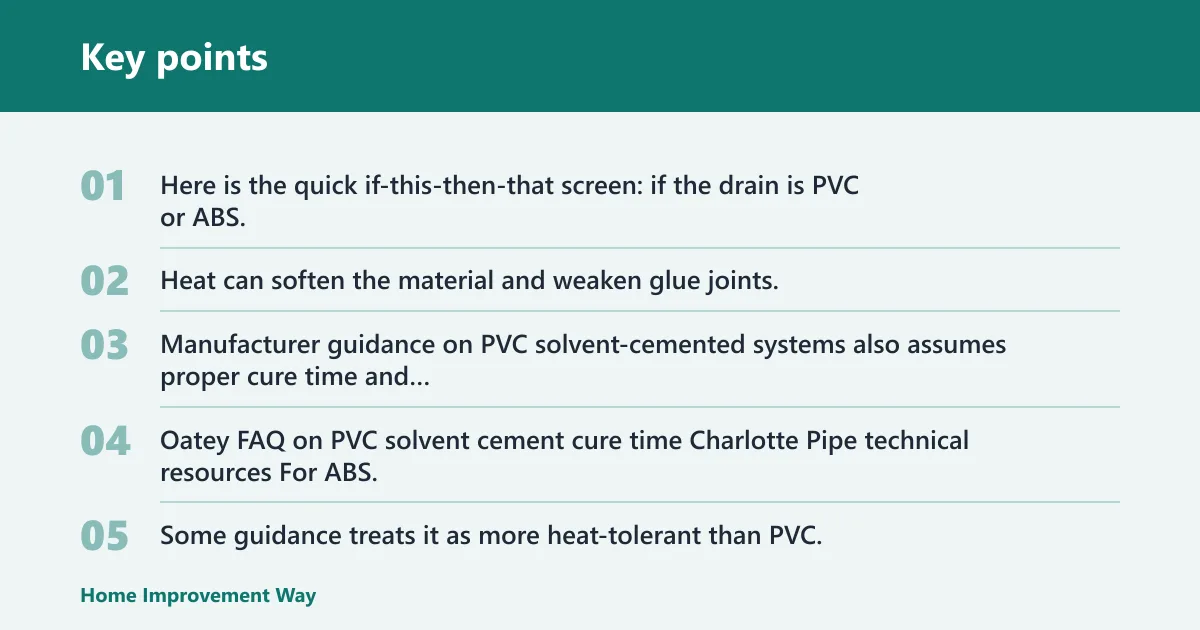
Here is the quick if-this-then-that screen: if the drain is PVC or ABS, do not use boiling water; if the fixture is porcelain, start with hot tap water instead; if standing water is already in the basin, inspect before heating; if the visible line is metal but joints or adapters are unknown, treat it as mixed-material.
For PVC, the risk is not only the pipe wall. Heat can soften the material and weaken glue joints, which is why a drain may fail later even if it seems fine right after the pour. Manufacturer guidance on PVC solvent-cemented systems also assumes proper cure time and compatible use conditions before pressurizing or flushing. Oatey FAQ on PVC solvent cement cure time Charlotte Pipe technical resources
For ABS, the margin is still limited. Some guidance treats it as more heat-tolerant than PVC, but it is still not the same as metal, and direct boiling-water use remains risky. When a plastic drain includes solvent-cemented joints, couplings, or a plastic trap, the safest default is hot tap water only. Watts plumbing resources
Can you pour boiling water down a frozen drain?
Sometimes, but only after you confirm the line is metal and the fixture can tolerate sudden heat. If the drain is PVC, ABS, porcelain, or a mixed-material setup with hidden plastic parts, boiling water is the wrong move because it can damage the system before it thaws the blockage.
When is a hot-water flush reasonable?
A hot-water flush makes sense when the drain is short, accessible, and known to be metal, and when the blockage is likely grease or shallow ice. Copper, cast iron, and galvanized steel are the better candidates here, with the understanding that joints and seals still matter more than the pipe body alone.
Example: a laundry sink with a visible copper trap and a short metal run that stopped after a cold snap may respond to a cautious hot-water flush. The logic is straightforward: the pipe is heat-tolerant, the freeze is likely shallow, and the risk of hidden plastic is lower when the assembly is visible.
When should you stop before you pour?
Stop if you cannot identify the pipe material, if the trap is plastic, if the fixture is porcelain and already under stress, or if the drain is backed up with standing water. Those conditions raise the chance that heat will hit a weak point instead of the blockage, especially when the line is partially hidden.
Another stop sign is a drain that was already slow before the freeze. That pattern often points to a grease or debris buildup, which can worsen when hot water moves loosened material into a narrow section and then it refreezes downstream. In that case, heat may only shift the problem, not solve it.
When is boiling water the wrong choice?
Boiling water is the wrong choice for PVC, for drains you suspect are cracked, and for any frozen line where you cannot see the trap or fittings. It is also a poor choice when the blockage may be deep in the line, because the heat can cool before it reaches the ice or can refreeze in a colder section.
A common mistake is to keep pouring after the first cup seems to help. That can send warm water into a colder section, where it refreezes and makes the blockage longer, tighter, or harder to reach. If the flow does not improve quickly, move to diagnosis instead of escalating heat.
Which pipe types can take it?
Copper, cast iron, and galvanized steel are generally safer candidates for brief hot-water use than plastic drain parts. Even then, the main limits are often not the pipe wall itself but the trap, connectors, and any hidden plastic or rubber parts in the assembly. Material compatibility matters as much as headline temperature resistance.
Copper
Copper is commonly treated as safe for brief hot-water exposure in drain use because it handles high temperatures well. That does not make every copper assembly safe, though, because a plastic trap adapter, rubber seal, or porcelain fixture can still fail. The strongest part of the system may not be the weakest point.
Cast iron
Cast iron can also withstand very high heat and is common in older drain stacks. The practical caution is age: corroded joints, old seals, and mixed-material repairs can become the weak point long before the pipe body does. Older systems need more inspection, not less, before adding heat.
Galvanized steel
Galvanized steel can handle hot water, but old galvanized drains often have corroded threaded joints or patched sections. That makes the line more unpredictable than its heat tolerance alone would suggest. A rusty or heavily scaled joint may be more likely to fail than a cleaner metal run.
PVC and ABS
PVC is the biggest red flag because it is not intended for direct boiling-water exposure, and boiling water reaches 212°F. ABS may tolerate hot water somewhat better than PVC in some applications, but it is still not the same as metal, and direct boiling-water use remains risky. Manufacturer guidance for plastic plumbing products consistently emphasizes material-specific limits. Charlotte Pipe technical resources Watts plumbing resources
Plastic supply systems also deserve caution. CPVC and PEX are not the same as drain pipe, but both require temperature-aware handling; broad manufacturer guidance does not support assuming that plastic plumbing in general will tolerate direct boiling water simply because it handles hot tap water. Watts plumbing resources
How do you tell a frozen pipe from a clog?
A frozen drain often shows up as no flowing water, especially during cold weather or after an unheated pipe run gets exposed to low temperatures. A grease clog usually builds more gradually and may be preceded by slow draining, gurgling, or repeated backups at the same fixture. The timing and pattern matter as much as the symptom.
What are the signs of an ice blockage?
A sudden stop during freezing weather is the classic clue. If nearby fixtures work and only one line stops, the blockage may be in that branch or trap, especially if the pipe runs through a cold crawlspace, exterior wall, or uninsulated cabinet. A frozen section often behaves like a hard stop rather than a slow drain.
No-flow conditions are a common frozen-pipe sign, but they are not exclusive to freezing. The difference is context: if temperatures dropped and the blockage appeared quickly, ice rises on the list. If the line had been slowing down for weeks, a clog is more likely.
What are the signs of grease or debris?
Grease tends to slow a drain first, then trap soap scum, food particles, or hair. If the drain has been sluggish for days or weeks, heat alone is less likely to solve it, even if warm water temporarily improves the flow. Debris can shift, but it will not melt away the way grease may.
Hair and solids do not dissolve just because the water is hot. Heat may move the clog a little, but it will not reliably remove the material from the line, especially if the buildup is compacted or mixed with grease.
What are the weak points in mixed-material runs?
Do not judge the whole line by the visible pipe alone. A metal sink drain can still include a PVC branch, a plastic trap adapter, or a rubber coupling hidden behind a wall or under a cabinet. The visible section may look safe while the hidden connection is the actual risk.
Picture a cast-iron stack under an older bathroom, but the P-trap was replaced with plastic during a remodel. The visible pipe suggests safety, yet the weak point is the newer plastic section, not the old metal run. That is why the safest approach is to verify every exposed component before using heat.
What should you pour instead?
When heat is appropriate, start with very hot tap water, not boiling water. That reduces thermal shock while still giving grease and shallow ice a better chance than cold water would. The goal is controlled warming, not maximum temperature.
Hot tap water versus boiling water: which is safer?
Hot tap water is the safer first try for many drains because it is less likely to crack porcelain or stress joints. It provides useful heat without the full 212°F shock of boiling water, which matters when the assembly includes plastic, old seals, or a fragile fixture surface.
Boiling water is the last-mile option only when the pipe and fixture materials support it. If you cannot confirm that, the safer path is a hot-water flush or a non-heat method. The more uncertain the assembly, the less aggressive the temperature should be.
What are staged pours instead of one blast?
- Turn off the water supply before thawing a frozen pipe.
- Confirm the drain material and the fixture material.
- Start with very hot tap water, then pour it slowly in small amounts.
- Pour slowly, in small amounts, so the pipe warms gradually.
- Stop if the fixture sounds stressed, the drain backs up, or water pools without movement.
Slow pouring matters because it limits splashing and reduces the chance of a sudden temperature shock at the trap or fitting. It also gives you a better read on whether the blockage is actually thawing. If the water disappears more slowly but keeps moving, you may be making progress.
When is heat not enough?
If the line stays blocked after a cautious hot-water attempt, stop adding heat. The problem may be deeper ice, a compacted debris clog, a damaged trap, or a venting issue that needs inspection rather than more hot water. More temperature is not always more solution.
If heat does not work, what next?
If flow does not return quickly, move from thawing to diagnosis. More heat is not always the next step, especially when the pipe could be plastic, the trap could be weak, or the blockage could be far from the fixture. At that point, the safer move is to inspect, not escalate.
What should you check next?
Look at the exposed drain for cracks, loose joints, and signs of leakage. Check whether the cabinet, crawlspace, or wall cavity around the line is unusually cold, which can point to poor insulation or an exposed run that keeps refreezing. Also confirm whether the fixture vents normally.
A blocked vent can make a drain behave like it is frozen even when the line itself is not, because water and air cannot move through the system the way they should. If the drain gurgles or backs up in a strange pattern, venting deserves a look.
When should you avoid more heat?
Avoid more heat if the sink or tub is porcelain and already under stress, if the drain is plastic, if standing water remains in the basin, or if you notice a smell of leaking wastewater. Those signs point to possible damage, not a simple freeze, and further heating can make the failure worse.
When does a plumber make sense?
Call a plumber if the drain stays frozen after careful hot-water attempts, if mixed-material plumbing is suspected, if the blockage may be behind a wall or under a slab, or if the drain starts leaking after the first thaw attempt. That is especially important when the fixture is porcelain or the line includes old joints.
Plumbing manufacturers and trade guidance generally recommend avoiding open flame or uncontrolled heat on plumbing systems, especially near plastic or mixed assemblies. If a careful hot-water approach fails, a controlled repair is safer than continued improvisation. Watts plumbing resources Charlotte Pipe technical resources
Frequently asked questions
Will boiling water thaw a frozen drain pipe?
Sometimes, but not always. Boiling water can thaw shallow ice in a metal drain line, yet it may cool before it reaches the blockage, or it may refreeze farther down a cold section. That is why a staged hot-water approach is safer than a fast full-boil pour.
Is boiling water safe for PVC drain pipes?
No. PVC has lower hot-water tolerance than metal plumbing, and boiling water reaches 212°F. In a drain, that can soften the pipe and weaken glued joints, which means the line can fail even if it does not crack right away. Manufacturer resources consistently advise respecting material-specific limits. Charlotte Pipe technical resources
What should I pour down a frozen drain instead of boiling water?
Start with very hot tap water, poured slowly in small amounts. That gives you heat without the same thermal shock risk. If the drain is not responding, stop and inspect the pipe material, the trap, and the fixture before trying more heat.
How do I know if my drain pipe is frozen or clogged with grease?
A frozen drain often appears suddenly during cold weather and may show no flowing water at all. A grease clog usually develops more slowly and often comes with prior slow draining. If the fixture is in a cold area, freezing becomes more likely than grease.
Can boiling water crack a porcelain sink or tub?
Yes. Porcelain can crack from sudden temperature change, especially if the fixture is already cold. The risk is higher when boiling water hits the bowl, the drain opening, or the trap area all at once, so fixture material matters as much as pipe material.
When should I call a plumber for a frozen drain?
Call a plumber if hot water does not restore flow, if the drain leaks after thawing, if you cannot confirm the pipe material, or if the blockage keeps returning. Those signs point to a deeper ice problem, a mixed-material weak point, or a clog that heat will not remove.
Sponsored / affiliate links. As an Amazon Associate I earn from qualifying purchases. I may earn additional commission from eligible campaigns.