Should You Put Antifreeze in Toilets and Drain Traps?
Use RV/boat antifreeze in toilet bowls and P-traps only when water cannot be fully drained. Skip it in most home toilets tied to a winterized, drained system only after the bowl, tank, and trap water have been emptied. Wrong product, or leftover standing water in a bowl or internal trap, can crack porcelain, split traps, and lead to leaks at spring startup. This guide separates RV toilets, home toilets, and drain traps, and tells you when antifreeze is useful, unnecessary, or risky.
When toilets and traps actually need antifreeze

The short answer depends on the system. RV toilet bowls and low-point drain traps may need antifreeze if water remains in the bowl, valve, or trap seal. Many indoor home toilets do not need antifreeze once the water supply is shut off, the tank is drained, the bowl and trap are emptied, and the room stays above freezing.
Home toilets differ from RV toilets in one key way: they usually sit in a drained indoor plumbing system, not a mobile one with hidden low points and small water pockets. Drain traps in sinks, showers, and floor drains are separate from supply lines, and they are usually the parts that need protection.
Rv toilet bowl
An RV toilet bowl can use antifreeze because the bowl seal or flush ball seal needs liquid sitting on it during storage, and that seal can dry out if left empty. The bowl also connects to a freeze-sensitive flush valve, so any standing water there can turn into a crack or leak.
Home toilet bowl
A home toilet bowl usually does not need antifreeze if the house plumbing is fully winterized and the heat stays on. If the building is unheated or vacant long enough for the toilet to freeze, shut off the supply, flush to empty the tank, then sponge or wet-vacuum the remaining water from the bowl and trap before deciding whether any antifreeze is needed.
Drain traps
Drain traps are low-point water pockets in sinks, showers, and floor drains. They are often treated separately from supply lines because the trap water is what freezes first, and that standing water can split the trap body or let sewer gas back into the room if the seal is lost.
When antifreeze is needed
Antifreeze is needed when a fixture or trap cannot be drained dry enough to avoid freeze damage. It is useful for RV toilet bowls, some RV flush valves, sink and shower traps, and floor drains. It is unnecessary when the fixture can be fully emptied and kept above freezing all winter.
Rv toilet bowl and flush valve
Use antifreeze in an RV toilet bowl when the toilet’s seal area may stay wet during storage. The bowl needs protection, but it should not be left completely dry if the seal depends on a liquid barrier.
Sink, shower, and floor traps
Sink, shower, and floor traps often need antifreeze if the trap water cannot be drained out completely. These are low spots, so they can hold enough water to freeze even after the rest of the line is emptied. In a winterized RV or vacant outbuilding, those traps are often the first places to protect.
Heated indoor plumbing
Heated indoor plumbing usually does not need antifreeze. If the home stays occupied and warm, draining the lines is often enough for toilets and traps that remain in service. Antifreeze is more useful for an empty home, a seasonal cabin, or any plumbing run that cannot be kept above freezing.
Winterizing decision table
This table gives the quick decision rule. If a fixture can be fully drained and kept warm, antifreeze is usually unnecessary. If a trap, bowl, or valve still holds water, use nontoxic RV/marine antifreeze labeled for potable water systems.
| System type | Antifreeze needed? | Exact action |
|---|---|---|
| RV toilet bowl | Yes, often | Flush out the bowl, then pour about a quart of RV antifreeze into the bowl so the seal area stays wet during storage. |
| RV black tank | Yes, after dumping | Flush and dump the black tank first, then let about one quart of RV antifreeze enter the tank through the toilet to protect the tank and dump-valve area. |
| Sink trap | Often yes | Drain the line, then add RV antifreeze until the trap is filled enough to cover the water seal. |
| Shower trap | Often yes | Pour RV antifreeze into the drain until the trap seal is covered and no clear water pocket remains. |
| Floor drain | Usually yes in cold storage | Add enough RV antifreeze to keep the trap seal liquid through storage and to block sewer gas. |
| Seldom-used guest bath | Usually no if heated | Drain the system and leave the toilet dry only if the room stays above freezing; if not, protect the bowl and trap like any other cold fixture. |
| Heated indoor plumbing | No | Drain the supply lines if needed, but do not add antifreeze to fixtures that will stay warm and in service. |
What antifreeze is safe?
Use nontoxic RV/marine antifreeze labeled for potable water systems. Never use automotive antifreeze in freshwater systems. The product for toilets and traps is the RV/boat type, and it is the one meant to be poured into drains and toilet bowls during winterizing.
Why automotive antifreeze is off-limits
Automotive antifreeze is generally not intended for freshwater systems, toilets, or drain traps. It is not the same product as RV antifreeze for potable water systems, and it should not go into any toilet bowl, black tank, sink trap, or shower trap. If it ends up in a system that later supplies water, cleanup is no longer a simple winterizing job.
How the product is used
RV antifreeze is typically poured into drains and toilet bowls, or pumped through the plumbing with a water pump converter kit. The point is to replace water in low spots and sensitive components, not to treat every foot of pipe with the same amount. That is why the trap seal and toilet bowl need their own attention.
How to prep an RV toilet
RV winterizing starts before any antifreeze goes in. Dump and flush the black tank first, drain the fresh water tank completely, and bypass the water heater before pumping antifreeze. That order reduces product use and keeps water from sitting in places that can freeze.
-
Dump the holding tanks.
Empty the black tank and gray tank before winterizing. The black tank should be flushed and dumped before antifreeze is added, because residual waste and liquid can freeze at the dump valve and in the tank itself.
-
Drain the fresh water tank.
Open the fresh water tank drain and empty it completely. This step removes the bulk water load so you are not trying to winterize around a full tank.
-
Bypass the water heater.
The water heater should be bypassed before pumping antifreeze. That keeps antifreeze out of the heater tank and reduces how much product the job consumes.
-
Choose your feed method.
Use a water pump converter kit if you want to draw antifreeze directly from a jug through the pump. If you do not have one, you can pour manually at the toilet and selected drains, but the converter kit is faster and uses less handling.
-
Protect the toilet and traps.
Run antifreeze through the toilet and into any trap that still holds water. Leave some antifreeze in the bowl or seal area so the flush ball seal stays wet during storage.
Say your RV has a toilet, one shower, and a galley sink. If the water heater is bypassed and the tanks are already dumped, antifreeze use drops because you are protecting only the bowl, the traps, and a short run of line rather than the whole hot-water loop.
How much RV antifreeze to use
There is no universal gallon count for every toilet and trap. A black tank may need only enough RV antifreeze to protect the dump valve and any remaining low spots after it has been flushed and dumped. Trap size and pipe layout change the total, so the safe rule is to cover the liquid seal, not chase a fixed number.
Toilet bowl amount
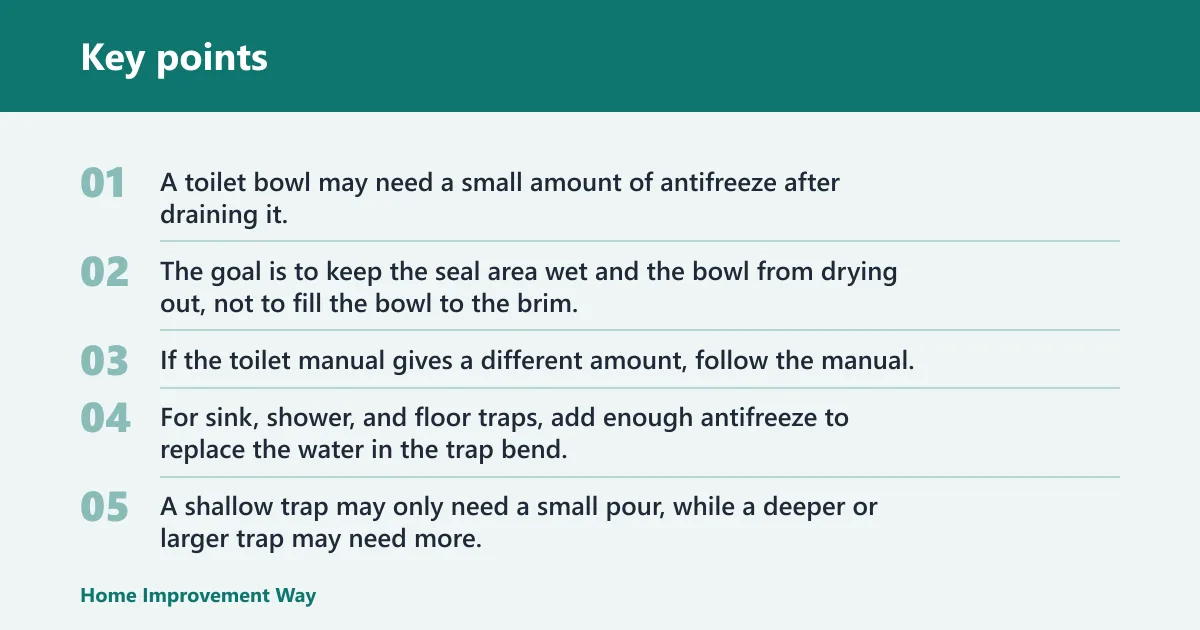
A toilet bowl may need a small amount of antifreeze after draining it. The goal is to keep the seal area wet and the bowl from drying out, not to fill the bowl to the brim. If the toilet manual gives a different amount, follow the manual.
Black tank amount
For the black tank, let enough antifreeze go into the tank after it has been flushed and dumped to protect the remaining film and the dump-valve area. That does not mean the tank is full of antifreeze. It means enough product enters the tank to protect the remaining film and the dump-valve area.
Trap seal coverage
For sink, shower, and floor traps, add enough antifreeze to replace the water in the trap bend. A shallow trap may only need a small pour, while a deeper or larger trap may need more. The correct target is a continuous liquid seal, not a specific number that fits every drain.
Suppose a shower trap is dry after draining, but the floor drain still holds a visible water pocket. Add antifreeze to the floor drain until the standing water is replaced, then stop. Adding more than needed does not improve protection once the seal is covered.
Seal and valve protection
The toilet bowl seal or flush ball seal needs liquid on it during storage. If it dries out, odor can escape and the seal can lose flexibility. The flush valve also needs freeze protection because water trapped in that valve can crack the body or make it leak when thawed.
Toilet bowl seal
The bowl seal is a small part with a big job. It closes off odor when the toilet is shut, and it can dry out if the bowl is left empty for months. That is why many RV winterizing guides tell you to leave some antifreeze in the bowl or seal area instead of drying everything to bare porcelain.
Flush valve freeze risk
The flush valve is activated by the toilet pedal, and it can crack or leak if frozen water remains inside it. An RV toilet should be protected as its own winterizing step instead of being treated like an ordinary sink.
Odor control during storage
Odor control is part of winterizing, not an afterthought. No water in the bowl can cause tank odor, so leaving the bowl completely dry may solve one freeze risk while creating a smell problem. A small amount of RV antifreeze in the bowl can help maintain the barrier.
Failure cases to avoid
The mistakes that cost the most are the ones that leave hidden water behind. Cracked bowls, burst traps, and frozen dump valves usually come from water that was not drained, a valve that was not bypassed, or the wrong antifreeze in the wrong place.
- Cracked bowls. A toilet bowl can split if water remains in the bowl or valve and freezes hard. Porcelain damage is usually obvious at startup and often means a full fixture replacement.
- Burst traps. Sink, shower, and floor traps can split at the bend when standing water freezes. A trap that looks empty from above can still hold enough water in the U-shaped section to crack.
- Frozen dump valves. The black tank dump valve can freeze if the tank was not flushed and dumped first. Once the valve or gate is damaged, the leak can show up only when the tank is opened again in spring.
Frequently asked questions
Should you put antifreeze in toilets when winterizing?
Yes, sometimes. RV toilets often need RV antifreeze in the bowl and valve area because they can hold water that freezes. Most home toilets do not need it if the system is drained and the building stays above freezing. The deciding factor is trapped water, not the fixture label.
Can you use automotive antifreeze in toilets or drain traps?
No. Automotive antifreeze should never go into freshwater systems, toilets, or drain traps. Use only nontoxic RV/marine antifreeze labeled for potable water systems. That product is intended for winterizing plumbing, while automotive antifreeze is not meant for those fixtures.
How much RV antifreeze should go into a toilet and black tank?
A practical starting point is a small amount in the toilet bowl and enough in the black tank after it has been flushed and dumped to protect the remaining liquid film and dump-valve area. Amounts vary by fixture size and manual, so the goal is coverage of the seal area and remaining liquid film, not an exact universal gallon count.
Do you need antifreeze in sink and shower drain traps too?
Often, yes. Drain traps are low-point water pockets, so they can freeze even when the rest of the plumbing is drained. Add RV antifreeze if the trap cannot be emptied fully or if the space will sit unheated for the winter. Heated indoor plumbing usually does not need it.
How do you winterize a toilet bowl so the seal does not dry out?
Drain the bowl, then leave a small amount of RV antifreeze in the bowl or seal area so the flush ball seal stays wet. That keeps the seal from drying out and helps block odor during storage. Do not leave a lot of standing water behind; use just enough to wet the seal.
Do you need to flush the toilet before adding RV antifreeze?
Yes, if you are winterizing an RV toilet or black tank, flush first so the water and waste are cleared as much as possible. The black tank should be flushed and dumped before antifreeze is added, and the toilet bowl should be emptied before you pour in the antifreeze needed for storage.
Can antifreeze damage toilet valves or seals if used incorrectly?
Yes. Too much antifreeze, the wrong product, or a system that still holds water can lead to leaks or seal problems. Freeze damage can make the water valve leak, and a dry seal can create odor issues. Follow the manual, bypass the water heater, and use only potable-water RV antifreeze.
Sponsored / affiliate links. As an Amazon Associate I earn from qualifying purchases. I may earn additional commission from eligible campaigns.
 Waterless EverPrime® 1514 Floor Drain Trap Seal Liquid, 1 Quart, Sewer Gas Odor Control, Dry Floor Drains, HVAC Traps, Biodegradable, Non-Evaporating, Freeze-Resistant to -20°F (1 Quart (Pack of 1))
 3 Inch Dual Flush Valve Replacement Kit for 2-Piece Toilets, Toilet Repair Kit Inside Tank with Fill Valve, Push Button, Metal Wrench, Gasket & Bolts, Fix Leaks, Weak Flush & Wobbling, Water Saving