Window Film vs. Cellular Shades for Heat Control
Window film usually works better for summer heat control on sun-facing glass, while cellular shades work better when you also want winter insulation, privacy, and daytime light control. The right pick depends on the room’s main problem, heat, drafts, privacy, or daylight. Use film for preserved views and solar gain; use shades for comfort you can adjust all day.
This guide is part of our Window weatherproofing guide series.
Comparing heat rejection and winter insulation performance
| Decision factor | Window film | cellular shades for heat control | Winner |
|---|---|---|---|
| Summer heat control | Intercepts solar heat at the glass and preserves the view. | Blocks some heat with honeycomb air pockets, but depends on fit and fabric. | Window film |
| Winter insulation | Limited help compared with an insulating window covering. | Air pockets slow heat loss through windows. | cellular shades for heat control |
| View and daylight | Keeps outward visibility better. | Reduces view when closed. | Window film |
| Privacy and light control | Usually changes glare more than privacy. | Lets you tune privacy and light through the day. | cellular shades for heat control |
| Installation and removal | Can be DIY or professionally installed; some films are less reversible. | Installed as a window treatment and usually easier to remove later. | cellular shades for heat control |
Summer heat control
Window film has the edge on direct-sun glass because it works at the window surface, before solar heat enters the room. Sources commonly describe it as able to block up to 86% of solar heat and reject up to 80% of heat before it enters the space, but real performance still varies by film type and visible light transmission.
Winter insulation
Cellular shades win here because the honeycomb air pockets slow heat loss through windows. The source figures describe them as reducing heat loss through windows by 40% or more, which is why they are often chosen for drafty rooms and cold nights. Film can help, but it is not the same thing as a thermal barrier.
View, privacy, and glare
Film can be a better fit when you want to keep the outside view and reduce solar load without making the room feel closed off. Cellular shades do more for privacy and glare control, especially in bedrooms and street-facing rooms, but the tradeoff is that they block the view whenever they are down.
Installation and reversibility
Window film can be a reasonable DIY project for smaller panes, and DIY window film kits can start at $49. Professional window film installation can add $3 to $8 per square foot, which improves consistency but adds labor. Some films are harder to remove cleanly, and lease rules or glass type matter.
Cost and upkeep
Window film pricing can run $5 to $20 per square foot depending on type, so whole-house cost scales quickly with window area. Cellular shades vary widely by size and material, but the value is often in the added control rather than a single upfront number. Film needs less upkeep; shades need dusting and occasional adjustment.
How window film controls heat
Window film reduces solar heat gain by intercepting sunlight at the glass, so less heat reaches the room. That makes it strongest on west- and south-facing windows, especially where direct sun hits for hours. It can also block 99% of UV rays, which helps limit fabric fading and reduces UV exposure through glass.
Solar heat rejection at the glass
The main advantage is timing. Film acts before the sun’s energy becomes indoor heat, which is why it is so effective on exposed windows. That also means performance depends on the film itself, the glass type, and installation quality.
UV blocking, glare, and view retention
UV reduction matters if you are trying to protect flooring, art, or upholstery from fading. Film also preserves the view better than a closed shade, and that is often the deciding factor in living rooms, kitchens, and view-facing offices. If glare is the bigger problem than privacy, film often solves it without changing the room much.
DIY kits versus professional installation
A DIY kit makes sense for a few small windows or a rental where you want a lower upfront cost and a removable path. Professional installation is better for large panes, awkward glass, or when you need a cleaner finish across many windows. Some dual-pane, tempered, or low-E windows need extra caution, so compatibility should be checked before you buy.
How cellular shades control heat
Cellular shades, also called honeycomb shades, use air pockets to help slow heat transfer across the window. That structure helps in summer and winter, which is why they are often described as a smart choice for energy efficiency and insulation. They can also give you more control over privacy and incoming light than film alone.
Honeycomb air pockets and insulation performance
Those trapped air pockets are the key. Air is a poor conductor, so the shade adds resistance between the room and the glass. That makes the treatment especially useful when heat loss through windows is part of the problem, not just summer sun.
Summer cooling and winter heat loss
Cellular shades can reduce heat gain during the day, but they work best when they fit the window well and are closed when needed. In winter, they usually beat film because the insulating layer helps slow heat loss at night. If the room feels cold near the glass, that extra barrier matters more than view preservation.
Light control, privacy, and drapes or thermal curtains
Shades are the better choice when you want to fine-tune privacy and daylight from one part of the day to the next. They also pair with drapes or thermal curtains, which can add winter insulation and nighttime privacy. The source pairing notes that film can reject up to 78% of solar heat when combined with thermal curtains.
Which works better for summer cooling?
For summer cooling, window film usually wins on direct-sun glass because it stops heat at the pane. Cellular shades can still help, especially if they fit tightly and the room is shaded or only gets afternoon sun, but they are generally a stronger answer for comfort and privacy than for pure solar rejection.
Direct-sun rooms versus shaded rooms
In a west-facing den with hard afternoon sun, film is often the first fix because the heat problem starts at the glass. In a bedroom that only gets bright light through a tree-filtered window, cellular shades may be enough because the room is getting less direct solar load to begin with.
When film has the edge
Choose film when you want cooling help without changing the look of the window. It is especially useful where you want the view, low upkeep, and minimal bulk. It is also a good fit if the room gets hot fast but does not need full daytime darkness.
When cellular shades do more
Choose shades when cooling is only one part of the problem. If the room also needs privacy, glare control, and a softer light level through the day, shades pull ahead because they give you more control. They are the better all-around fix for bedrooms and multipurpose rooms.
Which works better in winter?
Cellular shades are usually better in winter because they slow heat loss through windows with insulating air pockets. Window film can help with comfort and UV control, but it does not add the same thermal resistance. If winter drafts are the complaint, the shade is normally the stronger tool.
Why shades usually beat film for cold-weather comfort
Cold glass pulls heat from the room, and a cellular shade creates a layer of trapped air that slows that transfer. That is why the product is often used for both summer and winter comfort. Film may slightly temper solar effects on sunny winter days, but it is not the first choice for night insulation.
Where thermal curtains fit
Thermal curtains make sense when you want extra winter insulation or nighttime privacy over the same window. They can be layered with film, which lets the window keep its view benefit during the day while the curtains handle evening comfort. That combination is useful when the room needs both sun control and a softer nighttime feel.
Decision matrix for common rooms
Use the room, not the product label, to make the call. A direct-sun living room, a sleeping space, a rental, a drafty room, and a view-sensitive room all push the choice differently. The matrix below turns those tradeoffs into one fast decision.
| Room type | Best option | Why it wins | Downside | Hybrid alternative |
|---|---|---|---|---|
| Direct-sun room | Window film | Best for solar heat gain on exposed glass while keeping the room open and bright. | Less privacy and less winter insulation than a shade. | Film plus thermal curtains for evening comfort. |
| Bedroom | cellular shades for heat control | Better privacy, dimming, and nighttime comfort. | Blocks the view when closed. | Film with cellular shades for daytime and nighttime control. |
| Rental | Window film | Lower starting cost for small windows and a simpler path when you want to avoid a full treatment swap. | Lease rules, residue risk, and glass-compatibility checks can limit options. | Removable film plus lightweight shades. |
| Winter-drafty room | cellular shades for heat control | Insulating air pockets slow heat loss through windows. | Higher upfront cost than a basic film kit. | Cellular shades with thermal curtains at night. |
| View-sensitive room | Window film | Preserves the outside view far better than a closed shade. | Less daytime privacy than a closed shade. | Film plus top-down shades if privacy is occasional. |
How to read the matrix
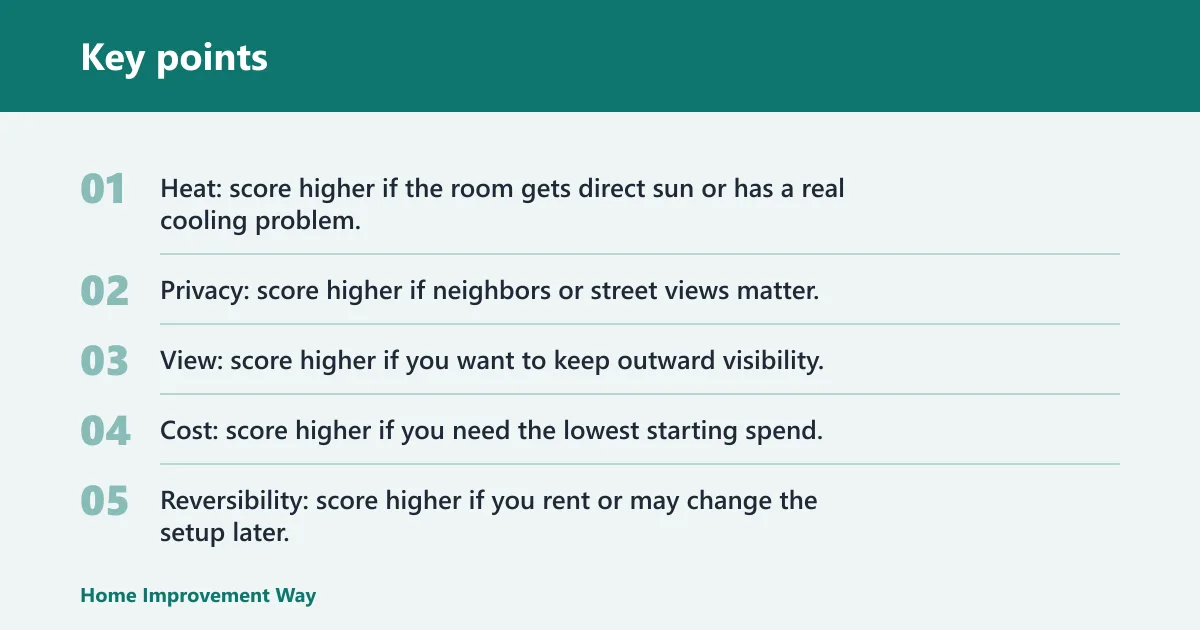
Heat: score higher if the room gets direct sun or has a real cooling problem. Privacy: score higher if neighbors or street views matter. View: score higher if you want to keep outward visibility. Cost: score higher if you need the lowest starting spend. Reversibility: score higher if you rent or may change the setup later.
For a quick score, give each category 1 to 5 points based on how well the option fits the room. Add the totals, then use the tie-breaker that matters most to you, usually privacy or view. If a window scores high for both heat and privacy, a hybrid setup is often the right answer.
Choose Window film if… / Choose cellular shades for heat control if…

Choose Window film if the room gets direct sun, the view matters, and your main goal is lowering solar heat gain with minimal visual change. Choose cellular shades for heat control if the room needs privacy, winter insulation, or flexible daytime light control. Choose both when one product cannot cover every need.
Choose Window film if…
- You want to keep the window view as open as possible.
- The room overheats from direct sun more than from drafts.
- You want a lower-profile fix for a living room, kitchen, or office.
- You are comparing a few small panes and a DIY kit makes sense.
Choose cellular shades for heat control if…
- You need privacy and light control as much as heat control.
- The room is drafty or uncomfortable in winter.
- You want a treatment that helps with both day and night use.
- You are willing to give up some of the view when the shade is closed.
When a hybrid setup makes sense
Say your west-facing family room gets hard afternoon sun, but you still want the view across the yard. Film on the glass handles the heat, and a pair of thermal curtains can close at night for extra comfort. That combination often makes more sense than forcing one product to do everything.
Suppose your bedroom faces a bright street and also feels cold in January. A cellular shade gives you privacy and insulation, while film can still help if glare or UV exposure is part of the problem. The layered setup is practical when the room has more than one complaint.


Frequently asked questions
Does window film or cellular shades work better for heat control?
Window film usually works better for summer heat on sun-facing glass because it intercepts solar gain at the window. Cellular shades are better when heat control needs to include winter insulation, privacy, and light control. If the room has both strong sun and cold nights, a hybrid setup can be the best answer.
How much heat does window film block compared with cellular shades?
Window film can block up to 86% of solar heat and reject up to 80% of heat before it enters the space, depending on the film. Cellular shades do not use the same solar-rejection method; they slow heat transfer with honeycomb air pockets. The better number depends on the window, the product, and the season.
Are cellular shades better than window film in winter?
Yes, usually. Cellular shades are better for winter comfort because they slow heat loss through windows, while film mainly targets solar gain and UV. If the complaint is drafty glass or cold nighttime rooms, shades are usually the stronger choice.
Can I use window film and cellular shades together?
Yes. Film can handle solar heat and UV at the glass, while cellular shades handle privacy, glare, and insulation. This combination works well in rooms that need daytime view control and nighttime comfort, especially on exposed windows.
Which is better if I want to keep the view through my windows?
Window film is the better choice because it preserves the view much better than a closed shade. Cellular shades block the view when down, even though they give you more control over privacy and light. If the view matters most, film should usually come first.
Which option is cheaper to install on a whole house?
That depends on the number and size of windows, but film has a lower entry point for small jobs because DIY kits can start at $49. On larger projects, film pricing can run $5 to $20 per square foot, and professional installation can add $3 to $8 per square foot. Cellular shades often cost more overall because each opening needs a finished treatment.
Do cellular shades help with cooling bills as much as window film?
They help, but not in the same way. Film is stronger when the problem is direct solar heat on exposed glass. Cellular shades help more when the room also needs insulation and better control over how much light enters during the day.
What works best for a bedroom or living room facing direct sun?
For a direct-sun living room, window film is often the better first move because it cuts solar heat while keeping the view. For a bedroom, cellular shades for heat control usually fit better because privacy and night comfort matter more. If the room has both issues, pair film with shades or thermal curtains.
Sponsored / affiliate links. As an Amazon Associate I earn from qualifying purchases. I may earn additional commission from eligible campaigns.