Do Attic Baffles Help in Winter?
Yes. In winter, attic baffles help when insulation can block soffit vents, because they keep a 1–2 inch airflow channel open from soffit to attic. Without that path, trapped moisture and heat can drive ice dams, wet insulation, and roof deck damage. This guide explains when baffles matter most, when they are only one part of the fix, and which attic repair should come first.
How baffles preserve airflow and prevent ice dams

Yes, in the right attic. Baffles are especially useful in a vented attic with soffit intake and ridge or gable exhaust, because they help keep the intake path open and support airflow from the soffits to the roof peak. They do not fix heat loss, and they do not replace insulation, air sealing, or balanced ventilation.
That is the key winter answer. If insulation is drifting into the eaves, or if blown-in insulation is packed against the roofline, baffles can stop the intake from getting buried. If the real problem is air leaks from the living space, thin insulation, or blocked exhaust vents, another repair matters more.
The short answer for vented attics
In a vented attic, baffles help by preserving the channel that lets outside air move in at the soffits and out at the ridge or gable vents. That airflow helps reduce winter condensation and lowers the chance that roof heat will melt snow and refreeze at the eaves. They are a support part, not the whole system.
When baffles matter most
Baffles matter most when the attic already has adequate vent openings but the intake route is threatened by insulation or roof framing. They are especially useful during blown-in insulation top-offs, when loose fill can drift into the eaves and block ventilation. They are also useful when the attic has standard rafter spacing and clear bays to work with.
When another fix matters more
If you see frost on the roof sheathing, warm air leaks, or wet insulation even though soffit vents are open, baffles are only part of the answer. Air sealing at ceiling penetrations, adding insulation depth, and clearing blocked exhaust vents may do more for winter performance than adding more vent chutes alone.
What attic baffles are used
Attic baffles are used as rafter vents, insulation stops, or attic vent chutes. They are installed right above soffit vents to create a clear air path between insulation and the roof deck. In vented attics, they support passive soffit-to-ridge ventilation and keep insulation from crowding the intake openings.
They do not replace insulation. Their job is to protect the ventilation route so the attic can breathe while the thermal barrier stays in place below it.
How they keep soffit intake open
Soffit vents are low intake vents at the eaves. They must remain unobstructed so outside air can enter the attic. Ridge vents are high exhaust vents near the roof peak, and they depend on open intake at the soffits. Baffles keep that intake route from being pinched shut by insulation.
A clear air channel is usually about one to two inches. Standard baffles are made for 16-inch and 24-inch on-center rafter spacing, so they fit the common bay sizes used in many homes.
Why they do not replace insulation
Baffles solve airflow, not heat loss. If the attic floor has thin insulation, the attic can still run warm enough to create winter moisture and snow melt at the roof edge. That is why baffles help best when they are paired with proper insulation depth and air sealing at the attic floor.
How winter attic problems start
Winter attic problems usually start when warm, moist indoor air reaches cold roof decking or when attic heat escapes into the roof space. That can create ice dams along the eaves, frost on the sheathing, and condensation that leads to mold, mildew, and wood rot. Baffles help with airflow, but they do not stop every moisture source.
Ice dams at the eaves
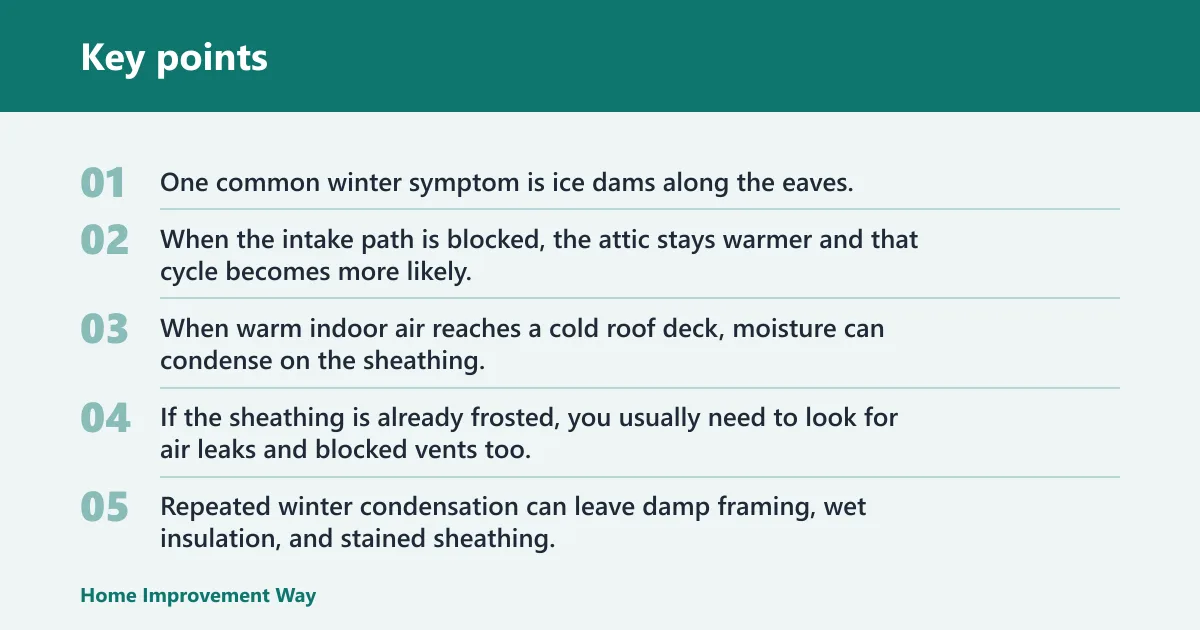
One common winter symptom is ice dams along the eaves. Heat escaping into the attic warms the roof deck, melts snow, and that meltwater refreezes at the colder edge of the roof. When the intake path is blocked, the attic stays warmer and that cycle becomes more likely.
Frost and condensation on roof sheathing
When warm indoor air reaches a cold roof deck, moisture can condense on the sheathing. Baffles help reduce condensation in winter by keeping air moving through the attic cavity instead of letting moisture linger near the deck. If the sheathing is already frosted, you usually need to look for air leaks and blocked vents too.
Moisture, mold, and wood rot risk
Repeated winter condensation can leave damp framing, wet insulation, and stained sheathing. Over time, that can support mold, mildew, and wood rot. A vent path that stays open helps, but it works best when the attic floor is air sealed and the insulation is not blocking the soffit openings.
When do attic baffles matter most?
Attic baffles matter most when insulation threatens the soffit intake, when a retrofit adds blown-in insulation near the eaves, or when a vented attic needs a clear route from soffit to ridge or gable exhaust. They are a targeted fix for blocked intake, not a cure for every winter attic issue.
Blown-in insulation at the eaves
Baffles matter most when adding blown-in insulation near soffit vents. Loose fill can drift into the eaves, and if insulation is pushed into the eaves, it can block ventilation. In retrofit top-offs, the chute gives the insulation a hard stop so air can still move in at the eave.
Blocked soffit vents
Blocked soffit vents can come from insulation piled against the roofline. If the vent slots are buried, the attic loses its low intake and the whole soffit-to-ridge path suffers. A baffle can reopen that path, but it will not help if the attic also lacks enough exhaust area.
Vented attic with ridge or gable exhaust
Baffles belong in vented attics that have a place for air to leave near the roof peak. Ridge vents are the most common high exhaust, though gable vents are also used in some layouts. If the attic is not designed as a vented assembly, adding chutes alone is not the right move.
Attic baffles winter decision table
This table separates the symptom from the likely cause, then shows whether baffles are the right fix or only part of it. Use it to decide what to do first.
| Attic symptom | Likely cause | Whether baffles help | Next best fix |
|---|---|---|---|
| Ice dams | Warm roof deck from heat loss, poor intake, or blocked soffits | Sometimes, if intake is restricted | Air seal the attic floor, add insulation, clear soffit intake, verify exhaust venting |
| Frost on roof sheathing | Moist indoor air reaching a cold roof deck | Yes, if the attic needs a clear soffit-to-ridge path | Find air leaks, improve ventilation balance, repair missing or crushed baffles |
| Blocked soffit vents | Insulation piled against the roofline | Yes | Install baffles above each affected vent opening, then restore insulation clearance |
| Crushed baffles | Insulation or storage compressing the chute | No, not until replaced or reopened | Reset the baffle, secure it, and keep insulation below the airflow channel |
| Uneven upstairs temperatures | Poor air sealing, thin insulation, or duct issues | Only indirectly | Check ceiling air leaks, insulation depth, and HVAC balance before chasing vent changes |
How to install attic baffles
Install baffles in the rafter bay above each soffit vent so the intake path stays open. In many attics, that means working bay by bay, following the rafter layout and keeping the insulation back from the chute. The goal is simple: preserve the air channel, then keep it clear.
-
Pick the right bay.
Choose the rafter bay that lines up with the soffit vent below it. Standard baffles are made for 16-inch and 24-inch on-center spacing, so confirm the bay width before you start. The chute should sit where air can pass from the soffit into the attic without obstruction.
-
Place the chute above the vent.
Set the baffle right above the soffit vent and fasten it so it holds a clear path. Keep the channel about one to two inches deep, which is the common clearance used to protect airflow. Make sure the bottom edge does not crush the vent opening.
-
Keep insulation back.
Push insulation away from the chute so it cannot creep into the eaves later. This matters most with blown-in insulation, which can drift into the opening if it is not restrained. The baffle should act as a stop, not a soft guide that collapses under fill.
-
Verify the whole path.
Check that the soffit opening is open, the baffle is not crushed, and the roof peak has a way for air to leave. If the exhaust vent is blocked, the intake side alone will not solve the winter moisture problem.
Picture an attic of about 1,200 square feet with blown-in insulation pushed up into the eaves. If the soffit slots are buried, adding more loose fill only makes the blockage worse. A baffle installed in each affected bay restores the path, but the attic still needs enough exhaust and a good air seal at the ceiling plane.
A common first-timer mistake is installing a chute and then piling insulation partway into it during a top-off. The attic may look insulated, but the airflow channel is gone, and the winter symptoms come right back.
How many attic baffles do you need?
Count the rafter bays that line up with soffit vents, then match the baffles to the attic layout. In many homes, that means one baffle per bay above each soffit opening. If the attic has multiple vented sections, the total depends on the number of openings, bay spacing, and how the roof is framed.
Count rafter bays and vent openings
Some competitor guidance says every bay above a soffit vent should have one. That is a practical rule for many vented roofs, especially where the soffit runs continuously. If only some bays have vents, focus on those areas first and keep the intake path open in each one.
Check 16-inch and 24-inch on-center spacing
Standard baffles are made for 16-inch and 24-inch on-center rafter spacing, which covers many common roof layouts. The spacing matters because the chute has to fit the bay without buckling or leaving a gap that lets insulation slip past it. Measure first, then buy to fit.
Match baffles to the attic layout
If the roof has intersecting hips, dormers, or short bays near corners, the count may not be a simple one-for-one across the whole attic. Use the vent layout, not just the floor area, to decide where baffles go. A layout with many soffit openings usually needs more chutes than a simple gable roof.
Frequently asked questions
Are baffles in attic necessary?
They are necessary when insulation threatens to block soffit vents in a vented attic. If the eaves are open and stay open, you may not need them everywhere. If blown-in insulation or batts crowd the roofline, baffles become a practical way to preserve the airflow path.
What are attic baffles used for?
They are used to keep a clear air path between insulation and the roof deck, especially above soffit vents. In winter, that helps protect intake airflow and reduce condensation risk. They are most useful in vented attics where ridge or gable exhaust depends on open soffits.
How do attic baffles stop ice dams?
They do not stop every ice dam by themselves. They help by keeping cold outside air moving through the attic so roof heat is less likely to melt snow on the upper roof and refreeze at the eaves. Air sealing and insulation still matter if heat loss is the main driver.
How do you install baffles in an attic?
Place each baffle in the rafter bay above the soffit vent, secure it, and keep insulation back from the channel. The key is maintaining the one to two inch airflow path. If the chute is crushed or buried later, the vent path is lost and the winter benefit drops fast.
Can insulation block soffit vents?
Yes. Insulation can drift into the eaves, especially with blown-in insulation, and block the soffit openings. That can cut off the low intake that ridge vents need to work well. Baffles help by holding the insulation back so the air path stays open.
What happens if attic baffles are missing?
If baffles are missing where insulation touches the eaves, the soffit vents can get buried. That can reduce airflow, increase winter condensation, and raise the chance of ice dams along the roof edge. Missing baffles matter most in retrofit attics with loose-fill insulation near the eaves.
Are attic baffles necessary?
They are necessary only when the attic design depends on open soffit intake and that intake is at risk of being blocked. In many winter problem attics, baffles are the simplest way to keep the ventilation path open. In other attics, air sealing or more insulation will matter more first.
What are attic baffles?
They are rafter vents, insulation stops, or vent chutes installed above soffit vents to hold a clear channel open. They are used in vented attics with ridge or gable exhaust, and they do not replace insulation. Their job is to keep the air path alive where insulation would otherwise crowd it.
Sponsored / affiliate links. As an Amazon Associate I earn from qualifying purchases. I may earn additional commission from eligible campaigns.