Best Siding Options for Fire Resistance (2026): Research Shows
For most homes, fiber-cement siding with noncombustible trim and tight, sealed joints gives the best balance of fire resistance, cost, and appearance; for the strongest ember resistance, metal or stucco over a noncombustible wall assembly is tougher. Bad siding details can let embers into gaps, ignite the wall, and turn a small exposure into major repair costs. This guide compares siding materials by whole-wall fire behavior, joint risk, and maintenance so you can choose the safest option for a remodel or rebuild.
Quick comparison
| Product | Badge | Best for | Price | ||
|---|---|---|---|---|---|
 |
20PCS 160ft² Metal Roofing Panels 61.02"x18.9" CorrugatedGeneric | Our pick | 20 pcs · galvanized steel · grey | $186.98
Price as of 18 Oct 2026
|
View |
 |
Faux Stone Wall Panels, 6-Pack PU Stone Veneer forLUXEYARD | Also great | 6-pack · PU stone veneer · black wood grain | $179.99
Price as of 18 Oct 2026
|
View |
 |
ROOMTEC 6-Pack Faux Stone Wall Covering Panels for InteriorROOMTEC | Upgrade pick | 6-pack · PU stone veneer · 45 x 12 in | $197.90
Price as of 18 Oct 2026
|
View |
Fire resistance is not just a product label. The wall assembly, joints, corners, vents, trim, and openings around windows and eaves can change the result more than the siding itself.
The ranking below focuses on whole-wall risk, not a brochure claim.
📊 CertainTeed’s Highland Slate shingles have a Class A fire rating and can withstand winds up to 110 mph. Source: Thisoldhouse.
How we chose
The comparison uses four checks: fire classification and documentation, risk at joints and openings, maintenance burden over time, and climate fit. That matters because a siding that rates well on paper can still fail early if gaps open, sealant dries out, or heat reaches vulnerable edges.
We also separated product-level fire resistance from assembly-level performance. A material can be listed as noncombustible or Class A-capable and still perform poorly if the install leaves exposed edges, weak corners, or unprotected trim.
Siding decision matrix
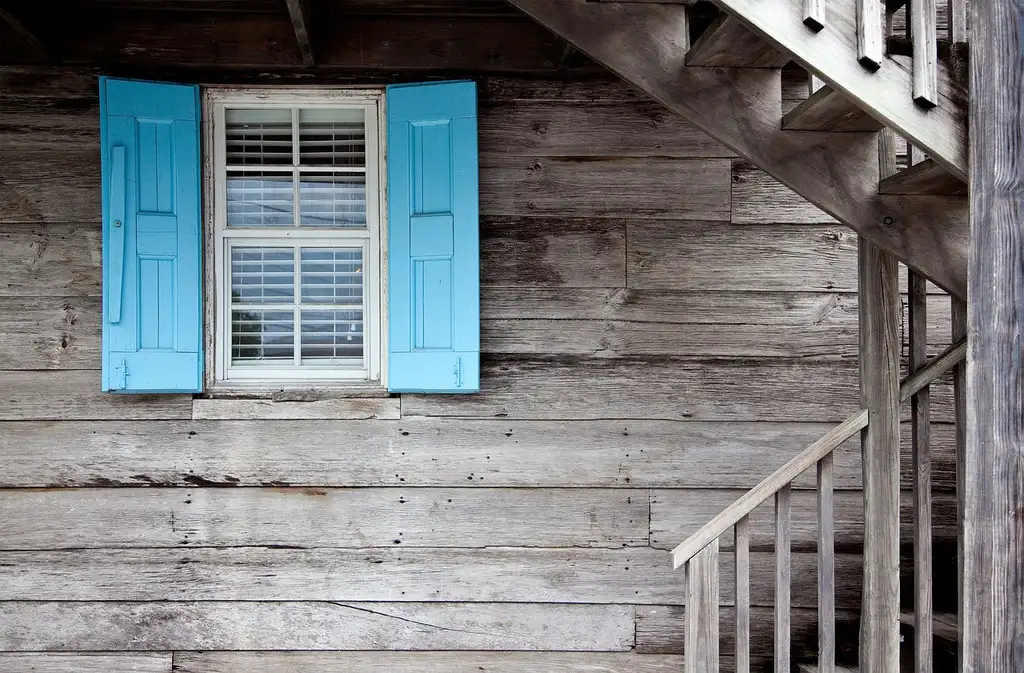
This matrix ranks siding by whole-wall fire risk. Lower rank is better for fire-prone sites.
| Material | Fire rating | Joint ignition risk | Heat behavior | Maintenance burden | Climate fit | Best for |
|---|---|---|---|---|---|---|
| Fiber cement | Often Class A-capable; some products are documented as noncombustible | Moderate if joints and trim are sealed well | Holds shape well under heat; finish and caulk still matter | Low to moderate | Strong in mixed climates and wildfire zones | Most homeowners who want the best balance of fire resistance, cost, and appearance |
| Stucco (3-coat cement) | Noncombustible; can have zero flame spread in some assemblies | Low when corners and penetrations are detailed well | Performs well against flame exposure | Low to moderate | Best in drier or milder climates; freeze-thaw needs care | Wildfire zones where a cement-based wall finish is acceptable |
| Metal siding | Noncombustible | Low if seams and fasteners are detailed well | Reflects heat, but can buckle under high heat | Low | Good in many climates; watch denting and thermal movement | Owners who want strong ember resistance and low upkeep |
| Brick siding | Noncombustible | Low to moderate at mortar joints and transitions | Handles heat well | Low | Good where structure and foundation can handle the load | Long-life exteriors and buyers who want masonry durability |
| Stone veneer | Depends on product and substrate | Moderate; substrate and install details matter | Can perform well if the full assembly is noncombustible | Low to moderate | Good when the backing system is compatible | Accent areas or partial coverage where appearance matters |
| Exterior-rated fire-retardant wood | Improved ignition resistance when properly treated | Moderate to high as weathering opens joints | Still combustible, though slower to ignite than untreated wood | Moderate to high | Better in moderate climates than harsh wildfire settings | Projects that need a wood look and accept added upkeep |
| Wood | Combustible unless specially treated | High if joints, trim, and weathering are ignored | Ignites more readily than noncombustible materials | High | Better away from severe wildfire exposure | Sites with lower fire exposure and strong maintenance commitment |
| Vinyl | Plastic-based; lower fire resistance than noncombustible options | High when heat warps edges and openings | Can melt when exposed to flames | Low | Acceptable only where fire risk is limited | Budget projects outside fire-prone areas |
Best for wildfire zones: fiber cement, stucco, metal, or brick on a well-detailed wall assembly.
Best for mixed climates: fiber cement usually leads because it balances fire performance, finish options, and maintenance.
Best for budget-sensitive remodels: fiber cement still tends to beat vinyl or untreated wood on fire risk, even if the upfront cost is higher.
Fiber cement siding: best overall value
Fiber cement leads for most wildfire-minded remodels because it gives you a strong mix of fire performance, curb appeal, and availability. Common formulations use Portland cement, sand, and cellulose fibers, and many products are sold with a Class A fire rating. Some products are also documented as noncombustible, but that depends on the exact listing and test reports.
Class A is a benchmark for flame spread, not a promise that the whole wall will survive a wildfire. ASTM E84 is used to measure surface flame spread and smoke development on materials, while ASTM E136 is used to classify materials as noncombustible under a different test method. You should check the product sheet, not assume every fiber-cement board is listed the same way.
Installation details matter as much as the board itself. Unsealed joints, poor flashing, weak corner treatment, gaps at penetrations, and exposed trim can create a path for embers and hot gases. That is where whole-wall risk rises.
Where fiber cement fits best
Fiber cement is a strong fit for homes in wildfire-prone areas, mixed climates, and neighborhoods where curb appeal matters. It also works well when you want a material that is generally lower maintenance than wood and less fire-prone than vinyl.
Its limits are practical. It still depends on the exact product listing, the finish system, and the installer’s attention to joints and edges. A poor install can erase some of the fire advantage.
Picture a 2,000-square-foot house on the edge of a foothill neighborhood with prevailing wind toward the front elevation. Fiber cement on the main walls, noncombustible trim, and protected soffits can reduce surface vulnerability, but open eaves and unsealed gaps still need attention.
Typical tradeoffs
Fiber cement is not the lightest option, and cutting and fastening it correctly takes care. It also needs exterior-rated finishes and periodic repainting or touch-up at exposed areas.
Which siding materials are noncombustible?
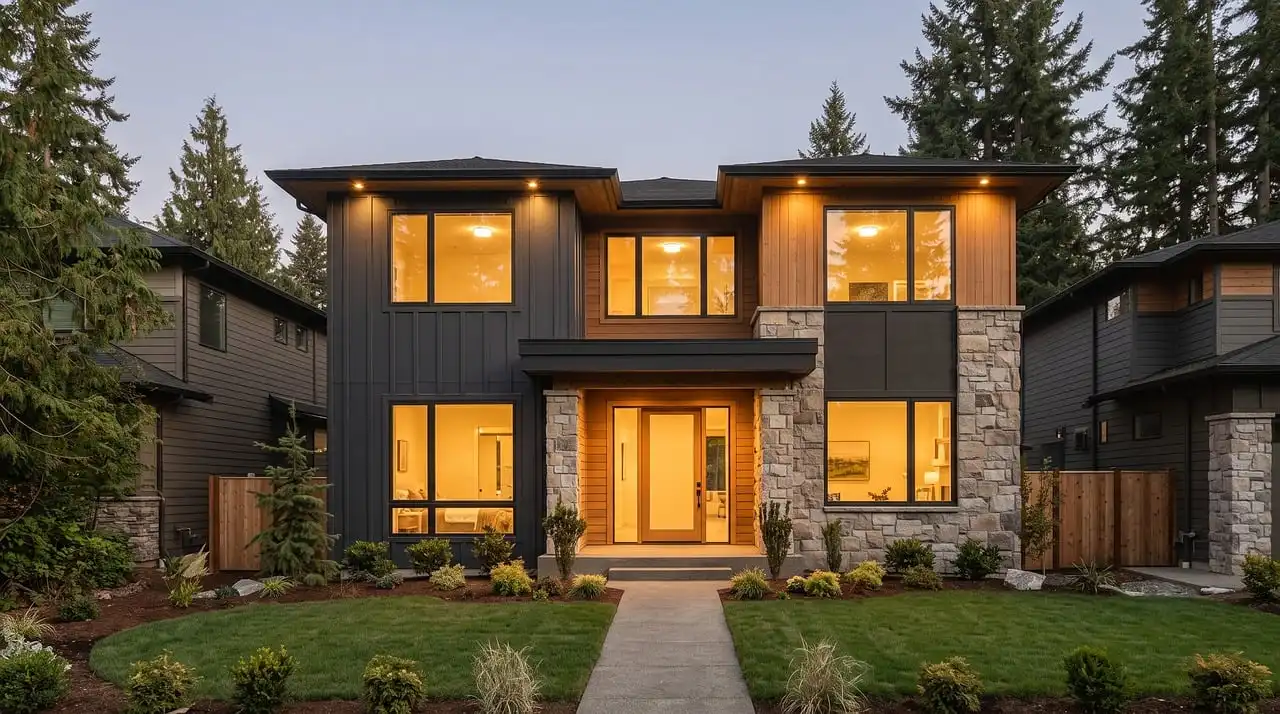
Stucco, brick, and metal are the strongest baseline options when you want noncombustible cladding. Fiber cement can also be a strong choice, but you should verify the exact product documentation because not every board is documented the same way.
Stone veneer is more complicated. Concrete-based or natural stone cladding can perform well, but fire resistance depends on the product and the substrate behind it. A noncombustible face does not fix a combustible backing layer.
Stucco, brick, and metal
Three-coat stucco is cement-based and can have zero flame spread in some assemblies. Brick is also noncombustible, and high-quality masonry can last 100+ years. Metal siding is noncombustible and reflects heat, but it can buckle under high heat and still needs careful fastening and flashing.
Lifetime Xteriors lists stucco as noncombustible at $7–$12 per square foot in Chicago, and brick as noncombustible with 100+ year life. Those numbers are location-specific, but they show the usual pattern: masonry and stucco often cost more than fiber cement, especially once labor is included.
Where stone veneer fits
Stone veneer is often used as a partial application or accent because of cost and weight. Installed cost is typically higher than fiber cement, and the substrate matters. If the backing wall or attachment system is combustible or weak, the whole assembly loses fire value.
A common first-timer mistake is assuming a stone face automatically means a fire-safe wall. The backing, fasteners, and transitions still decide a lot.
Brick, stucco, metal, and stone
These materials can beat fiber cement in pure fire resistance when the assembly is properly designed. Brick and stucco are the most established choices for high-fire-exposure sites. Metal has excellent noncombustible behavior, but it can dent, oil-can, or buckle under intense heat.
Climate changes the answer. Stucco can be less forgiving in freeze-thaw regions. Brick needs good detailing and a wall system that can support its load. Metal usually stays low maintenance, but it can telegraph movement and heat damage more quickly than masonry.
When these options win
Choose stucco when you want a cement-based envelope and the climate supports it. Choose brick when you want long service life and can handle the cost and structure. Choose metal when ember resistance and low maintenance matter more than masonry appearance.
For some homes, a mixed wall is smart: noncombustible cladding on the most exposed elevations and a different finish on sheltered sides. That can reduce cost without giving up protection where it matters most.
Why vinyl and wood rank lower
Vinyl and wood sit lower because whole-wall fire risk rises faster with them. Vinyl is plastic-based and can melt when flames reach it. Wood is combustible unless specially treated, and even treated wood remains less fire-resistant than noncombustible materials.
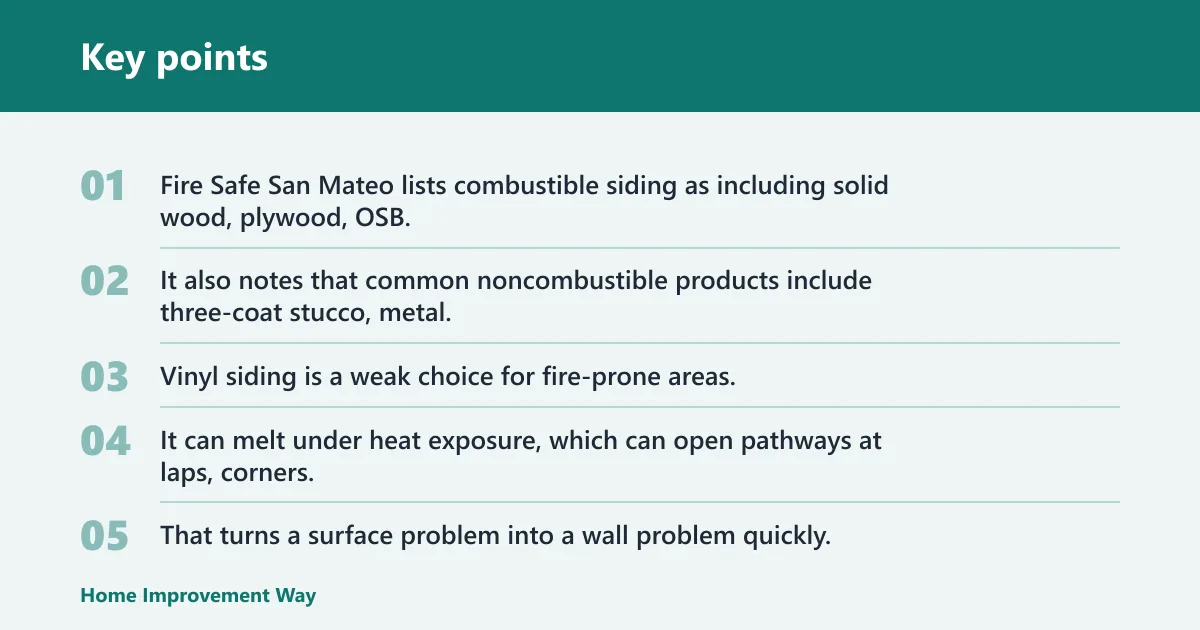
Fire Safe San Mateo lists combustible siding as including solid wood, plywood, OSB, vinyl, and other plastics. It also notes that common noncombustible products include three-coat stucco, metal, and fiber cement.
Vinyl
Vinyl siding is a weak choice for fire-prone areas. It can melt under heat exposure, which can open pathways at laps, corners, and around windows. That turns a surface problem into a wall problem quickly.
Vinyl can still work in lower-risk sites where budget matters most, but it is not the right answer when wildfire exposure is part of the brief.
Wood and fire-retardant wood
Untreated wood siding is combustible. Exterior-rated fire-retardant wood improves ignition resistance when it is properly manufactured and installed, but weathering can reduce performance over time. It should not be confused with a field-applied coating.
LP SmartSide and similar wood-composite products should be treated as a cautionary comparison, not as a substitute for true noncombustible claddings. Fire Safe San Mateo notes that compressed wood-fiber products can produce fast vertical flame spread in testing. That makes detailing and exposure control especially important.
If you want the wood look, ask for the exact exterior listing, the treatment method, and the maintenance schedule. Then decide whether the added upkeep fits the site.
Say your home sits in a subdivision with 10-foot side yards and a neighbor’s grill patio is close to one wall. A combustible or heat-softening siding choice makes that side more vulnerable than the street-facing side, even if the front elevation looks fine.
Fiber cement vs vinyl siding fire resistance
Fiber cement is the better fire-resistance choice in almost every direct comparison with vinyl. Fiber cement is commonly sold with Class A performance and may be documented as noncombustible in some products. Vinyl is plastic-based and can melt when heat builds at the wall.
The real difference shows up at joints and openings. Fiber cement can still fail if gaps are left open, but vinyl is more likely to deform first, which can expose the substrate and the framing below.
What that means on a house
If the goal is wildfire resilience, fiber cement is usually the safer upgrade. If the goal is the lowest upfront price in a low-risk area, vinyl remains common. Those are different goals.
Is cement fiber siding fire resistant?
Yes, fiber-cement siding is generally fire resistant, and many products are rated Class A. Some listings also identify specific fiber-cement boards as noncombustible, but you should verify the exact product documentation. The rating depends on the product, not just the category name.
That distinction matters because whole-wall performance depends on the assembly. If joints, trim, soffits, and penetrations are weak, the wall can still fail even when the cladding itself performs well on paper.
What to check on the product sheet
Look for the exact fire classification, the test standard used, and whether the product is part of a listed assembly. If the sheet does not show that, ask the supplier for the fire documentation before you buy.
Is lp siding fire resistant?
LP-style wood-composite siding can have some fire resistance benefits compared with untreated wood, but it should not be treated like noncombustible siding. It is still a wood-based product, so heat, joint exposure, and weathering matter. In wildfire-prone areas, it is usually a weaker choice than fiber cement or masonry.
The safer way to compare it is by product documentation, not by brand category. Ask whether the specific panel has an ignition-resistance treatment, what the exterior-use limits are, and how the finish ages in your climate.
Choose fiber cement if… / Choose brick, stucco, or metal if…
Choose fiber cement if you want the best balance of fire resistance, price, curb appeal, and maintenance. It is the easiest recommendation for most remodels that need better fire performance without moving into masonry budgets.
Choose stucco, brick, or metal if your site has high ember exposure, strict defensible-space limits, or repeated wildfire smoke and heat loading. These materials can offer a stronger baseline, but they can cost more or need more climate-specific detailing.
Choose wood or treated wood only if the project needs that look and the site risk is lower. Even then, keep the joint layout tight and the maintenance plan realistic.
Can fire-resistant siding lower homeowners insurance?
It can help, but it is not automatic. Some carriers may give credit for noncombustible or fire-resistant materials, especially in wildfire-prone areas, yet the result depends on the insurer, the full risk profile, and the documentation you provide. Do not count on a discount before you ask.
Save the product sheets, fire-test reports, invoices, and permit records. If your siding is part of a larger wildfire-hardening project, keep photos of the finished install too. Carriers often want proof of what was installed, not just what was promised.
Documentation checklist
- Keep the exact product sheet for each siding material.
- Save fire-test documentation showing the rating or classification.
- File contractor invoices that name the installed products.
- Keep permits and final inspection records.
- Photograph finished corners, joints, and openings.
Frequently asked questions
What is the best exterior siding for fire resistance?
For most homeowners, fiber cement is the best choice because it balances strong fire performance, broad availability, and manageable maintenance. If wildfire exposure is severe, stucco, brick, or metal over a well-detailed noncombustible wall assembly can be stronger. The wall details still matter as much as the cladding.
Does fiber cement siding need a fire rating to be noncombustible?
Yes, you should not assume that every fiber-cement product is noncombustible. Some products are documented as noncombustible under ASTM E136, while others are mainly sold with a Class A surface-fire rating. Check the product sheet for the exact claim and the test standard used.
Is wood siding fire resistant with treatment?
Treated wood can be more ignition-resistant than untreated wood, especially if it is listed for exterior use. Even so, it is still generally weaker than noncombustible siding, and weathering can reduce performance over time. If you choose it, plan for maintenance and keep joints and edges tightly detailed.
Which siding materials are noncombustible: stucco, brick, and metal?
Stucco, brick, and metal are the clearest noncombustible choices. Some fiber-cement products are also documented as noncombustible, but you need the exact listing to confirm that. Stone veneer depends on both the face material and the substrate, so the full assembly must be checked.
Can fire-resistant siding lower homeowners insurance: possibly, but there is no?
Possibly, but there is no guarantee. Some insurers may credit fire-resistant cladding, especially in wildfire-prone zones, yet savings vary by carrier and by the rest of the home’s risk profile. Save product sheets, test reports, invoices, permits, and photos so you can document the upgrade clearly.
Fiber cement vs vinyl siding fire resistance: fiber cement is the safer
Fiber cement is the safer choice. It is commonly rated Class A and can be documented as noncombustible in some products, while vinyl is plastic-based and can melt under flame exposure. That difference matters most at joints, corners, and around windows where fire can reach the wall assembly.
Is lp siding fire resistant: lP-style wood-composite siding may improve?
LP-style wood-composite siding may improve on untreated wood, but it does not belong in the same fire-resistance class as noncombustible cladding. Because it is wood-based, it still needs careful detailing and climate-aware maintenance. For wildfire-heavy sites, fiber cement, stucco, brick, or metal are usually better choices.
Sponsored / affiliate links. As an Amazon Associate I earn from qualifying purchases. I may earn additional commission from eligible campaigns.