Wood siding vs. composite siding: cost, pros, cons
Composite siding may cost more upfront, but over time it can cost less because it may reduce repainting, restaining, and moisture-related repairs. Choose wood only if the appearance is worth the upkeep. If climate and maintenance are not taken into account, wood can warp, rot, or peel earlier, which can make a lower install price less of an advantage. This guide compares installed cost, upkeep, lifespan, and climate risk for wood and composite siding.
This guide is part of our Exterior siding guide series.
| Decision factor | Wood siding | Composite siding | Winner |
|---|---|---|---|
| Upfront installed cost | Usually lower to midrange, depending on species and finish | Usually higher for fiber cement and engineered wood; vinyl is often the lowest-cost composite option | Wood or vinyl, depending on which composite you compare |
| Maintenance | Paint or stain every 4–6 years, plus annual inspection for rot and pests | Usually only routine cleaning, with fewer repair calls | Composite siding |
| Moisture and pest risk | Vulnerable to moisture, rot, termites, and carpenter ants | Fiber cement resists weather, fire, and pests; vinyl and engineered wood are less exposed to those risks than solid wood | Composite siding |
| Longevity | Often 20–30 years with steady upkeep | Fiber cement can last more than 50 years; vinyl and engineered wood vary by product | Fiber cement |
| Wood-look realism | True wood grain and natural character | Engineered wood is closest; fiber cement can mimic grain well; vinyl is usually the least convincing up close | Wood |
Wood siding vs. composite siding: the core trade-off



The real choice is not cheap versus expensive. It is authentic material and easier repairs on one side, versus lower upkeep and fewer failure points on the other. Wood looks right on many homes, but its finish and moisture control become part of the ownership cost.
Composite siding is a broad category, so the comparison only works if you separate fiber cement, vinyl, and engineered wood. Fiber cement leads for durability, vinyl leads for budget, and engineered wood sits in the middle as a wood-look option with less upkeep than solid wood.
Why first price does not tell the full story
A siding quote covers only installation. Over time, wood adds paint or stain cycles, inspection time, and repair risk from edge rot or failed caulk. Those recurring costs change the total bill.
How maintenance and failure risk change the long-term bill
Wood siding can look fine for years, then fail at the points that see standing water, damaged trim, or open joints. Once moisture gets behind the boards, the repair is rarely cosmetic only. That is why long-term cost depends as much on failure risk as on the first invoice.
📊 Wood siding has an R-value of about 0.8 per inch. Source: Wood Siding vs. Composite Siding: Pros and Cons.
What each siding type includes
Wood siding
Wood siding is a natural timber product, often made from species like cedar or pine. It brings a warm, authentic look, but it needs paint or stain renewal every 4–6 years and annual inspections for rot or pest infestations.
Composite siding
Composite siding is a category, not a single product. It can include fiber cement, vinyl, and engineered wood, and these materials are built for lower maintenance and better durability than solid wood.
Fiber cement, vinyl, and engineered wood
Fiber cement is made from cement, sand, and cellulose fibers. It resists weather, fire, and pests, and it can last more than 50 years. Vinyl is a PVC-based option that typically has low upkeep and may cost less upfront than wood. Engineered wood is a wood-look composite subcategory that uses wood fibers and binders in a factory-made product.

Side-by-side comparison table: cost, upkeep, and lifespan
| Factor | Wood siding | Composite siding | Winner |
|---|---|---|---|
| Installed cost | Often competitive at purchase, especially compared with premium composite products | Varies widely: vinyl is usually the low-cost option; fiber cement and engineered wood often cost more to install | Depends on the subcategory |
| Routine upkeep | Paint or stain every 4–6 years, plus inspections | Usually occasional cleaning, with less finish work | Composite siding |
| Repair risk | Higher risk from moisture, termites, carpenter ants, and paint failure | Lower risk overall; fiber cement has the strongest resistance to weather and pests | Composite siding |
| Expected service life | Often 20–30 years with upkeep | Fiber cement can exceed 50 years; vinyl and engineered wood depend on product quality and exposure | Fiber cement |
| Wood-look realism | Highest, because it is real wood | Engineered wood is closest; fiber cement is close from the curb; vinyl is usually less convincing | Wood |
Upfront installed cost
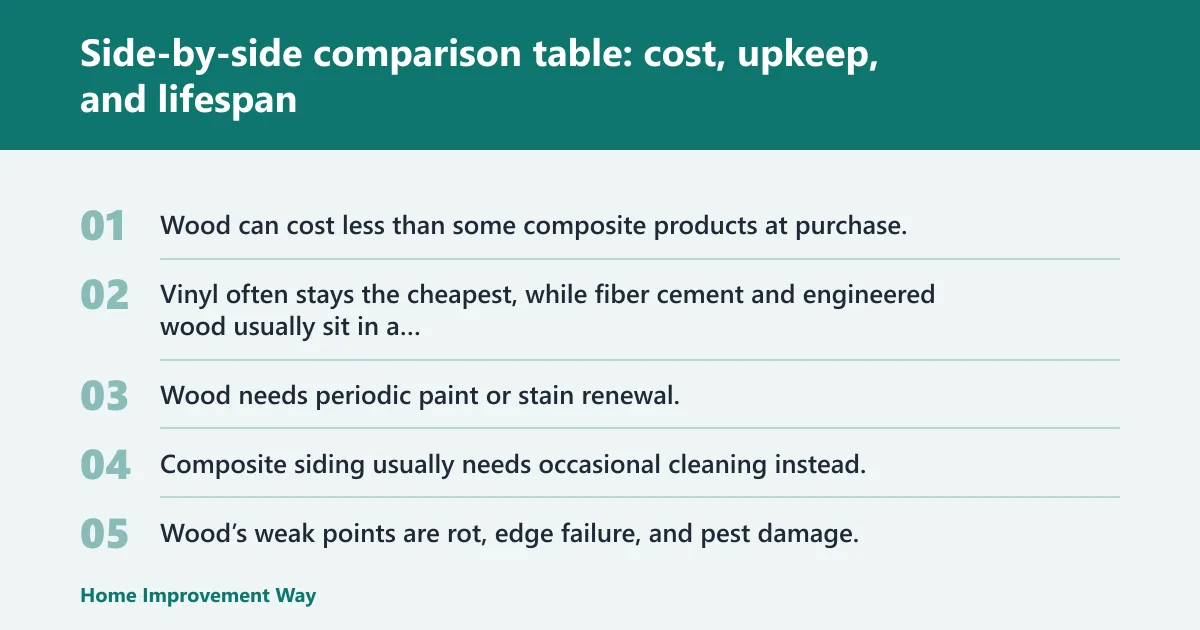
Wood can cost less than some composite products at purchase, but that comparison is incomplete unless you separate the composite types. Vinyl often stays the cheapest, while fiber cement and engineered wood usually sit in a higher initial cost band.
Routine upkeep and cleaning
Wood needs periodic paint or stain renewal, which is not optional if you want to slow moisture intrusion. Composite siding usually needs occasional cleaning instead, which keeps the annual maintenance burden lower and more predictable.
Expected lifespan and repair risk
Wood’s weak points are rot, edge failure, and pest damage. Composite products reduce those risks, and fiber cement stands out because it resists weather, fire, and pests while lasting more than 50 years. That matters on homes where access for repairs is difficult.
Appearance and wood-look realism
Wood still wins on authenticity. Engineered wood can come close, especially at normal viewing distance, and fiber cement can mimic grain convincingly on many elevations. Vinyl has improved, but the look gap can still matter on close-up porch columns, gables, and entry walls.
How much maintenance does wood siding need?
Wood siding needs regular attention. Plan on paint or stain every 4–6 years, annual inspections for rot and pest infestations, and spot repairs anywhere caulk fails or water starts collecting at joints, trim, or cut edges.
Paint or stain cycles every 4 to 6 years
That schedule is the core cost driver. If you let the finish break down, moisture gets into the boards faster and the siding’s service life shortens. A skipped coating cycle can cost more later than the repainting job would have cost up front.
Annual checks for rot, pests, and failed caulk
Look at the bottom edges, horizontal joints, window trim, and any place where water can sit. Wood is vulnerable to termites and carpenter ants, so an annual inspection is not optional. It is part of the ownership cost.
Common repair points: trim, edges, and joints
Failure usually starts at exposed cut ends, nail penetrations, and caulk lines that split. A common first-timer mistake is buying wood because the quote looks lower, then treating paint as optional. Once edge rot starts, repairs tend to spread beyond a single board.
Which composite siding performs best in wet climates?
Fiber cement is usually the best composite choice for wet or variable climates because it resists weather, fire, and pests better than solid wood. Vinyl is the low-maintenance budget option, while engineered wood is the better pick when you want a closer wood look with less upkeep than natural timber.
Humidity, temperature swings, and precipitation
Climate matters because repeated wetting and drying stresses siding finishes and joints. Northern Ohio is a useful example because humidity, temperature fluctuations, and precipitation all pressure exterior materials over time. That same pattern raises failure risk on wood, especially if repainting slips.
Fiber cement for weather, fire, and pest resistance
Fiber cement’s material makeup gives it the strongest durability profile in this group. Because it is made from cement, sand, and cellulose fibers, it handles wet weather better than wood and does not give termites the same food source.
Vinyl for low upkeep and lower upfront cost
Vinyl is the simplest ownership case. It is low-maintenance, usually needs only cleaning, and often has the lowest purchase price among composite options. It does not look as much like real wood as the better alternatives, but the maintenance burden stays light.
Engineered wood for a closer wood look with less maintenance
Engineered wood works for homeowners who want a wood appearance without the same maintenance schedule as solid timber. It still needs care, but it is generally easier to live with than cedar or pine when the priority is lower repaint frequency.
10- and 30-year cost worksheet for a 2,000-square-foot home
This worksheet uses a simple comparison framework for a 2,000-square-foot home. The goal is not to claim exact local pricing. It is to show how the cost structure changes when you include install, finish cycles, cleaning, and likely repair allowances over time.
Worksheet assumptions
- Wood siding: midrange installed cost, repaint or restain every 5 years, annual inspection, and a repair allowance for rot and pest-related fixes.
- Engineered wood: higher installed cost than basic wood in many markets, repaint or restain less often than solid wood, regular cleaning, and a smaller repair allowance.
- Fiber cement: higher installed cost, occasional cleaning, and a modest repair allowance because the material resists weather, fire, and pests.
- Vinyl: lowest installed cost among the four in many markets, occasional cleaning, and a low repair allowance unless panels are damaged.
Side-by-side worksheet
| Cost element for a 2,000-square-foot home | Wood siding | Engineered wood | Fiber cement | Vinyl |
|---|---|---|---|---|
| Upfront install assumption | Baselined as the reference cost | Higher than wood in many markets | Higher than wood in many markets | Lower than wood in many markets |
| 10-year finish cycles | Two paint or stain cycles | One to two finish cycles, depending on product | Usually none if factory-finished; otherwise limited repainting | Usually none |
| 10-year routine cleaning | Annual wash and inspection | Annual wash and inspection | Occasional cleaning | Occasional cleaning |
| 10-year repair allowance | Highest, due to rot, pests, and failed caulk risk | Moderate | Low | Low to moderate, depending on impact damage |
| 30-year finish cycles | Five to six paint or stain cycles | Several finish cycles, fewer than wood | Limited repainting or none, depending on finish | Usually none |
| 30-year repair allowance | Highest, because moisture and edge failures compound | Moderate | Low | Low to moderate |
What this worksheet shows is simple: wood’s low first price can erode quickly once you account for repeated finish work and repair risk. Fiber cement often wins on long-term resilience, vinyl often wins on budget, and engineered wood sits between them when appearance matters more than absolute upkeep reduction.
How the worksheet separates the materials
It does not bundle all composite siding into one line item. Fiber cement gets its own long-life profile because it is made from cement, sand, and cellulose fibers and is known for weather, fire, and pest resistance. Vinyl gets a lower-cost, lower-upkeep profile, and engineered wood gets a wood-look profile with reduced maintenance relative to solid timber.
Choose wood siding if… / choose composite siding if…
Choose wood siding if you want true timber character, are willing to repaint or restain on schedule, and can keep up with annual inspections. Choose composite siding if your priority is lower maintenance, fewer repair calls, or longer service life in a wet or high-variation climate. For many homeowners, the decision comes down to whether the wood look is worth paying for twice: once at install and again over time.
Best fit for wood siding
- You want authentic grain, shadow lines, and the repairability of real boards.
- You are prepared for paint or stain every 4–6 years.
- Your home has strong roof overhangs, good drainage, and careful upkeep habits.
Best fit for fiber cement
- You want the strongest durability in the composite group.
- Your climate brings humidity, precipitation, and freeze-thaw swings.
- You want a long service life with lower pest and rot risk.
Best fit for vinyl
- You need the lowest upfront cost among common cladding choices.
- You want the least finish maintenance.
- You care more about budget control than a perfect wood look.
Best fit for engineered wood
- You want a wood-like appearance with less upkeep than solid wood.
- You are willing to do some maintenance, but not the full wood schedule.
- You want a middle ground between authenticity and durability.
Frequently asked questions
Is wood siding cheaper than composite siding?
Sometimes at purchase, yes, but that is not the whole bill. Wood can look cheaper upfront than fiber cement or some engineered wood products, while vinyl is often cheaper than wood. Over time, repainting, staining, and repair risk can make wood more expensive than it first appears.
How long does wood siding last compared with composite siding?
Wood siding often lasts 20–30 years when it is kept painted or stained and regularly inspected. Composite siding varies by type: fiber cement can last more than 50 years, while vinyl and engineered wood depend more on product quality, installation, and exposure to moisture.
What does composite siding include?
Composite siding is a broad category that includes fiber cement, vinyl, and engineered wood. These products are man-made materials that combine wood fibers, cement, plastics, or related binders to lower maintenance and improve durability compared with solid wood.
Which siding is better for humid or rainy climates?
Fiber cement is usually the strongest choice in humid or rainy climates because it resists weather, fire, and pests better than wood. Vinyl also handles moisture well and stays low-maintenance. Wood is the riskiest choice unless you stay ahead of finish renewal and inspection.
Does composite siding look like real wood?
Some composite siding does, especially engineered wood and certain fiber cement profiles. The closer the product is viewed, the more the differences can show, particularly on entry walls and trim details. Vinyl usually has the biggest gap from real wood grain and depth.
What is the long-term cost of wood siding versus composite siding?
Over 10 to 30 years, wood usually carries the higher ownership risk because finish failure, moisture damage, and pest repairs can stack up. Composite siding often costs more upfront, but fiber cement and vinyl usually cut recurring work, and that is where many homeowners recover the difference.
Sponsored / affiliate links. As an Amazon Associate I earn from qualifying purchases. I may earn additional commission from eligible campaigns.