Best Exterior Siding for Wind-Prone Areas
For many wind-prone homes, fiber-cement siding is often considered a very strong all-around choice, with steel also commonly rated highly. Choose vinyl only if the product is wind-rated to roughly 110–160 mph and installed closely to spec. Poor choices can loosen panels, admit wind-driven rain, and trigger expensive wall damage. This guide compares siding by uplift, fastener retention, impact resistance, and moisture control.
This guide is part of our Exterior siding guide series.
Wind-risk siding selector
Use storm type first, then failure mode. Wind can lift panels, pull fasteners, drive water behind cladding, or send debris and hail into the wall surface. A siding choice that works for gusty inland weather may be a weaker pick in hail country or coastal exposure.
| Storm type | Failure mode | Best-fit material | Installation priority | Maintenance burden | Red-flag conditions |
|---|---|---|---|---|---|
| Inland high wind | Uplift, loose panels, fastener pullout | Fiber cement or metal | Code-compliant fastening, starter strip alignment, secure corners | Low to moderate | Gaps at trim, poor nail placement, weak wall sheathing |
| Hurricane exposure | Uplift, wind-driven rain, edge failure | Fiber cement or steel | Flashing, water barriers, sealed transitions, approved wind rating | Moderate | No product approval report, unclear wind warranty, missed clearances |
| Tornado-prone region | Impact from debris, panel loss | Steel or fiber cement | Strong fastening and continuous load path details | Moderate | Lightly attached trim, weak soffit edges, unreinforced corners |
| Hail-heavy plain | Dents, cracks, broken sections | Steel for impact, fiber cement for balance | Impact-aware product selection and tight detailing | Low to moderate | Basic vinyl, brittle accessories, exposed cut edges |
| Wet coastal zone | Water intrusion, hidden wall damage | Fiber cement or properly detailed metal | Drainage plane, flashing, corrosion-aware fasteners | Moderate | No back drainage, sloppy caulk lines, missing roofline flashings |
Decision flow: If wind is the main threat and hail is minor, start with fiber cement. If impact risk is high, move to steel. If budget is tight and the product has a strong wind rating, vinyl can work in lower-exposure areas. If you want a wood look, choose engineered wood only with strict moisture details. Reserve wood for sites where you can keep up with maintenance.
What wind actually does to siding
Wind does more than push on a wall. It can pry at laps, loosen fasteners, open joints at corners, and drive rain into places that should stay dry. Once water reaches the wall assembly, the real damage often shows up later in sheathing, insulation, framing, or interior finishes.
Uplift and loose fasteners
Strong gusts create suction on the leeward side of a wall and at edges, corners, and roofline transitions. That suction can lift panels, work nails loose, and open a path for water. This is why starter strips, corners, and trim transitions matter as much as the face material.
Wind-driven rain paths
Wind-driven rain can enter around windows, doors, seams, trim, and rooflines. If the wall lacks a reliable drainage path, water may stay trapped behind the cladding. That is a bigger issue than surface wetting, because hidden moisture can spread before you see any stain inside.
Impact from debris and hail
Wind can turn branches, gravel, and loose outdoor items into impact hazards. Hail adds another layer of damage. A siding product may resist wind well but dent, crack, or fracture under impact, so wind resistance and hail resistance should be judged separately.
Say your home sits on an open lot with strong crosswinds but limited hail. A stiff, well-fastened siding system can be the better priority even if it is not the most impact-tough option. If the site also sees hail, the ranking changes fast.
Which siding holds up best in high winds?
Fiber cement and steel are often a strong starting point for high-wind homes, because they tend to offer better resistance to uplift and more stable edges than lighter cladding. Vinyl can still be a valid option in milder wind zones, but only when the product rating, fastening pattern, and accessories are right.
Fiber cement in storm-prone homes
Fiber cement is durable and pest-resistant, and it is less likely to warp than some lighter materials. That makes it a strong choice for storm-prone homes. The tradeoff is weight, so it needs correct fastening, flashing, clearances, and caulking to perform as intended.
For a two-story home in a windy inland town, fiber cement often fits the risk profile because it balances wind exposure, rain exposure, and everyday durability. It still is not storm-proof. Poor fastening or skipped flashing can erase much of the advantage.
Metal siding for strength and dents
Metal siding is durable and pest resistant. Steel may provide strong impact resistance, which is useful where wind brings debris. Aluminum is lighter and corrosion-resistant, which can matter near salt air, but it can dent in hail, so the site risk matters.
Metal can be a smart pick in high wind areas when the wall assembly and fastening are built for the local code. If hail is common, steel usually deserves a closer look than aluminum. If corrosion exposure is high, the finish and fasteners need equal attention.
Vinyl siding when budget matters
Vinyl is affordable, needs little upkeep, and is easy to find. It can work in wind-prone areas when the product is wind-rated and installed exactly to spec. Basic vinyl may crack from hail or flying debris, and panels can loosen in high winds if installed poorly.
That does not make vinyl a bad choice overall. It does mean the margin for error is smaller. Easy section replacement is a plus after minor storm damage, especially when the color and profile are still in production.
Engineered wood and wood in windy climates
Engineered wood can offer strong curb appeal and impact resistance, but moisture management is critical in storm-prone regions. Edges, cuts, flashing, and clearances matter a lot. Wood siding may look beautiful, but it needs more maintenance in storm-prone areas.
Choose engineered wood only if the installer is disciplined about water management. Choose wood only if you are ready for regular inspection, sealing, painting, and repairs. Both can work, but neither is forgiving when wind-driven rain gets past the surface.
How does installation affect storm performance?
Installation can matter as much as the siding material. A good product can fail early if the fastening pattern, starter strip, flashing, water barrier, or trim details are wrong. In wind-prone work, follow manufacturer instructions and local code, not guesswork.
Fasteners, starter strips, and spacing
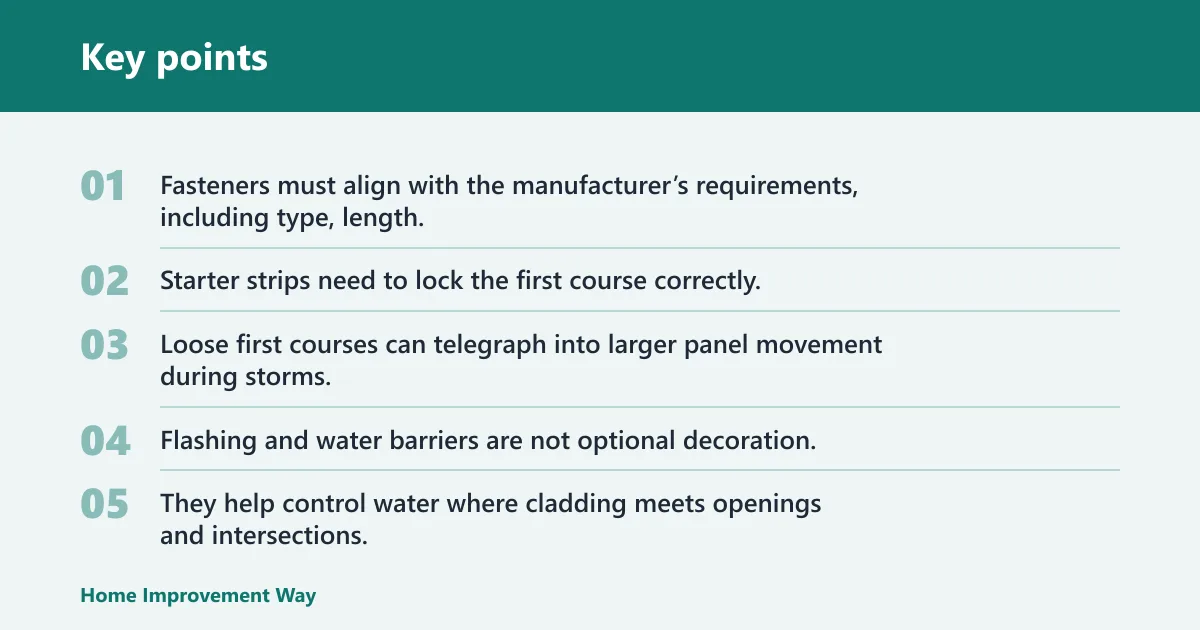
Fasteners must align with the manufacturer’s requirements, including type, length, placement, and spacing. Starter strips need to lock the first course correctly, because the bottom row often sets the tone for the rest of the wall. Loose first courses can telegraph into larger panel movement during storms.
Flashing, water barriers, and clearances
Flashing and water barriers are not optional decoration. They help control water where cladding meets openings and intersections. Clearances above roofs, decks, grade, and horizontal surfaces reduce the chance that water sits against the wall or wicks into vulnerable edges.
A common first-timer mistake is treating caulk as the primary defense. Caulk helps at specific joints, but it should not replace flashing, drainage, or a correct wall wrap. If the water management layers are wrong, the wall will still fail when wind drives rain hard enough.
Corners, soffits, trims, and penetrations
Corners and soffit interfaces are frequent failure points because wind finds edges first. Trim transitions around windows, doors, vents, and pipe penetrations need clean detailing and compatible materials. These are the places where a small install error can create a big repair later.
Picture a split-level house with a wide gable end and a badly sealed soffit return. The siding face may look fine after a storm, but water can still enter at the edge and soak the wall cavity. That kind of damage is why detailing matters so much.
What if wind-driven rain is the main problem?
Wind-driven rain changes the decision. You are no longer choosing only for uplift or impact. You are also choosing for how well the wall sheds water, how quickly it drains, and how easily hidden moisture can dry before it damages sheathing or framing.
Where water gets
Water can enter around windows, doors, seams, trim, and rooflines. The risky parts are usually the transitions, not the flat face of the siding. If those points are poorly flashed or poorly sealed, the cladding may look intact while the wall behind it slowly gets wet.
Why drainage behind siding matters
Drainage behind siding matters because no cladding is perfectly sealed under storm conditions. A wall that can shed incidental water and direct it out has a better chance of drying before damage spreads. That is especially important in coastal and other severe-weather settings referenced by FEMA’s Home Builder’s Guide to Coastal Construction.
Moisture-sensitive materials to watch
Engineered wood and wood need the most attention here. Edge sealing, cut protection, flashings, and clearances become critical. Stucco also needs strong moisture management. It has strong fire resistance and a solid exterior look, but cracks and trapped water can create hidden damage.
Compare siding by hail, repair, and maintenance
Hail resistance is a separate question from wind resistance. So is repairability. Some siding survives wind well but dents in hail. Others resist impact but need more careful moisture control. After a storm, the best repair choice is often the system you can source and match quickly.
Impact resistance tradeoffs
Steel usually leads when hail and debris are the main concerns, because it may provide strong impact resistance. Fiber cement is a strong choice, but it is still a rigid product that can chip or crack under severe impact. Vinyl can crack from hail or flying debris.
Stucco is less about impact and more about the wall assembly behind it. Once a crack opens, trapped water becomes the larger problem. That is why a hail dent and a hail crack are not the same failure.
Repairability after wind damage
Vinyl is often the easiest to patch because sections are widely available and simple to replace. Metal can also be practical when the profile is common and the finish is still sold. Fiber cement is more involved, and matching older trim or paint can take more work.
Engineered wood repair depends on the exact product line and whether moisture damage spread past the visible board. Wood is usually straightforward to cut and replace, but it may need paint, sealant, and adjacent board work to blend correctly. The hidden wall may need inspection first.
Ongoing maintenance burden
Vinyl tends to be low-maintenance after installation, though storm checks still matter. Fiber cement needs periodic caulking and paint upkeep, but it is less likely to warp than some lighter materials. Wood needs the most routine care in storm-prone areas because wind-driven rain, hail, and debris can damage boards and joints.
Should you choose fiber cement, vinyl, metal, or engineered wood for a windy climate?
Start with the storm pattern at your address. For high wind with moderate moisture, fiber cement is often the most balanced choice. For high wind plus hail, steel deserves serious consideration. For lower exposure and tighter budgets, wind-rated vinyl can be reasonable. For a wood look, engineered wood is the cautious middle path.
- Check your main risk: wind only, wind plus hail, or wind plus heavy rain.
- Compare the product’s wind rating, impact rating, and installation instructions.
- Match the wall system to moisture exposure, especially at openings and rooflines.
- Ask how the product handles repair after partial storm damage.
- Verify local code, approval reports, and warranty terms before buying.
Codes, warranties, and standards to check
Local code can change the answer before material choice does. Product approvals, wind warranties, and code-required fastening details may rule certain products in or out. In high-wind and coastal areas, check whether the siding has approval paperwork that matches your jurisdiction.
Local code and product approvals
Do not treat a marketing claim as approval. Ask for the product approval report, the installation instructions, and any local code language that applies to wind exposure. A product can be sold in one area and still need different fastening or underlayment details in another.
Manufacturer instructions and wind warranties
Manufacturer instructions are not optional if you want the wind rating to mean anything. They often define fastening, joint treatment, starter strips, trim use, and clearances. Wind warranties matter too, but only if the installation follows the exact requirements attached to the warranty.
FEMA and IBHS as review guides
FEMA’s Home Builder’s Guide to Coastal Construction is a useful reference for high-wind, coastal, and severe-weather settings. The IBHS FORTIFIED Home Standard is also a useful question framework when you want to strengthen the exterior against severe weather. Neither one replaces local code.
Frequently asked questions
What is the best exterior siding for wind-prone areas?
For many wind-prone homes, fiber cement is often considered a strong all-around choice because it balances wind resistance, moisture control, and durability. Steel is a close second, especially where debris or hail is a concern. Vinyl can work when the product is wind-rated and installed exactly to spec.
Is vinyl siding good for high wind areas?
Yes, but only with the right product and installation. Vinyl is affordable and low-maintenance, yet panels can loosen in high winds if installed poorly, and basic vinyl may crack from hail or flying debris. It is best suited to lower-exposure sites or tight budgets.
Which siding holds up best in hurricane or tornado zones?
Fiber cement and steel are usually the stronger starting points in hurricane or tornado zones because they better resist uplift and, in steel’s case, impact. No siding is storm-proof, so the wall assembly, fastening, flashing, and local approvals matter as much as the face material.
How does installation affect siding performance in strong winds?
Installation can decide whether siding stays attached or starts to fail at the edges. Fasteners, starter strips, flashing, water barriers, corners, soffits, and trim transitions all need to match the manufacturer’s instructions and local code. Poor detailing can turn a good product into a weak one.
What siding is best if wind-driven rain is a problem?
Fiber cement and properly detailed metal are usually the strongest options when wind-driven rain is the main issue. The key is not just the cladding face but also flashing, drainage behind the siding, and clearance at openings. Engineered wood and wood need especially careful moisture management.
What siding materials are easier to replace after wind damage?
Vinyl is often the easiest to source and replace in small sections. Metal can also be practical if the profile is common. Fiber cement, engineered wood, and wood may take more time to match, and hidden water damage can make the repair larger than the visible break.
Sponsored / affiliate links. As an Amazon Associate I earn from qualifying purchases. I may earn additional commission from eligible campaigns.