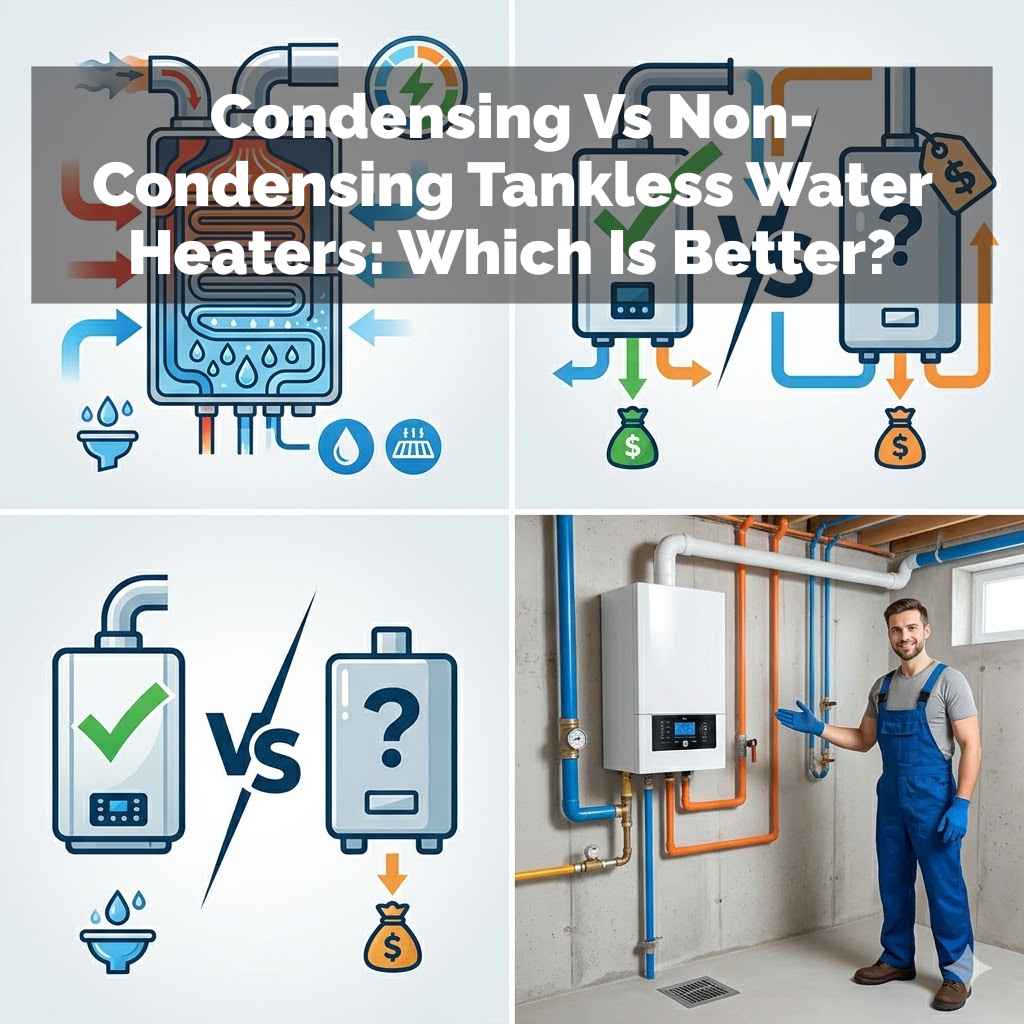
Condensing Vs Non-Condensing Tankless Water Heaters: Which Is Better?
A tankless water heater, also called an on-demand heater, heats water only when you need it. This is different from old tank heaters. They keep a big tank of water hot all the time.
Tankless units save energy because they don’t waste power heating water that isn’t being used. This means lower energy bills for you. They also last longer than tank heaters.
When you turn on a hot water faucet, a signal goes to the tankless unit. A burner or electric element heats the water as it flows through. It’s pretty neat.
You get hot water right away. And you don’t run out, like with a tank heater that empties.
The Big Difference: Condensing vs. Non-Condensing
The main difference between these two types is how they handle the heat they produce. It comes down to efficiency and how they are vented. Let’s look at each one.
What is a Non-Condensing Tankless Water Heater?
A non-condensing tankless heater is the more basic model. It works by burning natural gas or propane to heat the water. The hot exhaust gases then go out through a vent.
These gases are still quite hot when they leave. They are usually vented outside through a metal pipe. This is a simple and reliable way to get hot water.
These units are generally less expensive upfront. They are a good choice if your budget is tight. They also don’t need special venting materials.
Standard PVC or metal pipes can often be used. This can make installation simpler and cheaper. Think of it as the standard model that gets the job done well.
However, these heaters are less efficient than condensing models. Some heat escapes with the exhaust gases. This means more energy is used to heat the same amount of water.
They don’t capture as much of the heat energy produced.
What is a Condensing Tankless Water Heater?
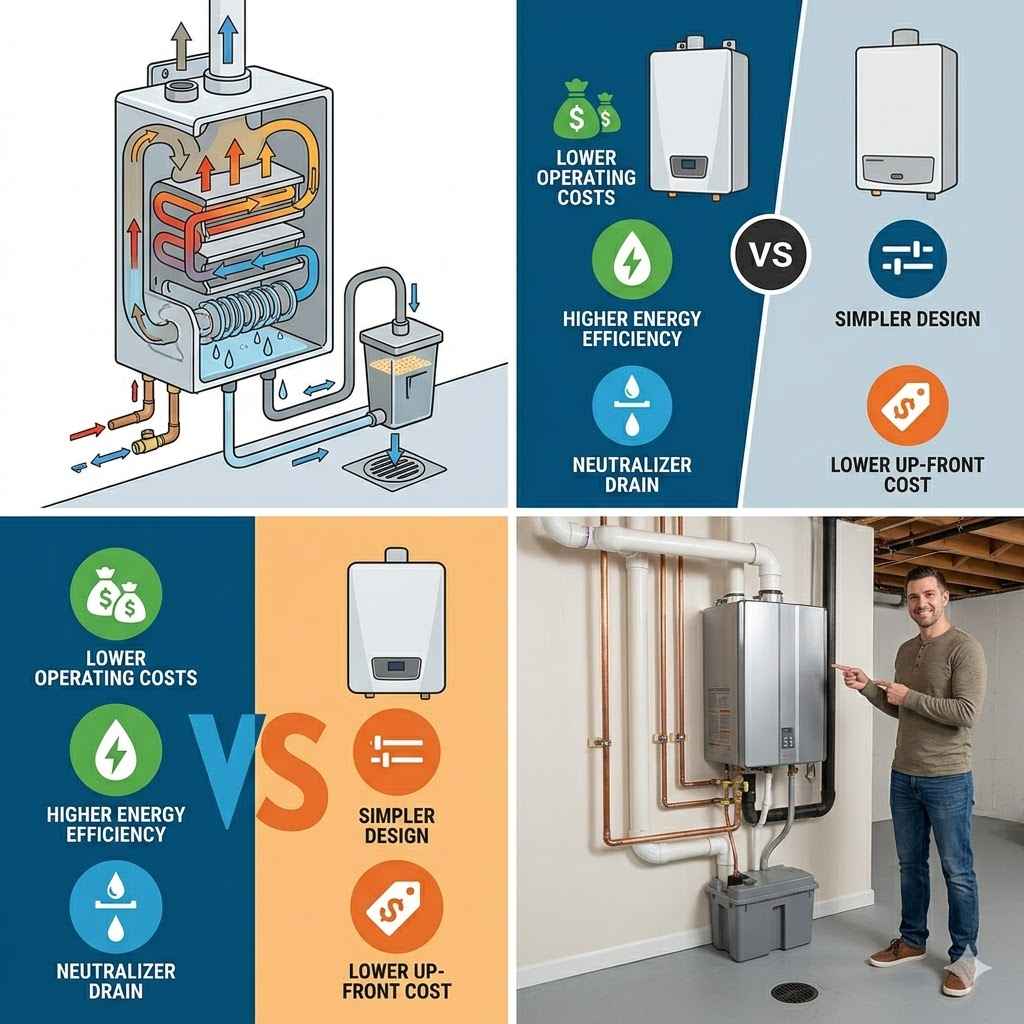
A condensing tankless water heater is a more advanced and efficient option. It uses a second heat exchanger. This extra part captures extra heat from the exhaust gases.
It uses this heat to warm the incoming cold water. This process is called condensation. It means the unit uses less gas or propane to heat the water.
Because the exhaust gases are much cooler after passing through the second heat exchanger, they can be vented with less robust materials. Often, standard PVC pipes are used for venting. This is a big plus for installation.
Also, these units produce a small amount of condensation (water) as a byproduct of this extra heating process. This condensation needs to be drained away.
Condensing heaters are more efficient. They save you more money on your energy bills over time. They are also better for the environment because they use less fuel.
While they cost more to buy, the savings can make up for it.
The higher efficiency means you use less energy overall. This is great for your wallet and the planet. They are a smart investment for many homes.
This is especially true if you use a lot of hot water.
How They Work: A Closer Look
Let’s dive a little deeper into the mechanics. Understanding how they work helps you see why one might be better for you.
Inside a Non-Condensing Unit
When you turn on the hot water tap, a flow sensor detects the water movement. This tells the unit to start. A gas valve opens, and an igniter sparks.
This lights a burner. Water then flows through a copper heat exchanger, which is heated by the burner. The hot water travels through pipes to your faucet.
The exhaust gases rise and exit through the vent. It’s a direct heating process. The heat that isn’t directly heating the water mostly goes out the vent.
The temperature of the exhaust gases can be quite high, often over 300 degrees Fahrenheit. This heat is lost energy. It’s not being used to heat your water.
This is the main reason they are less efficient.
Inside a Condensing Unit
A condensing unit starts the same way. Water flows, and the unit turns on. However, it has a more complex system.
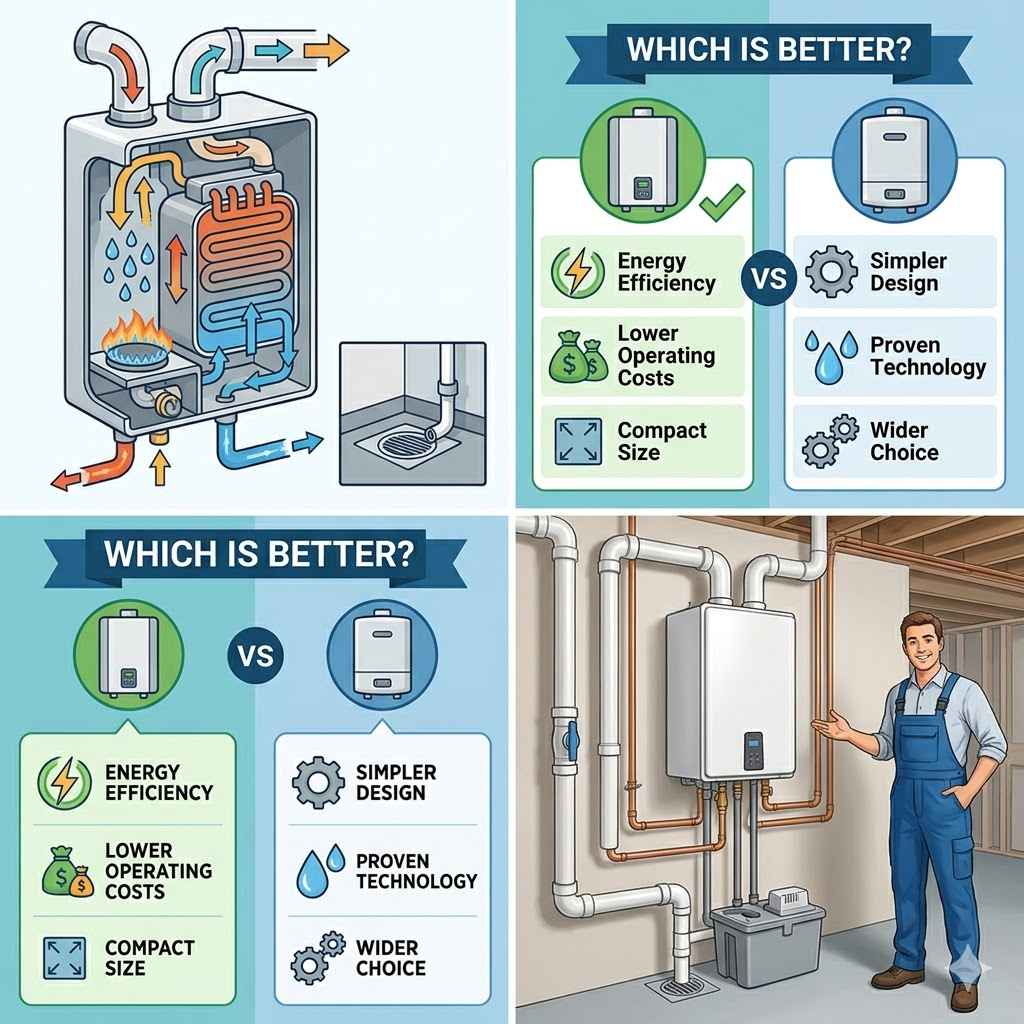
After the water passes through the primary heat exchanger, it goes to a secondary one. This secondary heat exchanger is designed to capture more heat from the exhaust gases. As these gases cool down, they release their latent heat.
This process can lower the exhaust gas temperature significantly, sometimes below 130 degrees Fahrenheit.
This captured heat is then used to pre-heat the cold water as it enters the unit. This means the primary burner doesn’t have to work as hard. It uses less fuel to reach the desired hot water temperature.
The byproduct of this condensation is water. This water is usually sent to a drain via a condensate line. This is a key feature of condensing units.
The increased efficiency of condensing models is a big advantage. You get more hot water for less energy. This makes them a more sustainable choice.
It’s like getting a free boost of heat from the waste gases.
Efficiency Ratings Explained
You’ll often hear about efficiency ratings when comparing water heaters. For tankless units, the key term is Uniform Energy Factor (UEF). This number tells you how much energy the heater uses to deliver hot water.
A higher UEF means a more efficient unit.
Uniform Energy Factor (UEF)
Non-condensing tankless water heaters typically have a UEF of around 0.80 to 0.85. This means about 80% to 85% of the energy from the fuel is used to heat your water. The rest is lost through the exhaust.
This is pretty good, but there’s room for improvement.
Condensing tankless water heaters have much higher UEF ratings. They can range from 0.92 up to 0.98 or even higher. This means 92% to 98% of the energy is used for heating.
This is a significant jump in efficiency. For every gallon of hot water you use, a condensing unit uses less fuel.
For example, if you use a lot of hot water, the difference in energy bills can be substantial over the year. This higher efficiency is why many people choose condensing models, even with the higher initial cost.
Installation and Venting Considerations
How these heaters are installed and vented is a major practical difference.
Venting for Non-Condensing Units
Non-condensing units produce hotter exhaust gases. These gases need to be vented safely outdoors. This often requires Type B double-wall metal vent piping.
This type of vent is designed to handle high temperatures and prevent heat transfer to surrounding materials. It’s a standard vent type for many gas appliances.
Sometimes, existing vent systems can be used if they are compatible. However, if you’re installing a new system, the metal venting can add to the installation cost. Proper venting is critical for safety.
It prevents dangerous carbon monoxide from entering your home.
Venting for Condensing Units
Condensing units have cooler exhaust gases. This allows for more flexible venting options. They can often be vented using PVC pipes.
PVC is less expensive than metal vent piping. It’s also easier to work with. You can vent through a wall or roof.
This flexibility can simplify installation. It may also reduce costs.
However, the condensate produced needs a proper drain. This means you’ll need a drain line nearby or a way to run one. The drain must be properly trapped to prevent odors from coming back into the house.
This is a key part of the installation for these units.
The venting flexibility of condensing units is a big advantage. It can open up more installation options in your home. This is especially true if you have an older home with limited venting possibilities.
Quick Venting Guide
Non-Condensing:
- Higher exhaust temperatures.
- Requires Type B metal vent piping.
- Potentially more expensive venting.
- Must be vented safely outdoors.
Condensing:
- Lower exhaust temperatures.
- Can use PVC pipes for venting.
- More flexible installation.
- Requires a drain for condensation.
Cost: Upfront vs. Long-Term
When you’re making this decision, the price is always a factor.
Upfront Costs
Generally, non-condensing tankless water heaters have a lower purchase price. They are simpler in design. This makes them more affordable to buy off the shelf.
Installation costs can also be lower, especially if you can use existing venting. If your home already has compatible venting, this can save you a significant amount.
Condensing tankless water heaters are more expensive upfront. The technology involved is more complex. They have that extra heat exchanger.
This drives up the manufacturing cost. Installation can also be more involved due to the condensate drain requirement. You might need to run a new pipe for this.
This adds to the labor cost.
Long-Term Costs (Energy Savings)
This is where condensing units really shine. Their higher efficiency means lower energy bills. The money you save on gas or propane over the years can offset the higher initial purchase price.
The exact savings depend on your hot water usage and local energy costs.
If you use a lot of hot water, like a large family or you run the dishwasher and washing machine often with hot water, the savings with a condensing unit will be more noticeable. Over the lifespan of the unit, which can be 20 years or more, these savings add up significantly.
Non-condensing units are less efficient. Your energy bills will be higher compared to a condensing model. While the upfront cost is lower, you’ll spend more on energy over time.
It’s a trade-off between initial spending and ongoing expenses.
Cost Comparison Snapshot
| Factor | Non-Condensing | Condensing |
|---|---|---|
| Unit Price | Lower | Higher |
| Installation Cost | Potentially Lower (if venting is simple) | Potentially Higher (due to condensate drain) |
| Energy Efficiency (UEF) | 0.80 – 0.85 | 0.92 – 0.98+ |
| Long-Term Energy Bills | Higher | Lower |
| Environmental Impact | Higher Fuel Use | Lower Fuel Use |
Energy Savings and Environmental Impact
Choosing a more efficient water heater isn’t just about saving money. It’s also about being kinder to the planet.
How Condensing Heaters Save Energy
The core of energy savings for condensing units is that secondary heat exchanger. By capturing waste heat from the exhaust, less primary fuel is burned. This means you’re getting more hot water for less energy input.
It’s like squeezing more juice out of the same lemon.
The U.S. Department of Energy (DOE) promotes energy-efficient appliances. These savings contribute to reducing overall energy consumption in homes.
This, in turn, lowers demand on power grids and reduces greenhouse gas emissions associated with energy production.
Environmental Benefits
Using less natural gas or propane means fewer emissions. Natural gas combustion produces carbon dioxide (CO2), a greenhouse gas. Propane also contributes to emissions.
By using less fuel, a condensing unit helps reduce your home’s carbon footprint.
Moreover, the reduced energy consumption means less extraction and transportation of fossil fuels. This has a ripple effect on the environment. So, when you choose a condensing unit, you’re making a more sustainable choice for your household and the wider world.
It’s a win-win. You save money, and you help the environment. Many homeowners are starting to see the value in this.
The initial investment feels better when you know it’s helping reduce environmental impact.
Experience: When Things Don’t Go As Planned
I remember helping a friend, Sarah, with her water heater decision a few years back. She had an older home with a traditional tank heater that was on its last legs. She was excited about going tankless.
She wanted to save space and money. We looked at options, and she was drawn to the lower upfront cost of a non-condensing model.
The installer said it would be fine. They used the existing vent, which seemed easy. For the first year, she was happy.
Her energy bills were a bit lower, and she loved not having to worry about running out of hot water for showers. Then, the winter hit hard. Her gas bill skyrocketed.
She couldn’t understand why.
She called me up, frustrated. My tankless heater is supposed to save me money,” she said. “But my bills are higher than ever!” We dug into it.
It turned out that in the colder months, the incoming water temperature was much lower. The non-condensing unit had to work much harder and burn a lot more gas to get the water up to the desired temperature.
The exhaust gases were still hot, but it was inefficient heat loss. She was essentially paying for heat that was just going out the vent. We looked at her usage and calculated the long-term costs.
If she had gone with a condensing model, she would have saved more money over five years. The venting would have been a bit more complex initially, but the energy savings would have been substantial. That was a tough lesson for her, and for me, seeing how climate and usage really impact the choice.
Real-World Scenarios and Usage Patterns
The best type of tankless heater for you depends a lot on your home and how you use hot water.
Home Size and Occupancy
If you have a large family living in a spacious home, you likely use a lot of hot water. Multiple showers, laundry loads, and dishwashing can happen simultaneously. In this case, the higher efficiency and capacity of a condensing unit are usually a better fit.
The consistent demand makes the energy savings more impactful.
For smaller households, like a single person or a couple in a smaller home, a non-condensing unit might be sufficient. Your hot water needs might be less demanding. The higher upfront cost of a condensing unit might not be recouped as quickly through energy savings.
However, if environmental impact is a top priority, a condensing unit is still a good choice.
Climate Considerations
The incoming water temperature varies greatly depending on where you live and the season. In colder climates, winter water temperatures can be quite low, often in the 30s or 40s Fahrenheit. In warmer climates, it might be in the 60s or 70s Fahrenheit.
A non-condensing heater will struggle more to heat very cold water. It will need to burn more fuel. This is why Sarah’s bills went up in the winter.
A condensing unit, with its secondary heat exchanger, is much better at handling these cold water inputs. It can still achieve high efficiency even when the incoming water is very cold.
If you live in a region with cold winters, a condensing unit is almost always the better choice for consistent performance and efficiency.
Fuel Source: Natural Gas vs. Propane
Both condensing and non-condensing units are available for natural gas and propane. The efficiency gains of a condensing unit apply to both fuel types. However, propane is generally more expensive than natural gas per unit of energy.
This means that the cost savings from a more efficient condensing unit can be even more pronounced if you use propane.
If you’re on propane, you might see a quicker return on investment for a condensing unit compared to natural gas. It’s always wise to check local fuel prices to get a clear picture.
Scenario Guide
Choose Non-Condensing if:
- You have a very tight upfront budget.
- Your hot water needs are minimal (e.g., single person).
- You live in a warm climate with mild winters.
- Your existing venting system is easily compatible.
Choose Condensing if:
- You want the highest energy efficiency and lowest long-term costs.
- You have a large family or high hot water demand.
- You live in a cold climate with very cold winters.
- You use propane (savings can be more significant).
- Environmental impact is a major concern.
What This Means for You: When to Worry and When It’s Normal
Understanding the differences helps you make an informed choice. But what does it mean for your daily life?
When Non-Condensing is Fine
A non-condensing unit is perfectly adequate for many homes. If you live in a warm area, have moderate hot water usage, and are on a stricter budget, it can be a good solution. You’ll still see benefits over an old tank heater.
You’ll save space and have continuous hot water. Just be aware that your energy bills will be higher than with a condensing model, especially in colder months.
The key is realistic expectations. A non-condensing unit offers a good balance of cost and performance. It’s not the “worst” choice, just not the “most efficient” choice.
When Condensing is Likely Better
If you live in a colder climate, have a busy household with high hot water demands, or want to minimize your environmental footprint, a condensing unit is the superior option. The long-term energy savings will pay off. The consistent performance in all weather conditions is a huge plus.
Think of it as an investment in your home’s future. It might cost more now, but it will save you money and hassle down the line. Plus, you’ll feel good about using less energy.
Simple Checks You Can Do
Before buying, ask yourself a few questions:
- How many people live in my home?
- How often do I run my dishwasher or washing machine on hot?
- Do I often take long showers?
- What is the typical water temperature in my area in the winter?
- What are the current prices for natural gas or propane in my area?
- What is my budget for upfront costs?
Your answers will guide you toward the right type of unit.
Quick Tips for Choosing
Making the right choice can feel overwhelming. Here are a few tips to simplify things.
Prioritize Your Needs
What matters most to you? Is it the lowest possible upfront cost? Is it the lowest energy bill in the long run?
Is it environmental impact? Ranking these priorities will help you weigh the pros and cons of each type.
Get Multiple Quotes
When you talk to installers, get at least three quotes. Ask them to explain the difference between the models they are recommending. Make sure they detail all costs, including venting and any necessary drain work.
Don’t be afraid to ask them to justify their recommendation based on your specific situation.
Understand the UEF Rating
Always look at the Uniform Energy Factor (UEF) for any unit you consider. A higher UEF means better efficiency. Even within condensing units, there can be slight variations.
Aim for the highest UEF you can afford.
Consider Future Needs
If you plan to expand your family or add a new bathroom, consider a unit that can handle increased hot water demand. Some tankless heaters have higher flow rates than others. Ensure the unit you choose can meet your future needs as well as your current ones.
Frequent Questions About Tankless Heaters
Are condensing tankless water heaters worth the extra cost?
For most homes, especially in colder climates or with higher hot water usage, yes, condensing units are generally worth the extra cost. The long-term energy savings and improved efficiency often recoup the initial investment over the life of the unit. They also offer better performance in cold weather.
Can I vent a non-condensing tankless heater with PVC?
No, you cannot safely vent a non-condensing tankless water heater with PVC. The exhaust gases are too hot. You must use approved metal vent piping, such as Type B double-wall vent pipe.
Using the wrong vent material is a serious safety hazard.
Does a condensing tankless water heater produce a lot of water?
Condensing units produce a small amount of water, typically a few gallons per day. This condensation is a normal byproduct of the unit’s high efficiency. It needs to be safely drained away using a condensate line.
The amount is usually not excessive and manageable with proper installation.
How often does a tankless water heater need maintenance?
Most tankless water heaters benefit from annual maintenance. This usually involves flushing the unit to remove mineral buildup, especially in hard water areas. Checking and cleaning the air intake and exhaust vents is also important.
Regular maintenance ensures optimal performance and extends the lifespan of the unit.
Will a tankless water heater give me endless hot water?
Tankless water heaters provide continuous hot water as long as the unit’s flow rate and temperature rise capabilities are not exceeded. They don’t run out like tank heaters. However, if multiple high-demand appliances are used simultaneously (e.g., two showers and a dishwasher), the flow rate could be exceeded, leading to slightly cooler water.
Choosing a unit with an adequate GPM (gallons per minute) rating for your needs is important.
What is the lifespan of a tankless water heater?
With proper maintenance, tankless water heaters typically last between 15 to 20 years, sometimes even longer. This is significantly longer than traditional tank water heaters, which usually last 10 to 12 years. The durable construction and simpler operation contribute to their extended lifespan.
Are tankless water heaters more expensive to repair?
Initial repairs on tankless water heaters can sometimes be more expensive than tank heaters due to their complex components. However, they tend to have fewer problems overall. The longer lifespan also means you’re less likely to face frequent repair bills.
The overall cost of ownership, considering repairs and energy savings, often favors tankless units.
Conclusion
Choosing between a condensing and non-condensing tankless water heater involves weighing upfront costs against long-term savings and efficiency. Condensing models offer superior energy efficiency and performance, especially in colder climates, but come with a higher initial price. Non-condensing units are more budget-friendly upfront but less efficient over time.
Consider your home’s needs, climate, and budget to make the best choice for you.
Sponsored / affiliate links. As an Amazon Associate I earn from qualifying purchases. I may earn additional commission from eligible campaigns.