Construction Sealant vs. Adhesive Caulk: What’s the Difference?
Construction sealant is for joints that move and still need to block water. adhesive caulk adds grab for light trim work and small gaps, but it is not a replacement for structural adhesive. Pick the wrong one and you get cracked beads, leaks, loose trim, and paint lines showing through the finish. This guide shows how to choose by joint movement, load, material, and indoor or outdoor use.
| Decision factor | Construction sealant | adhesive caulk | Winner |
|---|---|---|---|
| Joint movement | Built to flex as gaps open and close | Some grab, but less suited to repeated movement | Construction sealant |
| Bonding under load | Seals well, but bond strength is not the main job | Better for holding light trim, small panels, and similar parts | adhesive caulk |
| Paintability | Depends on chemistry; silicone is often nonpaintable | Often chosen where a paintable finish matters | adhesive caulk |
| Water, UV, and exterior exposure | Common choice for wet, exterior, and weather-exposed joints | Less reliable where sun, rain, or standing moisture are constant | Construction sealant |
| Common use case | Perimeter joints, expansion joints, windows, doors, wet areas | Trim, finish carpentry, small repairs, light bonding and sealing | Construction sealant |
What each product is meant to do
Construction sealant is the better label when the main job is sealing a joint and allowing movement. It blocks air, water, dust, and moisture while staying flexible enough for expansion, contraction, and seasonal shift.
adhesive caulk is for jobs that need sealing plus some holding power. The label is not standard across every brand, so read it this way: if the product is sold for bonding and sealing, treat it as a hybrid and check whether the joint also needs movement capacity.
Flexibility and movement
Movement is the first filter. If the joint opens and closes, the product has to move with it instead of becoming a hard bridge that cracks.
That is why flexible sealants are usually the right call for perimeters, expansion joints, and other places where the substrate shifts. A rigid or semi-rigid bead may look fine on day one, then split after a heating cycle, settling, or seasonal change.
Bond strength and load
Load is the second filter. If the bead has to help keep two materials together, bond strength matters more than simple gap filling.
That is where adhesive sealants and adhesive caulk products fit. They are used in construction and repairs where both bonding and sealing are needed, but they still do not replace a true structural adhesive when the joint carries serious load.
Paintability and finish quality
Finish work changes the decision fast. A paintable product is often the better choice for trim, baseboard, casing, and other visible lines that need to disappear under paint.
Silicone is often a common exception because it is generally nonpaintable. Acrylic caulk is easier to tool and is commonly chosen for interior trim because it accepts paint well, but it gives up exterior durability compared with more weather-tolerant chemistries.
Water, UV, and exterior exposure
Exterior joints need weather resistance, not just gap filling. Sun, rain, and temperature swing all work against a bead that was chosen only for appearance.
Silicone sealant is known for strong flexibility, waterproofing, and UV resistance. Polyurethane sealant is also used outdoors and at concrete interfaces because it bonds strongly and resists abrasion better than many basic interior products.
Common chemistries and substrates
Construction sealant is a product family, not one chemistry. Common versions include silicone, polyurethane, acrylic, and MS polymer sealant, and each fits a different mix of movement, finish, and exposure.
Green Building Supply lists ultra-low or no-VOC caulks and sealants, and the collection includes 13 products split into Adhesives and Caulk, with interior and exterior options, urethane-based products, and water-based products. That matters in occupied spaces where odor and emissions are part of the decision.
What construction sealant is best
Construction sealant is the better choice for joints that need movement and moisture control. Use it where the main failure risk is cracking, leaking, or pulling away from the substrate.
Moving joints and perimeter gaps
Perimeter gaps around windows, doors, tub surrounds, countertops, and framing transitions often move a little over time. A flexible sealant follows that movement instead of fighting it.
A common first-timer mistake is using a bond-first product on a gap that flexes every season. The bead may hold for a while, then split at the edges or separate from one side.
Exterior trim, windows, and doors
Exterior trim needs weather resistance and a bead that can survive sun and rain. That is why silicone and polyurethane show up often in these jobs.
For paintable exterior trim, a polyurethane or paintable hybrid may make more sense than silicone. For a wet or sun-exposed joint where paint is not the priority, silicone is often the safer finish.
Bathrooms, kitchens, and wet areas
Wet-area joints need sealing more than grab. Around tubs, showers, sinks, backsplashes, and similar change-of-plane joints, a flexible sealant is usually the right starting point.
Do not choose a bonding-first product just because the label sounds stronger. A sink rim or tub edge needs a bead that can handle water and movement, not a product that is mainly meant to hold two parts together.
What adhesive caulk is best
adhesive caulk is most useful where the joint needs some hold in addition to sealing. It is a better fit for light construction tasks than for joints that live in constant movement or harsh weather.
Bonding trim or panels
Trim, small backer pieces, and light wall panels are typical use cases. The product can help hold a piece in place while also sealing a narrow gap.
That said, surface prep still matters. Dust, gloss, old paint, and moisture can cut bond strength fast, even when the product is the right type.
Repairs where holding strength matters
For a loose corner, a small split joint, or a panel edge that needs extra grab, a bonding sealant can be useful. It bridges the gap between pure sealant and construction adhesive.
Use it only when the expected load is modest. If the piece must carry weight or resist peel stress, move up to a true construction adhesive or a mechanical fastener, then seal the joint separately if needed.
When a sealant alone is not enough
Some repairs need both a seal and a bit of hold. That is the point where adhesive sealant products make sense, especially on surfaces where a second fastener is awkward or impossible.
Suppose a 3-inch interior trim return keeps lifting at one end after paint. A paintable adhesive sealant may be a better fit than a flexible wet-area sealant, because the problem is bond loss, not a leaking joint.
Which chemistry should you choose?
Choose the chemistry by asking two questions: how much does the joint move, and how much does the bead need to hold? Once those are clear, the chemistry choice gets much easier.
Silicone sealant
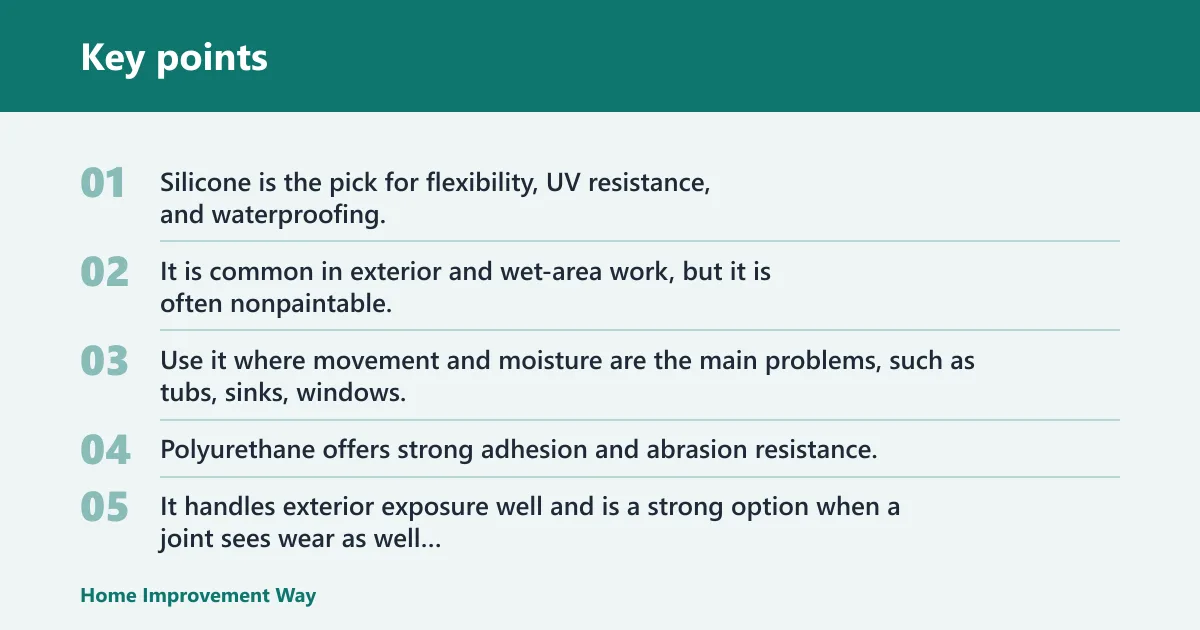
Silicone is the pick for flexibility, UV resistance, and waterproofing. It is common in exterior and wet-area work, but it is often nonpaintable, so it can be the wrong finish choice for visible trim that will be painted later.
Use it where movement and moisture are the main problems, such as tubs, sinks, windows, and exterior perimeters.
Polyurethane sealant
Polyurethane offers strong adhesion and abrasion resistance, which is why it appears in expansion joints and concrete interfaces. It handles exterior exposure well and is a strong option when a joint sees wear as well as weather.
Choose it when you need a tougher exterior bead and better adhesion than a basic interior caulk can provide.
Acrylic caulk
Acrylic caulk is valued for paintability and easy tooling. It is commonly used for interior trim where a clean paint line matters more than weather resistance.
Its weakness is durability outside. In exposed joints, it is usually the least durable option in this group.
MS polymer sealant
MS polymer is a hybrid sealant chemistry used for both bonding and sealing. It sits between a pure sealant and a pure adhesive, which makes it useful in construction tasks that ask for both flex and grab.
It is often worth checking when you want better all-around performance than acrylic, but do not want the paintability limitations of silicone.
Construction sealant decision matrix
| Scenario | Load-bearing need | Movement expected | Paintability needed | UV/water exposure | Preferred chemistry | Recommendation |
|---|---|---|---|---|---|---|
| Exterior window perimeter | Low | High | Sometimes | High | Silicone or polyurethane | Construction sealant |
| Bathroom tub edge | Low | High | Usually no | High | Silicone | Construction sealant |
| Interior baseboard gap before paint | Low | Moderate | Yes | Low | Acrylic | adhesive caulk |
| Loose trim that needs hold plus seal | Moderate | Low | Yes | Low | MS polymer or adhesive sealant | adhesive caulk |
| Concrete expansion joint | Low | High | No | High | Polyurethane | Construction sealant |
Exterior window perimeters favor movement tolerance and weather resistance, so construction sealant is often preferred there. If the bead must also be painted, pick a paintable exterior chemistry rather than assuming every sealant can take topcoat.
Bathroom tub edges are a seal-only job. The joint moves, it sees water, and the finish usually does not need paint, which makes construction sealant the safer choice.
Interior baseboard gaps are different. The movement is lower, the joint is usually dry, and the finish matters, so paintable adhesive caulk often fits better than a wetter-area sealant.
Loose trim asks for more grab. If the bead has to help hold the piece in place and also close a small gap, a hybrid adhesive sealant or adhesive caulk is more practical than a pure sealant.
Concrete expansion joints are the clearest case for polyurethane. The material needs flexibility, adhesion, and abrasion resistance in an exterior setting, which is more than a basic trim caulk should be asked to do.
Choose Construction sealant if… / Choose adhesive caulk if…
Choose Construction sealant if the joint must move, the joint is exposed to water or weather, the area is a tub, sink, window, door, or perimeter seam, or the bead needs UV resistance and moisture blocking more than holding power.
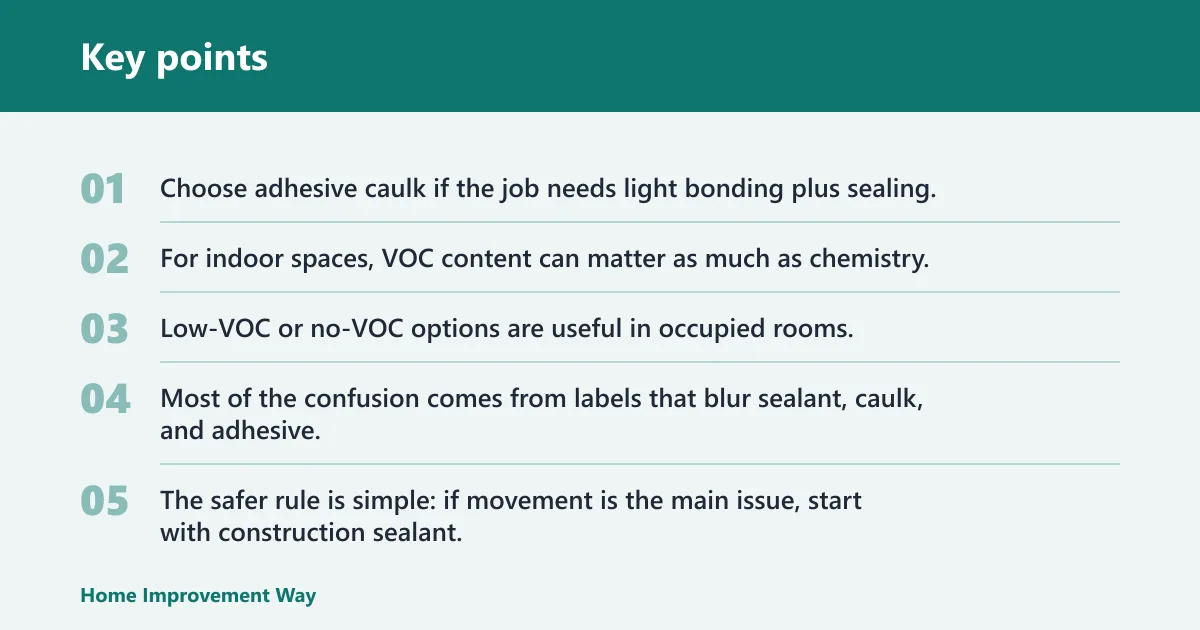
Choose adhesive caulk if the job needs light bonding plus sealing, the piece is trim or a small panel, the finish has to be paintable, the joint is mostly dry, and the load is modest rather than structural.
For indoor spaces, VOC content can matter as much as chemistry. Low-VOC or no-VOC options are useful in occupied rooms, especially when you are sealing a long run of trim, a freshly finished room, or a space with limited ventilation.
Most of the confusion comes from labels that blur sealant, caulk, and adhesive. The safer rule is simple: if movement is the main issue, start with construction sealant; if holding strength is part of the job, start with adhesive caulk or a hybrid adhesive sealant and check whether the joint still needs flexibility.


Frequently asked questions
What is the difference between construction sealant and adhesive caulk?
Construction sealant is chosen mainly to seal a joint and keep it flexible as materials move. adhesive caulk is chosen when you need some bonding along with sealing. If the joint is moving a lot, sealant is usually the better fit; if the joint needs light hold, the hybrid product is more useful.
Can adhesive caulk replace sealant in a joint?
Sometimes, but not by default. If the joint is dry, lightly loaded, and only needs a small amount of movement tolerance, adhesive caulk may work. If the joint is an exterior seam, wet-area perimeter, or expansion joint, a dedicated construction sealant is usually the safer choice.
When should I use a sealant instead of a construction adhesive?
Use a sealant when the main job is blocking air, water, dust, or moisture while allowing movement. Use construction adhesive when the main job is holding materials together under load. If the joint needs both, choose an adhesive sealant or use both products in separate steps.
Is construction sealant paintable?
Sometimes, but not always. Acrylic caulk is commonly paintable, while silicone is often nonpaintable. If you need a painted finish on trim or casing, check the label before you buy. Paintability should be treated as a primary selection factor, not an afterthought.
Which product is better for gaps that move?
Construction sealant is usually better for moving gaps because flexibility is part of its job. The best choice depends on the environment: silicone for wet or UV exposure, polyurethane for tougher exterior joints, and acrylic for paintable interior trim where movement is limited.
What surfaces can adhesive sealants bond to?
Adhesive sealants are used on many common construction substrates, including trim, panels, concrete interfaces, and other building materials, but compatibility depends on the exact chemistry and surface prep. Clean, dry, dust-free surfaces improve bond strength. For painted or glossy surfaces, check the manufacturer’s substrate list before starting.
Sponsored / affiliate links. As an Amazon Associate I earn from qualifying purchases. I may earn additional commission from eligible campaigns.