Contact Cement vs Construction Adhesive: Key Differences
Use contact cement when both surfaces need an instant, full-surface bond; use construction adhesive when the parts can clamp or stay put while it cures, and when you need gap-filling or some movement after curing. Pick the wrong adhesive and parts can slip, joints can weaken, or repairs can fail. This guide compares bond speed, gap-filling, flexibility, and the home-repair materials each adhesive handles best.
| Decision factor | Contact Cement | Construction Adhesive | Winner |
|---|---|---|---|
| Bond behavior | Immediate bond after two coated surfaces meet | Supports parts while it cures | Depends on job |
| Repositioning | Very limited once contact is made | Some working time before cure | Construction Adhesive |
| Gap filling | Poor for gaps and uneven joints | Better for small gaps and imperfect fits | Construction Adhesive |
| Best substrates | Laminate, veneer, rubber, cork, leather | Wood, paneling, trim, masonry, metal, some plastics | Depends on substrate |
| Clamp or support need | Pressure at join, usually no long clamp phase | Often needs clamping or temporary support | Contact Cement |
| Odor and indoor use | Solvent versions can smell strong and need ventilation | Low-VOC options can help indoors, but formulation and substrate limits still matter | Construction Adhesive |
| Cleanup and mess control | Spills are harder to correct after contact | More cleanup time before cure | Construction Adhesive |
| Failure risk on bad alignment | High if parts touch too soon or are misaligned | Higher if parts are left unsupported during cure | Depends on job |
Contact cement vs construction adhesive: the core trade-off
Use contact cement when both surfaces need to grab immediately after they reach the tacky stage; use construction adhesive when the joint can be held in place while it cures. DAP’s and 3M’s contact-adhesive guidance both emphasize a dry-to-tacky open window, while construction-adhesive literature from Loctite/PL and Wilsonart focuses on support during cure, not instant grab.
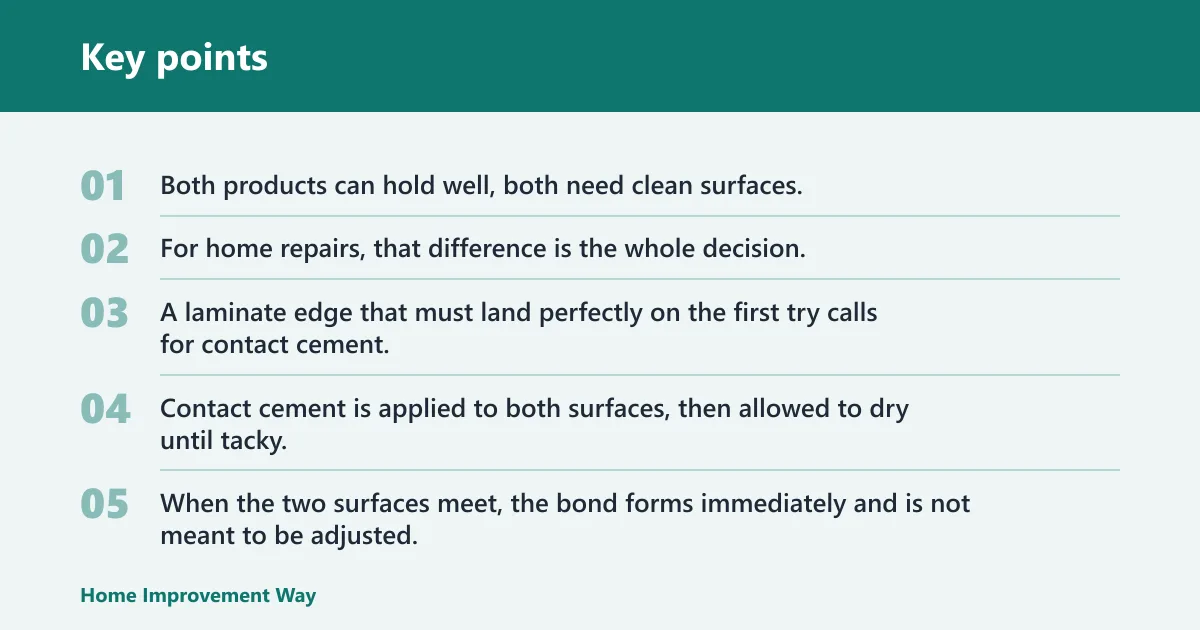
The overlap is real, but narrow. Both products can hold well, both need clean surfaces, and both have formulas for different materials, yet the job behavior is different enough that the substrate and joint design matter more than the label.
For home repairs, that difference is the whole decision. A laminate edge that must land perfectly on the first try calls for contact cement; a trim board that can be braced while it sets usually fits construction adhesive better.
How each adhesive works
Contact cement is applied to both surfaces, then allowed to dry until tacky. When the two surfaces meet, the bond forms immediately and is not meant to be adjusted. Manufacturer instructions for contact cements commonly describe an open time of roughly 10 to 20 minutes, but temperature, humidity, coat weight, and substrate porosity can shorten or extend that window (see DAP Weldwood and 3M contact-adhesive technical data and SDS guidance).
Construction adhesive works more like a load-supporting bond line. You apply a bead or spread layer, bring the parts together, and keep them in place with clamping, bracing, or weight until cure finishes. Product guides from Wilsonart and Loctite/PL stress support and cure time because the bond does not fully develop at the moment of contact.
Open time matters for both products, but it matters more for contact cement because the tacky stage is the alignment window. Temperature and humidity affect that window, and solvent-based contact cement can move from workable to too-dry quickly in warm, low-humidity rooms. In practice, the safer read is not a fixed timer but the tack test the manufacturer specifies: surfaces should be dry to the touch and still tacky enough to bond cleanly.
Which materials does each one bond best?
Contact cement is the better fit for laminates, veneers, cork, rubber, and leather because those jobs usually involve broad, flat contact areas and little tolerance for movement after touch-down. Construction adhesive is commonly suited to wood, paneling, trim, masonry, metal, and some plastics, especially when the joint can be held in place during cure.
Flat, high-contact surfaces favor contact cement because the bond happens across the whole area at once. That makes it a common choice for laminate countertops and other large surfaces where a clamped, wet adhesive line would be awkward or risky. Wilsonart’s laminate installation guidance specifically relies on contact-type bonding for high-pressure laminate because the sheet must be seated cleanly across the substrate.
Why flat, high-contact surfaces favor contact cement
When the surfaces are wide and accurately fitted, contact cement reduces the chance of slippage. It is also useful where you cannot easily clamp the full area, or where a traditional wet bond might starve the joint if pressure shifts the pieces around.
Suppose you are re-laminating a 24-inch cabinet side. If the sheet lands crooked by even a small amount, the bond locks in that error immediately. That is why dry fitting, mark lines, and careful edge control matter much more with contact cement than with construction adhesive.
That same behavior is why contact cement can succeed on rubber-to-metal patch jobs where other adhesives fail: once the surfaces are properly cleaned and the tack stage is reached, the bond forms without needing a long clamp phase. It is also why some construction adhesives are a poor substitute on plastics or nonporous sheet goods; several formulas simply cannot wet out slick, low-energy surfaces well enough to replace a true contact bond.
Do you need clamps or pressure?
Contact cement needs pressure right after the tacky surfaces meet, but not a long clamp phase. Construction adhesive usually needs clamping, bracing, or temporary support while it cures, especially on vertical or overhead work. Wilsonart’s installation instructions and Loctite/PL’s guidance both treat support as part of the bond process for construction-adhesive applications.
The difference is about timing, not strength alone. Contact cement asks you to press once, correctly. Construction adhesive asks you to hold the joint until the chemistry finishes doing its work.
When temporary bracing is enough
Some construction-adhesive jobs only need a few supports, not full clamping. A short trim run or a panel placed against studs may stay put with tape, finish nails, or blocks while the adhesive cures, provided the product label allows that support method.
A common first-timer mistake is assuming every adhesive needs the same kind of pressure. A laminate sheet usually needs careful rolling pressure after contact; a wooden shelf cleat usually needs support that prevents sag until the bead cures.
For contact cement, the pressure requirement is immediate and even rather than prolonged. Manufacturers typically call for firm hand or roller pressure across the entire bond line right after alignment; in laminate work, a J-roller or similar tool helps eliminate trapped air and uneven grab. For construction adhesive, pressure is about holding position until cure, not about creating instant adhesion.
Contact cement decision matrix
This matrix compares common home-repair pairs by the way the adhesive behaves on the job, not by label alone. The pick changes with substrate, fit, and how much support the joint can get during cure.
| Substrate pair | Recommended adhesive | Clamp/support need | Repositionability | Ideal cure conditions | Top failure risk |
|---|---|---|---|---|---|
| Laminate to plywood | Contact Cement | Pressure roller; no long clamp stage | Very low after contact | Dry, dust-free, room temperature, aligned before touch-down | Premature contact or trapped misalignment |
| Trim to drywall | Construction Adhesive | Temporary bracing or finish nails | Moderate before cure | Stable wall surface, light support, cure without movement | Insufficient support while curing |
| Veneer to MDF | Contact Cement | Firm pressure over full sheet | Very low after contact | Flat panel, even coverage, correct open time | Over-drying before joining |
| Rubber to metal | Contact Cement | Immediate pressure after tack stage | Very low after contact | Clean, dry surfaces; ventilation; proper open time | Solvent attack or weak prep |
| Cork to underlayment | Contact Cement | Pressure at installation | Very low after contact | Flat substrate, even coat, controlled alignment | Uneven coat or early contact |
| Paneling to studs | Construction Adhesive | Support with fasteners or bracing | Moderate before cure | Stud alignment, consistent bead, cure without sag | Weak bond if the board moves during cure |
| Countertop edge repair | Contact Cement | Strong press across the whole edge | Very low after contact | Clean edge, dry fit, even pressure | Visible seam from bad alignment |
| Plastic trim to wood | Construction Adhesive | Temporary support often needed | Moderate before cure | Use a plastic-safe formula and support until set | Solvent damage or bond failure on slick plastic |
When should you choose one over the other?
Choose contact cement when the parts need to bond immediately, the surfaces are broad and flat, and there is almost no margin for movement after joining. Choose construction adhesive when the joint can be held in place while it cures, or when the fit has small gaps that need support.
Construction adhesive can replace contact cement only when the joint does not depend on instant full-surface grab. It should not replace contact cement for laminates, veneer sheets, or other jobs where the pieces must land in the right spot on the first press.
Step-by-step checklist for choosing the right adhesive
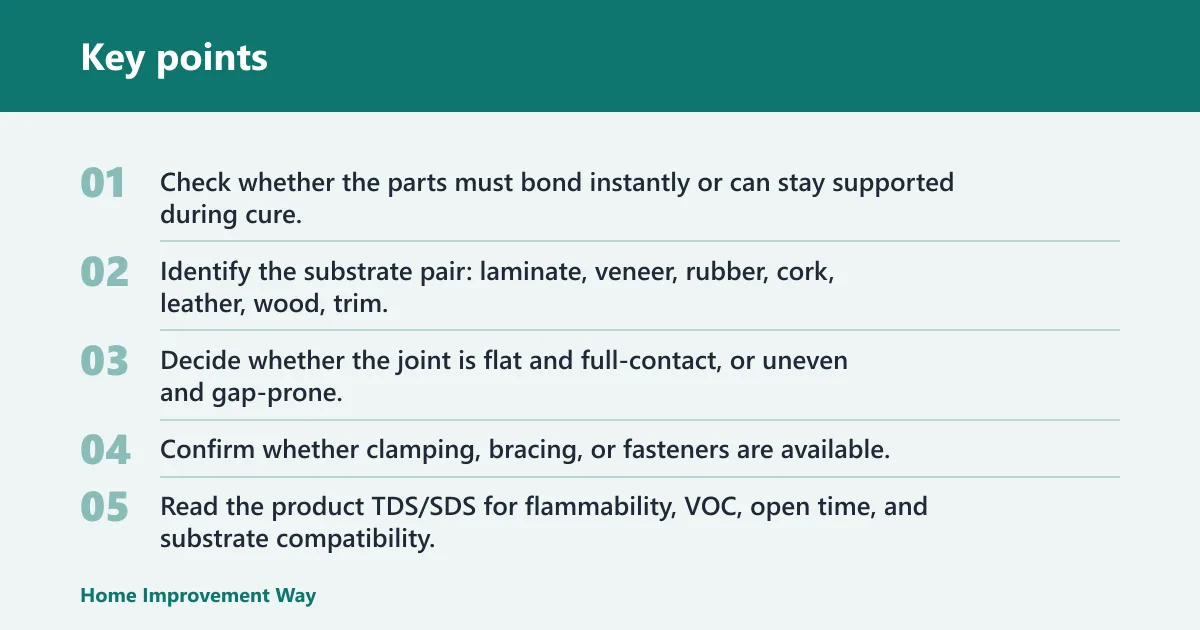
- Check whether the parts must bond instantly or can stay supported during cure.
- Identify the substrate pair: laminate, veneer, rubber, cork, leather, wood, trim, masonry, metal, or plastic.
- Decide whether the joint is flat and full-contact, or uneven and gap-prone.
- Confirm whether clamping, bracing, or fasteners are available.
- Read the product TDS/SDS for flammability, VOC, open time, and substrate compatibility.
- Choose contact cement for immediate tack and large flat bonds; choose construction adhesive for support-dependent, gap-filling repairs.
Choose Contact cement if…
Choose Contact Cement if you are covering a large, flat surface such as laminate or veneer. Choose it if you cannot clamp the whole assembly, need immediate grab, or are bonding materials like rubber, cork, or leather that match its common use cases.
Choose Contact Cement if alignment can be set before the parts touch and you can control ventilation well. That is the safer choice for full-surface jobs with little room for correction.
A practical example is a laminate countertop edge that has lifted over a long span but is still flat beneath the loose strip. Contact cement is the better match because the repair needs even pressure and immediate grab along the full edge; a bead adhesive would usually be too slow and too dependent on support.
Choose construction adhesive if…
Choose Construction Adhesive if the pieces can be braced, clamped, or fastened while the adhesive cures. Choose it for trim, paneling, masonry, wood, metal, and some plastics, especially when the joint needs gap support or a little flexibility after cure.
Choose Construction Adhesive if indoor odor matters and a low-VOC formula is available for your substrate. It is also the better pick when the bond line is not perfectly flat and the repair can tolerate cure time.
Picture a loose oak baseboard in a hallway with about a 1/8-inch gap behind one end. Construction adhesive fits that repair because the board can be pushed tight and braced while it cures. Contact cement would lock too soon and offer no useful way to correct the gap.
Suppose a laminate countertop edge has lifted over about a 30-inch run, but the core is still flat. Contact cement is the better match because the repair needs uniform contact and immediate grab across the full length. A bead adhesive would need support and could leave a wavy edge.
For a rubber-to-metal repair, the tipping point is usually surface energy and timing. If the rubber is clean and the metal is degreased, contact cement can deliver a reliable immediate bond; if the part needs gap filling or structural buildup, a construction adhesive made for that substrate pair is the better fit, but many general-purpose formulas will not bond slick rubber well.
Safety, odor, and cleanup compared
Solvent-based contact cement and some solvent-based construction adhesives produce strong fumes, and a safety data sheet may classify solvent-based contact cement as a highly flammable liquid and vapor. That makes ventilation a major planning step, especially indoors or near ignition sources. DAP and 3M both warn against use near heat, sparks, pilot lights, or open flame.
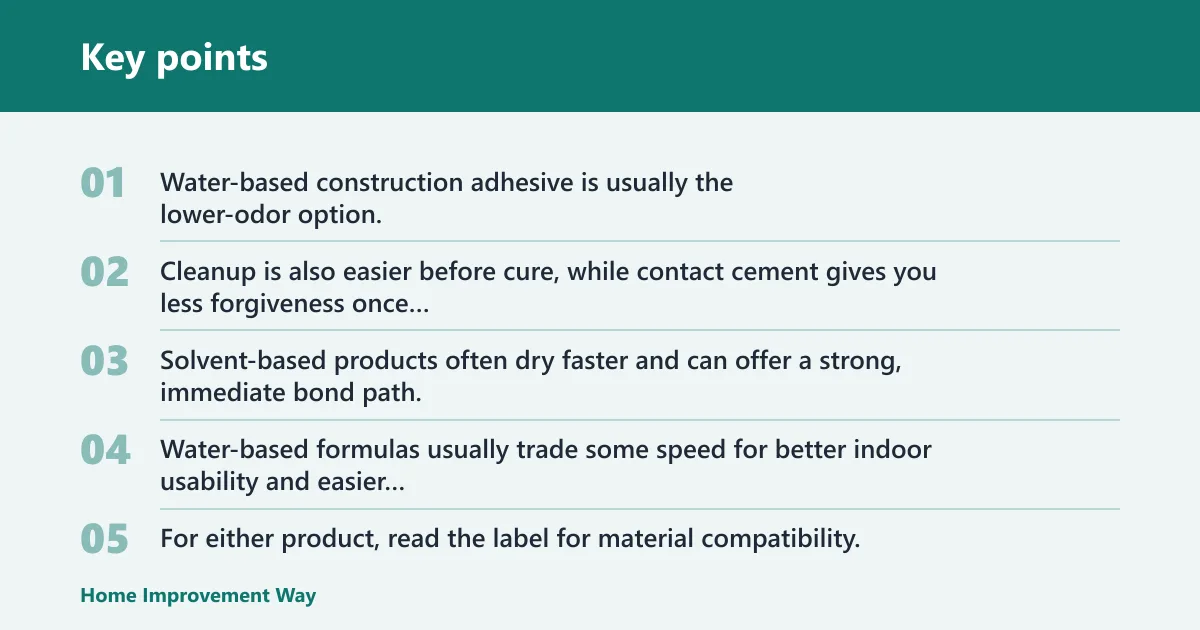
Water-based construction adhesive is usually the lower-odor option, though it may dry more slowly and can behave differently in final strength and flexibility. Cleanup is also easier before cure, while contact cement gives you less forgiveness once the pieces meet.
Solvent-based versus water-based formulas
Solvent-based products often dry faster and can offer a strong, immediate bond path, but they bring odor and flammability concerns. Water-based formulas usually trade some speed for better indoor usability and easier handling.
For either product, read the label for material compatibility. Some contact adhesives include acrylic, polyurethane, or silicone-based formulas, while contact cement itself is often neoprene or another synthetic rubber-based product. That distinction matters because “construction adhesive” is a broad category, and some formulas are not suitable for plastics, vinyl, or nonporous sheet goods.
Ventilation, flammability, and indoor use
Ventilation matters because fumes can build up quickly in small rooms. Keep flames, pilot lights, sparks, and heat sources away from solvent-based products, and do not rely on a surface that looks dry to the touch as a safety signal. A product can feel dry yet still release flammable vapors or remain inside its tack window.
Cleanup also affects project quality. Excess contact cement is hard to correct after joining, while construction adhesive squeeze-out is usually easier to tool or remove before it cures, especially on trim and paneling jobs.

Frequently asked questions
What is the difference between contact cement and construction adhesive?
Contact cement bonds after both coated surfaces dry to a tacky stage and meet, so the grab is immediate and hard to adjust. Construction adhesive goes on as a bead or spread layer, then cures while the parts stay supported. That makes it better for fill, support, and some movement after cure.
Can you use construction adhesive instead of contact cement?
Sometimes, but only when the job does not depend on instant full-surface bond. Construction adhesive can replace contact cement on some trim, paneling, or wood repairs. It should not replace contact cement for laminates, veneer, or other accurately aligned sheet goods that need immediate grab.
When should I use contact cement for home repairs?
Use contact cement for laminates, veneer, cork, rubber, and leather when the surfaces are broad, flat, and ready to meet in the right position on the first try. It also fits repairs where clamping is impractical and immediate bond behavior matters more than repositioning.
What materials does construction adhesive bond best?
Construction adhesive is a better match for wood, paneling, trim, masonry, metal, and some plastics. It is most useful when the joint can be braced or clamped while it cures and when you need some gap support instead of instant full-surface grab.
Does contact cement need to dry before joining surfaces?
Yes. Contact cement is applied to both surfaces, then allowed to dry until tacky before the parts are joined. If you bring them together too early, the bond can be weak or uneven. If you wait too long, the adhesive can lose the tack needed for proper contact. Manufacturer instructions from DAP and 3M both frame this as a dry-to-tacky stage rather than a fixed clock time.
Do you need clamps with contact cement or construction adhesive?
Contact cement usually needs firm pressure at the moment of joining, but not the long clamp time many wet adhesives require. Construction adhesive often needs clamps, fasteners, or temporary support while it cures. The more vertical or heavy the part, the more likely support will be needed.
Are low-VOC construction adhesives always better indoors?
Not always. Low-VOC formulas can reduce odor and exposure concerns, but they still need the right substrate match, proper cure conditions, and the ventilation the label calls for. Some low-odor formulas are not appropriate for plastics, slick laminates, or nonporous sheet goods, so compatibility matters as much as VOC level.
Sponsored / affiliate links. As an Amazon Associate I earn from qualifying purchases. I may earn additional commission from eligible campaigns.