Garage Door Repair Cost: What Affects the Price Most?
Garage door repair cost usually ranges from about $98 to $860, but broken springs, damaged panels, opener failure, or difficult access can push it higher. If you miss the real fault, the same breakdown can return, your car can stay trapped, or the door can become unsafe to use. This guide explains how estimates are built, which problems raise the bill, and which quote details usually do not change the price much.
This guide is part of our Garage door repair guide series.
How much does garage door repair cost?
A realistic garage door repair estimate starts with a broad range, then narrows by failed part, labor time, and service timing. This Old House lists $98 at the low end, $479 as the average, and $860 at the high end. Common failures usually fall between $98 and $300, while more complex repairs climb fast.
The reason quotes vary so much is simple: two doors can show the same symptom and need very different work. A noisy opener may only need one component, while a crooked door may point to a spring issue, cable problem, or track damage that adds labor and risk.
What a standard estimate should tell you
A clear estimate should name the likely failed part, list parts and labor separately, and say whether the price includes diagnostic time, disposal, and any trip charge. It should also say whether the quote covers one repair only or a broader fix if other worn parts are found.
If a quote only says “garage door repair” with one lump sum, ask for a breakdown before approving it. You want the scope, timing, and any after-hours fee in writing.
📊 Garage door repairs can cost anywhere from $98 to $860. Source: Garage Door Repair Cost (2026 Pricing).
What goes into a garage door repair quote?
Garage door quotes are built from diagnosis, parts, labor, and timing. The final number changes when the job needs specialized skill, takes longer than expected, or requires a same-day, weekend, or after-hours visit. Scope matters too: one broken piece is priced very differently from a repair that exposes other worn parts.
Parts cost versus labor cost
Some jobs are part-heavy, while others are labor-heavy. Springs, cables, panels, and tracks can require replacement parts; opener work may involve electrical troubleshooting, gear replacement, or a motorized lifting mechanism issue. Labor rises when the technician needs to disassemble, realign, or safely rebalance the door.
Diagnostic time and service call fees
Many companies separate the diagnostic visit from the repair itself. That fee can be small or folded into the work, but it should be stated clearly. Ask whether the diagnosis is credited toward the repair, and whether the quote includes the cost of returning with special-order parts.

Which garage door parts usually drive the price?
Springs, cables, opener components, panels, and tracks are the parts that most often move a quote from low to high. Springs are often the most common repair homeowners face, and they are heavy-duty counterbalance springs that make the door easier to lift. Cables, openers, panels, and tracks each bring different labor and risk levels.
Garage door springs
Spring work often costs more than a small adjustment because replacement may be needed rather than a simple tune-up. Springs carry a lot of tension, so safe removal and installation matter. When a spring fails, the door may not open evenly, and forcing it can damage other parts.
Garage door cables
Cables are steel guidance cables that help lift and lower the door. If one is frayed, jumped off the drum, or damaged by a broken spring, replacement is often the better call. A cable that has stretched or kinked rarely returns to reliable service with a minor fix.
Garage door opener
Opener repairs can vary widely because the motorized lifting mechanism can fail in electrical or mechanical ways. A sensor issue is usually simpler than a stripped gear, worn drive component, or motor problem. Labor time often depends on whether the fix is a quick component swap or deeper troubleshooting.
Garage door panels
Panel repairs can range from dent fixes to full section replacement. Light damage may be cosmetic, but crushed, bent, or cracked sections can weaken the door or throw it out of balance. If the door is older, matching a single panel can be hard, which pushes the estimate upward.
Garage door tracks
Track repairs may involve realigning or replacing metal door guides. Minor misalignment can be labor-light, but bent track sections or repeated derailment usually take longer and can point to a larger balance problem. Track alignment also affects whether the door can move safely after the repair.
How do damage patterns change the final bill?
Minor repairs cost less when the problem is isolated and easy to access. Major repairs cost more when the failure spreads across parts, creates safety risk, or reveals wear that was hidden until the door was opened. One bad part is rarely priced the same as several failed parts.
Say your double door will not close evenly after a loud bang. If the issue is one broken spring, the job may stay in a common repair range. If the cables are off the drum and one track is bent, the quote usually grows because the repair now includes more labor and more risk.
One broken part versus several failed parts
A single repair can often be completed in one visit with limited labor. Multiple failures can change the cost quickly because each added part may require more teardown, testing, and rebalancing. This is where repair bundles can make sense, since fixing multiple broken parts at the same time can save money.
Visible damage is easier to price than hidden wear. A dented panel is straightforward compared with a door that also has weak springs, stretched cables, or a track that is slightly out of line. Hidden wear often explains why a “small” problem becomes a larger quote after inspection.
Why do labor, skill level, and location affect pricing?
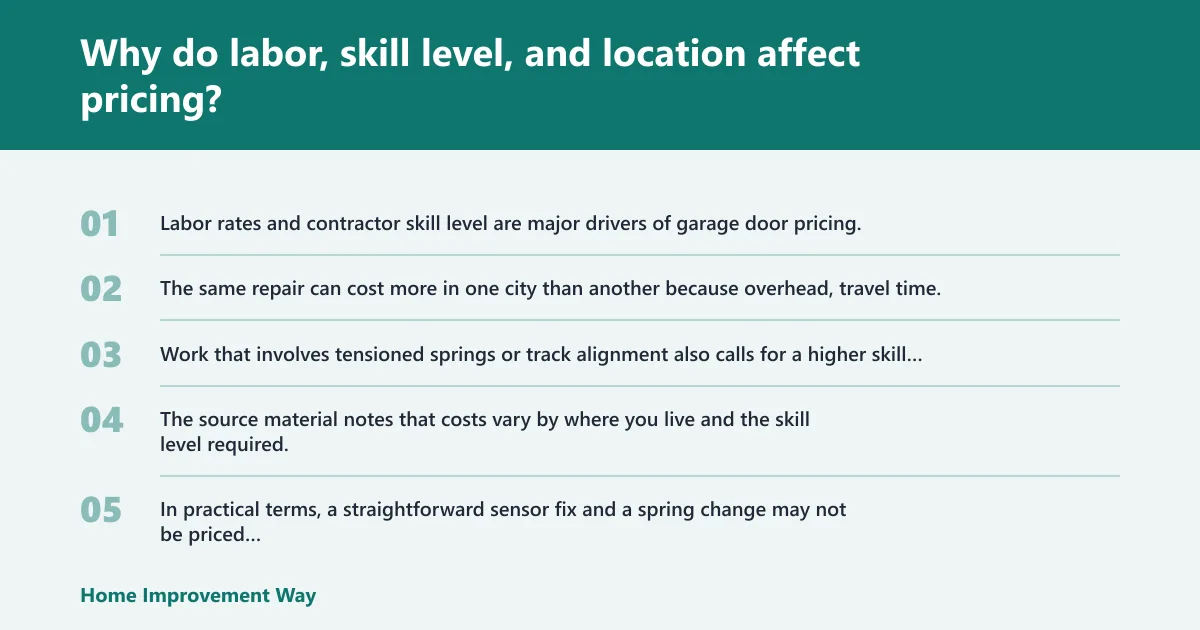
Labor rates and contractor skill level are major drivers of garage door pricing. The same repair can cost more in one city than another because overhead, travel time, and local wage levels differ. Work that involves tensioned springs or track alignment also calls for a higher skill level, which raises the quote.
Local market conditions matter too. The source material notes that costs vary by where you live and the skill level required. In practical terms, a straightforward sensor fix and a spring change may not be priced close together if one market has more experienced technicians or a tighter schedule.
Specialized spring and track work
Spring and track repairs are not the same as a simple screw-tightening visit. They can require balancing the door, handling stored tension, or correcting alignment so the rollers move cleanly. That added risk is why technicians often price these jobs above a basic service call.
Does emergency or weekend service cost more?
Yes. Weekend or after-hours service can sometimes double the bill, especially when the appointment is urgent and outside normal hours. Even if the repair itself is simple, the timing fee can change the total sharply. For a car trapped inside the garage, that extra cost may still be worth it. (thisoldhouse.com)
After-hours scheduling fees
After-hours jobs often add a surcharge for staffing and dispatch. Ask whether the rate is flat or time-based. A quote should spell out whether any emergency fee applies before work starts and whether it is separate from labor and parts.
Weekend appointment surcharges
Weekend service can cost more because the contractor is paying to send someone out during a higher-demand window. If the door is stuck open, that fee may be justified for security or weather protection. If the door still works, waiting for regular hours can lower the total.
Repair or replacement: which is better value?
Repair is usually the better value when the failure is limited, the door is otherwise sound, and the estimate stays near a common repair range. Replacement starts to make more sense when the same parts keep failing, the panels are badly damaged, or the door is old enough that matching parts and labor add up.
When repair usually makes sense
Repair is often the right call for a single broken spring, one cable issue, a localized opener failure, or a panel dent that has not spread into the frame. If the door is structurally solid and the estimate only addresses one issue, repair usually protects the budget.
When repeated failures point to replacement
Repeated spring breaks, recurring track problems, and multiple damaged sections are warning signs. When the door needs several high-risk or labor-heavy repairs, the total can creep toward replacement territory. Older doors also raise the odds that one fix exposes another weak point soon after.
Suppose a homeowner has an aging sectional door with one broken spring, a noisy opener, and a panel that no longer lines up cleanly. That is no longer a simple one-part repair. The quote should compare the cost of fixing each issue against replacing the door if the failures are tied to age and wear.
Homeowner quote breakdown: what to compare before you hire
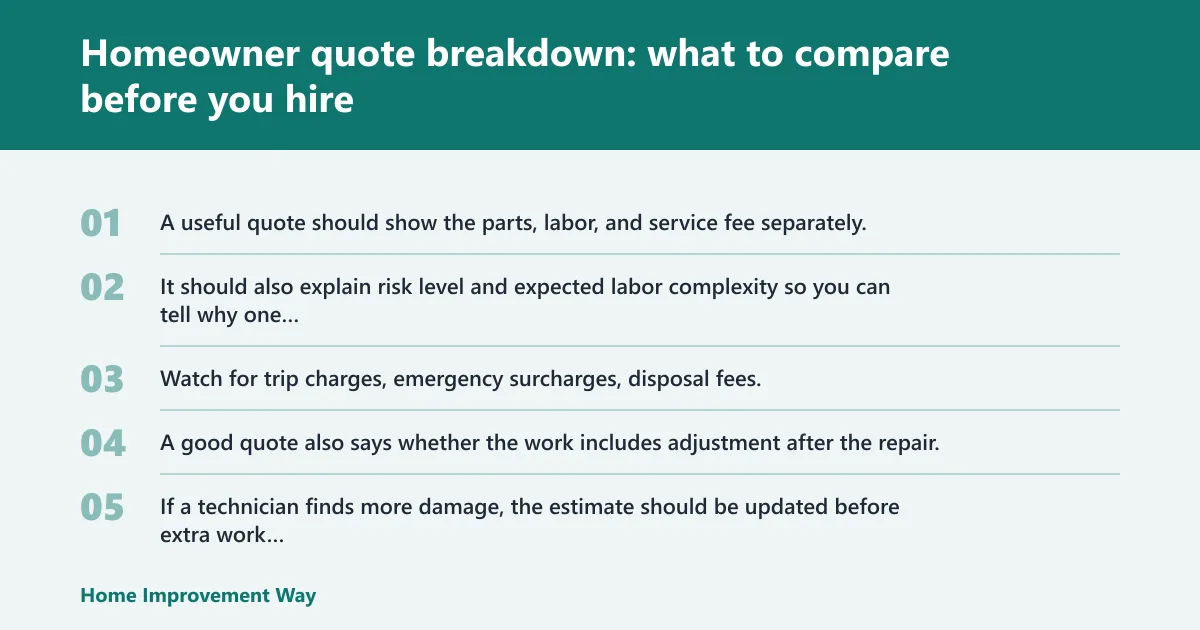
A useful quote should show the parts, labor, and service fee separately, then say whether the repair is limited to one component or includes any follow-up adjustment. It should also explain risk level and expected labor complexity so you can tell why one bid is higher than another.
| Common failure | Likely cost drivers | Risk level | Expected labor complexity | Repair or replacement usually better value? |
|---|---|---|---|---|
| Broken spring | Spring type, tension handling, balancing, part availability | High | Moderate to high | Repair, unless repeated failures or door wear are widespread |
| Frayed or off-track cable | Cable replacement, drum reset, spring-related damage | High | Moderate | Repair, unless a second failure is present |
| Opener failure | Electrical troubleshooting, gear or motor parts, sensor issues | Medium | Low to high | Repair for single-component faults; replace if the opener is old and unreliable |
| Damaged panel | Dent repair, section matching, full section replacement | Medium | Low to moderate | Repair for light damage; replacement if the section is cracked or unavailable |
| Misaligned or bent track | Realignment, replacement, roller inspection, door balance check | Medium to high | Moderate | Repair if the track is only out of line; replace if bent or repeatedly damaged |
Watch for trip charges, emergency surcharges, disposal fees, and any vague “shop supplies” line that is not explained. A good quote also says whether the work includes adjustment after the repair. If a technician finds more damage, the estimate should be updated before extra work starts.
How do I avoid paying too much for a garage door repair?
You avoid overpaying by comparing written estimates, checking the scope line by line, and making sure the quote matches the actual problem. Ask whether the repair is a single-part fix or part of a broader wear issue, and whether timing fees or diagnostic charges are separate from labor.
- Ask for a written estimate with parts, labor, and service fees listed separately.
- Confirm whether the quoted price covers one part or several related repairs.
- Ask if the technician expects hidden wear, such as balance or track issues.
- Check whether the appointment is regular hours, weekend, or after-hours.
- Compare at least two or three quotes for the same scope of work.
- If several parts are failing, ask whether doing them in one visit lowers the total.
Frequently asked questions
How much does garage door repair cost?
Garage door repair can cost anywhere from $98 to $860, with many common failures landing between $98 and $300. The exact number depends on the part that failed, the labor involved, and whether the visit is during normal business hours or on an emergency schedule.
What makes a garage door repair quote more expensive?
Quotes rise when the repair needs specialized labor, more than one part, or difficult access. Spring and track work usually costs more than a basic sensor fix, and after-hours service can add a large surcharge. Older doors also raise pricing when parts are harder to match.
Why is spring replacement more expensive than a sensor fix?
Spring replacement is more expensive because springs are under heavy tension and require careful removal, installation, and door balancing. A sensor fix is usually a smaller electrical or alignment job. Spring failure also creates more safety risk, so the labor is priced accordingly.
Does emergency or weekend service cost more for garage door repair?
Yes. Weekend or after-hours service can sometimes double the bill. The higher total often reflects staffing, dispatch timing, and urgency, not just the repair itself. If the door is safe and usable, waiting for standard hours can reduce the cost.
Is it cheaper to repair one part or several garage door parts at once?
It is often cheaper to repair several broken parts during the same visit, especially when the problems are related. A technician is already on site, and the door only needs to be opened, tested, and balanced once. That said, the job still costs more than fixing one issue.
When does a repair turn into a replacement?
Repair turns into replacement when failures repeat, damage spreads across multiple sections, or the total repair cost approaches the value of a newer door. Old panels, repeated spring trouble, and bent tracks are common signs that replacement may be the better long-term value.
Sponsored / affiliate links. As an Amazon Associate I earn from qualifying purchases. I may earn additional commission from eligible campaigns.