Does Calcium Chloride in a Sock Melt Ice Dams?
Calcium chloride in a sock can melt a narrow channel through an ice dam if the dam is thin enough, but only as a short-term drainage aid, not a fix for the roof problem. Used poorly, it can send water under shingles and lead to leaks or interior damage. This guide covers when the sock method works, when it fails, and what to do next.
Does a calcium chloride sock melt ice dams?
A calcium chloride sock can melt a narrow drainage channel in an ice dam when the dam is thin enough for the salt to reach the ice surface and stay in contact. It is a short-term drainage aid at the roof edge, not a cure for the heat loss or ventilation issue that created the dam.
What the sock can do on a roof edge
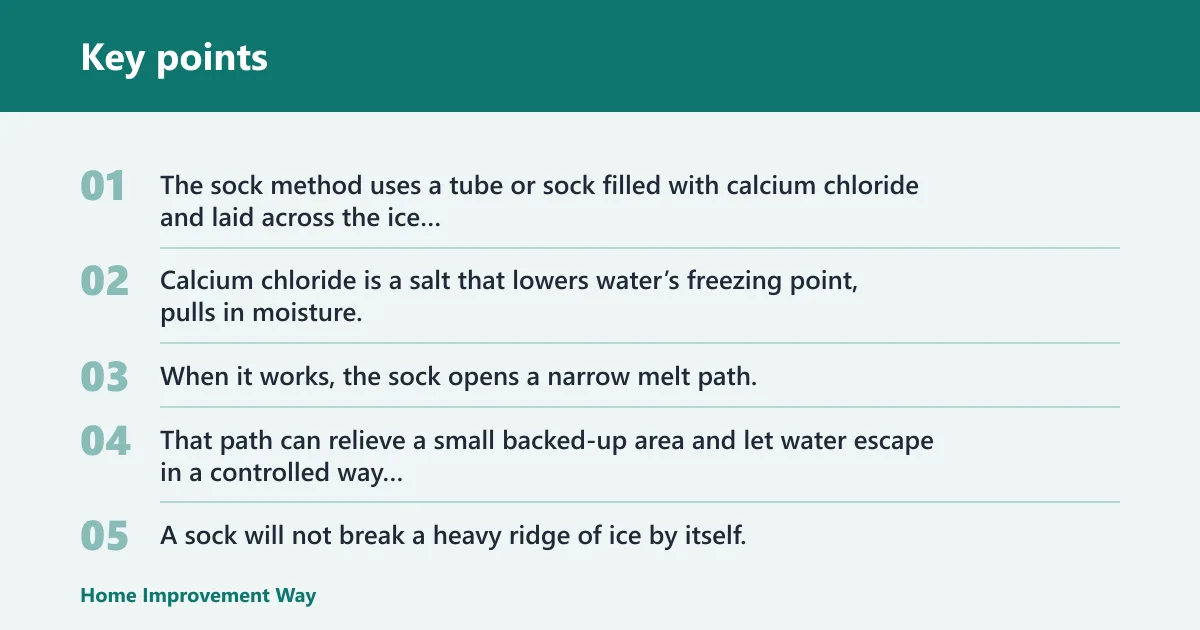
The sock method uses a tube or sock filled with calcium chloride and laid across the ice at the eave. Calcium chloride is a salt that lowers water’s freezing point, pulls in moisture, and can work in colder weather than plain sodium chloride.
When it works, the sock opens a narrow melt path. That path can relieve a small backed-up area and let water escape in a controlled way instead of pooling behind the dam.
What it cannot do in thick ice
A sock will not break a heavy ridge of ice by itself, and it will not correct attic heat loss, insulation gaps, or ventilation problems. If the dam is thick, buried under snow, or already forcing water under shingles, the sock may melt only a surface groove and leave the blockage in place.
How calcium chloride works
Calcium chloride lowers water’s freezing point, which is why it can keep working in colder weather than sodium chloride. It is also hygroscopic, so it draws in moisture from the air and surrounding snow. That moisture helps start melting, but the surrounding conditions still control how useful the sock will be.
Product form matters. Calcium chloride may be sold as pellets, flakes, or blends, and different concentrations can change how quickly it starts to work. Product listings for calcium chloride pellets, Dowflake Xtra, and ComboTherm describe differences in concentration and pellet form.
Cold-weather limits to know
Calcium chloride is used in winter maintenance, and performance depends on the blend and on how much liquid the salt can create. In very cold weather, some formulations still work better than sodium chloride, but melting slows as temperatures drop.
Potassium chloride works only above a warmer threshold, so it is usually a weaker choice for cold roof-edge melting. Calcium chloride generally makes more sense when temperatures are low and you need a small melt path rather than a broad melt area.
Ice dam basics
An ice dam forms when roof snowmelt refreezes at the eave. Water then backs up behind the ice and can move under shingles. That backup can lead to leaks, stained ceilings, wet insulation, and other interior damage. (Wikipedia)
A common first-time mistake is treating the visible ice ridge as the whole problem. The ridge matters, but the water source is often snow higher on the roof. If that snow keeps melting from below and refreezing at the edge, the dam keeps getting fed.
Why water backs up under shingles
Shingles overlap, so water normally sheds downhill. An ice dam blocks that path at the roof edge, and liquid water pools behind it. Once the water reaches seams or nail holes, it can travel beneath the roofing layers and appear inside the home.
Why leaks can start inside
Interior leaks often begin after water has already been trapped behind the dam for some time. The damage may show up as drips, bubbling paint, or damp spots, but the source is still the roof edge. A sock may reduce the flow, yet it does not remove the conditions that caused the backup.
Ice dam decision table

This table gives a roof-specific rule of thumb. It is meant to help you decide whether a calcium chloride sock is a reasonable temporary step or a poor bet. The safest next move depends on ice thickness, snow depth, and whether water is already entering the home.
| Scenario | Can a calcium chloride sock help? | Expected melt speed | Likely failure mode | Safer next step | Do not use if |
|---|---|---|---|---|---|
| Light ridge at the eave | Yes, often | Small channel may form within a few hours, sometimes faster in milder cold | Channel is too narrow and refreezes overnight | Use the sock only as a temporary drain, then reduce the snow feeding the ridge with a roof rake | You would need to climb onto a slippery roof to place it |
| Thick ice dam | Maybe, but limited | Slow and uneven; may only soften the surface | Salt cannot reach enough ice to open a lasting path | Use a roof rake where you can safely remove snow above the dam; call a pro if the dam is large | The dam is hard, deep, or spans a long section of roof edge |
| Deep snow above the dam | Usually not enough by itself | Very slow because the snow keeps feeding melt water | New meltwater keeps freezing at the edge | Remove snow above the dam first with a roof rake or a shovel from the ground where possible | The roof is loaded with snow and access looks unsafe |
| Active interior leak | Only as a short bridge until help arrives | May relieve pressure slowly, if at all | Water continues to back up under shingles before the channel opens | Protect the interior, stop the water source if possible, and call a roofer or emergency service | Leakage is already inside or the ceiling is sagging |
How do you use the sock method?
Use the sock method only as a temporary emergency measure at the roof edge or eave. The goal is to place calcium chloride where it can cut a narrow melt channel without damaging shingles or forcing you onto an unsafe roof. If the roof is heavily loaded, do not treat this as routine roof work.
Materials checklist
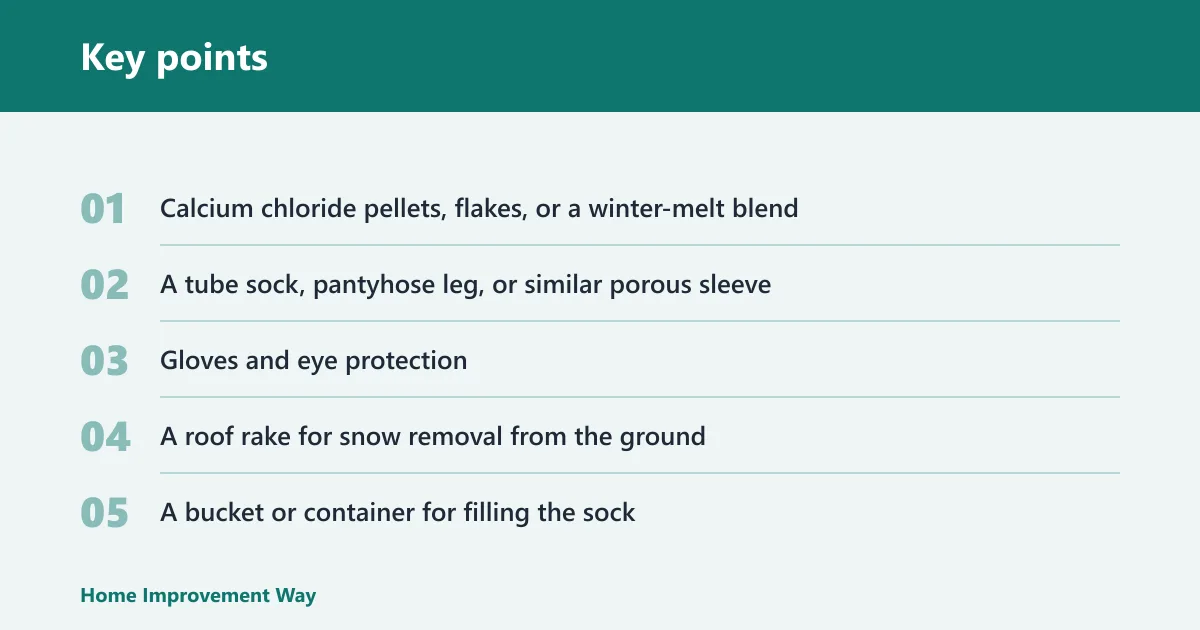
- Calcium chloride pellets, flakes, or a winter-melt blend
- A tube sock, pantyhose leg, or similar porous sleeve
- Gloves and eye protection
- A roof rake for snow removal from the ground
- A bucket or container for filling the sock
Placement at the roof edge
Place the filled sock across the ice at the roof edge or eave, where ice dams commonly form. Keep it on top of the roof surface rather than pulling it under shingles. The sock should rest where meltwater can run downhill and escape, not where the material can pry up roofing or sit against a vulnerable seam.
Do not force it under shingles. That can damage the roof covering and may create a new leak path. A light placement across the dam is usually safer than aggressive positioning.
Spacing and expected melt path
One sock may create only a narrow melt track. If the dam is long, you may need several socks spaced across the problem area, but more material is not always better. Too much concentrated salt can leave a messy runoff area without solving the blockage above it.
Suppose the dam is a shallow 6-foot ridge at the eave and the snow above it is thin. A sock may open a small channel in that section. If the same roof has a 12-foot band of hard ice under 8 inches of snow, the sock is far less likely to keep pace with the meltwater feeding the dam.
When to stop and switch tactics
Stop relying on the sock if the channel does not form, if the ice is refreezing as fast as it melts, or if water is still entering the house. At that point, the safer move is to reduce the snow load above the dam, avoid roof access, and bring in help if conditions are risky.
Will calcium chloride damage your roof?
Calcium chloride can irritate skin and eyes, and it deserves caution around roofing materials. Keep the runoff away from concrete and plants. Treat the runoff as a maintenance chemical, not as harmless water.
Shingles, gutters, and flashing
On shingles, the biggest risk is not usually the salt itself; it is poor placement that lifts or tears the roofing. On gutters and metal flashing, repeated exposure to concentrated runoff can be a concern, especially if the product sits in one spot and keeps wetting the same area.
Will calcium chloride damage shingles, gutters, or metal flashing? It can, if it is placed badly or if runoff concentrates in one place. Keep it at the roof edge, use only enough to create a channel, and avoid forcing material under roofing or into hidden seams.
Concrete and plant exposure
Runoff can still leave residue on walkways or steps. Plants near the drip line may also be exposed to salty meltwater. If possible, direct the drainage away from sensitive landscaping and rinse surfaces after the event.
Skin and eye contact precautions
Wear gloves and eye protection when handling the product. Calcium chloride can irritate skin and eyes, especially if the pellets or flakes are dusty. Keep the material dry until use, and wash exposed skin after handling it.
What to do if it does not work
If a calcium chloride sock does not open a usable channel, the next step is to reduce the snow feeding the dam and avoid risky roof access. A sock is only a temporary drainage tool. If the roof stays loaded or water keeps backing up, the problem has moved beyond a simple emergency melt.
Use a roof rake to reduce the snow load
A roof rake can remove snow from the lower roof area before it refreezes at the edge. That matters because snow above the dam is the fuel source. If you can work from the ground, remove as much of that snow as you safely can without pulling on the shingles.
Avoid risky roof access
Do not walk a snow-loaded or icy roof as routine advice. The combination of ice, slope, and weight makes the fall risk too high for a temporary repair. If you cannot reach the problem safely from the ground or from a stable ladder position, stop there.
When to call a pro
Call a roofer if the dam is large, leaks are active, the roof is steep, or the snow load is heavy enough to make access unsafe. Professional help is also the better choice when ice keeps returning, which usually means the root cause needs attention in the attic or roof assembly, not at the edge.
Frequently asked questions
Does calcium chloride in a sock melt ice dams?
Yes, it can melt a narrow drainage channel through an ice dam if the dam is thin enough and the salt can reach the ice surface. It is a temporary emergency aid, not a repair. Thick dams, deep snow cover, and strong refreezing can keep it from working well.
How do you put calcium chloride in a sock on a roof?
Fill a porous sock or sleeve with calcium chloride pellets, flakes, or a blend, then place it across the ice at the roof edge or eave. Do not force it under shingles. Keep the placement light and temporary, and avoid roof access if the roof is snow-loaded or slick.
What temperature does calcium chloride work in?
Performance depends on the formulation. Some products work in very cold weather, while others slow down as temperatures drop. Calcium chloride generally works better than plain salt in colder weather, but deep cold still slows melting.
Will calcium chloride damage shingles, gutters, or metal flashing?
It can cause problems if placed badly or if runoff concentrates in one spot. The main risks are physical damage from poor placement, repeated wetting of metal parts, and residue on nearby surfaces. Keep it at the roof edge and avoid forcing it under shingles or into seams.
How many socks of calcium chloride do I need for an ice dam?
There is no fixed number. A short, light ridge may need one or a few socks spaced across the problem area, while a long or thick dam may need more than a temporary sock method can reasonably solve. If the dam is broad or deep, shift to snow removal and professional help.
What should I use if calcium chloride in a sock does not work?
Use a roof rake to reduce the snow load above the dam, then stay off the roof if conditions are unsafe. If water is already entering the home or the ice remains thick, call a roofer. The next step is to address the snow feeding the dam, not to keep adding salt.
Sponsored / affiliate links. As an Amazon Associate I earn from qualifying purchases. I may earn additional commission from eligible campaigns.