Does Ice Melt Damage Wood Decks?
Yes, ice melt can damage wood decks if you use chloride deicers often or leave them on wet boards; for wood, start with the mildest product that works and apply only a light layer. Wrong products can strip finish, raise grain, stain boards, and speed corrosion in fasteners and connectors. This guide covers the safest deicer ingredients, when traction is a better choice, and how to remove ice without adding more wear.
Why repeated deicer exposure degrades deck finish
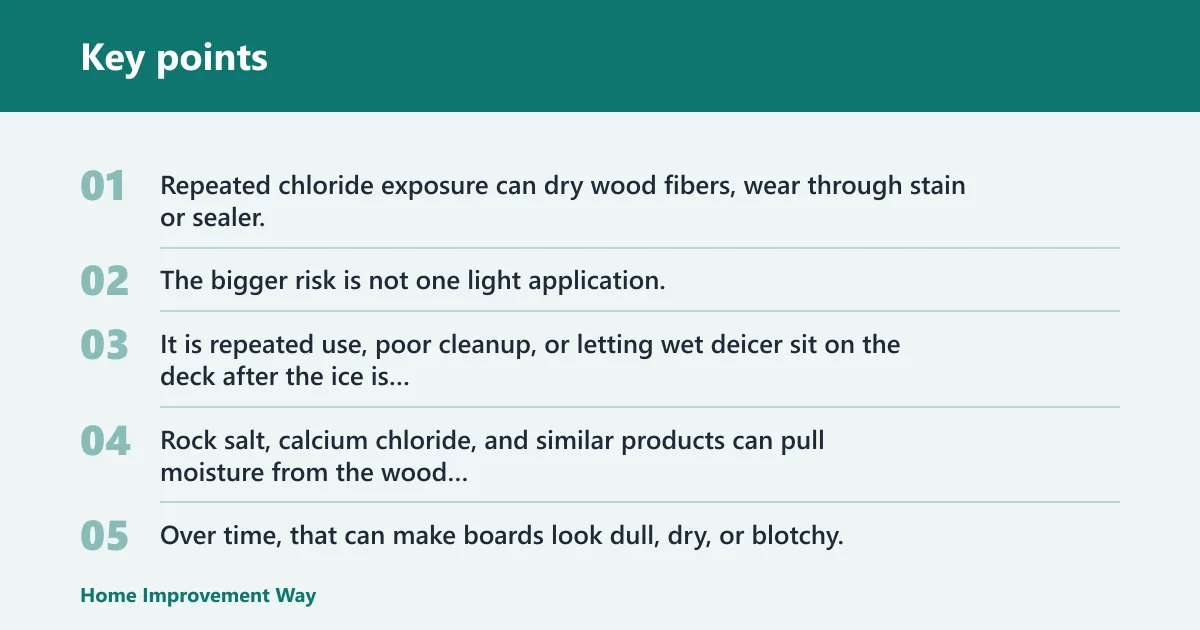


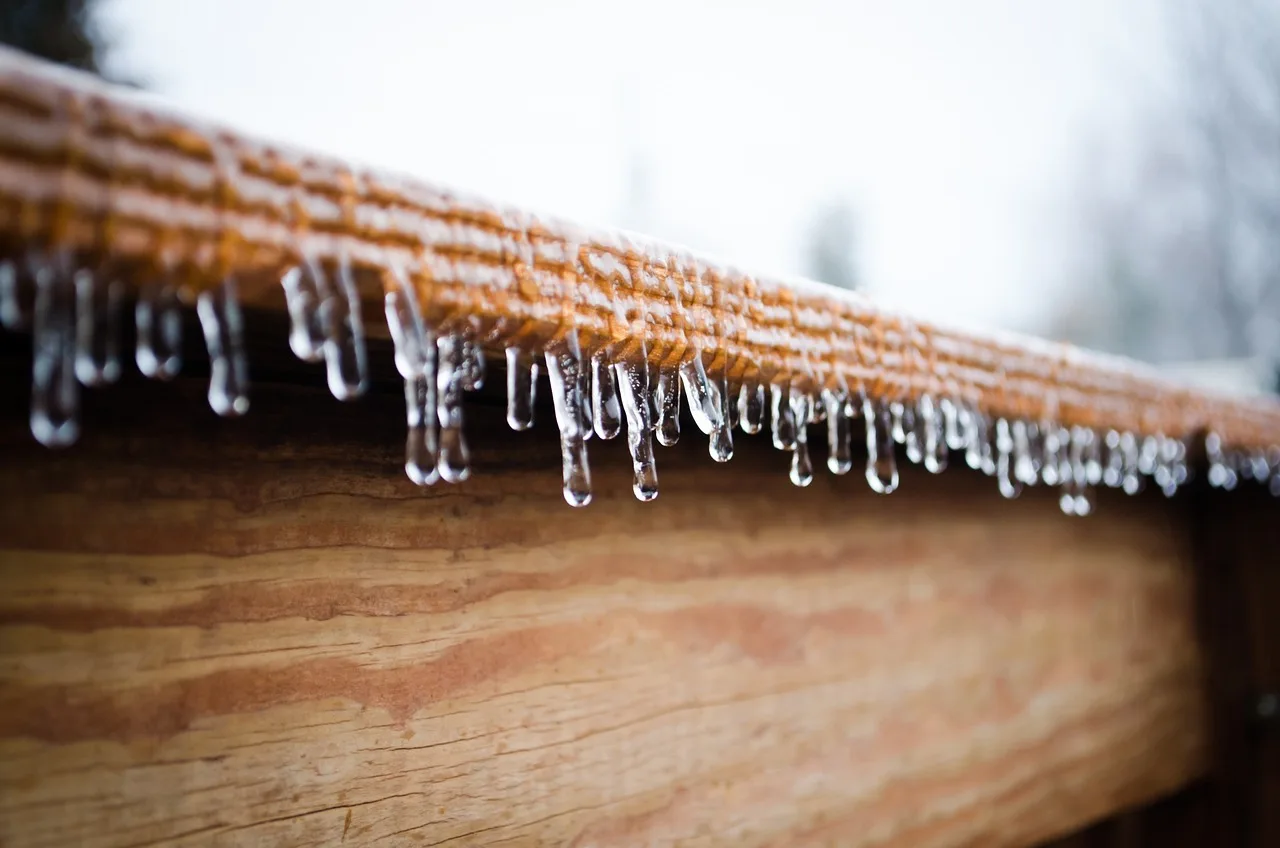
Yes. Repeated chloride exposure can dry wood fibers, wear through stain or sealer, and leave residue in the grain. The bigger risk is not one light application. It is repeated use, poor cleanup, or letting wet deicer sit on the deck after the ice is gone.
What repeated exposure does to wood
Rock salt, calcium chloride, and similar products can pull moisture from the wood surface and leave crystals behind as water evaporates. Over time, that can make boards look dull, dry, or blotchy. On finished decks, the coating can lose protection faster, which leaves the wood more exposed to winter moisture and abrasion. That caution is consistent with wood-preservation guidance from the University of Minnesota Extension and with deck-care guidance from major deck makers such as Trex and Fiberon.
Fasteners matter too. Salt residue and runoff can speed corrosion around screws, nails, brackets, and connectors. That is a slow failure, not an instant one, but it is one of the main reasons wood decks need more caution than concrete walks.
How finish wear changes the risk
A stained or sealed deck has a buffer, but it is not a shield. If the finish is already thin, worn at traffic lanes, or peeling at board edges, deicer reaches the wood faster. Once the protective layer is compromised, resealing may be needed after winter rather than waiting for routine maintenance.
Can you put ice melt on wood?
Yes, but only when melting is actually needed and only in a light, targeted application. Wood decks are more vulnerable than concrete because deicer residue can linger in grain, fastener holes, and joints. For light frost, sweeping or brushing is usually safer than adding chemicals, especially on finished boards.
Should you put salt on a wood deck?
Generally, no. Plain rock salt is the roughest common choice for wood because it can dry the surface, dull finishes, and contribute to corrosion around metal hardware. If you have to use a chloride product, use the smallest amount that works, keep it off the whole deck, and clean it up as soon as the thaw allows.
What ice melt is safe for wood decks?
No deicer is fully risk-free on wood, but calcium chloride and magnesium chloride are usually preferred over plain rock salt when melting is necessary. Even then, the safest choice depends on the deck finish, current temperatures, and how quickly you can remove residue. Follow the deck maker’s care guidance and the deicer label, since temperature performance varies by product.
Wood vs. composite guidance
Wood and composite should not be treated the same way. Composite decking often has specific manufacturer rules about what is allowed, while wood needs more attention to finish wear and fasteners. Some composite makers permit certain calcium chloride products, but that does not mean the same product is ideal for wood. Keep wood guidance separate so the two materials do not get mixed together.
Temperature-performance caveats
Deicer labels often list low-temperature performance, but those numbers are product-specific, not universal. A blend that works in one bag formulation may not behave the same way in another, especially if it contains colorants, anti-caking agents, or fillers. Use the label as a ceiling, not a promise, and expect any product to work less efficiently on wet, windy, or heavily shaded boards.
Wood deck ice-removal decision table
Use the least aggressive method that solves the problem. If melting is not necessary, skip chemical residue altogether and remove the snow or ice mechanically with a plastic shovel, broom, or traction aid.
| Scenario | Safest action | Use deicer? | Ingredient to avoid | Cleanup required | Risk to stain/sealer and fasteners |
|---|---|---|---|---|---|
| Light frost | Brush off with a broom or plastic shovel | No | Rock salt | Little to none | Low if you avoid scraping and residue |
| Thin bonded ice | Use a light application of a wood-appropriate deicer, then clear loosened ice with a plastic shovel | Yes, if needed | Rock salt if the finish is worn | Remove residue after thaw; rinse lightly when temperatures allow | Moderate if used repeatedly or left on wet boards |
| Heavy refreeze | Break the cycle with deicer, then remove meltwater and slush before it refreezes | Yes | Sand if it will grind into the surface | More cleanup, plus follow-up after the weather warms | Higher; finish wear and fastener corrosion become more likely |
| Recurring shaded-spot ice | Prioritize traction, shading fixes, drainage checks, and selective deicer use only where needed | Sometimes | Heavy rock salt use | Frequent cleanup and monitoring | Highest because repeated exposure compounds damage |
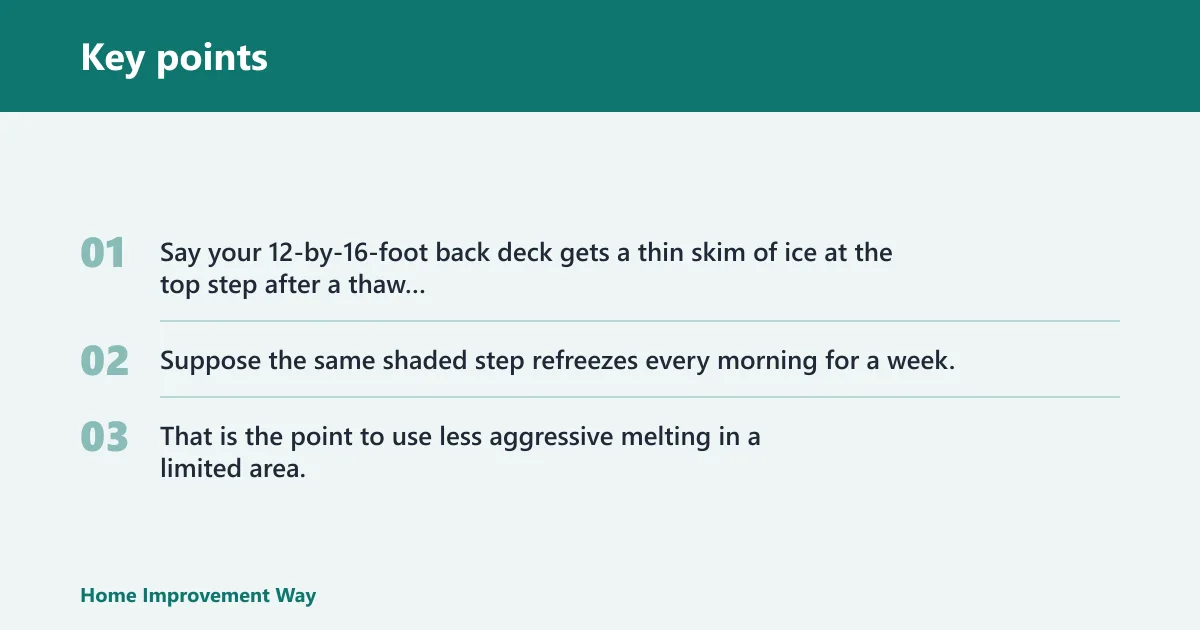
Say your 12-by-16-foot back deck gets a thin skim of ice at the top step after a thaw and freeze cycle. A quick brush-off may be enough. Suppose the same shaded step refreezes every morning for a week. That is the point to use less aggressive melting in a limited area, then address the drainage or shade problem so the cycle does not keep repeating.
How do you melt ice without salt?
Start with mechanical removal, then use traction or prevention before reaching for chemicals. For frost, sweep the deck. For bonded ice, use a plastic shovel after loosening the bond with a small amount of deicer only where needed. If the area keeps refreezing, correct drainage, shade, and runoff so the problem does not return.
Step 1: Brush off frost and loose snow
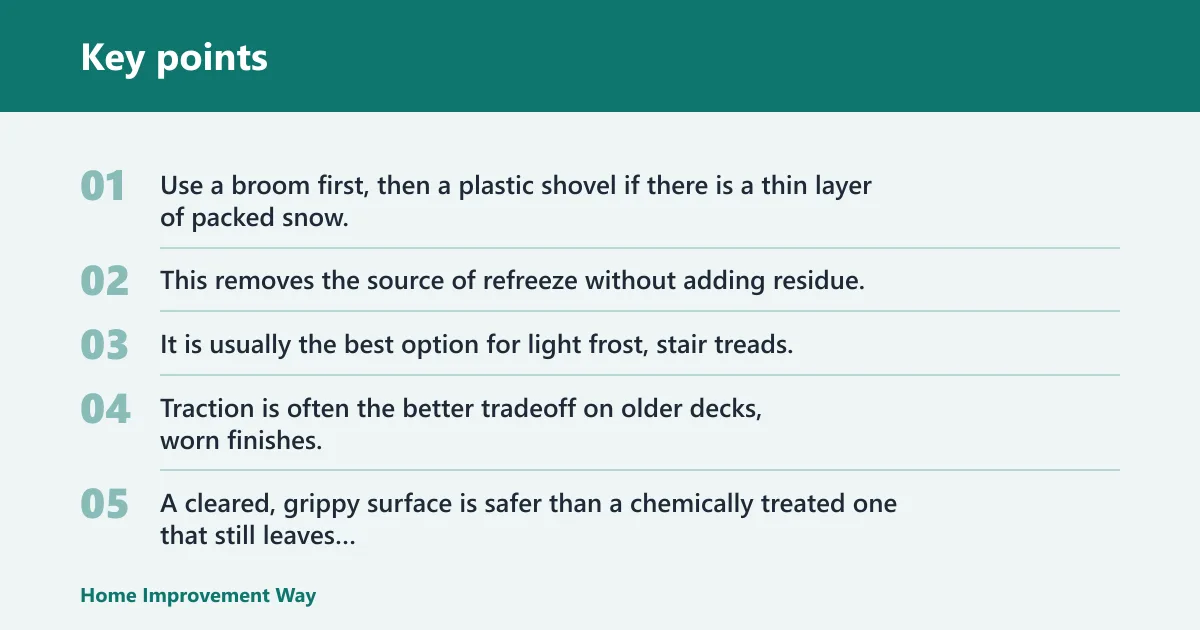
Use a broom first, then a plastic shovel if there is a thin layer of packed snow. This removes the source of refreeze without adding residue. It is usually the best option for light frost, stair treads, and spots that do not need melting at all.
Step 2: Use traction where you can
Traction is often the better tradeoff on older decks, worn finishes, or places where runoff can pool. A cleared, grippy surface is safer than a chemically treated one that still leaves residue, especially on stairs and traffic paths. If the ice is minor, mechanical removal plus traction is usually the cleaner answer.
Step 3: Treat bonded ice in small areas only
If a patch is stuck down, apply the smallest effective amount of a wood-appropriate deicer to that spot and wait for it to loosen the bond. Then lift the ice with a plastic shovel instead of prying. Avoid spreading product across the full deck when only one step or corner needs help.
Step 4: Fix recurring shaded refreeze
If the same area keeps icing up, the long-term fix is not more product. Check for poor drainage, shaded runoff, clogged gaps, or snowmelt that drains back onto the deck and refreezes. Reducing the moisture source is the best way to keep a deck safer with less winter wear.
Step 5: Clean up promptly after thaw
Once temperatures allow, remove slush, rinse away visible residue lightly, and inspect the finish and fasteners. Cleanup timing matters because chloride crystals can sit in grain and joints even after the ice is gone. Prompt cleanup protects the finish and reduces corrosion risk around hardware.
How do you get ice off a wood deck safely?
Start with the least abrasive method: remove loose snow, brush off frost, and use a plastic shovel for bonded ice when needed. Work parallel to the deck boards and stop short of any method that gouges, scrapes, or grinds into the finish. If traction can solve the problem, choose traction over melting.
Use a plastic shovel or broom first
Decks by E3 says a plastic shovel should be used, not metal, to avoid scratching decking. That advice fits wood especially well, because metal blades can cut into soft grain and damage stained or sealed boards. A broom is even better for light frost and dry snow.
Work parallel to the boards
When you do need to scrape, keep the edge flat and move along the board direction. Cross-grain scraping leaves visible marks more quickly. If the ice is tightly bonded, apply a small amount of deicer first, wait for it to loosen the bond, then lift the ice rather than prying at it.
Choose traction instead of melting when you can
Traction is often the better tradeoff on older decks, worn finishes, or places where runoff can pool. A cleared, grippy surface is safer than a chemically treated one that still leaves residue, especially on stairs and traffic paths. If the ice is minor, mechanical removal is usually the cleaner answer.
What to avoid on wood and composite
Do not treat wood and composite as the same surface. Composite decking can tolerate some deicers better than wood, but it still has staining and fastener risks. On wood, avoid anything that increases abrasion, residue, or finish loss.
Sand and gritty traction material
Sand can help with grip, but it may also scratch the surface and grind into the deck boards. Use it only when traction is more important than keeping a perfect finish, and sweep it away later so it does not act like abrasive grit. On soft or already worn wood, the scratch tradeoff is real.
Metal shovels and sharp tools
Sharp scrapers, ice picks, and metal shovel blades can leave permanent marks. They also catch on raised grain and worn finish. If you are tempted to pry, stop and let a deicer or warmer weather do the work.
Colored products and residue buildup
Some blends leave white residue or have colorants that linger on the grain. That residue is more than cosmetic if it sits through thaw and refreeze cycles. It can keep drawing attention to wear spots and may need a more thorough wash once temperatures improve.
Deck ice melt cleanup and finish care
Cleanup matters as much as product choice. Remove meltwater, slush, and leftover crystals after the weather warms, then inspect the deck for whitening, dull patches, or areas where the finish has thinned. Rinsing helps, but it does not undo finish damage that has already happened.
Watch for whitening, drying, and finish wear
White haze on wood grain, a dry chalky feel, or faster water absorption after thaw are all signs that the finish has taken a hit. If the deck starts to darken unevenly when damp, the protective coat may be failing. That is when spot repairs or resealing become more than a cosmetic choice.
When resealing becomes necessary
Decks by E3 warns that salt can strip stain and sealer protection, requiring resealing every spring. Not every deck will need that schedule, but the point stands: if winter deicer use was heavy, check the finish before the next wet season. Bare or weakened boards should be resealed before more moisture gets in.
A common first-timer mistake is spreading extra product because the first pass did not melt everything at once. That usually creates more residue, not faster results. A lighter application, then a short wait and a plastic shovel, is usually easier on wood than repeated heavy dosing.
Fastener, pet, and plant safety
Fasteners still matter even when the boards look fine. Salt and chlorides can creep into gaps, around screw heads, and under hardware where you do not notice the damage right away. That is why cleanup and limited application are part of the safety plan, not an afterthought.
Keep runoff away from plants and entry paths
Runoff can collect near planters, steps, and walkway edges. Keep deicer away from beds and rinse away residue before it tracks indoors. If your deck drains toward shrubs or lawn edges, use the smallest effective amount and limit it to the icy spot. University extension guidance commonly recommends reducing exposure to landscape plants because chloride runoff can injure roots and foliage.
Use pet-safe labels carefully
Pet-safe language is helpful, but it does not replace label review. Some products are marketed as non-corrosive or chloride-free for pet traffic, yet still leave residue on wood or nearby surfaces. If pets walk the deck, remove leftover crystals and monitor for paw irritation or slippery patches. Pet-safe labels should be treated as a precaution, not a guarantee that the product is gentle on wood or hardware.
Frequently asked questions
Does ice melt damage wood decks?
Yes, it can. Repeated use of chloride deicers can dry the surface, wear away stain or sealer, and leave residue in the grain. The risk rises when the product is left on wet boards or used every time the deck freezes.
Is magnesium chloride safe for wood decks?
It is usually considered one of the lower-risk choices, but that does not make it harmless. Product performance varies, and some blends are gentler than others. Use it sparingly, then clean up residue after the thaw.
Will rock salt stain or dry out a wooden deck?
Yes. Rock salt can dry wood, dull the finish, and leave white residue behind. It can also speed corrosion in screws and other metal parts. If you use it, keep the application light and rinse it off after temperatures rise.
Sponsored / affiliate links. As an Amazon Associate I earn from qualifying purchases. I may earn additional commission from eligible campaigns.