Garage Door Repair vs. Replacement: Which Is Smarter?
Repair the door if the damage is minor and the frame, springs, and panels are sound; replace it when damage affects structure or safety, or when repair costs start to approach about 50% to 70% of the cost of a new door. If you choose the wrong fix, you can end up paying for the same failure again, losing efficiency, or operating a door that is no longer safe. This guide gives a repair-vs-replacement decision matrix, cost and safety trade-offs, and a quick way to tell when the opener is the real problem.
| Decision factor | Garage door repair | replacement | Winner |
|---|---|---|---|
| Upfront cost | Usually lower for isolated parts and small fixes | Higher upfront because you are replacing the full door | Garage door repair |
| Long-term value | Good if the door is otherwise sound | Better if repeated repairs, old hardware, or poor efficiency are already driving cost | replacement |
| Safety and reliability | Works when the problem is limited to one component | Better when the door is crooked, sagging, or failing in multiple places | replacement |
| Energy efficiency and comfort | Limited improvement unless you are only fixing seals or weatherstripping | Better when you move to insulated panels or newer cores | replacement |
| Curb appeal and resale | Fine for a small visible flaw | Stronger if the exterior is dated or damaged and you want broader value return | replacement |
Should you repair or replace a garage door?
The trade-off is direct: repair keeps the bill lower today, while replacement cuts the chance of repeat work, weak performance, and safety trouble over time. Your decision depends on age, the type of damage, how often the door has failed, and whether energy loss or curb appeal now matters more than a short-term fix.
Garage door comparison at a glance
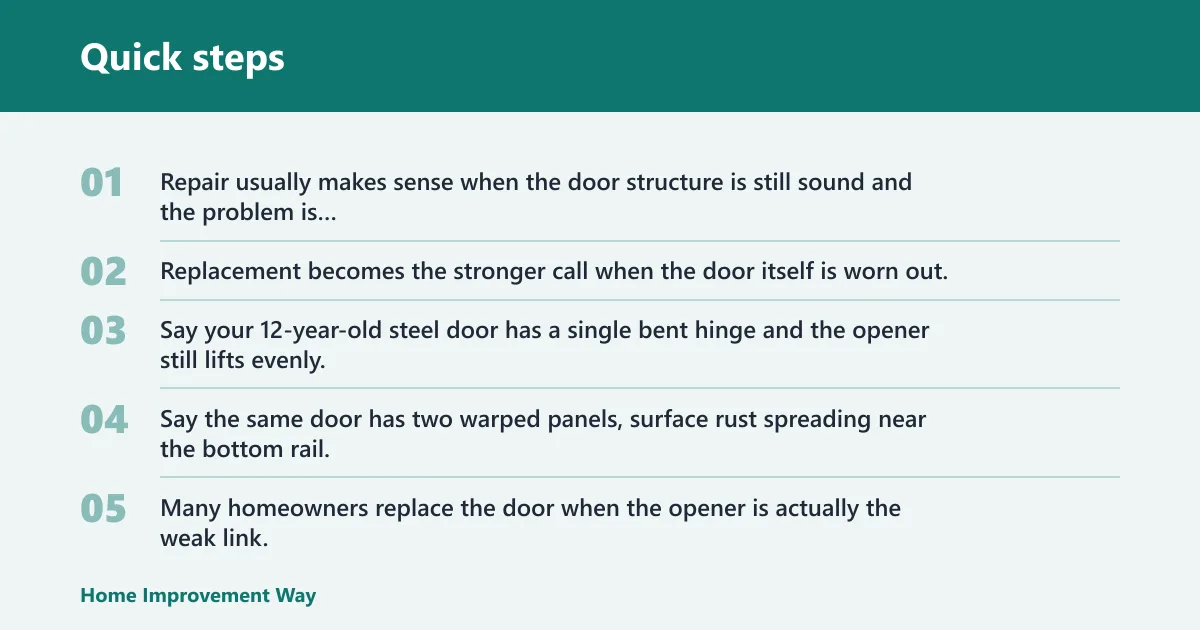
Repair usually makes sense when the door structure is still sound and the problem is isolated to one part, such as worn rollers, misaligned tracks, springs, cables, hinges, weatherstripping, or an opener component. Replacement becomes the stronger call when the door itself is worn out, hard to keep aligned, or no longer safe or efficient.
Say your 12-year-old steel door has a single bent hinge and the opener still lifts evenly. That is a repair scenario. Say the same door has two warped panels, surface rust spreading near the bottom rail, and uneven travel after each service call. That points toward replacement.
Door-only problems versus opener-only problems
Many homeowners replace the door when the opener is actually the weak link. A door can be structurally fine while the opener has bad gears, tired force settings, or failing safety sensors. Sort those problems out separately before you spend money on the wrong equipment.
| Problem type | Signs | Likely fix |
|---|---|---|
| Door-only problem | Warped panel, cracked panel, bent frame, rust, sagging, repeated binding at the tracks | Repair or replace the door, depending on severity |
| Opener-only problem | Door is straight but does not reverse correctly, struggles to close, or has intermittent remote response | Repair or replace the opener components |
| Mixed problem | Door travels crooked and the opener strains or reverses | Professional inspection before any replacement decision |
Garage door decision matrix
Use this 0-to-2 scorecard to help separate a solid repair from a replacement decision. Add the four scores for age, damage severity, repair frequency, and insulation or safety needs. Low totals point to repair, mid-range totals point to repair now but plan for replacement, and high totals point to replacement now.
| Factor | 0 points | 1 point | 2 points |
|---|---|---|---|
| Age | Under 10 years | 10 to 15 years | 15+ years, or 20+ years if the door has seen frequent repairs |
| Damage severity | Minor cosmetic damage or one repairable part | One damaged panel or localized wear that may be repairable | Warped, cracked, rusted, bent, or sagging sections; frame damage |
| Repair frequency | Rare service calls | Some repeat fixes, but not every season | Repeated failures, especially on the same door or the same issue |
| Insulation or safety needs | No attached garage concern and no safety issue | Some comfort, noise, or aging-safety concern | Attached garage, major heat loss or cooling loss, or safety concerns with travel or sensors |
Score 0 to 3: Repair. Score 4 to 6: Repair now, then plan for replacement if the pattern continues. Score 7 to 8: Replace now.
How to read the matrix
The matrix matters because a garage door can be cheap to patch and still expensive to own if it keeps failing. A door that is 18 years old, has two damaged panels, and has needed multiple repairs already is not the same as a newer door with a single worn roller.
Suppose a builder-grade door is 22 years old, has a sagging section near the bottom, and has needed spring and cable work in the last two years. That combination pushes hard toward replacement. Now suppose a 9-year-old insulated steel-back door only needs a roller and hinge replacement. That stays in repair territory.
How old is too old for a garage door?
Age alone does not force replacement, but it changes the odds. Modern garage doors can last about 15 to 30 years with proper maintenance, yet 10 to 12 years is often still a repair-friendly window, while 15+ years and especially 20+ years can start to shift the decision toward replacement if problems are stacking up.
When 10 to 12 years still points to repair
A door in the 10 to 12 year range is often still a sensible repair candidate if the structure is straight and the problem is isolated. Worn rollers, a broken spring, loose hinges, or misaligned tracks can usually be handled without replacing the whole door.
Why 15 to 20+ years often shifts the decision
Older doors have less remaining life, even if the first repair seems small. At 15 years and beyond, the question becomes whether you are buying a short-lived patch or resetting the clock with a new door that is more likely to need fewer maintenance calls.
Door Serv Pro notes that older doors over 20 years old that need frequent repairs may be more cost-effective to replace. That advice is especially relevant for builder-grade doors, which often have weaker insulation, thinner materials, and less forgiving hardware than better-insulated steel doors.
Why door quality changes the age call
A steel-back insulated door usually gives you more reason to keep repairing it than a low-grade, lightly built door of the same age. Better construction can mean more stable panels, better weather sealing, and a longer useful life before the structure itself starts failing.
What damage usually means replacement?
One dented panel does not automatically mean replacement. Warped panels, cracked panels, a bent frame, rust that has spread beyond the surface, or sagging that affects how the door hangs and travels usually point to replacement because the door is no longer sound as a system.
When one dented panel is still a repair
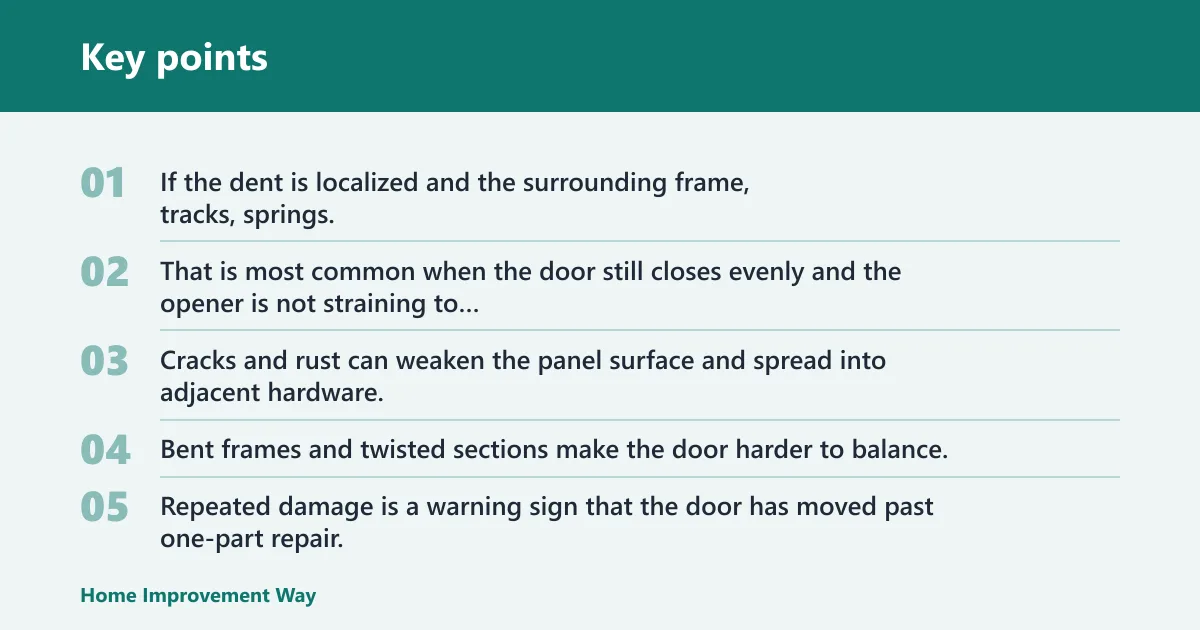
If the dent is localized and the surrounding frame, tracks, springs, and cables are still sound, a panel repair or panel replacement can be the right move. That is most common when the door still closes evenly and the opener is not straining to move it.
When structural damage pushes you toward replacement
Warping and sagging affect alignment. Cracks and rust can weaken the panel surface and spread into adjacent hardware. Bent frames and twisted sections make the door harder to balance, which can turn a small service call into a recurring safety problem.
How repeated damage changes the call
Repeated damage is a warning sign that the door has moved past one-part repair. If one panel fails, then another panel starts to bow, then the door begins to travel crooked, the cost of patching each failure can outgrow the value of a new door.
Is it cheaper to repair or replace a garage door?
Repair is usually cheaper upfront, especially for a single part. Small repairs are typically described as costing between $150 and $500, while a new garage door installation is said to range from $1,000 to $4,000 or more. The better question is whether the cheaper fix actually lasts long enough to make sense.
How the 50% rule works in practice
A common rule is that replacement is usually smarter when repair costs exceed 50% of a new door. That rule helps when you are comparing one large repair against a new installation, but it matters less for a low-cost part replacement like worn rollers or weatherstripping.
The same source gives the same 50% threshold, which turns a vague hunch into a clear line. If the estimate keeps creeping toward half the cost of a new door, replacement deserves a hard look.
Three- to five-year cost of ownership
Short-term cost is not the whole bill. A repaired older door may need follow-up work on springs, cables, hinges, tracks, or weatherstripping over the next few years, while a new door can come with warranty coverage and fewer maintenance needs. That is where the long-term math can flip.
Say a homeowner keeps repairing an aging door every year because the rollers, then the cable, then the track all need work. The total over three to five years can rival the cost of replacement, even though each individual repair looked affordable at first.
Choose Garage door repair if… / Choose replacement if…
Choose Garage door repair if the door is structurally sound, the failure is isolated, and the age is still within a reasonable repair window. Choose replacement if the door is older, failing in multiple places, unsafe to operate, or no longer worth keeping for efficiency or appearance reasons.
Choose Garage door repair if…
- The problem is limited to springs, cables, rollers, hinges, tracks, weatherstripping, or an opener part.
- The door is under about 10 to 12 years old, or older but still straight and stable.
- You have one dented panel and the rest of the door is aligned and sound.
- The repair estimate is well below 50% of the cost of a new door.
Choose replacement if…
- The door has warped, cracked, rusted, bent, or sagging sections.
- You are dealing with repeated breakdowns, especially on a door over 15 to 20 years old.
- The door has safety concerns such as crooked travel, repeated reversing, or unreliable sensor behavior.
- You want better insulation for an attached garage, quieter operation, or a stronger curb appeal return.

Frequently asked questions
Should I repair or replace my garage door?
Repair it when the damage is minor and the door structure is still sound. Replace it when the door has major panel damage, frame problems, repeated failures, or repair costs that get close to half the cost of a new door. A full inspection helps separate a one-part fix from a system-wide problem.
When is garage door repair not worth it?
Repair is usually not worth it when the door is old, has repeated breakdowns, or needs major structural work. If the panels are warped, the frame is bent, or the estimate is near 50% of a new door, replacement is often the lower-risk choice over the next few years.
What garage door problems usually require replacement?
Warped panels, cracked panels, bent frames, rust that has weakened the structure, and sagging that affects balance often point to replacement. A door that travels crooked, binds repeatedly, or keeps losing alignment after repairs also needs a closer look because the problem may be in the door itself, not just one part.
Will a new garage door improve energy efficiency?
Often, yes. Insulated doors can reduce heat loss and cooling loss, especially for attached garages. Sears notes that modern insulated doors may use polyurethane or polystyrene cores, which can improve thermal performance compared with older, thin builder-grade doors.
How often should a garage door need repairs before replacing it?
If the same door keeps needing service every year or two, replacement deserves serious consideration. Frequent work on rollers, springs, cables, tracks, or panels usually means the door is wearing out as a system, not just losing one part. That pattern is especially important on older doors over 20 years old.
Sponsored / affiliate links. As an Amazon Associate I earn from qualifying purchases. I may earn additional commission from eligible campaigns.