Does Heat Cable Stop Ice Dams?
Heat cable can reduce ice-dam damage, but it does not stop ice dams at the source; use it as a targeted backup after fixing insulation, air sealing, and ventilation. If you ignore ice dams or install cable poorly, water can push under shingles, stain ceilings, rot roof decks, and damage insulation. This guide explains what heat cable can do, what it cannot fix, when it makes sense, and how it compares with the roof and attic fixes that control heat loss. For product safety and installation basics, see the NRCA guidance on roofing systems, the U.S. Department of Energy’s air sealing guidance, and the DOE insulation overview.
Heat cable is a targeted drainage aid, not a cure


Heat cable can keep meltwater moving at the eaves, in gutters, and through downspouts, but it usually does not stop the melt-refreeze cycle that creates ice dams. Think of it as a drainage aid, not a cure for roof heat loss. The best use is targeted protection where water backs up. Manufacturers commonly rate residential roof and gutter de-icing cables in the 5 to 12 watts-per-foot range; the exact output and spacing should follow the installation instructions and the cable’s listing, not guesswork. The International Residential Code and roofing guidance both emphasize following the listed system and the roofing manufacturer’s details when penetrations and attachments are involved.
What heat cable can do at the roof edge
A roof de-icing system is meant to create channels for water. It can lower the chance that meltwater refreezes at the cold edge and creeps under shingles. That matters most where snow melts above a warm roof deck, then refreezes at the overhang or in a cold gutter.
What it cannot fix in the attic
Heat cable does not lower attic temperature, seal air leaks, or improve insulation. If warm indoor air is leaking into the attic, or if insulation is thin, the roof deck can stay warm enough to keep melting snow above the eaves. The dam can still form beyond the cable’s reach.
Why drainage matters more than melting everything
Full-roof snow melt is not the goal. In most homes, that wastes power and can create runoff where you do not want it. The practical goal is narrower: keep a path open so meltwater can exit instead of refreezing at the roof edge, in the gutter, or in a downspout.
Say your 20-foot roof edge over a front porch keeps icing up after every 4-inch snowfall, but the rest of the roof sheds snow normally. Heat cable can be a reasonable targeted fix there, because it protects one freeze-prone path instead of trying to warm the whole roof.
How ice dams form at the eaves
Ice dams can form when snow melts on a warmer roof, runs down to the colder eaves, and refreezes. That ridge of ice blocks drainage. Water then backs up under shingles, where it can wet the underlayment, stain ceilings, and damage sheathing and insulation.
Snow melt, refreeze, and water backup under shingles
The cycle usually starts higher on the roof, where heat escaping from the house warms the deck enough to melt snow. At the eaves, temperatures drop. Meltwater freezes there first, often in a gutter or on the lower shingle courses, and starts forming a dam.
Why attic heat loss matters
Attic insulation reduces heat escaping into the roof deck. Air sealing cuts the leaks that move warm indoor air into the attic. Together, those two steps lower the chance that the roof surface melts snow unevenly. Without them, heat cable may simply manage the symptom while the cause remains.
How roof shape and snow load change the risk
Long roof runs, low slopes, north-facing areas, and valleys all raise the odds of trouble. Heavy snowfall adds load and keeps the roof covered longer, which lets the melt-refreeze cycle repeat. Homes with deep overhangs, complicated rooflines, or a history of gutter ice are also harder to protect with cable alone.
Heat cable types and controls
Heat cable commonly comes in two main types: self-regulating and constant-wattage. Both can work for roof-edge and gutter de-icing, but they behave differently. The right choice depends on the problem area, the climate, and how much control you want over runtime and operating cost. For installation and performance comparisons, the manufacturer installation literature for listed de-icing systems and the NRCA technical resources are good reference points.
Self-regulating vs constant-wattage cable
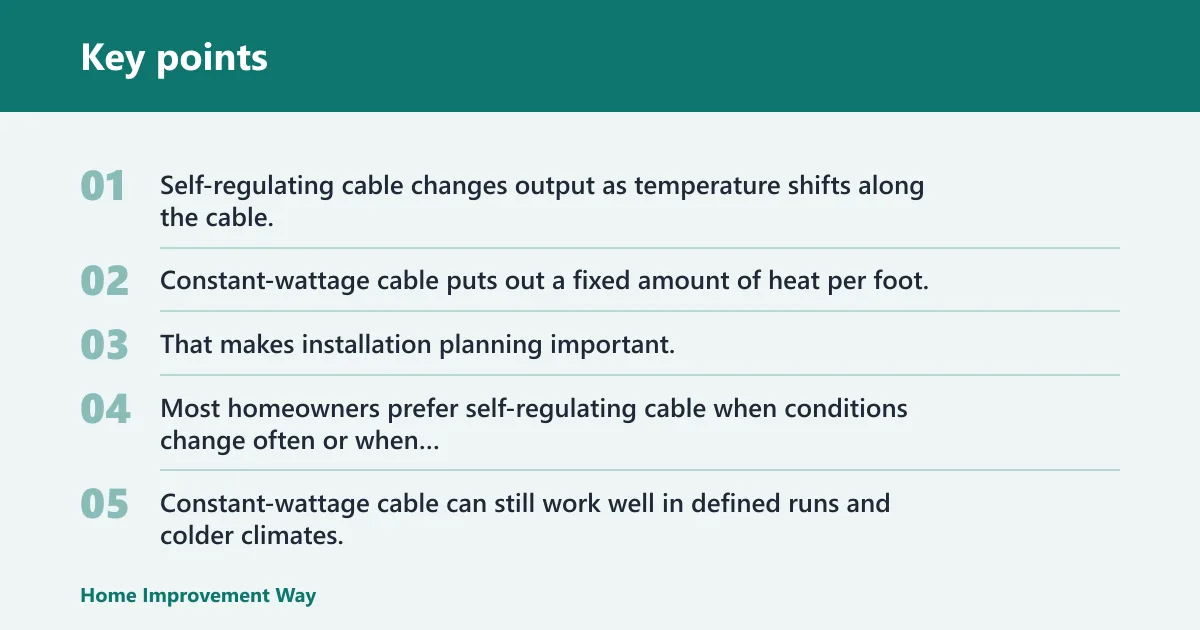
Self-regulating cable changes output as temperature shifts along the cable, so it can use less power in warmer sections and more in colder ones. Constant-wattage cable puts out a fixed amount of heat per foot. That makes installation planning important, because spacing and routing control how much heat reaches the roof edge.
Most homeowners prefer self-regulating cable when conditions change often or when partial snow cover is common. Constant-wattage cable can still work well in defined runs and colder climates, but it depends more on proper layout and control. Neither type should be treated as a set-it-and-forget-it cure.
Thermostat and moisture-sensor control
A thermostat or snow-and-ice sensor reduces wasted runtime by turning the system on only when temperatures and moisture conditions support icing. Some controls respond to temperature alone; others look for both cold conditions and moisture. That matters because a cable that runs all winter can cost much more than one that runs only during freeze-thaw periods.
UL listing, power draw, and operating cost
Look for UL listing for roof and gutter de-icing. That helps confirm the product is intended for this use. Power draw varies by cable type, but many residential products fall in the rough range of 5 to 12 watts per foot. Longer runs and frequent cold rain or wet snow mean higher operating cost.
For a simple example, a 100-foot run at 8 watts per foot uses about 800 watts when energized. If it runs 10 hours, that is 8 kilowatt-hours. Actual cost depends on local electricity rates and how often the control allows the cable to run. In practical terms, a short, sensor-controlled system in the Upper Midwest may cost roughly $25 to $90 per winter, while a longer Gulf Coast or Northeast installation that runs more often during freeze-thaw cycles can land closer to $80 to $250 per winter. Those are directional estimates, not universal quotes, because utility rates and runtime vary widely.
| Type | Typical watt behavior | Best use case | Tradeoff |
|---|---|---|---|
| Self-regulating cable | Output changes with temperature along the cable | Variable winter conditions, mixed roof shading, simpler energy management | Usually costs more upfront |
| Constant-wattage cable | Fixed wattage per foot | Predictable runs and colder climates with consistent ice-prone areas | Depends more on correct spacing and controls |
| Thermostat-only control | Runs by temperature setpoint | Cold but mostly dry winters | Can miss wet-snow events |
| Moisture-sensor control | Runs when cold and wet conditions align | Freeze-thaw areas and gutters that ice during precipitation | More sensor placement and wiring complexity |
Where heat cable works best
Heat cable works best where meltwater is most likely to refreeze and block drainage. That usually means roof edges, gutters, downspouts, and some valleys. The goal is to target freeze-prone paths, not cover the entire roof with cable.
Roof edges and drip lines
Start at the roof edge where the dam forms. Cable is often installed in a zigzag pattern above the eave so it can keep a channel open near the cold edge. That pattern is meant to support drainage, not warm the whole roof deck.
Gutters and downspouts
Gutters and downspouts are common freeze points. If the gutter is full of debris or slope is poor, meltwater can sit and refreeze even if the roof edge is warm enough. Routing cable through the gutter and down the downspout helps keep the water moving off the roof system.
Valleys and other freeze-prone paths
Valleys collect snow and runoff from multiple roof planes. They often stay wetter longer and can ice up before the rest of the roof. Cable can help there, but only where the valley repeatedly traps water. Running it everywhere wastes power and makes troubleshooting harder.
Heat cable installation priorities
Good installation matters as much as the product itself. Wrong routing, too little cable, loose clips, clogged gutters, or a dead control can leave the house with the same ice problem and extra electrical risk. Follow the manufacturer’s instructions and local electrical code. In one failure case a roofing inspector documented, a homeowner had installed a de-icing cable over a leaf-filled gutter but never cleared the downspouts; the roof edge thawed, yet the backed-up meltwater had nowhere to go, so the water simply overflowed at the fascia and stained the soffit. The lesson was simple: cable can open a path, but it cannot overcome a blocked drainage system.
Spacing and routing basics
Heat cable should follow the freeze-prone path, with spacing and spacing pattern set by the product instructions. The common mistake is to drape it randomly or leave gaps where water actually refreezes. Another mistake is to run it too far up the roof, where it uses power without helping drainage at the edge.
Common installation mistakes
- Installing cable where water never pools or freezes.
- Using too little length to cover the gutter or valley section.
- Leaving leaves and grit in gutters and downspouts.
- Mounting clips poorly so the cable sags or shifts.
- Ignoring damaged insulation on the cable jacket.
- Letting a failed thermostat or sensor keep the system off.
- Assuming the cable will work during a power outage.
Shingle and underlayment compatibility
Heat cable should not be installed in a way that damages shingles or underlayment. Some roofing manufacturers have specific guidance, and warranty coverage can depend on following it. Ice-and-water shield is a separate, complementary layer that can help limit leaks if ice forms, but it does not replace roof-edge drainage or attic fixes. For manufacturer-specific details, check the product instructions and the NRCA technical bulletins.
A common first-timer mistake is to add cable after a single bad winter and skip the gutter cleanup. If the downspouts are blocked, the cable may keep a short section open, but the meltwater still has nowhere to go once it reaches the plug below.
Heat cable decision checklist
Use this checklist to decide whether heat cable is a good fit, a temporary aid, or a sign that attic work should come first. It is most useful when the roof problem is localized and the drainage path is clear. It is least useful when the attic is warm and the roof is losing heat everywhere.
| Heat cable likely helps | Heat cable may help temporarily | Fix insulation/ventilation first |
|---|---|---|
| Ice forms only at one or two eaves or gutters. | Ice forms in several spots, but one area causes most leaks. | Ice appears across long roof runs or many sides of the house. |
| Gutters and downspouts are clean, sloped, and intact. | Gutters are functional but need frequent winter cleaning. | Gutters are clogged, sagging, or badly pitched. |
| Roof gets moderate snow, with repeat thaw-and-freeze cycles. | Roof sees heavy snow, but the problem is seasonal and localized. | Deep snow cover stays on the roof for long periods. |
| Power is available and a control can turn the cable on and off. | Power is available now, but outages or control failures are a concern. | No reliable power path or control location is practical. |
| Maintenance is manageable: inspections, clips, and debris removal. | You can maintain the system, but only during short weather windows. | You need a long-term fix because maintenance would be difficult or unsafe. |
Do you still need insulation and ventilation?
Yes. Heat cable is not a substitute for attic insulation, air sealing, or balanced ventilation. Those are the long-term measures that reduce roof heat loss and keep the roof deck colder. Cable can reduce damage, but it should sit on top of a sound roof-heat strategy. The DOE insulation guidance and air sealing guidance both point to these steps as core efficiency measures, not optional add-ons.
Attic insulation and air sealing as the long-term fix
Attic insulation slows heat flow into the roof deck. Air sealing stops warm, moist indoor air from leaking through bypasses such as recessed lights, top plates, plumbing penetrations, and attic hatches. Those two steps are the core of ice-dam prevention because they address the heat source.
Balanced attic ventilation and its limits
Balanced intake and exhaust ventilation helps keep the roof deck colder by moving outside air through the attic. That can reduce the chance of uneven snowmelt. Still, ventilation is not a stand-alone fix for every ice dam problem, especially when insulation gaps or major air leaks are the real cause.
Ice-and-water shield as a complementary layer
Ice-and-water shield adds a leak-resistant layer at vulnerable edges and valleys. It can buy time if water backs up. But it does not make ice dams harmless, and it does not remove the need for better attic insulation, ventilation, or a targeted de-icing system where drainage is a recurring problem.
When to call a roofer or electrician
Call a roofer if shingles are lifting, underlayment is damaged, or you already see staining, wet sheathing, or recurring leaks. Call an electrician if the circuit, control wiring, outlet placement, or grounding is uncertain. Roof de-icing systems depend on power and controls, so unsafe wiring can create more trouble than the ice.
If the roof is steep, brittle, or difficult to access, professional installation is often the safer choice. The same is true when the system needs to tie into a dedicated circuit or when local code requires specific wiring methods. A poor electrical install can be as costly as a poor roof repair.
Frequently asked questions
Do heat cables prevent ice dams?
Heat cables do not usually prevent ice dams at the source. They can reduce backup by keeping a drainage path open at the roof edge, in gutters, and in downspouts. The roof can still form ice if attic heat loss, poor ventilation, or heavy snow cover keeps the eaves colder than the upper roof.
Does heat tape work for ice dams?
Yes, heat tape can work as a targeted de-icing aid when the problem area is limited and the system is installed correctly. It is best viewed as damage control, not a full prevention method. If gutters are clogged or the attic is leaking heat, results are much less reliable.
What cable type is best for gutters?
Self-regulating cable is often the easier choice for gutters because it adjusts output along the run and can be more forgiving in mixed conditions. Constant-wattage cable can also work if the layout is simple and the product instructions call for it. Either way, the gutter still needs to be clean and pitched correctly.
When should I turn heat cable on and off?
Turn it on when freezing weather, snow, sleet, or refreezing conditions are forecast and the control system is designed to respond. Turn it off when the roof is no longer experiencing freeze-thaw or wet-snow conditions and temperatures stay above freezing. A sensor-based control can handle this automatically and usually costs less to run than manual all-season use.
Does heat tape prevent roof ice dams?
No. Heat tape can reduce icing at the edge, but it does not remove the heat loss that creates ice dams. If the attic is underinsulated or leaky, the roof will still melt snow unevenly and the ice-dam cycle can continue.
Where should heat cable be installed to stop ice dams?
Install heat cable where water is most likely to refreeze: roof edges, gutters, downspouts, and selected valleys. The cable should follow the freeze-prone path rather than cover the whole roof. Correct spacing matters, because too little coverage leaves cold gaps that still trap meltwater.
How much electricity does roof heat cable use?
Usage depends on cable type, length, control strategy, and weather. Many products draw roughly 5 to 12 watts per foot when energized. A thermostat or moisture sensor can reduce runtime, which lowers operating cost.
Can heat cable damage shingles or gutters?
It can, if installed badly. Cable that is clamped incorrectly, routed too tightly, or used on incompatible roofing materials can stress shingles and gutters. Follow manufacturer instructions, confirm roof compatibility, and use UL-listed roof and gutter de-icing products. Warranty terms may also matter.
Will heat cable fix the cause of ice dams?
No. Heat cable does not fix attic heat loss, missing air sealing, or weak ventilation. It manages runoff after snow has already started to melt. If the attic keeps warming the roof deck, the underlying cycle stays in place even if the cable reduces some of the visible damage.
Sponsored / affiliate links. As an Amazon Associate I earn from qualifying purchases. I may earn additional commission from eligible campaigns.