Belt Drive vs. Chain Drive Garage Door Openers
Choose a Belt drive if the garage shares a wall with living space or sits under a bedroom; choose a chain drive if budget matters most and noise is acceptable. Pick wrong and you may pay for extra vibration, noise, or an opener that strains an older door. This guide compares belt drive and chain drive garage door openers by noise, price, maintenance, garage layout, door condition, and opener specs.
| Decision factor | Belt drive | chain drive | Winner |
|---|---|---|---|
| Noise and vibration | Usually quieter and smoother, with less metal-on-metal sound | Noisier and more vibration-prone | Belt drive |
| Upfront cost | Higher upfront cost on average | Lower upfront cost on average | chain drive |
| Maintenance | Low maintenance, but belt tension still needs periodic inspection | More routine care, including chain tension and lubrication as the manual specifies | Belt drive |
| Best fit for living spaces | Best for garages below or next to bedrooms and main rooms | Better when noise is less important, such as detached garages | Belt drive |
| Heavy or tall doors | Can fit standard residential sectional doors when the model rating matches the door | Often a practical choice for heavier doors when model specs and balance also check out | chain drive |
Belt drive vs. chain drive: the real trade-off
The trade-off is plain: belt drive usually runs quieter, while chain drive usually costs less. That does not settle the choice by itself. Door balance, opener power, rail setup, and nearby noise sources often matter more than the drive type alone.
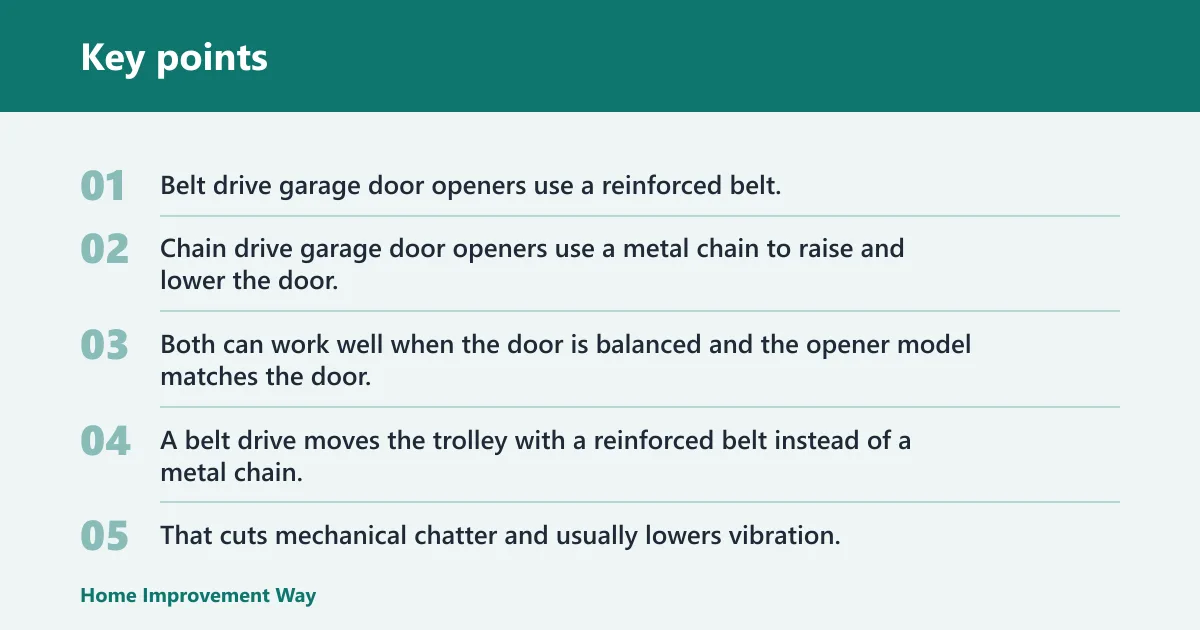
Belt drive garage door openers use a reinforced belt, often described as steel-reinforced rubber or polyurethane. Chain drive garage door openers use a metal chain to raise and lower the door. Both can work well when the door is balanced and the opener model matches the door.
How each drive type works
A belt drive moves the trolley with a reinforced belt instead of a metal chain. That cuts mechanical chatter and usually lowers vibration. A chain drive uses a chain running on the rail, which is a common design and easy to service.
The drive type changes how the opener sounds and feels. It does not replace the need for proper springs, a straight rail, and a model with enough motor output for the door.
What usually matters more than the drive itself
Garage door balance matters more than most buyers expect. A binding, dragging, or heavy-feeling door can mimic an opener problem even when the opener is fine. If the door is out of balance, no drive type can fully compensate.
Motor output matters too. Horsepower or motor capacity should match the door’s weight, height, and use pattern. Standard residential sectional doors are often easier to match than heavy wood, tall, or custom doors.
Side-by-side comparison
Noise, price, maintenance, and fit are the main comparison points. Travel speed is not a clean win for either drive type. Soft start/stop features and installation quality can change how smooth the opener feels more than the drive type itself.
Which opener fits your garage layout?
Start with layout, not marketing. If the garage sits below a bedroom or shares a wall with a family room, quiet may matter more than a lower purchase price. If the garage is detached or used as a workshop, noise may matter less than cost and serviceability.
Attached garage near living space
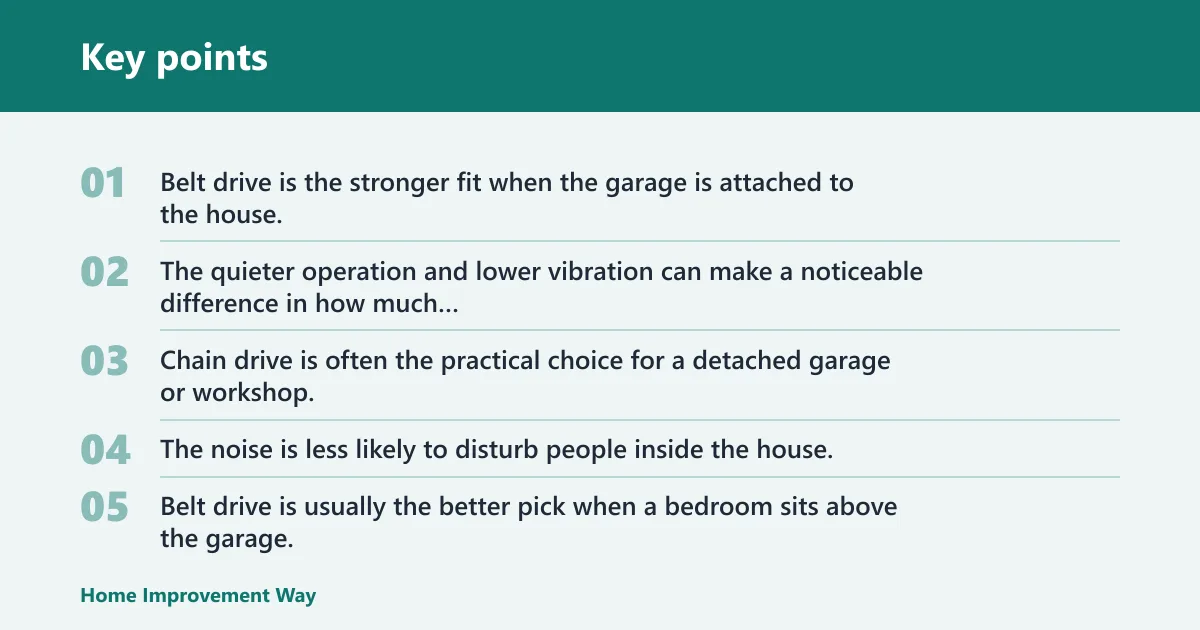
Belt drive is the stronger fit when the garage is attached to the house, especially near a bedroom or main living area. The quieter operation and lower vibration can make a noticeable difference in how much sound travels through walls and floors.
Detached garage or workshop
Chain drive is often the practical choice for a detached garage or workshop. The noise is less likely to disturb people inside the house, and the lower upfront cost can be easier to justify for a space used less often.
Bedroom above the garage
Belt drive is usually the better pick when a bedroom sits above the garage. Even small improvements in vibration and sound can matter here. If the opener is already noisy because of worn rollers or loose hardware, fixing those issues may matter more than switching drive types.
Rental or occasional-use garage
Chain drive often makes sense for a rental property or a garage that sees occasional use. Budget and common service parts usually matter more than ultra-quiet operation. Still, the opener should match the door and include the features the property needs, such as battery backup or smart controls.
Suppose a 16-foot sectional door on a detached garage rattles every time it moves. A chain drive may be perfectly reasonable there, but loose track bolts or worn rollers can still be the real noise source. A quieter opener will not fix bad hardware.
Noise, vibration, and what belt drive actually changes
Belt drive is usually quieter because the belt transmits less mechanical noise than a metal chain. That helps most when the garage is close to living space. Chain drive produces more vibration and sound, which is why it stands out more in attached garages.
But belt drive is not a cure for every noise complaint. Worn rollers, loose hinge bolts, track issues, and poor installation can all create noise that a new opener will not solve.
Why belt drive is usually quieter
The belt material dampens movement better than a chain. That usually means less clatter and less vibration transferred into the ceiling structure. Reinforced belt designs are common in modern openers for this reason.
Why chain drive sounds louder
Metal chain movement creates more audible contact and more vibration. That does not make it a bad design. It just means the sound is more noticeable, especially under a bedroom or beside a quiet room.
Other noise sources to check first
A noisy garage door is not always an opener problem. Check rollers, hinges, track alignment, and fasteners. If hardware is loose or worn, a quieter opener will only reduce part of the noise.
Will it lift your door reliably?
Reliability depends on the opener model, the door’s balance, and how the door is built. Drive type alone does not decide lifting performance. A properly balanced door lets the opener do less work, which matters more than whether the system uses a belt or chain.
Garage door balance and spring condition
The springs carry much of the door’s weight. If the door is out of balance, the opener can strain, stall, or act inconsistent. A binding door can look like a weak opener even when the motor is not the problem.
Door weight, height, and custom sizes
Standard residential sectional doors are the easiest fit for most openers. Heavy wood doors, tall doors, and custom sizes deserve closer attention to the model’s limits. In those cases, the installer should confirm that the opener and rail setup match the door.
Horsepower or motor output by model, not by drive type
Motor output matters more than belt versus chain alone. Two openers with different drive types can have very different performance if one has a stronger motor or better controls. If the door is oversized or used often, read the model limits first.
Picture a heavy wood door that sticks near the floor because the springs are tired. A chain drive may seem like the obvious answer, but the real fix is correct balance and a model rated for the door. A stronger drive type cannot replace that setup.
Belt vs chain decision matrix
Use this matrix as a quick filter, not a final verdict. The right pick depends on the garage, the door, and the opener model.
| Scenario | Belt drive | chain drive | Pick |
|---|---|---|---|
| Attached garage | Quieter, less vibration near living space | More noise carries into the house | Belt drive |
| Detached garage | Quietness still helps, but is less critical | Lower cost and common service fit well | chain drive |
| Bedroom above garage | Better match for sound control | More likely to disturb sleep areas | Belt drive |
| Heavy wood door | Can work if the model is rated for the door | Often the safer default when model specs and balance line up | chain drive |
| Budget replacement | Higher purchase cost on average | Lower purchase cost on average | chain drive |
| Low-maintenance preference | Less routine care overall | Needs chain tension and lubrication checks per manual | Belt drive |
| Cold-climate use | Can be a concern if the belt material is more temperature-sensitive in a given model | Metal chain is less affected by belt material behavior | chain drive |
| Smart-feature upgrade | Often available with DC motors, battery backup, and app controls | Also available with smart features on many models | tie |
Choose Belt drive if… / Choose chain drive if…
Choose Belt drive if quiet operation and lower vibration matter most, especially in an attached garage or under a bedroom. Choose it if you want less routine maintenance and your door is a standard residential sectional door with a balance that checks out.
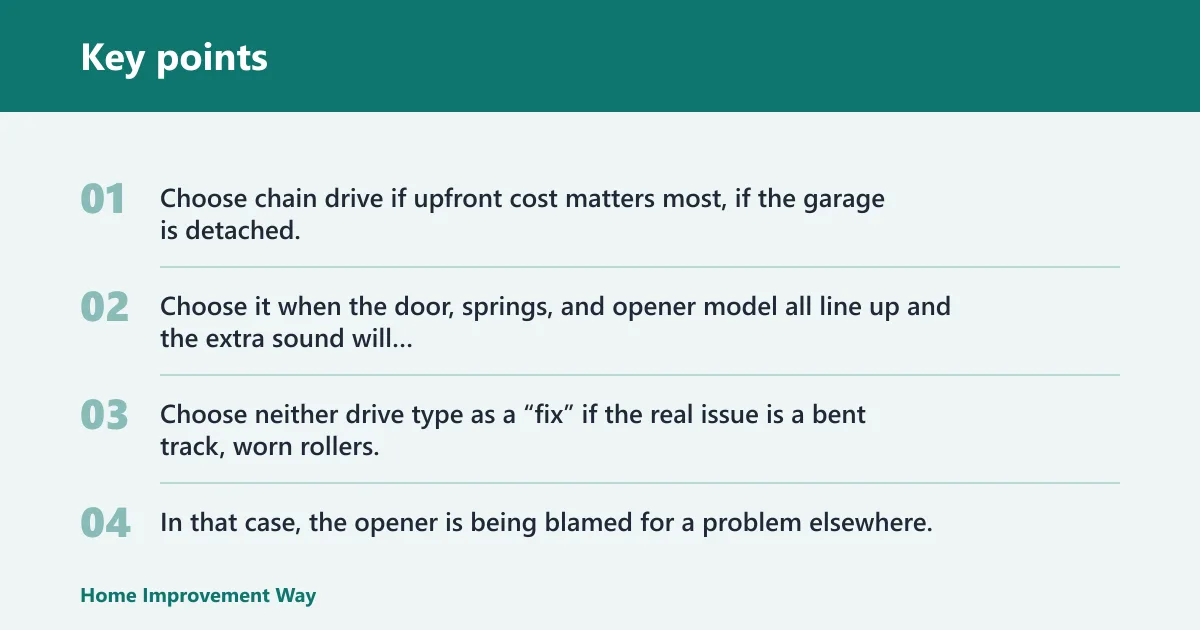
Choose chain drive if upfront cost matters most, if the garage is detached, or if you want a widely available option that is common for service work. Choose it when the door, springs, and opener model all line up and the extra sound will not bother anyone.
Choose neither drive type as a “fix” if the real issue is a bent track, worn rollers, loose hardware, or a badly balanced door. In that case, the opener is being blamed for a problem elsewhere.


What to check before you buy
A short checklist is more useful than a brand comparison. These items determine whether the opener will work well and stay quiet after installation.
- Door balance: Have the door checked for proper spring balance before choosing the opener.
- Door weight and height: Confirm the actual door size, especially for heavy, tall, or custom doors.
- Horsepower or motor output: Match the opener model to the door’s weight and use pattern.
- Rail length: Make sure the rail suits the door height and travel distance.
- Installed noise sources: Fix loose hardware, worn rollers, and track issues before blaming the drive type.
After installation or any adjustment, run the safety reversal test recommended in the manual. That step matters as much as any comparison between belt and chain. If the opener does not reverse correctly, stop and correct the setup before regular use.
Frequently asked questions
Belt drive vs chain drive garage door openers
Belt drive is usually quieter and lower maintenance, while chain drive is usually cheaper upfront and widely used. The better choice depends on garage layout, door balance, and the opener model, not on noise alone. Attached garages usually favor belt drive; detached garages often favor chain drive.
Are belt driven or chain driven garage door openers better?
Neither is better in every case. Belt drive is usually the better fit for noise control and low vibration, especially near living spaces. Chain drive is often the better fit for tighter budgets and garages where sound is less important.
Which lasts longer belt drive or chain drive garage door opener?
There is no universal lifespan rule that applies to every model. Installation quality, door balance, use level, and maintenance matter more than drive type alone. A well-matched opener that is adjusted correctly can outlast a poorly installed one of either type.
Should I get a belt drive or chain drive garage door opener?
Get belt drive if the garage is attached to the house, sits under a bedroom, or needs quieter operation. Get chain drive if you want the lower-cost option and the garage is detached or noise is not a concern. Check door balance first.
Is belt drive better than chain drive for garage door opener?
Belt drive is better when quietness, smoother operation, and lower maintenance matter most. Chain drive is better when budget and common serviceability matter more. The opener still has to match the door’s weight, height, and condition.
What’s the difference between belt drive and chain drive garage door openers
The difference is the lifting mechanism: belt drive uses a reinforced belt, while chain drive uses a metal chain. That changes sound, vibration, and often price. It does not override the need for a balanced door and the right motor output.
Screw drive vs belt drive vs chain drive garage door opener
Screw drive uses a threaded steel rod instead of a belt or chain, so the movement and service needs differ. For most homeowners choosing between belt and chain, the key question is still noise versus cost. Door balance and model limits remain the main sizing checks.
Sponsored / affiliate links. As an Amazon Associate I earn from qualifying purchases. I may earn additional commission from eligible campaigns.