Best Lubricants for Garage Doors (2026): We Compared
For most garage doors, use a garage-door-rated silicone spray on moving parts; reserve white lithium grease for metal hinges, bearings, and springs, and keep lubricant off the tracks. Using the wrong product can pull in grit, gum up rollers, and hide worn parts until a minor noise becomes a costly repair. This guide shows what to use and avoid on each part, plus the warning signs that point to damage instead of dry hardware.
What you’ll need
- Garage-door-rated silicone spray lubricant
- White lithium grease
- Clean rags or paper towels
- Soft brush or shop brush
- Vacuum or handheld blower for dust
- Gloves and eye protection
- Step stool, if needed for reach
What is the best lubricant for garage doors?
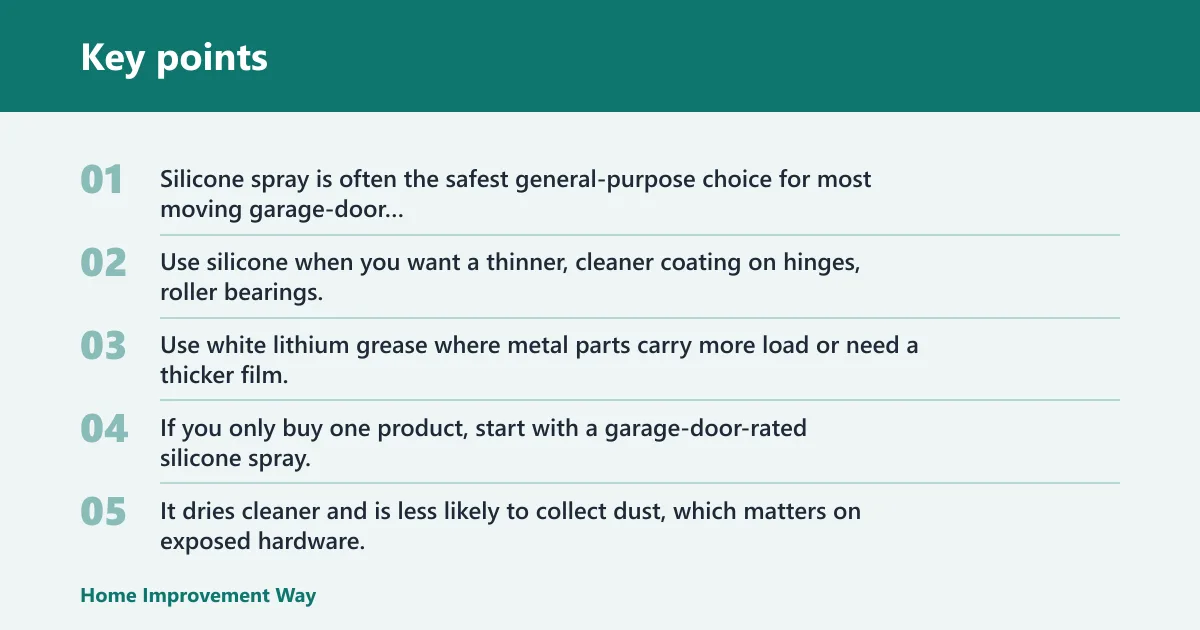

Silicone spray is often the safest general-purpose choice for most moving garage-door parts, while white lithium grease is often better for heavier metal-to-metal contact points. Use silicone when you want a thinner, cleaner coating on hinges, roller bearings, and tight spots. Use white lithium grease where metal parts carry more load or need a thicker film.
If you only buy one product, start with a garage-door-rated silicone spray. It dries cleaner and is less likely to collect dust, which matters on exposed hardware. White lithium grease often lasts longer on metal contact points, but it can be easier to overapply and harder to keep tidy.
Quick comparison
| Product type | Best use | What to avoid | Main drawback |
|---|---|---|---|
| Silicone spray | Hinges, nylon rollers, light friction points, tight spaces | Heavy buildup on open metal joints | Can be too light for some high-load metal parts |
| White lithium grease | Metal hinges, metal rollers, bearing plates, some springs | Tracks, plastic tread surfaces, sloppy overspray | Attracts dirt if applied too heavily |
| WD-40 | Rust loosening or cleaning in a pinch | Using it as the main lubricant | Not the right long-term film for most door hardware |
| Specialty products | Locks, opener shafts, and drive-specific parts | Substituting them everywhere | Some parts need manufacturer-specific guidance |
Most homeowners should buy silicone spray first, then keep white lithium grease for metal parts that need a heavier coat. If your opener manual specifies a different product, follow that instead of a general-purpose can.
How we chose
The best lubricant depends on part material, not just noise. Metal-to-metal points need different treatment than nylon rollers or track surfaces.
Cleaner application matters too. A dry finish means less dust buildup and fewer sticky residues near moving hardware.
Safety and manufacturer guidance come first. Some opener parts, locks, and screw-drive shafts use their own recommended product.
Just as important, lubrication is not always the fix. Bent tracks, worn rollers, damaged springs, and failing bearings need repair or replacement.
Silicone spray lubricant: best for quick maintenance

Silicone spray is a strong choice for hinges, nylon rollers, and tight contact points that need a thin, clean film. It dries cleaner than oily sprays and usually attracts less dust. That makes it a good fit for routine maintenance on parts you want to keep free-moving without leaving heavy residue.
Apply it sparingly. Aim at the moving joint or bearing area, not the whole door. Wipe off anything visible on the outside of the part so dirt does not stick to excess lubricant.
Where silicone spray fits best
- Hinge pivot points
- Nylon roller bearings, if the maker allows lubricant
- Latch mechanisms
- Tight friction points where a thin film is better than grease
White lithium grease: best for metal wear points

White lithium grease is better for heavier metal-to-metal contact, especially on metal hinges, metal rollers, bearing plates, and some spring contact points. It forms a thicker, longer-lasting film than spray-only options, which is useful where the parts carry load and the noise comes from metal rubbing metal.
Use it carefully. Too much grease on exposed hardware can collect grit, drip, or move where it does not belong. A thin coat is enough for most garage-door components.
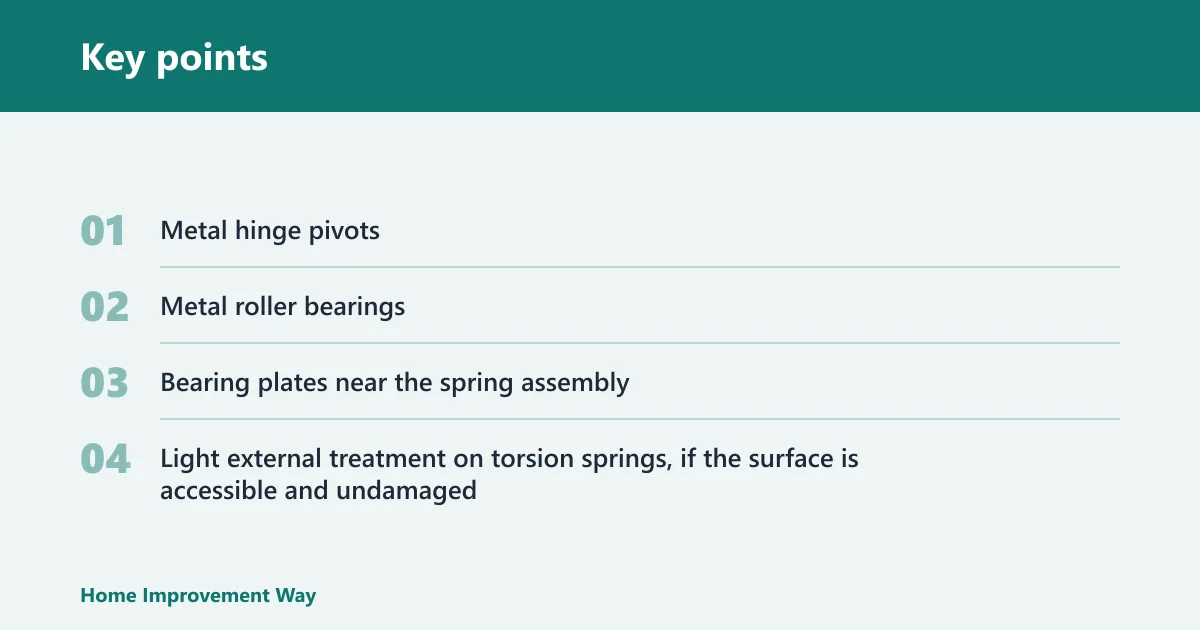
Where white lithium grease fits best

- Metal hinge pivots
- Metal roller bearings
- Bearing plates near the spring assembly
- Light external treatment on torsion springs, if the surface is accessible and undamaged
Should you use WD-40 on garage door parts?

WD-40 should not be the main garage-door lubricant. It can help loosen rust, displace moisture, or clean a stuck fastener, but it is not the best long-term lubricant for most door hardware. If you use it for cleanup, follow with the right lubricant on the correct part.
Use it as a helper, not as the finish coat. After cleaning a rusty hinge or freeing a sticky latch, switch to silicone spray or white lithium grease depending on the part. That keeps the hardware lubricated without leaving a thin, short-lived residue.
Garage door lubrication decision table
| Part | Recommended product | Avoid | Why | Red-flag symptoms | When lubrication is not enough |
|---|---|---|---|---|---|
| Hinges | Silicone spray for light maintenance; white lithium grease for metal pivots | Flooding the hinge or coating the outside of the hardware | Lubricate pivot points only, and wipe off excess | Grinding, bent leaf, loose hinge pin, visible cracking | If the hinge is bent, cracked, or loose after cleaning and lubrication, replace the hinge |
| Metal rollers | White lithium grease on the bearing area | Coating the roller tread or the track | Lubrication belongs on the bearing, not the rolling surface | Flat spots, wobble, rough rolling, repeated squeal | If the roller is worn, noisy after lubrication, or visibly damaged, replace the roller |
| Nylon rollers | Silicone spray only if the manufacturer allows it | Heavy grease on the tread or bearing housing | Nylon rollers may have different instructions, and many do not need a heavy film | Cracks, chipped wheels, side-to-side shake, rough rotation | If the roller is noisy because of wear, replacement is the fix |
| Springs | Light external white lithium grease or silicone spray on the coil surface | Trying to bend, adjust, or heavily coat a damaged spring | Spring surfaces can be lightly treated, but tension makes this a safety-sensitive area | Gap in the coil, rust flaking, bent shape, uneven tension, door that will not balance | If the spring is bent or damaged, stop and call for repair or replacement |
| Bearing plates | White lithium grease | Dry-run operation, overfilling the housing | These are friction points near the spring assembly | Whining near the center of the door, rough rotation, heat or visible wear | If the noise remains after lubrication, the bearing may need replacement |
| Locks | Graphite powder for the lock cylinder | Grease or oily spray in the keyway | Locks work better with a dry lubricant that will not gum up the cylinder | Sticky key, hard turn, debris in the cylinder | If the lock still binds after cleaning and graphite, the lock cylinder may be failing |
| Tracks | Clean only; inspect after wiping down | Lubricant on the track channel | Tracks should be cleaned but usually not lubricated | Rust, dents, misalignment, debris, roller chatter | If the track is bent, misaligned, or heavily rusted, repair is needed instead of more lubricant |
| Opener rail or chain | Follow the opener manual; some chain-drive units accept a light film, and screw-drive shafts may call for a specific grease | Guessing on belt-drive parts or over-greasing the rail | Not all opener components use the same lubricant | Jerking, chain slap, dry squeal, manual mentions specific product | If the opener is noisy after the correct lubricant, inspect the trolley, sprocket, or drive parts |
Where should you spray lubricant on a garage door?
Spray only the moving contact points: hinge pivots, roller bearings, spring coils if accessible, and any opener parts the manual says to lubricate. Do not spray the track channel, the roller tread, or the outside of hardware just because it is visible. That creates buildup without solving the noise.
Say your door makes a sharp squeak near the top section every time it opens. Focus on the hinge pivot and the roller bearing there, not the track. If the squeak stays in one spot after cleaning and lubrication, the hinge or roller may be wearing out.
Basic application order
- Close the door fully and disconnect the opener if the manual allows it.
- Brush or wipe away dust, cobwebs, and old residue.
- Apply lubricant to the exact moving joint.
- Wipe off visible excess immediately.
- Operate the door two or three times to spread the film.
Do garage door tracks need to be lubricated?
No. In most guides, garage-door tracks should be cleaned, not lubricated. Lubricant on the track attracts dirt and can create a sticky film that makes the door run worse, not better. A clean track with proper roller contact is the goal.
If the track is noisy, look for dirt, bent metal, rust, or misalignment instead of reaching for a can. A roller that chatters along a dirty or bent track can sound like a lubrication problem, but the real issue may be the track shape or the roller itself.
When a noisy track is really a repair issue
- The track is visibly bent or bowed
- The rollers jump or scrape at one spot
- The door binds in the same place every cycle
- Rust pitting or loose mounting brackets are visible
Can I lubricate garage door springs myself?
You can lightly lubricate the outside of an intact torsion spring, but you should treat the area with caution. Springs hold high tension, and a bent or damaged spring needs replacement, not more lubricant. If the spring is visibly out of shape, stop there.
Do not try to bend, adjust, or compensate for spring problems with lubricant. If the door feels unbalanced, rises unevenly, or the coil has a gap or twist, lubrication will not fix it. That is a repair job.
How often should I lubricate my garage door?
A common schedule is about once every 6 months, or roughly twice a year, for a typical home door. That timing fits general maintenance well and helps keep the door moving smoothly before dry hardware starts to squeal or wear. Busy doors or harsh weather can justify more frequent checks.
Suppose a coastal garage starts making a dry chirp after a damp winter month. Clean the hardware first, then lubricate the correct points. If the same noise returns quickly, check for rust, worn rollers, or loose hardware rather than adding more product.
Maintenance checklist
- Inspect hinges, rollers, springs, and bearing plates.
- Clean dust and residue from moving parts.
- Apply the right lubricant to the right part.
- Wipe away excess so dirt does not stick.
- Test the door open and closed a few times.
What garage door parts should not be lubricated?
Do not lubricate the tracks, the roller tread, or any part that the manufacturer says should stay dry. Avoid spraying grease into a lock cylinder, and avoid guessing on opener parts that have specific instructions. The wrong product can create drag, collect dust, or interfere with movement.
Common mistakes include overspraying the track, using WD-40 as the final lubricant, and treating every roller the same. Nylon rollers may need different treatment than metal rollers, and some locks work best with graphite powder instead of wet lubricant.
Common mistakes
- Spraying the track instead of cleaning it
- Using too much lubricant and leaving wet residue behind
- Applying the same product to nylon and metal rollers without checking the material
- Using WD-40 as the main lubricant instead of a true garage-door lubricant
- Ignoring a bent spring, loose hinge, or worn roller that needs replacement
Which one should you buy?
If you want one product for general maintenance, buy a garage-door-rated silicone spray. It is the safest default for hinges, rollers, and tight friction points, and it dries cleaner than oily sprays. If your door has mostly metal hardware and heavier wear points, white lithium grease is the better second choice.
If the door stays noisy after cleaning and lubricating the correct parts, stop adding product. Persistent squeal, rough rolling, or one-point grinding often means a worn roller, bent track, or failing bearing. At that point, repair is the next step, not more spray.
Sponsored / affiliate links. As an Amazon Associate I earn from qualifying purchases. I may earn additional commission from eligible campaigns.