How to Fix a Garage Door That Won’t Open
If a garage door won’t open, start with the outlet, breaker, wall control, lock, and photo eyes. If the opener hums and the door stays still, or the door feels too heavy to lift by hand, stop and call a pro. Forcing the door can strip gears, bend parts, or make a broken spring more dangerous. This guide walks you through a symptom-first decision tree for power, sensors, opener, balance, and hardware issues.
Quick garage door decision tree
Use this fast split to decide whether the problem is power, sensors, opener controls, balance, or hardware damage. Make one safe check, then stop if you see a warning sign. Garage-door openers commonly use photo eyes mounted close to the floor, and many manufacturers place them about 4 to 6 inches above the floor; always confirm the setup in your model’s manual. Manufacturer support and setup guidance can help verify the exact sensor placement and light behavior for your opener.
- Power issue: Check the outlet and breaker once. Stop now if the opener has no lights, no sound, and no response after you verify power.
- Safety-sensor issue: Clean both lenses and look for steady indicator lights. Stop now if the door reverses, the opener light flashes, or the beam still looks blocked after cleaning.
- Opener/control issue: Test the wall button before the remote. Stop now if the opener hums, chatters, or runs without moving the door.
- Balance issue: Pull the manual release and lift the door by hand. Stop now if the door feels heavy, drops, or won’t stay open.
- Hardware damage: Look for visible cable, track, or roller problems from a safe distance. Stop now if you see a snapped cable, a broken spring, or an off-track door.
What you’ll need
- Flashlight
- Step ladder
- Clean cloth
- Replacement remote batteries
- Owner’s manual or opener model label
Why won’t my garage door open?
Start with the opener’s power and controls, then separate opener trouble from door trouble with the manual release cord. A door that responds to the wall button but not the remote points to the remote or receiver. A door that will not lift by hand points to a balance, spring, cable, track, or lock problem.
Troubleshoot in order
- Check the opener outlet, breaker, and wall button.
- Compare the wall control to the remote.
- Check the interior lock or vacation lock.
- Inspect and clean the photo eye sensors.
- Pull the manual release cord and test the door by hand.
- Watch for track, roller, spring, or cable warnings.
Power and control checks
Make sure the opener is plugged into a working outlet, then reset any tripped breaker and try the wall button before the remote. A dead remote battery can make the whole system seem dead. If the wall button works and the remote does not, reprogramming or battery replacement is the next safe step. Many opener brands also describe this same sequence in their support materials before moving to receiver or logic-board troubleshooting.
Lock and release checks
Some garage doors have manual locks that keep the door shut when they are engaged. Also check whether the trolley was disconnected by the manual release cord. If the opener runs but the door still will not move, the issue may be in the door, not the opener.
Sensor and signal checks
Photo eye safety sensors sit 4 to 8 inches above the floor. Look for steady indicator lights, then wipe the lenses and clear anything blocking the beam. On many openers, misaligned sensors make the opener light flash and can stop the door from closing or from operating correctly. Most manufacturer manuals and safety guidance describe a steady light as the normal state and a blinking or unlit sensor as a misalignment or wiring warning.
Garage door troubleshooting matrix
Use this table to match the symptom to the safest next check. If the safe check points to springs, cables, or an off-track door, stop there. Those are not homeowner repairs. The table also helps you separate opener faults from door faults before you touch anything risky.
| Symptom | Likely cause | Safe homeowner check | Stop-now warning | Pro-level repair |
|---|---|---|---|---|
| No response at all | No power to the opener | Check outlet, breaker, and opener light | No lights, no sound, no movement | Electrical diagnosis or opener replacement |
| Remote fails, wall button works | Dead remote battery or lost pairing | Replace batteries or reprogram remote | Wall control still operates normally | Receiver or remote replacement |
| Opener light flashes | Safety sensors misaligned or blocked | Clean lenses and realign the sensors | Beam still interrupted after cleaning | Sensor replacement or wiring repair |
| Door opens a few inches then stops | Track problem or travel setting issue | Check for visible track obstruction | Door binds, grinds, or tilts | Track realignment or hardware repair |
| Opener hums but will not lift | Broken spring, jammed door, or opener gear failure | Pull manual release and test door by hand | Door feels heavy or will not lift smoothly | Spring or opener repair |
| Door feels heavy on manual lift | Spring failure or balance problem | Stop and avoid forcing the door | Door drops, sticks, or needs two hands to move | Spring and balance service |
| Door jerks or scrapes halfway | Roller binding or bent track | Look for bent rails and damaged rollers | Off-track movement or loud metal scraping | Track and roller repair |
| Door will not open manually | Locked door, failed spring, cable issue, or severe binding | Check interior lock and release cord | Snapped or frayed cable, or heavy door | Lock, spring, cable, or track service |
| Visible cable damage | Frayed or snapped garage door cable | Do not operate the door | Any broken strand or loose cable | Cable replacement |
| Door sits crooked or out of track | Off-track condition or bent rail | Stop operating the opener | Roller has left the track | Track reset and alignment |
Use opener checks only after you rule out a locked, heavy, or off-track door. If the opener responds differently to the wall button and remote, focus on controls. If it hums without lifting, the problem is usually not a simple setting issue. Force settings and travel limits are only a narrow diagnostic step.
If the opener still won’t respond, try these next checks
- Replace the remote battery and retry the wall button.
- Reset the breaker and confirm the opener has power.
- Reprogram the remote using the opener’s learn button.
- Check the force and travel settings only if the door moves partway and then stops.
- Restore the settings one notch at a time, then retest after each change.
Do not use force adjustment to push a stuck, heavy, or off-track door through a problem. A common first-timer mistake is turning the force control until the opener strains harder, which can damage the unit while leaving the door fault untouched. Opener troubleshooting guides from major manufacturers typically separate remote, wall control, and travel-limit checks from mechanical door faults for this reason.
What opener behavior means
A hum with no lift usually points to a mechanical load the opener cannot move. A stop after a few inches often points to track resistance, travel settings, or a door that is beginning to bind. If the wall button works but the remote does not, the opener is probably not the main issue.
Is it the opener or the door?
The manual release cord is often the quickest way to separate opener trouble from door trouble. If the trolley disconnects and the door still will not lift by hand, the opener is not the root cause. If the door lifts smoothly by hand, the opener, controls, or settings are more likely.
How to use the manual release cord
- Pull the manual release cord with the door closed.
- Lift the door by hand a few inches.
- Lower it and feel for smooth movement.
- Reconnect the trolley only after the door moves normally.
If a 7-foot door lifts easily by hand after the trolley disconnects, but the remote still does nothing, that can point to opener or control-path trouble. That points to the opener or its control path. If the same door feels heavy, hangs at mid-height, or will not stay up, the problem is in the door hardware, not the opener.
What a heavy door means
A garage door that feels heavy on manual lift often has a spring problem. Torsion or extension springs are high-tension parts, and they can make an electric garage door not open at all. Do not adjust, rewind, or replace springs yourself. If the door feels unusually heavy, the safest next step is a professional inspection for spring or broken spring repair service; pricing often varies by region, door type, and parts availability, but U.S. market estimates commonly land in the low hundreds rather than a simple DIY parts cost.
Common mistakes
The biggest mistake is forcing a door that already gives warning signs. Heavy lift, off-track movement, snapped cable marks, and loud grinding are stop signs. Another common error is assuming every no-open complaint is the opener, when a locked door or failed spring can produce the same symptom.
- Forcing a locked or heavy door: Check the manual lock and the manual release first.
- Adjusting springs or cables: Stop and call a pro.
- Ignoring off-track or frayed cable signs: Do not run the opener again.
- Skipping sensor alignment checks: Clean the lenses and confirm the indicator lights before deeper troubleshooting.
Say your opener light flashes and the door reverses before closing. Clean both sensor lenses, then confirm the photo eyes are still mounted 4 to 8 inches above the floor and pointed at each other. If the light still flashes after that, the issue is more than dirt.
When should I call a pro?
Call a garage door technician as soon as you see a snapped or frayed cable, a broken spring, an off-track door, or a humming opener that will not lift the door. Also stop if the door will not open manually after the release cord is pulled. These are not safe homeowner repairs.
Cost clues to expect
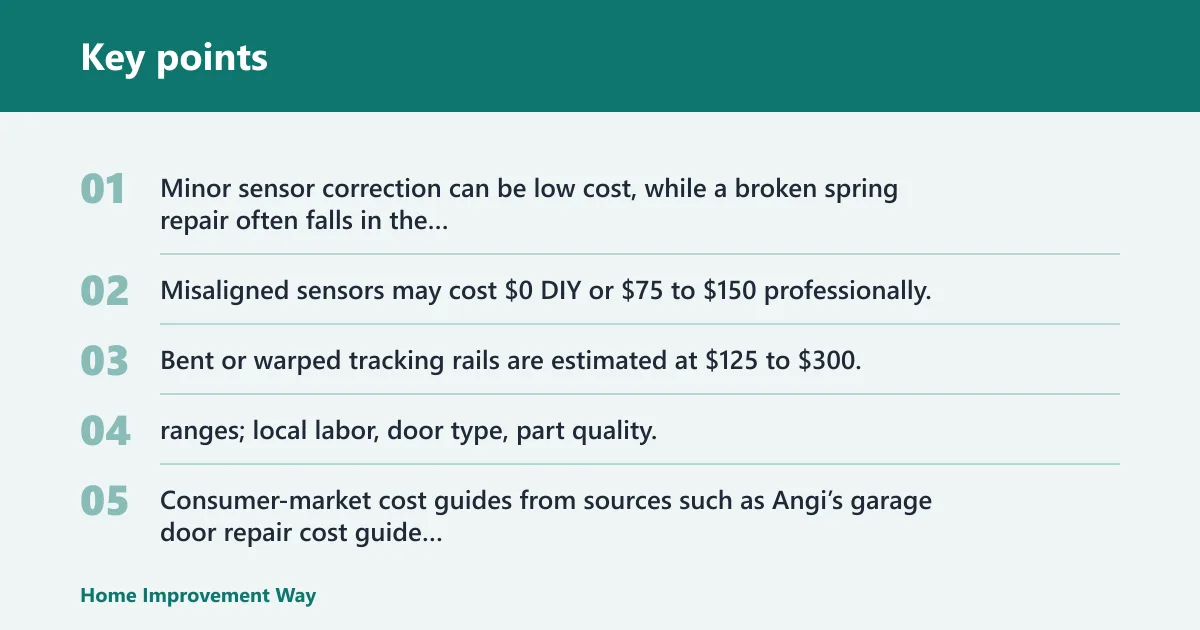
Minor sensor correction can be low cost, while a broken spring repair often falls in the $150 to $350 range. Misaligned sensors may cost $0 DIY or $75 to $150 professionally. Bent or warped tracking rails are estimated at $125 to $300, and dead remote or vacation lockout fixes can run $0 to $50. These estimates are typical U.S. ranges; local labor, door type, part quality, and emergency timing can push prices higher or lower. Consumer-market cost guides from sources such as Angi’s garage door repair cost guide and similar service estimates show broad regional variation.
Service call or diagnostic fees are often $50 to $95, with hourly labor rates listed at $75 to $150 per hour. After-hours emergency premiums can add $75 to $200. If the door has a broken cable, do not operate it while waiting for service. Those figures are estimates, not guarantees, and they tend to vary by metro area, distance, and whether the technician is handling a standard repair or a same-day emergency call.
Prevention: Keep the sensor area clear, replace remote batteries before they die completely, and check the door’s balance periodically by pulling the manual release and lifting by hand. If the door feels heavy, stop using the opener until it is inspected. A balanced door should move smoothly and stay near mid-position without falling back down; if it doesn’t, that’s a sign the spring system needs attention. Industry guidance and many manufacturer manuals treat this as a basic safety check, not a tune-up step.
Frequently asked questions
How do I fix a garage door that won’t open?
Check the outlet, breaker, lock, sensors, and remote batteries in that order. Then pull the manual release and test the door by hand. If the door is heavy, crooked, or stuck, stop. That points to springs, cables, or tracks, not a simple opener setting.
How do I troubleshoot a garage door opener?
Use the opener’s learn button to reprogram a dead remote, replace the remote battery, and reset the breaker if needed. If the opener hums but cannot lift the door, do not keep cycling it. That usually means the opener is not the only problem.
Why won’t my garage door open manually?
First check the interior lock and the manual release cord. If the door still will not move, the issue is likely a spring, cable, or track fault. Do not force it open. A door that will not move by hand can fail suddenly if pushed harder.
How do I troubleshoot a garage door that won’t open?
A common symptom-first order is to check power, controls, lock, sensors, manual release, then hardware. Do not start with force settings or travel adjustments. Those settings are only for a door that moves partway and then stops, not for a locked, heavy, or damaged door.
How do I fix a garage door that won’t close?
Start with the photo eye sensors. Clean the lenses, confirm the indicator lights, and clear anything in the beam. If the opener light flashes or the door reverses near the floor, the sensors are the first place to look. Do not bypass them.
Sponsored / affiliate links. As an Amazon Associate I earn from qualifying purchases. I may earn additional commission from eligible campaigns.