How to Remove Salt Stains From Concrete and Garage Floors
Start by sweeping or vacuuming the white residue, then wipe it with a damp cloth. If it dissolves, it may be salt. If it keeps reappearing from the slab, it is likely efflorescence. Using the wrong cleaner or scrubbing too hard can etch concrete, dull coatings, and let moisture damage spread. This guide shows how to identify the residue and remove it safely from bare, sealed, and coated garage floors.
This guide is part of our Ice Dams, Gutters and Snow: Protect Your Roof This Winter series.
What you’ll need

- Broom or shop vacuum with a hard-floor attachment
- Bucket of clean water
- Wet vacuum for extraction
- Microfiber mop or soft sponge mop
- Soft nylon pad or white scrub pad for delicate finishes
- Stiff nylon brush for bare concrete
- pH-neutral cleaner for general cleaning and organic grime
- Concrete-safe degreaser for oil and greasy spots
- Masonry or concrete rust remover for rust or fertilizer staining
- Gloves and eye protection
- Clean towels or fans for drying
Salt residue decision table
| Visual clues | Likely cause | Safest next step for bare concrete, sealed concrete, and painted or coated garage floors |
|---|---|---|
| White powder wipes away and returns after vehicles or boots track it in | Tracked-in road salt | Bare concrete: flush with clean water and extract with a wet vac. Sealed concrete: use the lightest rinse that removes residue, then dry fast. Painted or coated floors: spot-test, then wipe with a damp microfiber mop and stop if the finish dulls. |
| White powder comes back from the slab, especially after damp weather | Efflorescence caused by moisture moving salts upward | Bare concrete: clean the surface, then address moisture entry before resealing. Sealed concrete: do not trap moisture; let the slab dry and check for coating failure. Painted or coated floors: inspect for bubbling, peeling, or soft spots. |
| White haze sits with rust, orange marks, or fertilizer tracking | Mixed staining, not plain road salt | Bare concrete: choose the matching specialty cleaner after a spot test. Sealed concrete: use the gentlest cleaner first. Painted or coated floors: avoid harsh acids and test in an out-of-the-way area first. |
How do you remove tracked-in salt?
Begin with dry cleanup, then rinse the residue with clean water and pull the slurry out with a wet vac. On bare concrete and unfinished garage slabs, that rinse-and-extract cycle is the first-line method for dissolved road salt. If residue remains, repeat the rinse-and-extract cycle before reaching for stronger chemicals.
- Vacuum or sweep up loose grit, sand, and salt crystals before any water touches the floor.
- Wet a small area with clean water and let the salt dissolve for a minute or two.
- Agitate lightly with a microfiber mop or soft brush, then extract the water with a wet vac.
- Repeat the rinse-and-extract cycle on stubborn patches.
- Dry the floor with towels or airflow before you judge whether more cleaning is needed.
Picture a two-car garage with white arcs near the entry and tire paths. If the marks fade after one rinse but return after the next thaw, that points to tracked-in salt plus ongoing wet traffic, not a single stain event.
If that did not work, check for a second problem. Oil, rust, or efflorescence can sit under the salt film and keep the floor looking cloudy even after repeated rinsing.
How do you clean sealed or coated floors?
Use the mildest cleaner that will handle the residue, because sealed, painted, polished, and coated floors can dull or soften if water, scrubbing, or chemistry is overdone. Spot-test a hidden corner first. If the finish changes color, turns sticky, or loses sheen, stop and switch methods.
- Vacuum or dust-mop the surface before any liquid goes down.
- Mix a pH-neutral cleaner at the label rate for the first pass.
- Test it in a hidden corner and wait for the finish to dry.
- Wipe the floor with a lightly damp mop, not a soaking one.
- Rinse with a clean damp mop, then dry the floor quickly.
Suppose a painted garage floor has white residue near the door but still looks glossy elsewhere. A gentle mop pass is safer than a stiff brush, because the problem may be on the coating rather than inside the concrete.
If that did not work, stop before you move to stronger chemistry. On coated floors, the next step is often checking whether the finish has failed at the edges or joints, not scrubbing harder.
When do other stains need a different cleaner?
Salt is only one type of white or pale residue. If the floor also has oil, rust, fertilizer marks, or organic grime, match the cleaner to the stain. A pH-neutral cleaner is the safer starting point for many organic stains. Older oil stains need a concrete-safe degreaser, and rust or fertilizer staining needs a masonry or concrete rust remover.
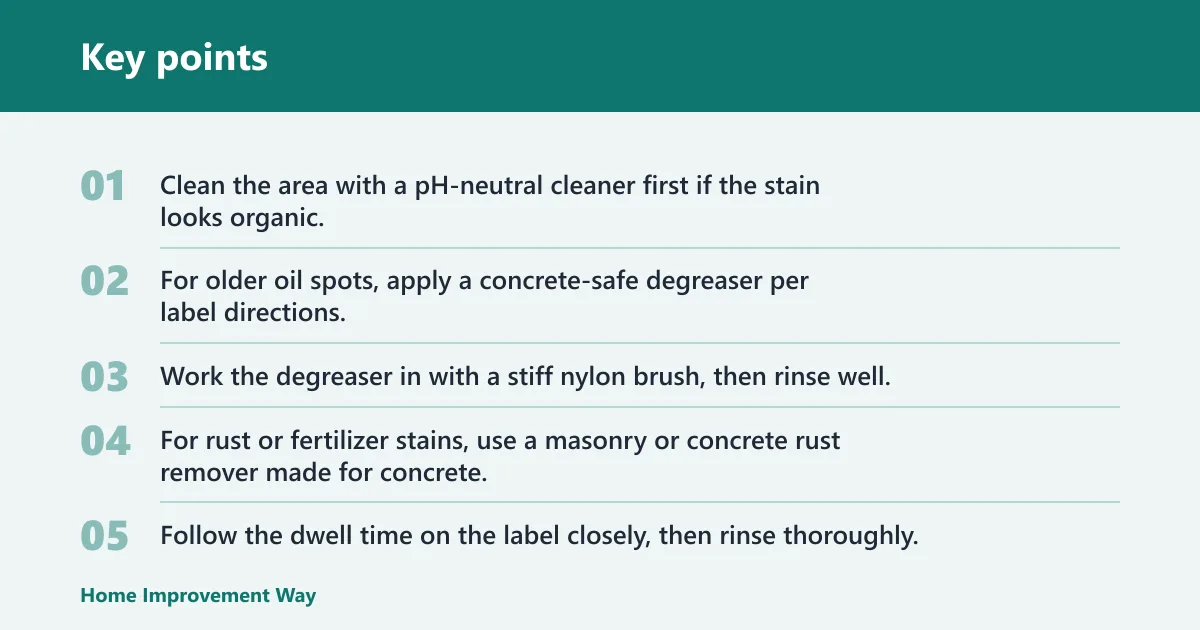
- Clean the area with a pH-neutral cleaner first if the stain looks organic.
- For older oil spots, apply a concrete-safe degreaser per label directions.
- Work the degreaser in with a stiff nylon brush, then rinse well.
- For rust or fertilizer stains, use a masonry or concrete rust remover made for concrete.
- Follow the dwell time on the label closely, then rinse thoroughly.
A common first-timer mistake is scrubbing every white crusty patch on the garage slab with the same cleaner, even though some are fresh salt residue and others are set-in grime. A greasy patch near the car’s front wheel and a white crust near the overhead door need different cleaners, even though both can look pale from a distance.
Common mistakes
- Scrubbing before removing loose salt: that drives grit into pores and joints. Sweep or vacuum first.
- Using vinegar by default: vinegar can etch some concrete and damage sealers or coatings, so it should not be the first choice for every white mark.
- Leaving rinse water behind: water left in pores can carry dissolved salts back to the surface as it dries.
- Using muriatic acid on concrete: it is specifically flagged as a problematic cleaner for concrete.
- Sealing too soon: let the slab dry fully before any sealer or coating decision.
If white residue keeps returning after cleaning, treat that as a moisture problem until proven otherwise. Efflorescence can reappear when water keeps moving salts to the surface, so cleaning alone may not solve it.
After the slab is fully dry, a penetrating sealer can help reduce future absorption. Do not seal damp concrete, because trapped moisture can create more staining and coating failure.
Frequently asked questions
How do I remove salt stains from a concrete garage floor?
Sweep first, then rehydrate the residue with clean water and extract it with a wet vac. Repeat the rinse-and-extract cycle until the white film stops reappearing. If the floor is sealed or coated, use the lightest possible cleaning pass and dry it quickly.
How do I clean salt from a garage floor without damaging it?
Use clean water, a soft mop, and wet-vac extraction before any stronger cleaner. Avoid abrasive pads on painted, polished, or coated concrete. Spot-test the cleaner in a hidden area, and stop if the finish dulls, softens, or changes color.
What removes white salt stains from concrete?
For true road salt, clean water is the first-line remover because it rehydrates the crystals so they can be lifted off the surface. If the white film returns from below, the issue is likely efflorescence and you need to address moisture movement, not just the surface.
How do I get stains off a concrete garage floor?
Match the cleaner to the stain. Use a pH-neutral cleaner for organic grime, a concrete-safe degreaser for older oil, and a masonry or concrete rust remover for rust or fertilizer marks. Rinse well after each product and let the floor dry before deciding on a repeat pass.
Why does salt leave a white haze on concrete?
Concrete and garage floors are porous, so liquids can move below the surface. White residue is commonly efflorescence, which forms when moisture carries salts upward and leaves them behind as the water dries. If the moisture source remains, the haze can return.
Should I use vinegar to clean salt off concrete?
Not as the default choice. Vinegar can etch some concrete and may damage sealers or coatings. Start with clean water for salt, then move to a product made for the specific stain type if the residue does not release or if the floor finish needs extra care.
Sponsored / affiliate links. As an Amazon Associate I earn from qualifying purchases. I may earn additional commission from eligible campaigns.