How to Insulate a Sliding Glass Door for Winter
To insulate a sliding glass door for winter, first locate the leak path: weatherstripping fixes perimeter leaks, caulk or backer rod seals frame gaps, and interior window film or a thermal shade helps when the glass itself is the cold spot. Skip the wrong fix and the room stays drafty, heating bills rise, and moisture can collect around the track or frame. This guide shows how to find the leak path, then pick the right repair for the glass, the perimeter seal, or the frame.
This guide is part of our Winter Weatherproofing: How to Draft-Proof Your Home series.
How sliding glass doors lose heat



A sliding glass door can leak heat through the glass, the perimeter seal, the bottom edge, and the frame-to-siding seam. Start by finding the coldest spot before adding products. A hand check can help show whether the door is the main source of the draft or whether another nearby surface may be affecting the temperature.
If the door is older, warped, or hard to latch, the problem may be larger than insulation. Complete Window Care notes that older sliding glass doors often lack modern efficiency features, and drafts are a sign a sliding glass door may need replacement.
What you’ll need
- Self-adhesive foam weatherstripping
- Clear shrink-film insulation kit
- Door sweep
- Exterior-grade caulk
- Rigid foam board insulation
- Degreaser or rubbing alcohol
- Utility knife or scissors
- Measuring tape
- Hair dryer
Sliding glass door decision table
| Symptom | Likely leak path | Best DIY remedy | Tools needed | Permanence | When to stop DIY and call a pro |
|---|---|---|---|---|---|
| Draft at the latch side or around the perimeter | Perimeter seal | Self-adhesive foam weatherstripping | Degreaser, scissors, tape measure | Seasonal to medium-term | Gap changes along the frame or the door will not close evenly |
| Cold glass feels like the main problem | Glass surface heat loss | Clear shrink-film insulation kit | Hair dryer, scissors | Temporary seasonal | Condensation is trapped between panes or the glass is damaged |
| Cold air at the floor | Bottom edge | Door sweep | Screwdriver, utility knife | Seasonal to long-term | The sweep drags, binds, or prevents clean closing |
| Draft where the frame meets siding | Frame-to-siding gap | Exterior-grade caulk | Caulk gun, cleaner, rag | Medium-term | The frame is loose, rotted, or visibly out of square |
| Door is rarely opened | Unused opening | Foam batting insulation | Utility knife, measuring tape | Temporary while unused | You need daily access through the panel |
| Persistent leaks after surface sealing | Warped frame or deeper repair issue | Pro adjustment or replacement | Thermal camera, level | Not a DIY seal issue | Frame is warped, track is damaged, or latch will not align |
How do you insulate a sliding glass door for winter?

Start with the leak path that matches the symptom. If the frame gap is the problem, seal the perimeter first. If the glass feels like the cold surface, add film to a fixed panel or an unused seasonal opening. If air comes in at the bottom edge, look for the door’s bottom weatherseal or fin seal before considering anything else. That order keeps you from covering the wrong spot and still feeling a draft.
- Use a hand check to find the coldest edge, then mark the frame, glass, and bottom seal.
- Clean and degrease the frame before any adhesive product so tape can bond properly. (Familyhandyman)
- Apply self-adhesive foam weatherstripping to consistent perimeter gaps on newer doors. A 30-foot roll can cover a standard 36-inch by 80-inch door.
- Add clear shrink-film insulation to a fixed panel if the pane is the main heat-loss path. Install it, then use a hair dryer to shrink it smooth.
- Check the bottom weatherseal or fin seal before adding anything to the lower edge. If the door design allows an adjustment at the bottom, set it so it seals without dragging.
- Seal exterior frame-to-siding gaps with exterior-grade caulk on a dry day above 40°F.
- Use rigid foam board insulation only on doors you almost never open, or between two doors in an inactive opening.
Picture a 36-inch by 80-inch patio door that feels cold near the latch and at the bottom edge. If the glass is fine but the perimeter gap is uneven, foam tape usually makes more sense than film alone. If the glass is the coldest surface, film on the fixed panel will do more than another strip of tape.
If that didn’t work, try this next
If the first layer of sealing still leaves a draft, move outward from the door slab to the frame and siding joint. That is where many missed air leaks live. A common first-timer mistake is sealing the glass and ignoring the crack where the frame meets the wall.
- Recheck the latch and close the door fully before adding more material.
- Add a second thin layer of foam tape only where the gap is still visible, not around the entire frame.
- Adjust the bottom seal only if the door design allows it and the panel still closes without rubbing.
- Caulk the exterior seam only after the door operates cleanly.
Can weatherstripping fix a drafty sliding glass door?
Yes, if the draft comes from a fairly even perimeter gap and the frame is straight. Self-adhesive foam weatherstripping is a good fit for newer doors with consistent gaps. It will not fix a warped frame, a bad track, or a door that refuses to close evenly.
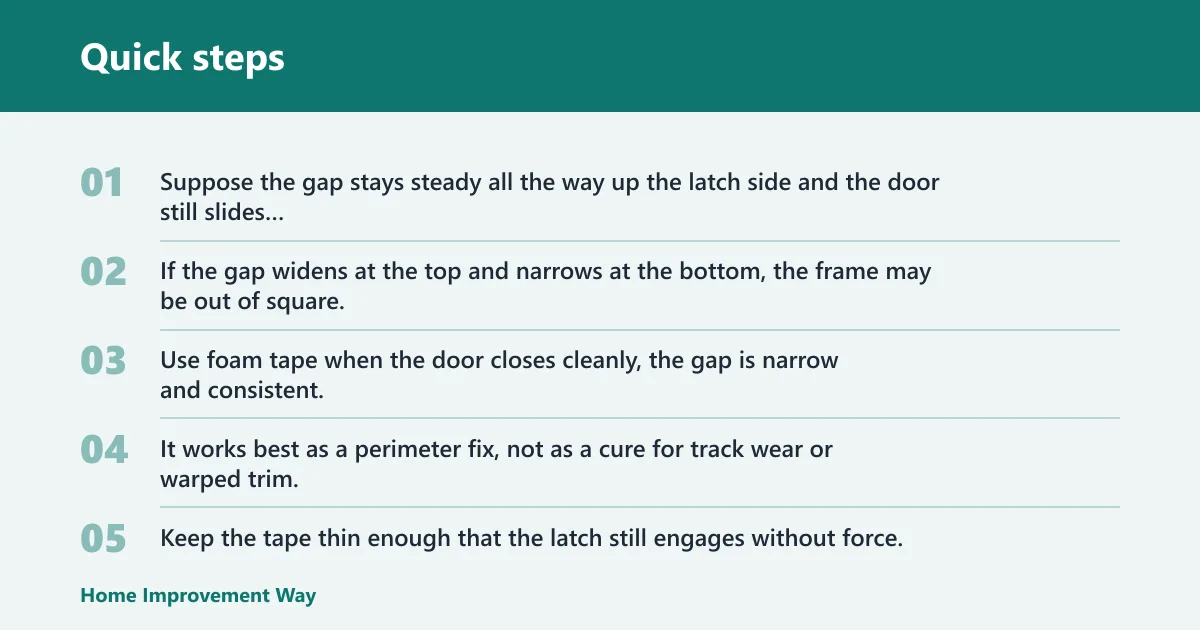
Suppose the gap stays steady all the way up the latch side and the door still slides freely. Foam tape is a practical first step. If the gap widens at the top and narrows at the bottom, the frame may be out of square, which means more tape can hide the symptom without fixing it.
When foam tape is the right fit
Use foam tape when the door closes cleanly, the gap is narrow and consistent, and the frame surface is clean enough for adhesive. It works best as a perimeter fix, not as a cure for track wear or warped trim. Keep the tape thin enough that the latch still engages without force.
When a warped frame changes the plan
A warped frame can reduce seal quality because the gap changes from point to point. In that case, stacked foam tape or a magnetic vinyl strip may help, but only as a temporary correction. If the door will not close squarely, insulation is not the real fix.
How to avoid adhesion failures
Clean and degrease before you stick anything down. Press the tape into place with firm, even pressure. If tape lifts at the corners, remove it, clean again, and reset the strip. Dust, old adhesive, and silicone residue are common reasons the strip fails early.
Do door sweeps help with sliding glass door drafts?
Yes, if the draft is coming from the bottom edge and the door design uses a sweep-style seal. A door sweep can block floor-level drafts on some patio doors, but many sliding glass doors use a bottom weatherseal or fin seal instead, so the wrong part can interfere with sliding or not fit the door design at all. Family Handyman recommends checking the bottom edge for drafts, and adjustable aluminum sweeps with rubber seals are more durable than simple fixed strips when the door is built for that style of seal.
Install or adjust the sweep
- Measure the bottom edge and compare the sweep length before cutting.
- Set the sweep so the seal just touches the threshold.
- Open and close the door several times to confirm that it does not drag.
- Raise the sweep one notch or trim the seal if it binds.
If the sweep drags, stop and adjust. A dragging sweep can make the door hard to close and can wear the seal faster. The goal is contact, not pressure that scrapes the floor.
When should you stop DIY and call a pro?
Stop DIY when the frame is warped, the door will not close cleanly, or the hardware is out of alignment. At that point, more tape or more caulk only hides the problem. Replacement or repair is smarter when drafts come from structural or hardware issues instead of simple air gaps.
Signs the frame is warped or out of square
If the gap changes a lot from top to bottom, the latch needs force, or the panel scrapes at one point in the track, the frame may be distorted. That can prevent any seal from sitting evenly. A professional can check squareness, alignment, and whether the frame needs repair.
Track, roller, or latch problems that block closure
When rollers are worn or the track is dirty and uneven, the door may not meet the frame tightly enough for weatherstripping to work. Clean the track first. If the panel still sits high, low, or crooked, the rollers or latch likely need adjustment before insulation makes sense.
When replacement is smarter than more insulation
Older sliding glass doors often lack modern efficiency features, and drafts can point to a door that has reached the limit of simple fixes. If the glass is single-pane, the frame is warped, and the seals keep failing, replacement may cost less over time than repeating the same temporary fixes.
Common mistakes
Skipping the prep work causes most failed winter fixes. Each product depends on the surface and the leak path. If you match the wrong product to the wrong problem, the draft usually stays.
- Skipping cleaning before adhesive products: dirt and grease weaken foam tape. Clean and degrease the frame first.
- Using shrink film as a permanent fix: it is a seasonal layer, not a long-term repair.
- Choosing a seal that drags or binds: it should block air without fighting the track.
- Caulking in wet or cold conditions: exterior-grade caulk works best on a dry day above 40°F.
- Adding rigid foam board to a daily-use door: it fits rarely opened openings, not panels you need every day.
Another common mistake is sealing every surface at once. That can make the door harder to use without fixing the draft. Work from the symptom outward: perimeter, glass, bottom edge, then exterior seam.
Frequently asked questions
How do you insulate a sliding glass door for winter DIY?
Start with a hand check, then fix the leak path you find. Use foam weatherstripping for perimeter gaps, a bottom seal adjustment for the lower edge when the door design allows it, shrink film for a fixed panel, and exterior caulk for frame-to-siding seams. Do not apply every product if only one area is leaking.
How do you insulate a sliding glass door and still use it?
Keep the sliding panel operational by using thin perimeter weatherstripping, a properly set bottom seal, and caulk only outside the frame. Skip rigid foam board on a daily-use panel. If you need a temporary glass layer, limit shrink film to a fixed panel or an unused opening.
Should you use shrink film on a sliding glass door?
Use shrink film when the glass is the main heat-loss path and you want a temporary seasonal layer on a fixed panel. It is installed with a hair dryer and can be put up in about 20 minutes. It is not the best fix for warped frames, failed latches, or major perimeter gaps.
When should you replace a sliding glass door instead of insulating it?
Replace it when the frame is warped, the door will not close squarely, or the unit is old enough that repeat sealing does not hold. Older sliding glass doors often lack modern efficiency features, and persistent drafts can signal that repair or replacement is the better investment.
Sponsored / affiliate links. As an Amazon Associate I earn from qualifying purchases. I may earn additional commission from eligible campaigns.