Blown-in Insulation vs. Batt Insulation Cost and Performance
In attics, blown-in insulation is often favored for retrofit coverage and can perform well when installed correctly, while batt insulation can cost less in open, accessible cavities; for walls and floors, batt insulation often costs less upfront, but blown-in insulation can help reduce gaps and may lower settlement concerns. Pick the wrong product and you can pay for air leaks, uneven R-values, cold spots, and repeat insulation work. This guide compares attic, wall, floor, and retrofit jobs by installed cost, thermal performance after installation, and failure risk.
| Factor | Blown-in insulation | batt insulation | Winner |
|---|---|---|---|
| Cost per square foot | About $0.50–$2.30 per sq ft in attics; retrofit walls usually cost more because of drilling, patching, and labor | About $0.30–$1.50 per sq ft in attics; open cavities are usually the cheapest case | batt insulation |
| Installed R-value reliability | Strong when depth and density are correct; coverage is usually more uniform over obstructions and irregular spaces | Strong in clean, open bays; performance drops fast with gaps, compression, and miscuts | Blown-in insulation |
| Air-leak resistance | Loose-fill is not air sealing, but dense-pack retrofits can slow air movement better than loose-fill alone | Batts are not air sealing, and air gaps at edges or around wires can leave direct leak paths | Blown-in insulation |
| DIY difficulty | Needs a blower, setup time, and careful depth control; attic top-ups are more manageable than wall retrofits | Easier in open framing because you can cut, fit, and inspect each bay before drywall | batt insulation |
| Failure risk | Lower risk of voids in complex attic layouts, but settling and under-fill can reduce performance | Higher risk of compression, gaps, and wind-washing if the fit is poor or the cavity is crowded | Blown-in insulation |
| Best use by room | Attic floors, irregular cavities, closed-wall dense-pack retrofits | New construction wall cavities, straight floor and ceiling bays, accessible open framing | Tie |
Cost access and failure modes drive performance
The two products stop being interchangeable the moment the cavity stops being simple. Blown-in insulation is loose-fill installed with pneumatic equipment, so it fills around wires, trusses, and pipes more easily; batt insulation is a pre-cut blanket or roll that depends on clean, repeatable framing for a good fit. The better choice follows the room, the access, and the failure mode you want to avoid.
Cost is driven by access, not just material
Material price is only one line in the quote. Installed attic pricing often overlaps, but labor, prep, old insulation removal, depth targets, and access difficulty can move the total more than the product name on the bag.
That is why attic top-ups often price closer together than wall retrofits. Once you add drilling, patching, or hauling out old material, the lower-cost product on paper can become the pricier job.
Installed performance depends on fit
R-value measures resistance to heat flow, but the field result depends on installation quality. A Grade III R-19 wall can perform like R-13 when the batts are poorly fitted, which is the difference between a tidy spec sheet and a cold wall.
Blown-in insulation avoids some of that fit loss because it can cover irregular spaces more evenly. It still fails if the installer leaves thin spots or misses the target depth and density.
Failure mode matters more than label
Batts lose performance when they are compressed, cut too small, or left with voids around wiring and framing. Loose-fill loses performance when it settles, when the installed depth is wrong, or when wind washes it near the eaves.
A common first-timer mistake is treating insulation type as a substitute for air sealing. It is not. Rim joists, top plates, and penetrations still need separate sealing.
Does blown-in insulation work better in attics?
Yes, usually. Attic floors are the strongest use case for blown-in insulation because they often include obstructions, uneven framing, and hard-to-fit corners, so coverage consistency matters more than a clean labeled R-value. Batts can work in simple attic runs, but they are easier to leave gapped or compressed.
Obstructions change the result
Attic floors often have wires, trusses, recessed lighting, and pipes that break up a straight batt layout. Blown-in insulation can flow around those obstacles, while batts need careful cutting and trimming that is easy to get wrong.
Suppose an attic has a 24-by-30-foot floor with several cross-braces and a few penetrations. A batt layout may look complete from the access hatch and still miss narrow strips that matter, while loose-fill can cover those zones more evenly if the installer keeps the depth uniform.
Settling and wind-washing are the attic risks
Loose-fill cellulose settles more than fiberglass, and the listed settlement is about 20%. Loose-fill fiberglass settlement is about 1–3%. That difference matters most in attic top-ups, where settled depth affects the final thermal layer.
Wind-washing at the eaves is another issue. Baffles help keep loose-fill from being blown away from the perimeter, and they help both products hold their effective coverage near the roof edge.
Material type still matters
Blown-in insulation is available in fiberglass, cellulose, and rockwool. In attics, blown-in cellulose is commonly listed around R-3.2–3.8 per inch, while blown-in fiberglass is about R-2.2–2.7 per inch. Those numbers only help if the installed depth and density match the target.
When are batt insulation and mineral wool the better fit?
Batts are the better fit in open framing, especially in new construction wall cavities and other spaces where you can inspect the bay before it is closed. Mineral wool batts are often the smarter choice when the cavity needs more stiffness, a tighter friction fit, or easier trimming around irregular framing than fiberglass can provide.
Open wall cavities favor batts
New construction wall cavities are the classic batt job because the framing is open and standard stud spacing makes sizing predictable. That is why batts win for new construction walls.
Open framing also lets you inspect each bay before drywall. That matters because gaps, slumping, and compression are much easier to fix before the wall is closed.
Floors and ceilings can go either way
For open floor and ceiling cavities, batts often fit well when the joist bays are repeatable and accessible. They are simple to cut to length and easier to verify than loose-fill in a clean, open assembly.
Blown-in insulation still has an advantage when the cavities are irregular or crowded. If joists, wiring, or plumbing break up the bay, loose-fill often fills more consistently than a batt stuffed into place.
Mineral wool batts can be a better match than fiberglass when the cavity benefits from a stiffer blanket that resists sagging and fits more tightly. The label does not decide the outcome; the assembly does.
Closed walls and retrofit cavities
Closed-wall work is often handled with dense-pack blown-in insulation rather than batts. Once the cavity is already enclosed, the practical options are drilled-hole access, patching, and a fill method that can reach the full void without opening every stud bay. That is where dense-pack cellulose or fiberglass fits best.
Dense-pack is the retrofit answer
Closed-wall retrofit work is typically done by drilling holes, blowing material into each cavity, and then patching the openings. That approach is common when you want to improve an existing wall without removing drywall or plaster.
Batts are usually not practical here because they require open access. If you do not open the wall, you cannot place and inspect the batt properly.
Under-filled walls fail quietly
Dense-pack retrofits can fail if the cavity is under-filled, because voids leave a lower effective R-value and may allow air movement. The issue is not the material alone; it is whether the cavity ends up fully packed to the intended density.
That is why retrofit wall work belongs in a different budget line from attic top-ups. You are paying for access, fill consistency, and patching, not just insulation material.
Cost drivers that change the quote
Project quotes change most when the job changes from simple coverage to prep work. Old insulation removal, air sealing before insulation, access difficulty, and depth targets all affect installed cost more than the label on the bag or bale.
- Check whether old insulation must be removed before new work starts.
- Ask whether the crew is air sealing before adding insulation.
- Compare access: open attic, tight crawlspace, or closed wall cavity.
- Confirm the depth or cavity fill target, not just the product type.
- Ask whether the quote includes patching, cleanup, and debris removal.
Say your attic has 400 square feet of open floor and no old insulation to remove. The quote may stay near the lower attic range because access is easy and the fill is straightforward. Add old debris, low roof clearance, or a need to air seal penetrations first, and the job changes fast.
Choose blown-in insulation if… / Choose batt insulation if…
Choose blown-in insulation if the space is irregular, already closed, or full of obstructions. Choose batt insulation if you have open framing, repeatable cavity sizes, and a chance to inspect the fit before the wall or ceiling is covered. The room decides the winner more often than the material name does.
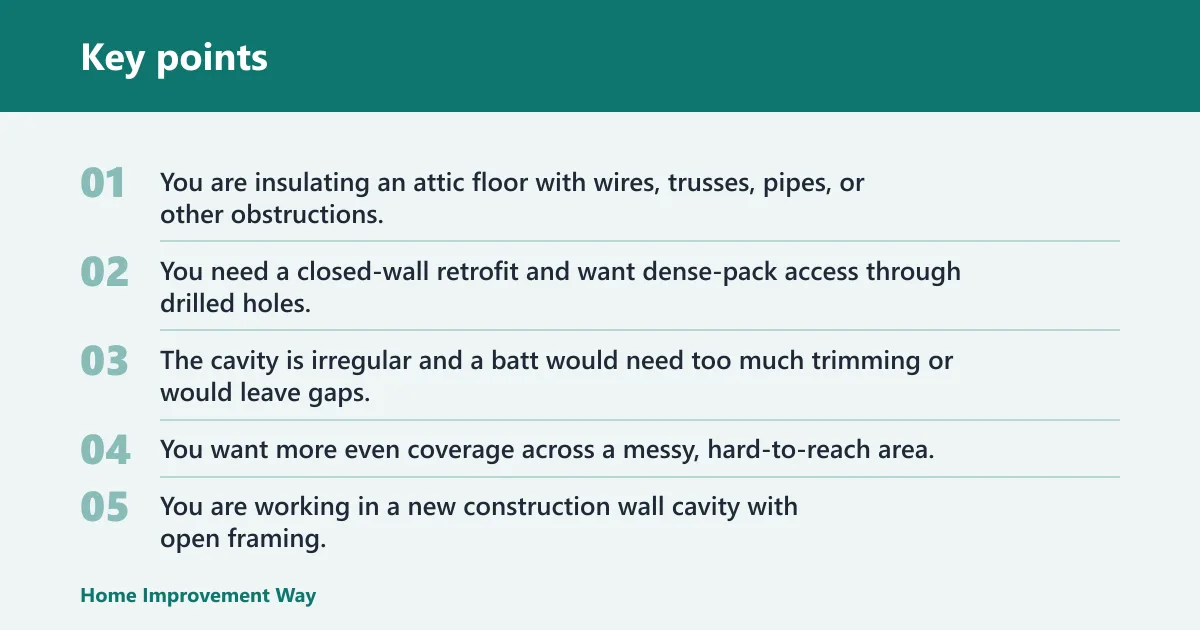
Choose blown-in insulation if…
- You are insulating an attic floor with wires, trusses, pipes, or other obstructions.
- You need a closed-wall retrofit and want dense-pack access through drilled holes.
- The cavity is irregular and a batt would need too much trimming or would leave gaps.
- You want more even coverage across a messy, hard-to-reach area.
Choose batt insulation if…
- You are working in a new construction wall cavity with open framing.
- You have straight floor or ceiling bays with standard spacing and clear access.
- You want a simpler DIY job and can inspect every bay before drywall.
- You need a stiffer mineral wool batt for fit or sag resistance in an open cavity.

Frequently asked questions
Is blown-in insulation better than batt insulation?
Not universally. Blown-in insulation is usually better in attics, irregular cavities, and closed-wall retrofits because it fills around obstructions and can reduce voids. Batt insulation is usually better in open framing where you can cut it cleanly, inspect it, and keep the cavity shape simple.
Which is cheaper, blown-in or batt insulation?
For attics, batt insulation can run about $0.30–$1.50 per sq ft, while blown-in insulation can cost about $0.50–$2.30 per sq ft. That does not settle the decision by itself, because removal, prep, access difficulty, and drilling can change the installed cost far more than material price.
Can batt insulation be used in existing walls?
Usually not without opening the wall. Batt insulation needs access so it can be cut, fitted, and inspected in the cavity. For existing closed walls, dense-pack blown-in insulation is usually the practical option because it can be installed through drilled holes and then patched.
How much R-value do I need from blown-in vs batts?
The target R-value comes from the assembly and climate, not from whether the product is blown-in or batt. The important part is installed quality. A Grade III R-19 wall can perform like R-13, so a higher label does not help if the cavity is poorly filled or compressed.
Does either insulation type air seal a home?
No. Neither batt insulation nor loose-fill insulation is a primary air seal. Dense-pack cellulose can reduce air movement more than loose-fill alone, but rim joists, top plates, and penetrations still need separate sealing. Insulation slows heat flow; it does not close all leak paths.
What is the difference in settling between cellulose and fiberglass?
Loose-fill cellulose settles more, with about 20% listed in the comparison table, while loose-fill fiberglass is listed at about 1–3%. That matters most in attic top-ups because the finished depth determines performance. Installed depth and density still matter more than the material name alone.
When should I choose batts instead of blown-in?
Choose batts when the cavity is open, straight, and easy to inspect, especially in new construction walls. They also make sense in some floor and ceiling bays with standard spacing. If the space is closed, crowded, or irregular, blown-in insulation usually gives the more reliable fill.
Sponsored / affiliate links. As an Amazon Associate I earn from qualifying purchases. I may earn additional commission from eligible campaigns.