How to Insulate a Crawl Space: Vented vs. Unvented
Use floor insulation in a vented crawl space, or insulate the walls in an unvented, sealed crawl space; do not combine the two without a moisture plan. Bad assemblies trap moisture, drive up energy costs, and can rot framing. This covers which strategy fits your climate, where each layer goes, how to control water vapor and drainage, and which code checks to verify first. For most humid or mixed climates, unvented is the safer default; vented still makes sense in dry, low-moisture crawl spaces that can stay dry.
This guide is part of our Insulation and air sealing series.
| Factor | vented | unvented | Winner |
|---|---|---|---|
| Moisture control | Uses outdoor air through foundation vents, plus a ground cover over exposed soil. | Uses sealed vents plus active drying or conditioned air. | unvented |
| Insulation location | Insulation goes in the floor framing above the crawl space. | Insulation goes on the perimeter foundation walls, often with rigid foam. | tie |
| Climate fit | Works best where outdoor air stays dry enough that venting does not raise crawl space humidity. | Usually better in humid and mixed climates where outside air brings moisture. | unvented |
| Retrofit complexity | Usually simpler if the floor is already open and dry. | Usually more work because vents, walls, rim joists, and air leakage paths must be sealed. | vented |
| Long-term risk | Damp batts can sag, lose R-value, and perform poorly. | Needs careful detailing, but avoids outdoor air washing through a damp space. | unvented |
How insulation placement shifts the thermal boundary
The core difference is simple: a vented crawl space uses open foundation vents to the outdoors and insulates the floor framing above it, while an unvented crawl space seals those vents and insulates the perimeter walls instead. The moisture strategy changes with the insulation location, so the wrong stack can trap water in the assembly.
Where the insulation goes
In a vented crawl space, the insulation belongs between the floor joists. In an unvented crawl space, the thermal layer shifts to the crawl space walls, and the crawl space can become part of the home’s thermal envelope.
That change matters because heat loss and moisture movement follow the same path. If you keep vents open, the floor assembly is the boundary. If you seal the vents, the boundary moves to the perimeter walls and rim joists.
How moisture control changes
Vented spaces depend on outdoor air, so they need a ground vapor retarder and dry enough conditions outside. Unvented spaces need active moisture control, such as a dehumidifier, conditioned supply air, or another approved drying method, because sealed crawl spaces can otherwise hold humid air against cool surfaces.
Which one usually fits best?
Humid and mixed climates usually point to unvented construction because outdoor air often adds moisture instead of removing it. Dry regions can still support vented crawl spaces when the assembly stays dry and the code path is met.
Which crawl space should you keep?
Keep a vented crawl space only if your climate, drainage, and humidity stay dry enough that outside air helps more than it hurts. Convert to unvented when the crawl space regularly smells damp, shows condensation, or sits in a humid or mixed climate where venting keeps feeding moisture into the assembly.
Climate clues that point one way
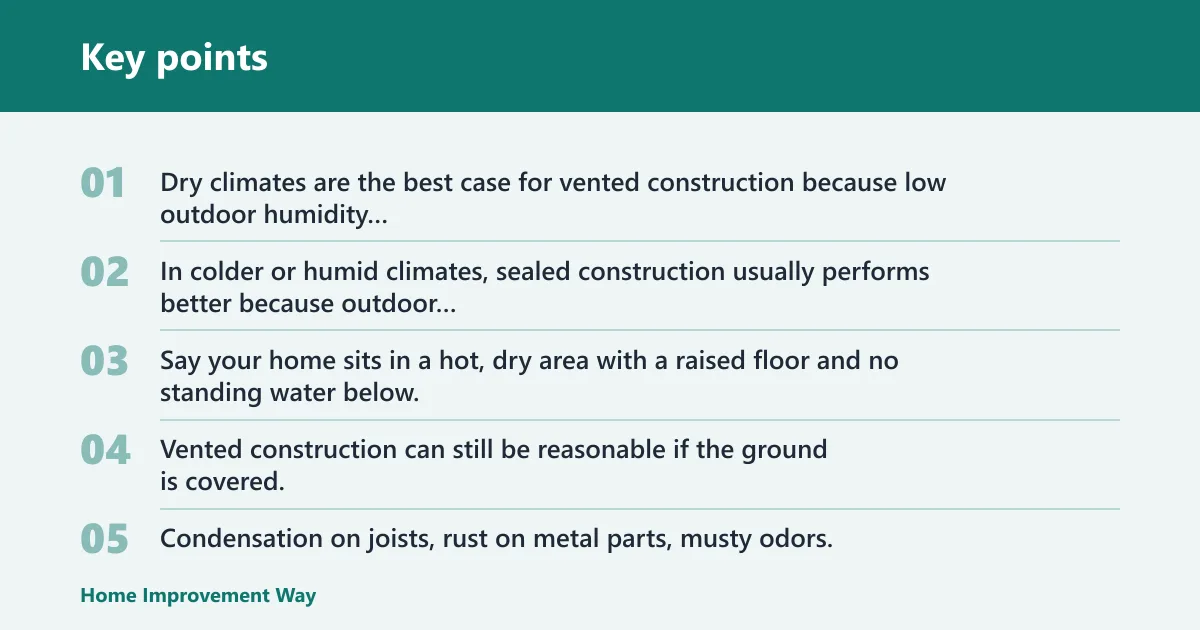
Dry climates are the best case for vented construction because low outdoor humidity makes it easier to avoid a damp crawl space. In colder or humid climates, sealed construction usually performs better because outdoor air can cool surfaces and raise relative humidity inside the crawl space.
Say your home sits in a hot, dry area with a raised floor and no standing water below. Vented construction can still be reasonable if the ground is covered, the vents are code-compliant, and the floor insulation stays dry and supported.
Moisture red flags that favor conversion
Condensation on joists, rust on metal parts, musty odors, or visible mildew point toward unvented construction with active drying. If the crawl space already shows damp insulation or darkened wood, leaving vents open usually keeps the problem going.
A common first-timer mistake is to close vents without adding moisture control. That can trap humid air inside a sealed crawl space and make condensation worse, especially on cool ducts, pipes, and masonry walls.
When a vented crawl space is still acceptable
A vented crawl space can still be acceptable when the site is dry, the ground is covered with a Class I vapor retarder, and the vent area meets code. It is also the simpler choice when you need a low-cost path and the floor cavity can be kept dry and fully supported.
Vented crawl space checklist
For a vented crawl space, the assembly starts below the floor, not on the wall. Insulation goes in the floor framing above the crawl space, the ground gets a vapor retarder, and the vents remain open to the outdoors.
Build the vented stack in order
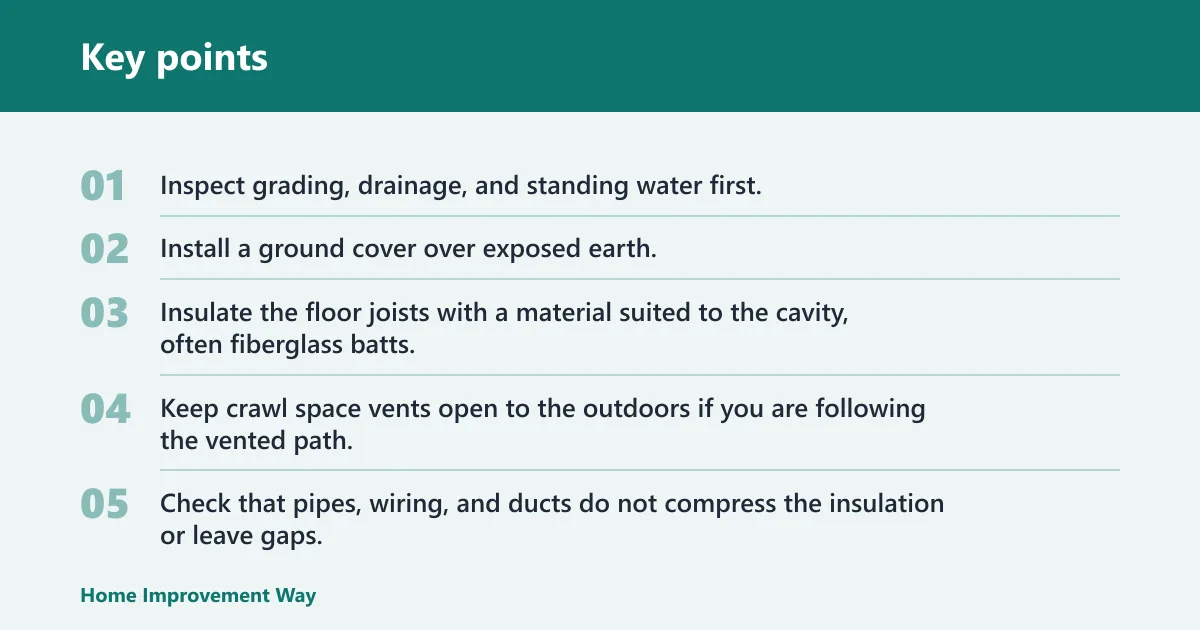
- Inspect grading, drainage, and standing water first.
- Install a ground cover over exposed earth; the cited code summary calls for at least a 6-mil polyethylene ground cover.
- Insulate the floor joists with a material suited to the cavity, often fiberglass batts.
- Keep crawl space vents open to the outdoors if you are following the vented path.
- Check that pipes, wiring, and ducts do not compress the insulation or leave gaps.
What usually works, and what fails
Fiberglass batts are common in vented crawl spaces because they fit between floor joists and are easy to install. They fail when they sag, get wet, or lose contact with the subfloor, which reduces R-value and can leave cold spots.
Picture a crawl space of about 900 square feet in a mixed climate with damp soil and loose batts falling away from the joists. The floor above feels cold, the insulation hangs in places, and the crawl space starts holding moisture longer after rain. That assembly is telling you the vented strategy is struggling.
Open vent area and floor targets
The vented path uses open foundation vents to the outdoors. A vented crawl space may need 1 square foot of net free vent area per 150 square feet of floor area, and with a Class I vapor retarder, that can drop to 1:1,500.
Floor insulation targets also change with climate zone. Vented crawl space floor insulation targets can reach R-38 in colder climate zones, with Zone 5-6 at R-30, Zone 3-4 at R-19, and Zone 1-2 at R-13.
Common failure points to check
Before you close a vented crawl space, check for exposed earth, torn ground cover, blocked vents, and compressed batts. Also inspect the rim joist and access door; those leaks can bypass the insulation layer and pull humid outdoor air into the cavity.
Unvented crawl space checklist
An unvented crawl space shifts the job to the perimeter walls and the moisture-control system. Vents are sealed, the wall insulation becomes the thermal boundary, and the crawl space needs drying or conditioned air to stay stable.
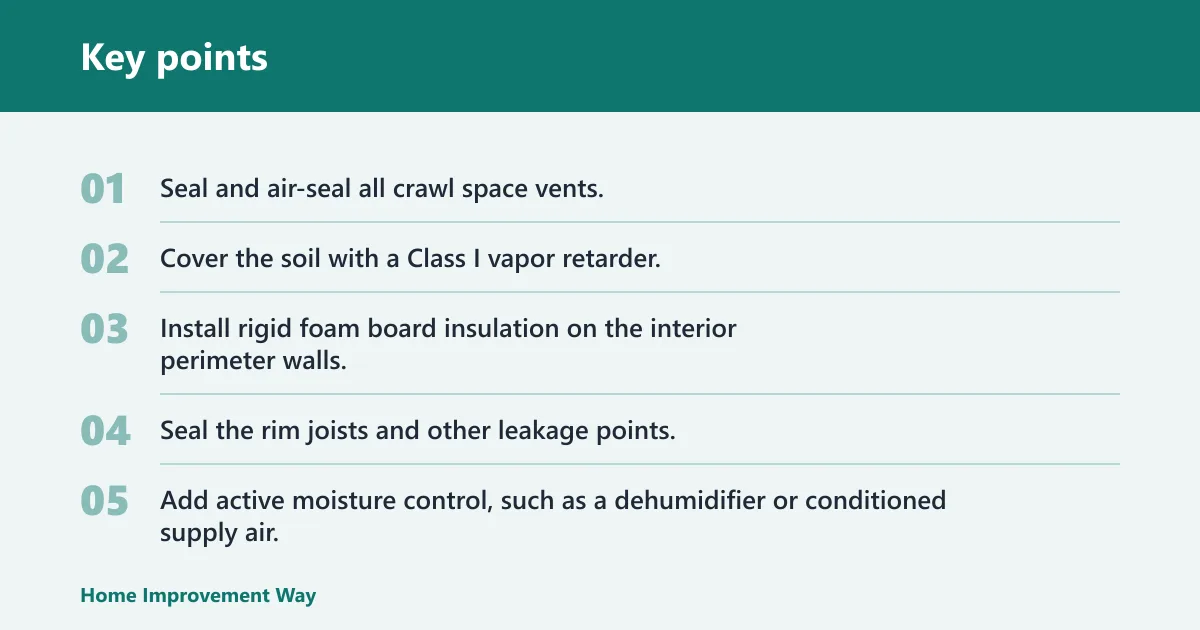
Build the unvented stack in order
- Seal and air-seal all crawl space vents.
- Cover the soil with a Class I vapor retarder; the cited code summary says at least 6-mil polyethylene.
- Install rigid foam board insulation on the interior perimeter walls.
- Seal the rim joists and other leakage points.
- Add active moisture control, such as a dehumidifier or conditioned supply air.
- Seal the access door so the crawl space stays within the intended air barrier.
Wall insulation and rim joists
Rigid foam board insulation is commonly used in sealed crawl spaces because it resists moisture better than fibrous insulation and provides useful R-value per inch. The Building America guide recommends polyisocyanurate or XPS rigid foam board, and it describes wall insulation for closed crawlspaces as a cost-effective method. (PNNL)
The rim joist needs the same attention as the walls. If you leave that edge leaky, outside air can short-circuit the assembly and create a cold band where condensation collects.
Moisture control is not optional
Unvented crawl spaces require active moisture-control mechanisms under IRC Section R408.3. That can mean a dehumidifier, conditioned supply air, or another approved drying method, but the key is that the crawl space must not rely on passive sealing alone.
The Building America guide also says to cover walls and floor with a polyethylene vapor retarder first and to seal vent openings with rigid foam cut to fit. Foam insulation often needs a thermal or ignition barrier, so verify that detail before you finish the walls.
Crawl space decision checklist
This checklist translates the vented-versus-unvented choice into pass/fail items. If several items fail under the vented column, conversion usually makes more sense than patching around the problem.
| Check | Keep it vented | Convert to unvented |
|---|---|---|
| Climate clue | Dry region with low crawl space humidity and no recurring condensation. | Humid or mixed climate, or a crawl space that stays damp after rain. |
| Moisture red flag | No mold, no musty odor, no wet framing, no standing water. | Any of those red flags are present. |
| Insulation location | Floor framing above the crawl space. | Perimeter foundation walls and rim joists. |
| Vapor retarder | Ground cover under exposed earth; 6-mil polyethylene minimum in the cited code summary. | Ground cover plus wall/floor vapor retarder details as part of the sealed assembly. |
| Vent treatment | Open vents to the outdoors. | Seal and air-seal vents with rigid foam cut to fit or equivalent approved sealing. |
| Minimum code items to verify | IRC R408.1 vent area, ground cover, and local floor R-value requirements. | IRC R408.3, active moisture control, sealed vents, and fire-protection requirements over foam. |
How do code rules change the plan?
Code does not only set insulation thickness. It decides whether your crawl space may stay vented, how much vent area you need, and what moisture-control and foam-protection details must be in place before the work is considered complete.
IRC R408.1 for vented crawl spaces
IRC R408.1 is the vented crawl space section.
Pass/fail check: if you keep it vented, the vents must remain open to the outdoors, the ground must have a vapor retarder, and the insulation target must match the climate zone.
IRC R408.3 for unvented crawl spaces
Sealed crawl spaces require IRC Section R408.3 in the cited article. That path recognizes conditioned or sealed crawl spaces, but it also requires active moisture control so the crawl space does not become a damp, stagnant box.
Pass/fail check: if you convert to unvented, vents must be sealed and air-sealed, wall insulation must be in place, and the crawl space must have a drying method that keeps humidity in check.
What to verify with the local inspector
Before work starts, ask which climate-zone R-value applies, whether foam needs a thermal or ignition barrier, and whether local amendments change vent area or moisture-control requirements. Local codes can tighten the details even when the general IRC path is clear.
Can you convert a vented crawl space?
Yes, but the order matters. You need to solve drainage and ground moisture first, then seal the vents, then insulate the perimeter walls, and only then add moisture control and final sealing details.
Safe conversion sequence
- Fix bulk water outside the crawl space first.
- Cover exposed soil with a Class I vapor retarder, using at least 6-mil polyethylene in the cited code summary.
- Seal the crawl space vents with rigid foam cut to fit.
- Insulate the perimeter walls with polyisocyanurate or XPS rigid foam board.
- Seal the rim joists, access door, and any pest-intrusion gaps.
- Add a dehumidifier, conditioned supply air, or another approved drying method.
Where condensation risk shows up
Condensation risk often shows up on cool masonry walls, ducts, plumbing, and rim joists during the transition. If you close vents before the ground is covered and the moisture load is controlled, the crawl space can trap humid air and wet those surfaces.
Suppose a 1,200-square-foot crawl space already has damp soil and a leaky access door. If you seal the vents first and wait on the vapor retarder, the crawl space can spike in humidity and leave condensation on the newly cooled walls. The sequence needs to prevent that change, not react to it.
When to add dehumidification or conditioned air
Add active drying whenever the crawl space is sealed, the climate is humid or mixed, or the site has a history of moisture problems. That is the main reason sealed systems outperform vented ones in damp climates: they control the air inside instead of betting on outdoor air to dry it out.
Choose vented if…
Choose vented if you live in a dry climate, the crawl space stays dry through wet weather, and you want the simpler assembly with floor insulation above the crawl space. Keep the vents open, install a ground vapor retarder, and verify that the floor insulation meets the climate-zone target.
Choose unvented if you live in a humid or mixed climate, the crawl space has recurring moisture problems, or you want the crawl space inside the home’s thermal envelope. Seal the vents, insulate the perimeter walls with rigid foam, seal the rim joists and access door, and add active moisture control.
Dry, stable sites can stay vented; damp or variable sites usually need the sealed path.


Frequently asked questions
Vented vs unvented crawl space: vented crawl spaces insulate
Vented crawl spaces insulate the floor framing above the crawl space and depend on open foundation vents plus ground cover. Unvented crawl spaces seal the vents, move insulation to the perimeter walls, and need active moisture control. The better option depends on climate, site moisture, and whether the crawl space stays dry.
Should a crawl space be vented?
Only if the site is dry enough that outdoor air will not add moisture. That can still be true in some dry regions, especially when the ground is covered and the vent area meets code. In humid or mixed climates, venting usually works against the moisture plan.
Sealed crawl space vs vented
A sealed crawl space usually gives you better moisture control and more predictable energy performance in damp climates. A vented crawl space can be acceptable where outdoor air is dry and the floor cavity can stay insulated and dry. The decision turns on climate, not preference alone.
Where does insulation go in a vented crawl space?
It goes in the floor framing above the crawl space, typically between the joists. That keeps the thermal boundary at the floor instead of the walls. A ground vapor retarder still matters because moisture from exposed soil can rise into the cavity and damage the insulation.
Where does insulation go in an unvented crawl space?
It goes on the perimeter foundation walls, with rim joists sealed and insulated as part of the same boundary. Rigid foam board is commonly used for this path. The crawl space also needs sealed vents and a moisture-control method so the sealed assembly does not trap humidity.
When should a crawl space be converted to sealed?
Convert to sealed when the crawl space has recurring dampness, a musty odor, condensation, or a climate that makes outdoor air a moisture source instead of a drying aid. It is also the better path when you want the crawl space inside the thermal envelope and can add active drying.
Sponsored / affiliate links. As an Amazon Associate I earn from qualifying purchases. I may earn additional commission from eligible campaigns.