Cellulose vs. Fiberglass Insulation: Which Is Better for Attics?
For most attics, cellulose is the stronger choice for topping up coverage and slowing air movement. Fiberglass is the better fit when low weight, easier handling, or a lower installed cost matter more. Start with the attic’s condition, access, and moisture risk, because the wrong pick can leave cold spots, compress insulation, trap moisture, or cost more in energy than it saved. This guide compares R-value, settling, air sealing, moisture behavior, and installation fit for attic use.
| Factor | Cellulose | fiberglass insulation | Winner |
|---|---|---|---|
| R-value per inch | About 3.6 to 3.8 per inch | Varies by form; loose-fill is commonly lower per inch than cellulose, and batts depend on thickness and product | Cellulose |
| Settling and depth control | Can settle up to 20% in attics and must follow the coverage chart | Batts and rolls do not settle the same way; loose-fill still depends on installed depth | fiberglass insulation |
| Moisture tolerance | Must stay dry; wet cellulose can clump and lose performance | Handles incidental moisture better than cellulose, but wet insulation of any kind performs worse | fiberglass insulation |
| Air sealing impact | Can reduce air leakage better than fiberglass in some studies, but still needs sealing at leak points | Cannot stop air from passing through it and needs separate air sealing | Cellulose |
| DIY and access fit | Loose-fill needs blowing equipment and careful depth checks | Batts are usually more DIY-friendly; loose-fill also needs equipment | fiberglass insulation |
| Best attic use case | Good for topping up, irregular spaces, and attic floors with lots of obstructions | Good for open, simple layouts and projects where handling and cost matter most | Depends on attic |
How to choose insulation for your specific attic
Cellulose and fiberglass both work in attics, but they solve different problems best. Cellulose usually wins when you need better coverage around framing, pipes, and wiring; fiberglass usually wins when you want simpler handling and a more DIY-friendly install. Neither material seals air leaks by itself.
What each material
Cellulose is commonly described as a loose-fill material made from recycled paper or paperboard. In attics, it is commonly blown across the attic floor thermal boundary, meaning across the joists in a vented attic rather than onto the roof deck.
Fiberglass comes as batts, rolls, or loose-fill. Batts and rolls fit simple spans well, while loose-fill fiberglass can cover awkward areas more evenly than batts, but still depends on proper depth and coverage.
The real attic trade-off
The real decision is not “which material is better” in the abstract. It is “which material fits this attic’s shape, access, and moisture risk without leaving gaps or creating a repair problem later.” That is why an open attic, a cramped attic, and a damp attic do not call for the same answer.
Say your attic has 2-by-6 joists, a dozen recessed light cans, and a short kneeling path to the hatch. Cellulose can flow around the obstructions better, but only if you air seal first and install to the bag’s coverage chart. A bare price comparison misses that detail.
Attic insulation comparison table
This table keeps the comparison on attic-use factors that actually change results. Material cost matters, but installed depth, settling, and access usually decide whether the attic ends up performing as expected.
| Factor | Cellulose | fiberglass insulation | Why it matters in an attic |
|---|---|---|---|
| Approximate R-value per inch | About 3.6 to 3.8 per inch | Depends on form; batts, rolls, and loose-fill vary | R-value per inch affects how much depth you need to reach target R-value. |
| Settling | Can settle up to 20% in attics | Batts do not settle the same way; loose-fill depth still needs checking | Settling changes final depth, so loose-fill must follow the coverage chart. |
| Moisture behavior | Needs to stay dry; wet cellulose clumps and loses performance | Also loses performance when wet, but does not have the same clumping concern | Roof leaks and condensation must be fixed before new insulation goes in. |
| Air sealing need | Still needs sealing around leaks, but cellulose may limit air movement better than fiberglass | Requires separate air sealing | Insulation alone does not stop air leaks around wires, pipes, lights, or hatches. |
| Installed cost and DIY fit | Often about $0.40 per square foot for material, plus blower and labor | Also about $0.40 per square foot for material in cited pricing, with batts easier to handle by hand | Installed cost changes with equipment, labor, and how much coverage the attic needs. |
R-value per inch
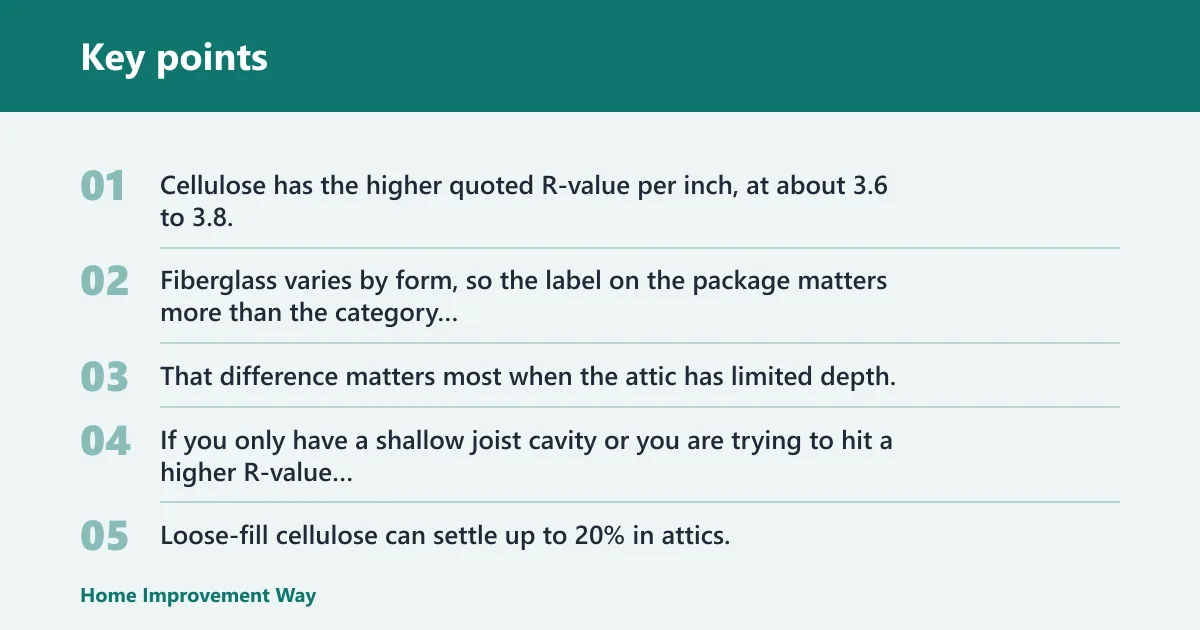
Cellulose has the higher quoted R-value per inch, at about 3.6 to 3.8. Fiberglass varies by form, so the label on the package matters more than the category name.
That difference matters most when the attic has limited depth. If you only have a shallow joist cavity or you are trying to hit a higher R-value without building up too much height, cellulose often needs less depth to reach the same target.
Settling and coverage depth
Loose-fill cellulose can settle up to 20% in attics, so the bag’s coverage chart is not optional. The chart tells you how much material is needed for the installed depth and target R-value after settling has been accounted for.
Fiberglass batts avoid the settling issue in the same way, but they only perform well when they stay in full contact with the attic floor and do not leave voids or compression gaps. Loose-fill fiberglass still needs depth control, so the installer must check coverage just as carefully.
Moisture behavior
Moisture is a first-order issue. Wet cellulose can clump, sag, and lose performance, and wet insulation is generally reported to perform worse than dry material.
That is why roof leaks, flashing failures, and condensation problems need to be fixed first. If the attic has repeated damp spots near the eaves or around penetrations, insulation choice matters less than finding the water source and stopping it.
Air sealing needs
Air sealing still matters if you choose cellulose. Insulation can slow heat flow, but it does not automatically block air moving through gaps around wiring, pipes, can lights, partition tops, or the attic hatch.
A common failure looks like this: the attic gets about 12 to 16 inches of insulation, but the hatch edge leaks, recessed lights are unsealed, and bath fan ducts still dump into the attic. The homeowner paid for more insulation, yet the attic still feels drafty because the leak paths were left open.
Which attic insulation has the higher R-value per inch?
Cellulose has the higher stated R-value per inch in the attic comparison, at about 3.6 to 3.8. Fiberglass varies by form, and its performance depends on whether you are using batts, rolls, or loose-fill. In practice, installed depth matters more than the label alone.
Why installed depth matters more than a label
A labeled R-value only helps if the attic ends up with that depth after installation and settling. For loose-fill products, the coverage chart on the bag or website is the source you use to translate square footage into installed depth.
That is also why a thinner layer of a higher-R-per-inch material can still lose to a thicker, well-installed layer of a lower-R-per-inch material. Coverage and continuity matter as much as the number on the package.
Does cellulose need air sealing too?
Yes. Cellulose still needs air sealing, because insulation does not close the leak paths around lights, wiring, pipes, duct boots, or the attic hatch. Cellulose may limit air movement better than fiberglass in some situations, but it does not replace sealing work.
Leak paths that still need sealing
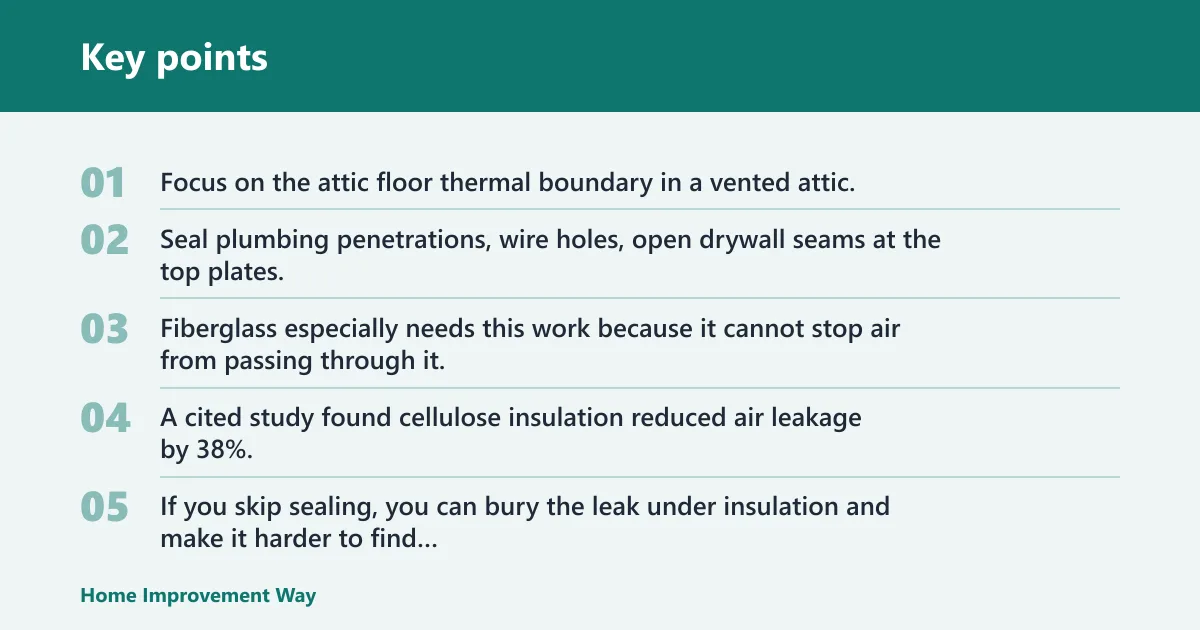
Focus on the attic floor thermal boundary in a vented attic. Seal plumbing penetrations, wire holes, open drywall seams at the top plates, recessed light openings that are not rated for insulation contact, and the attic access panel.
Fiberglass especially needs this work because it cannot stop air from passing through it. A cited study found cellulose insulation reduced air leakage by 38%, but that is not the same as a fully air-sealed attic.
What happens if you skip sealing
If you skip sealing, you can bury the leak under insulation and make it harder to find later. Warm indoor air can still reach cold attic surfaces, which raises condensation risk and weakens real-world performance.
Picture a 700-square-foot attic with a leaky hatch and several unsealed penetrations. Adding more insulation without sealing can leave the same cold spots at the ceiling plane, because the air is still moving through the weak points.
Where to seal before insulation goes
Start at the biggest openings first. The attic hatch, top plates, wiring holes, plumbing stacks, chimney clearances that need proper fire-safe treatment, and duct or bath fan penetrations should be handled before new insulation covers them.
After that, install the insulation to the target depth and recheck low spots. If the attic is already insulated, a top-up should still begin with leak sealing so the new layer is not covering a problem instead of solving it.
Moisture and settling risks
Moisture and settling are the two attic risks that change the job later, not just on installation day. Cellulose needs dry conditions and correct coverage depth; fiberglass needs protection from wetting and good placement so it does not leave gaps or compression.
Why wet insulation is a problem
Wet insulation of any type performs poorly, but wet cellulose is especially concerning because it can clump and lose loft. If the roof has an active leak or the attic shows condensation damage, fix the source before adding material.
This is not a cosmetic issue. Moist material can hide damage, reduce R-value, and create a repair job that costs more than the insulation itself.
Cellulose settling and re-check depth
Because cellulose can settle up to 20% in attics, depth should be checked against the installed coverage chart, not guessed from the day of installation. If the chart says a certain bag count is needed for a target depth, that is the number that should guide the install.
If the attic is topped up later, remeasure at several points. Joist bays, corners, and the eaves often end up at different depths.
Where fiberglass has limits
Fiberglass batts are a better fit for regular, open spans than for a broken-up attic floor. In a cramped attic with obstructions, batts can leave voids, get cut too small, or bridge over areas that should be covered.
Loose-fill fiberglass handles irregularity better than batts, but it still needs the same basic discipline: correct depth, even distribution, and air sealing underneath.
Attic insulation matrix
This matrix ties the material choice to the attic condition first. It is the most useful way to avoid choosing by sticker price alone.
| Attic condition | Recommended material | Reason | Risk warning |
|---|---|---|---|
| Open vented attic | Cellulose | Better for covering the attic floor thermal boundary evenly and limiting air movement across a large open area | Seal the ceiling plane first; do not rely on insulation to stop leaks |
| Cramped or irregular attic | Cellulose | Loose-fill covers around wires, pipes, and odd framing better than batts | Use the coverage chart so settling does not leave you short of target depth |
| Moisture-prone attic | fiberglass insulation | Safer than cellulose when moisture risk is a concern, though leaks still must be fixed first | Do not put any insulation over a wet roof deck or active condensation problem |
| Top-up over existing insulation | Cellulose | Loose-fill fills low areas and irregular gaps better than batts over old insulation | Check existing depth, air seal first, and confirm the added layer will reach the target R-value |
| DIY installation | fiberglass insulation | Batts are usually more DIY-friendly; loose-fill installation needs blowing equipment | DIY installs often miss edges and penetrations unless the layout is simple |
Open vented attic
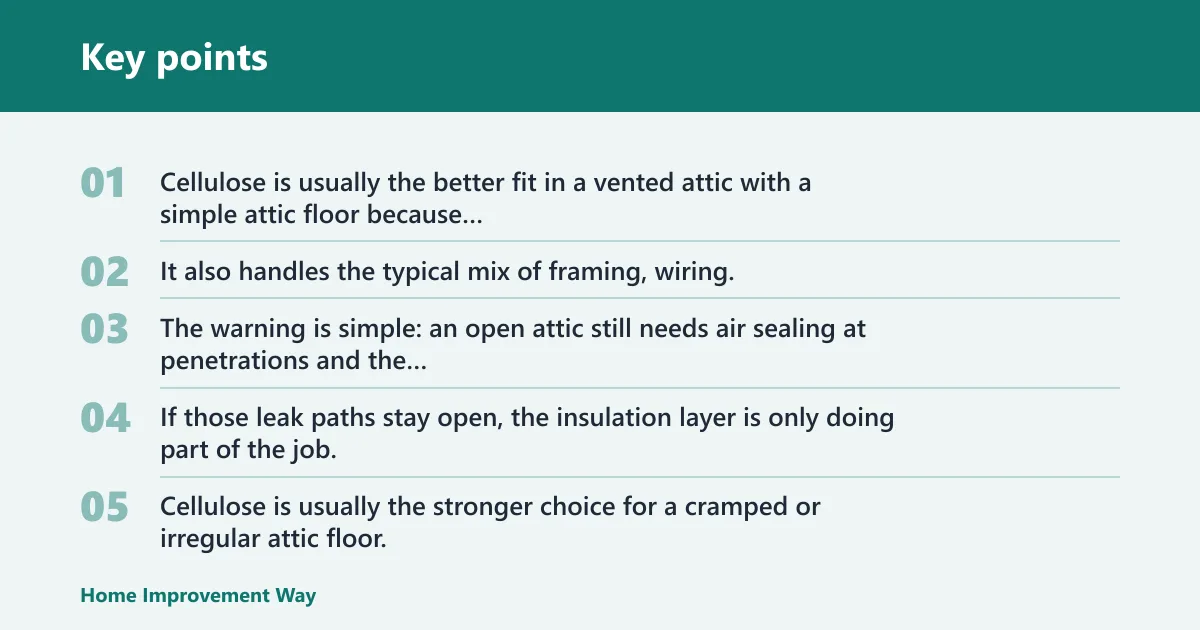
Cellulose is usually the better fit in a vented attic with a simple attic floor because it covers the joist field evenly and limits air movement better than fiberglass alone. It also handles the typical mix of framing, wiring, and small obstructions better than batts.
The warning is simple: an open attic still needs air sealing at penetrations and the hatch. If those leak paths stay open, the insulation layer is only doing part of the job.
Cramped or irregular attic
Cellulose is usually the stronger choice for a cramped or irregular attic floor. Loose-fill can flow around odd framing, small cavities, and partial obstructions that make batt placement uneven.
The risk is underfilling. If the installer does not follow the coverage chart or checks depth only in the center of the attic, the edges and corners can end up thin.
Moisture-prone attic
fiberglass insulation is the safer pick when an attic has a moisture history, but only after roof leaks and condensation sources are fixed. The goal is not to install over damp material and hope for the best.
If the attic has stains, frost patterns, or a history of roof leaks, get the moisture issue corrected first. Wet insulation cuts performance no matter what you choose.
Top-up over existing insulation
Cellulose is often the better top-up material because loose-fill can bridge over uneven existing insulation and fill low spots more effectively than batts. It also works well when you are trying to raise attic R-value without tearing out the old layer.
Be careful with the added depth. A top-up should be based on the target R-value, the existing depth, and the cellulosic settling allowance from the coverage chart.
DIY installation
fiberglass insulation is usually the easier DIY choice when the attic is simple and open. Batts can be measured, cut, and set by hand without rental equipment.
That said, loose-fill cellulose or loose-fill fiberglass may still be better for coverage in difficult attics. If you choose them, plan for blower equipment, even coverage, and a careful final depth check.
Choose Cellulose if… / Choose fiberglass insulation if…
Choose cellulose if your attic is open, irregular, or being topped up and you want better coverage over the attic floor. Choose fiberglass insulation if the attic is damp, simple, or a DIY project where batts are easier to place and handle. Neither is the first fix for leaks or moisture.
- Choose Cellulose if you need loose-fill coverage over wires, pipes, and uneven joists.
- Choose Cellulose if you are trying to limit air movement in a vented attic floor.
- Choose Cellulose if you are topping up existing insulation and need better fill around old, uneven material.
- Choose fiberglass insulation if moisture risk is part of the attic problem and the roof has already been repaired.
- Choose fiberglass insulation if you want the easier DIY path and the attic layout is simple enough for batts.
- Choose fiberglass insulation if you need a lower-weight material and plan to install it without blowing equipment.

Frequently asked questions
Is cellulose or fiberglass insulation better for attic?
Cellulose is usually better for irregular, leaky, or top-up attic jobs because it fills around obstacles more completely and can limit air movement better. fiberglass insulation is usually better for simple, dry attics where low weight and easier handling matter more. The attic condition should decide the material.
Does cellulose insulate better than fiberglass in an attic?
In many attic situations, cellulose performs better in the real world because it covers irregular spaces more completely and can reduce air leakage more than fiberglass. That advantage depends on correct depth, air sealing, and keeping the material dry. If those steps are skipped, the benefit shrinks fast.
Is blown fiberglass or cellulose cheaper for an attic?
The cited material cost for both is about $0.40 per square foot, so upfront price alone does not settle the choice. Installed cost changes with blower rental, labor, depth needed, and how much coverage each product needs to reach the target R-value. The attic layout changes the bill.
Do I still need air sealing if I use cellulose insulation?
Yes. Cellulose does not make leak sealing optional. You still need to seal around wires, pipes, lights, the attic hatch, and other openings before or alongside insulation because air can still move through those paths and reduce the attic’s real performance.
How much insulation do I need to reach my target attic R-value?
Use the product’s coverage chart and your target R-value to work backward from square footage and installed depth. For cellulose, the chart matters because settling can reach up to 20% in attics. For fiberglass, depth depends on the specific form and product rating, so measure the finished layer, not the guess.
Sponsored / affiliate links. As an Amazon Associate I earn from qualifying purchases. I may earn additional commission from eligible campaigns.