
What Is the Best Permanent Window Draft Seal?
A common rule of thumb is that the best permanent window draft seal depends on the gap: use caulk for fixed frame joints up to about 1/4 inch, weatherstripping for moving sashes, and consider glass or sash repair when the opening is larger or the parts no longer meet. A poor match leaves air leaks in place, pushes utility costs up, and can hold moisture against trim or drywall. This guide shows how to choose the right permanent seal by window type, gap size, and budget.
Best seal by gap type
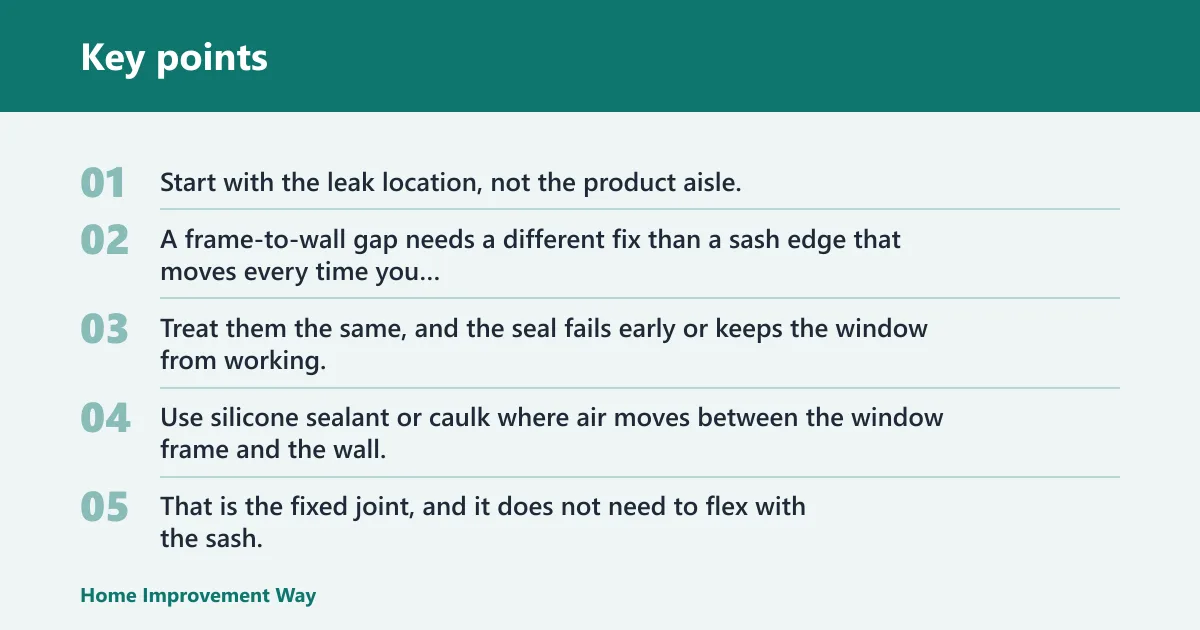


Start with the leak location, not the product aisle. A frame-to-wall gap needs a different fix than a sash edge that moves every time you open the window. Treat them the same, and the seal fails early or keeps the window from working.
Frame-to-wall gaps
Use silicone sealant or caulk where air moves between the window frame and the wall. That is the fixed joint, and it does not need to flex with the sash. Silicone sealant is listed for gaps between the frame and wall and is described as high durability, lasting 5-10 years.
Window sash gaps
Use weatherstripping at moving edges, not caulk. On sash windows, the goal is to stop air while preserving travel. Brush strips, pile weather strips, and V-strips can work at moving interfaces when the window still has to open and close.
Moving edges on operable windows
For casement and sash windows, choose a seal that compresses or slides without binding. Self-adhesive foam weatherstripping compresses against the frame and is rated very low cost and easy to install. V-strips are suitable for casement and sash windows and sit along the moving edge.
Window draft seal decision matrix
This table separates permanent sealing from semi-permanent fixes. “Permanent-ish” means long-lasting for that location, not forever. Movement, sunlight, and surface wear still matter.
| Gap location | Window type | Best permanent-ish seal | Expected durability | What fails if you choose wrong |
|---|---|---|---|---|
| Frame to wall | Any fixed frame | Silicone sealant or caulk | 5-10 years | Movement breaks tape or weatherstripping, or caulk on a moving joint cracks and opens again |
| Sash edge or meeting rail | Sliding sash window | Brush strips / pile weather strips | 3-5 years | Caulk blocks movement; foam compresses too hard or tears; the sash sticks |
| Stiles and edges on operable windows | Casement or sash window | V-strips / tension seals | Medium durability | Seal placed across the wrong face can drag, peel, or leave gaps at corners |
| Small, flat, temporary overlap | Any smooth window surface | Transparent weather sealing tape | Short to medium, product-dependent | Dirty or textured surfaces cause peeling; residue risk rises on removal |
| Single-glazed pane area | Fixed or low-use window | Insulating window film kit | One season | It is seasonal only; it will not solve a structural gap or a stuck sash |
What is the best permanent window draft seal?
For fixed gaps, the best long-life answer is silicone sealant or caulk at the frame-to-wall joint. For windows that still must open, the best answer is weatherstripping matched to the sash design. For old wood windows with failed parts, repair or reglazing is usually better than adding more sealant.
For fixed gaps
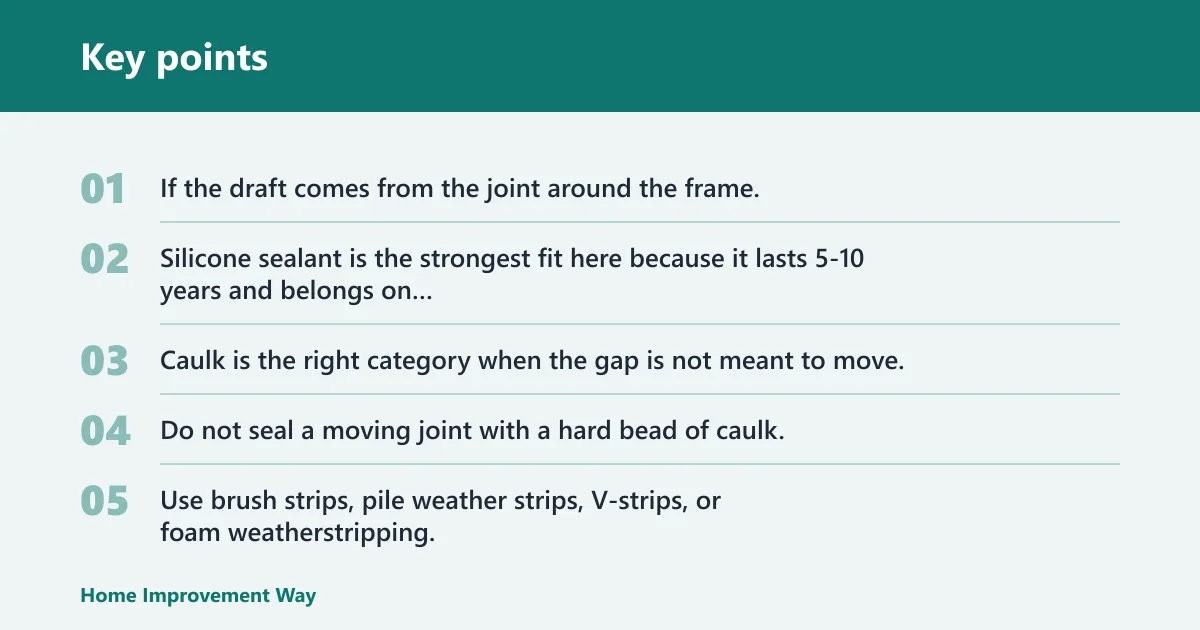
If the draft comes from the joint around the frame, use sealant made for stationary building joints. Silicone sealant is the strongest fit here because it lasts 5-10 years and belongs on gaps between the frame and wall. Caulk is the right category when the gap is not meant to move.
For windows that still must open
Do not seal a moving joint with a hard bead of caulk. Use brush strips, pile weather strips, V-strips, or foam weatherstripping, depending on the window type and clearance. The seal has to compress or slide, or the sash will bind and the air leak will return through a new opening.
For old wood windows
Old wood windows often need repair before they need more sealant. A swollen sash, loose glazing, or a warped meeting rail can make weatherstripping fail fast. If the wood no longer closes evenly, a new strip may only hide the problem for a short time.
Say your 30-inch-wide sash window closes with a visible daylight line at one side but still opens. A pile weather strip in the sash channel is a better fix than caulk, because the sash still needs to move and the leak is at the moving edge, not the wall joint.
Caulk and sealant for fixed gaps
Silicone sealant belongs where the frame meets the wall or where an exterior joint is stationary. It is the best outdoor window sealant choice when the gap is fixed and exposed to weather. It is not the best choice for sash edges, hinges, or any surface that moves.
Where silicone sealant fits
Use silicone sealant on exterior or interior frame-to-wall gaps after the surface is clean, dry, and stable. It is listed for gaps between the frame and wall and has high durability, lasting 5-10 years. That makes it a strong option for fixed trim joints and other nonmoving seams.
When caulk is the wrong choice
Caulk is wrong on moving parts. If you run a hard bead across a sash edge, the window may stick shut or scrape the seal away the first time you open it. The wrong seal can also pull loose and leave a ragged gap that looks fixed from a distance.
Exterior versus interior use
For exterior joints, choose a product rated for outdoor exposure and prepare for weather and UV wear. For interior joints, focus on cleanliness and adhesion. In both cases, remove loose paint, dust, and old failing sealant first, or the new bead will follow the old failure line.
Weatherstripping for moving windows

Weatherstripping is the right category for operable windows. It stops air at moving edges while leaving room for the sash to slide or swing. That is why the best product changes with window type. A sliding sash and a casement do not need the same profile.
Self-adhesive foam weatherstripping
Self-adhesive foam weatherstripping is very low cost and easy to install. It compresses against the frame, which makes it useful on casement windows where the sash closes against a fixed stop. Its typical lifespan is 1-3 years, so it is better for simple DIY fixes than for long service.
Brush strips and pile weather strips
Brush strips are recommended for sliding sash windows. They allow movement while filling the small gaps inside channels and along sash edges. Their typical lifespan is 3-5 years, which makes them a stronger long-term choice than foam on many sash setups.
V-strips and tension seals
V-strips are suitable for casement and sash windows. They run along moving edges and create a spring-like seal that works when the sash closes. They are a good middle ground: low cost, medium durability, and less likely than caulk to block operation.
Picture an older double-hung window where the bottom sash rattles but still slides. A brush strip in the channel can cut the air leak without freezing the sash. If you used caulk there instead, the window would lose movement and likely need repair sooner.
Do tape, film, or curtains count as permanent?
Not usually. Transparent weather sealing tape, insulating window film, and thermal curtains can all reduce air leaks, but they are support measures rather than true permanent repairs. Tape depends on surface prep, film is seasonal, and curtains do not close the gap at the source.
Transparent weather sealing tape
Transparent weather sealing tape has a discreet look and can be used on windows and doors. The residue-free removal claim depends on the product, so do not assume every tape will lift cleanly later. It also needs clean, dry, smooth surfaces to bond well.
Insulating window film kits
Insulating window film is a low-cost option at £10-£20 per kit and is described as lasting one season. It works best on single-glazed windows and can help cut heat loss for cold months. It is a seasonal layer, not a structural seal.
Thermal curtains
Thermal curtains are a durable add-on that works year-round and pairs well with other measures. They reduce heat loss and can help with condensation control near the glass. They do not seal the gap by themselves, but they can improve comfort when the leak source is already treated.
One common first-timer mistake is putting tape over dusty paint and expecting it to last through winter. The tape may hold for a few days, then lift at the corners and leave an ugly edge. Surface prep matters more than the label on the roll.
When a seal is not enough
Use sealant only when the parts still meet properly. If the sash is warped, the frame is out of square, or the glazing has failed, more weatherstripping only delays the real fix. At that point, repair or replacement is the lasting answer.
Failed sash repair
A sash that will not stay aligned can reopen the same air leak after every season. If the wood is swollen, cracked, or loose at the joints, the best fix may be repair of the sash itself, including reglazing or hardware work. New strips will not correct a bad fit.
Warped frame problems
When the frame is bowed or the opening is uneven, a seal may compress on one side and leave a gap on the other. That can happen on old wood windows especially. The symptom is a draft that changes with weather because the frame movement changes the gap.
When replacement makes more sense
If the window is badly damaged, hard to operate, or repeatedly fails after repair, replacement may be the better investment. This is especially true when the gap is large, the sash no longer meets the stop, or moisture damage has spread into the surrounding trim or wall.
How do I seal drafts around windows for good?
Seal drafts for good by matching the material to the gap, then checking that the window still works. Clean the surface, seal fixed joints with caulk or silicone, add weatherstripping to moving parts, and use film or curtains only as support. If the window no longer fits, repair it first.
- Find the leak point: frame-to-wall, sash edge, or pane area.
- Check whether the window must still open and close.
- Choose caulk or silicone for fixed joints.
- Choose foam, brush strip, pile strip, or V-strip for moving edges.
- Clean and dry the surface before applying anything adhesive.
- Test the window after installation to make sure it still moves freely.
- Inspect the seal each season and replace worn strips before they fail completely.
Frequently asked questions
Should I use weatherstripping, caulk, or tape on windows?
Use weatherstripping on moving parts, caulk on fixed joints, and tape when you want a discreet, removable option on smooth surfaces. Tape is not a universal fix. It works best on clean, dry, flat material and is less suited to rough trim or joints that move.
What is the best sealant for window frames?
For frame-to-wall gaps, silicone sealant is the strongest long-life choice here. It is listed for gaps between the frame and wall and is described as high durability, lasting 5-10 years. Use it only on fixed joints, not on sashes or hinges that need to move.
How long does window weatherstripping last?
It depends on the type. Self-adhesive foam weatherstripping is about 1-3 years, brush strips are 3-5 years, and V-strips are a medium-durability option. Wear comes from compression, friction, and sunlight, so inspect the seal each season and replace it before the gap returns.
Which window seal works best for old wood windows?
Old wood windows usually do best with a repair-first approach. If the sash still moves, brush strips or V-strips can work on the moving edges. If the wood is swollen, warped, or loose, sealing alone may fail quickly. Reglazing or sash repair may be the lasting fix.
Sponsored / affiliate links. As an Amazon Associate I earn from qualifying purchases. I may earn additional commission from eligible campaigns.