Garage Door Closes Then Reverses: Sensor, Track Checks
If your garage door starts to close and then reverses, inspect the photo eyes first. If the door reverses near the floor, look for track drag, binding, or balance problems. Ignoring it can leave the door stuck open, strain the opener, or point to a safety fault. This guide maps the reversal point and symptoms to the most likely cause.
Why does the door reverse?
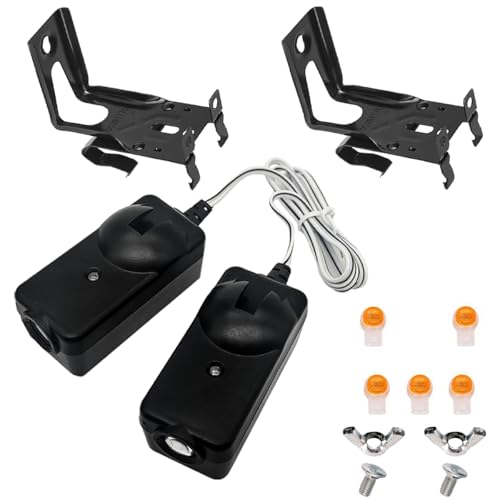
A garage door that closes and then reverses is usually reacting to either a sensor fault or extra resistance. Early reversal points to the photo eyes or opener settings, though some openers can also reverse immediately because of limit or logic faults. Reversal near the floor points more often to drag from the tracks, rollers, seal, floor contact, or balance problems.
Early reversal, mid-close reversal, and near-floor reversal
The point where the door turns back is a strong clue. A door that reverses right away often has a photo-eye issue or an opener fault, while a door that gets halfway down before reversing more often points to resistance, a low force setting, or a travel-limit problem. If the reversal happens only in the last few inches, inspect the bottom seal, floor, and lower track area first.
Opener safety logic can add another clue. On most openers, indicator lights show sensor status, and some systems require the wall button to be held to close when the sensors are unhappy. That behavior does not mean the sensors should be bypassed; it means the opener is protecting the opening and needs the fault found.
How to read grinding, jerking, or a sudden stop
Noise matters. Closing-only grinding often points to rollers, hinges, tracks, cables, or opener drive strain, and grinding usually suggests metal-on-metal wear. Jerking or a sudden stop fits binding, bent track sections, a failing roller, or a door that is out of balance and too heavy for the opener to move cleanly.
Garage door troubleshooting matrix
This table separates the symptom pattern from the likely cause category so you can avoid random adjustments. Start with the row that best matches what you see and hear, then stop at the first sign of wiring damage, spring trouble, or a door that will not move smoothly by hand.
| Symptom pattern | Likely cause category | Safe homeowner checks | Stop-DIY threshold |
|---|---|---|---|
| Reverses immediately after starting to close | Photo-eye alignment, dirt, wiring, bracket position, or sunlight interference | Wipe the sensor lenses, check that both indicators look normal, confirm the beam path is clear, and look for bright sun hitting one sensor | Stop if the wiring is damaged, the sensor brackets will not stay aligned, or the fault remains after cleaning and a careful alignment check |
| Reverses partway down, after several feet of travel | Track drag, roller wear, opener force set too low, or travel limit set too early | Inspect track alignment, loose brackets, dents, corrosion, debris, roller condition, and whether the door feels smooth by hand when disconnected | Stop if the door binds hard, the track is bent, or the door feels unusually heavy or uneven by hand |
| Reverses only near the floor | Bottom seal drag, uneven floor contact, lower track obstruction, or resistance from the last section of travel | Look for a stiff seal, cracked seal, floor slope, debris at the threshold, and lower track contact marks | Stop if the door scrapes the floor hard, the seal is torn badly, or the door seems to twist at the bottom |
| Reverses with blinking lights or a wall button that must be held to close | Sensor fault or beam interruption | Check the sensor lights, clean the lenses, confirm the beam path is open, and test for direct sunlight interference | Stop if the opener gives repeated blink codes, the sensors will not stay lit normally, or the close circuit behaves unpredictably |
| Reverses with grinding or jerking | Roller wear, bearing failure, bent track, loose hardware, cable trouble, or opener drive strain | Inspect rollers for flat spots, wobble, or rough motion; check hinges, brackets, and track fasteners for looseness | Stop if a cable is loose, a spring looks broken, or the door jerks enough to threaten derailment |
Use the matrix as a decision path, not a guess list. If the problem starts at the beam, stay in the sensor branch. If the door gets farther down before reversing, move to the resistance branch and inspect the door itself before touching opener settings.
Are the photo eyes the problem?
Photo-eye sensor trouble is the first thing to check when a door reverses before closing. The sensors are mounted near the bottom of the garage door tracks, and they send an invisible beam across the opening. If that beam is blocked, misaligned, dirty, or affected by wiring or bracket position, the opener may refuse to close.
Clean, align, and inspect the sensors
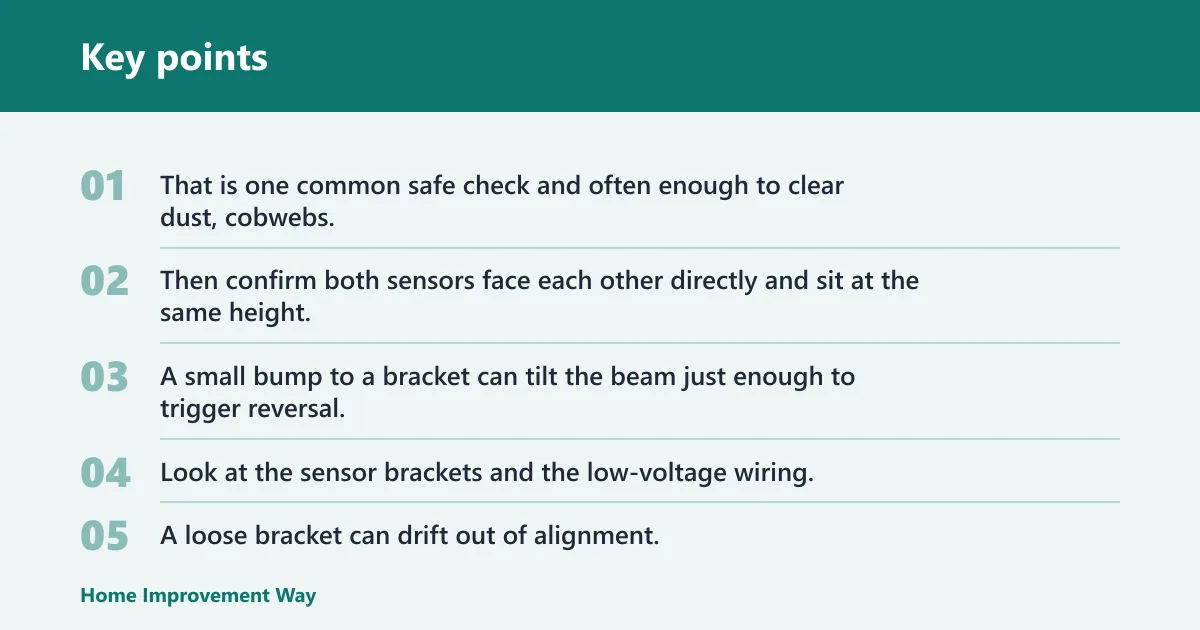
Wipe the sensor lenses first. That is one common safe check and often enough to clear dust, cobwebs, or film on the lens. Then confirm both sensors face each other directly and sit at the same height. A small bump to a bracket can tilt the beam just enough to trigger reversal.
Check brackets, wiring, and indicator lights
Look at the sensor brackets and the low-voltage wiring. A loose bracket can drift out of alignment, and a damaged wire can cause intermittent faults that come and go with door movement. Most openers use indicator lights to show sensor status, so a dim, off, or flashing light can be a useful clue.
Look for sunlight interference or blocked beam path
Bright sun can worsen sensor-related closing problems. That happens most often when sunlight hits one eye directly or floods the opening at a low angle. If the door closes at night but not in late afternoon, sunlight interference becomes a strong suspect. Do not bypass the sensors to “test” the opener.
Picture a south-facing garage where the door closes fine before noon, then reverses every evening. If the lenses are clean and the brackets look straight, the beam may be getting washed out by sun glare rather than blocked by debris.
How do you tell sensor trouble from resistance?
Sensor trouble usually shows up immediately, often with blinking lights or a close cycle that will not start normally. Resistance problems usually appear after the door begins moving and may come with grinding, jerking, or a reversal near the floor. The reversal point, sound, and door feel all help separate the two.
Track alignment, dents, corrosion, and loose hardware
Inspect both tracks from top to bottom. Look for dents, corrosion, debris, and loose brackets that could narrow the path. Even a small inward bend can create drag at one roller and make the opener think the door is hitting an obstacle. Tracks should be secure and parallel to the door path.
Roller wear, flat spots, and bearing failure
Rollers can create resistance if they wear unevenly, develop flat spots, or lose bearing smoothness. Nylon rollers tend to run quieter than steel rollers, but either type can fail. A worn roller may chatter, wobble, or bind under load, and that extra drag can trigger reversal if the opener senses more resistance than expected.
Bottom seal drag and uneven floor contact
A bad bottom seal or an uneven floor can make the opener think the door has struck an obstruction. If the seal is stiff, torn, swollen, or packed with grit, the last inches of travel may feel tight. Uneven concrete can create early contact on one side, especially on wider doors.
Suppose the door closes most of the way, then reopens the last 2 inches every time. If the sensors stay lit normally and the tracks look straight, the bottom seal or floor may be the issue, not the photo eyes.
Could the opener settings be wrong?
Yes. The opener’s close force setting can be too low and cause a false reversal even when the door and sensors are fine. Force settings are not the same as travel limit settings. One controls how much resistance the opener tolerates; the other tells it where to stop fully open or fully closed.
Down-force setting versus travel limits
A low down-force setting can make the opener reverse when the door is actually moving normally but meets a little resistance. A mis-set travel limit can also cause the door to stop or reverse before fully closing. Those two adjustments are separate, so changing one will not fix the other.
When a small adjustment is reasonable
If the door is sound, the sensors are clean and aligned, and the reversal points to resistance rather than beam trouble, a small force adjustment may be reasonable. Make only the smallest adjustment the opener allows. Do not keep turning the setting in large steps, because that can hide the real problem or create a safety risk.
Why you should retest after each change
After each force adjustment, retest the door carefully with an object under it. Use the opener’s own reversal test procedure instead of a generic block. Adjust a little, then test again. If the door does not reverse when it should, stop and return the setting before looking elsewhere.
What if the door is out of balance?
An out-of-balance door strains the opener and can trigger reversal even when the sensors and opener settings look normal. If the springs are losing support or a cable problem is changing how the door hangs, the opener may meet more resistance than it was designed to handle. Spring work is not a DIY task.
How balance affects opener strain
A balanced door should move with far less effort when disconnected from the opener. Use the emergency release only with the door fully closed and clear of people and property; do not disconnect it with the door open. If it feels heavy, drifts, or does not stay where it is placed, the spring system may not be supporting it correctly. That extra load can make the opener reverse, stall, or grind as it tries to finish the close cycle.
Signs of spring or cable trouble
Watch for uneven travel, a crooked door, visible cable slack, or a door that starts smooth and then binds hard. Loud snaps, a door that hangs one-sided, or a sudden change in lifting effort are warning signs. Do not attempt spring or cable repairs yourself.
When to stop and call a pro
Stop DIY if the door is clearly out of balance, a cable is loose or damaged, or the door seems to twist in the tracks. Also stop if the opener reverses after repeated small adjustments and the mechanical parts still feel rough. At that point, the problem is beyond routine homeowner checks.
Frequently asked questions
Why does my garage door close then reverse right away?
Right-away reversal usually points to the photo eyes, because the opener sees a fault before the door gets far. Check for dirty lenses, poor alignment, a blocked beam path, loose brackets, or sunlight interference. If the sensors look normal and the door still reverses immediately, the wiring or opener logic may need attention.
How do I know if the garage door sensors are misaligned?
Start with the indicator lights. If one sensor light is off, dim, or acting differently from the other, alignment is a likely issue. Make sure both sensors are mounted near the bottom of the tracks and face each other directly. A loose bracket can throw the beam off even when the sensors look clean.
Can dirty sensors make a garage door reverse?
Yes. Dust, cobwebs, and film on the lenses can interrupt the invisible beam and make the opener reverse or refuse to close. Wiping the lenses is one common safe check. If cleaning helps only briefly, look for a loose bracket, misaligned beam, or sunlight hitting one sensor directly.
What if the door reverses but the sensor lights look normal?
If the sensor lights look normal, the cause may be resistance rather than a beam fault. Check the tracks for dents, corrosion, debris, or loose hardware, then inspect the rollers for wear or bearing failure. A stiff bottom seal or uneven floor can also trigger reversal near the end of travel.
Could bent tracks or worn rollers cause a reverse?
Yes. Bent tracks and worn rollers can create enough drag for the opener to reverse, especially mid-close or near the floor. Look for flat spots, wobble, or rough movement in the rollers, and check for track sections that pinch the door path. Grinding or jerking makes this branch more likely.
When is a reversing garage door unsafe to keep using?
Stop using it if the door will not close reliably, if wiring is damaged, if a spring or cable looks wrong, or if the door jerks hard enough to risk derailment. A door that reverses unpredictably can leave the opening unsecured and may signal a failure that needs professional repair.
Sponsored / affiliate links. As an Amazon Associate I earn from qualifying purchases. I may earn additional commission from eligible campaigns.