
Why Is Frost Forming Around My Bathroom Exhaust Vent in Winter?
Frost around a bathroom exhaust vent in winter usually means warm, moist air is reaching a cold surface through duct leakage, poor insulation, a blocked cap, or roof ice backup. Leave it alone, and you can end up with wet drywall, mold, attic rot, or a fan that stops moving air. This guide shows how to tell condensation, air leakage, vent blockage, and ice dam backup apart before the next thaw.
Why frost forms around bathroom vents
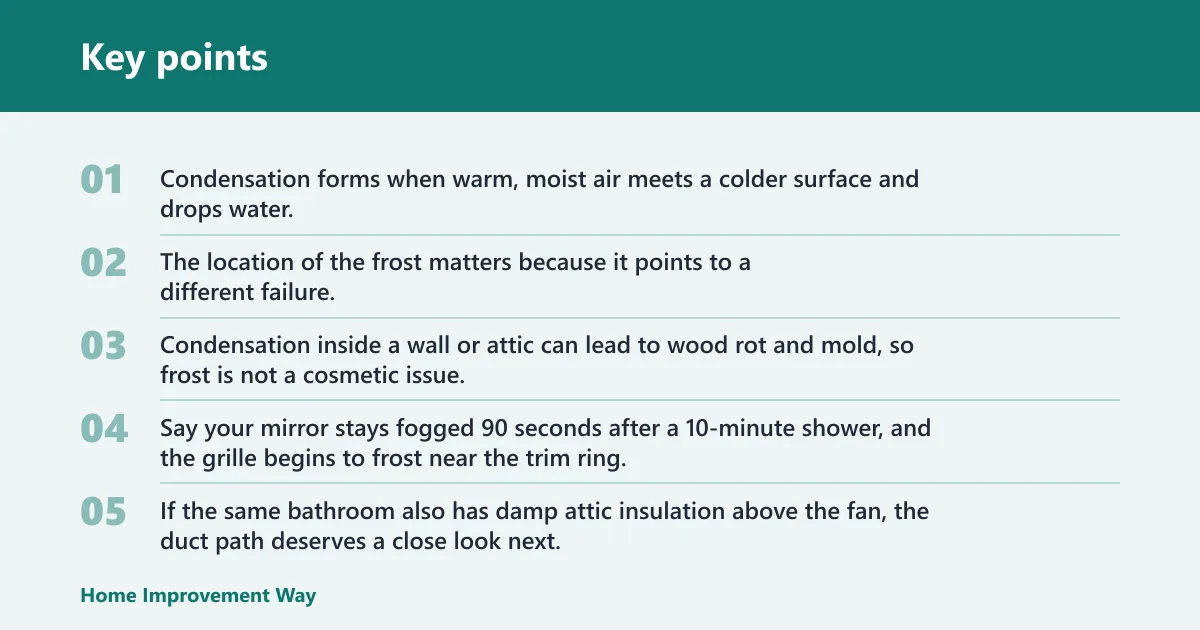


Condensation forms when warm, moist air meets a colder surface and drops water. Around a bathroom exhaust vent, that cold surface may be the grille, the duct in the attic, the roof or wall cap, or the roof deck near an ice dam. The location of the frost matters because it points to a different failure.
That failure can turn into a second problem during a thaw. Condensation inside a wall or attic can lead to wood rot and mold, so frost is not a cosmetic issue. It means moist air is moving, trapped, or cooling in the wrong place.
Bathroom vent frost diagnosis table
| Symptom location | Likely cause | Quick homeowner check | Next action |
|---|---|---|---|
| Frost at the ceiling grille | Warm moist air leaking back at the fan housing, loose grille fit, or weak air movement that leaves humid air near the opening | Run the fan for about 15 to 20 minutes after showering and check for air movement at the grille. | Seal obvious gaps, confirm the fan is exhausting outside, and check that the fan moves enough air |
| Frost at the attic-side duct | Uninsulated, disconnected, crushed, or too-long duct that cools moist air before it reaches the exterior | Inspect the attic section for missing insulation, sagging flex duct, or open joints | Reconnect, shorten, insulate, and seal the duct joints |
| Frost at the roof cap | Restricted cap, snow cover, backdrafting, or a cap that is exposed to wind and cold enough to freeze moisture at the termination | Check the cap from outside for blockage, ice, lint, or a stuck backdraft damper | Clear the blockage and replace a damaged or undersized cap if needed |
| Repeated bathroom mirror fogging | Fan is not removing enough moisture from the room | See whether the mirror stays fogged for more than a minute after the shower | Increase fan runtime and inspect the duct, cap, and fan capacity |
Say your mirror stays fogged 90 seconds after a 10-minute shower, and the grille begins to frost near the trim ring. That points first to weak ventilation at the room side, not to the roof. If the same bathroom also has damp attic insulation above the fan, the duct path deserves a close look next.
Suppose the cap is clear outside, but frost keeps showing up on the attic-side duct. The likely issue is not the termination. It is usually cold ductwork that is either underinsulated or leaking moist air into the attic before it reaches the cap.
Is the fan venting outside or into the attic?
The bathroom exhaust fan should move moisture-laden air directly outdoors. It must not discharge into an attic, crawl space, or other interior area, and it should not end in a soffit or ridge vent. If the duct stops in the attic, the frost is a warning that the moisture path is wrong.
Signs the duct ends where it should not
-
Find the termination point.
Follow the duct as far as you can from the fan housing. If it disappears into attic insulation or ends short of a roof or wall cap, it is likely not exhausting properly. -
Look for wet insulation.
Moisture on the attic floor or on roof sheathing above the bath often means the fan is dumping humid air into the attic space. Lowe’s warns that exhausting into an open attic causes moisture buildup on the underside of the roof. -
Check nearby vents.
A duct that ends at a soffit or ridge vent is also wrong. Exhaust air may not go into a soffit or ridge vent, because that can send bathroom moisture back into the attic or roof system.
A proper bathroom exhaust fan connects to a roof cap or wall cap as the final termination point. The fan itself may be tied to a switch, timer, humidity sensor, or light/heater combo, but the control does not change the basic requirement: the final answer still has to be outdoors.
Replacement and new installation are different jobs. A replacement may reuse part of an existing path if the duct is sound and properly terminated. A new installation often needs a full route, a cap, and insulation where the duct crosses cold space. The final answer still has to be outdoors.
What a proper roof or wall termination looks like
A correct termination has a visible cap on the roof or side wall, a clear outlet, and a backdraft damper that can close when the fan is off. The duct should be sealed at joints and supported so it does not sag into pockets where water can collect. A cap buried under snow or blocked by debris can trap moisture and create frost near the termination.
Can the duct sweat in winter?
Yes. A bathroom exhaust duct can sweat in winter when moist air travels through cold air spaces and hits colder metal or plastic. Condensation forms when warm, moist air meets a colder surface, so a cold attic duct can collect water on the inside or outside if it is short on insulation or has air leaks.
Why uninsulated ducts collect moisture
ENERGY STAR recommends insulating the duct to minimize condensation. It also says to slope the duct down to a side wall where possible. That slope helps water drain instead of pooling inside the run, where it can freeze and thaw with each shower cycle.
The shortest practical route matters too. A long, winding duct has more cold surface area and more chances for leakage. A short, straight, sealed run is easier to keep warm enough to move moist air through the cold season without heavy sweating.
Crushed flex duct can make the problem worse. It reduces airflow, holds water in low spots, and adds resistance that leaves damp air in the line longer. Disconnected joints create the same result in a different form: warm air escapes early, cools fast, and leaves water behind.
-
Inspect all visible joints.
Look for loose clamps, tape failures, or gaps at the fan outlet and at the cap connection. Even a small leak can dump moist air into cold attic space and start frost at the nearest cold surface. -
Check duct insulation.
Confirm that the attic run is wrapped or boxed in insulation with no bare sections. Missing insulation is a common reason a duct sweats in winter. -
Verify the slope.
Make sure the duct does not sag into a water trap. A slight downward slope toward the wall cap or roof cap helps moisture drain instead of freezing in place.
How humidity and fan runtime affect frost
Indoor humidity rises quickly during a shower, and that extra moisture feeds frost problems. The EPA advises keeping indoor humidity below 60 percent, ideally 30 to 50 percent. If the fan shuts off too soon, the humid air stays in the room and duct long enough to condense on cold parts.
A mirror that stays fogged for more than a minute can mean the fan is not moving enough air. That is a useful clue because it tells you the problem may be airflow, not only insulation or roof conditions.
Indoor humidity targets that help
- Stay below 60 percent indoor humidity whenever possible.
- Use 30 to 50 percent as the preferred range.
- Run the fan during the shower and keep it on afterward long enough to clear steam from the room and duct.
- Open a window during showers if the weather and layout allow it, especially when the fan is weak or the bathroom is small.
Recurring bathroom mold usually points to poor ventilation. If mold returns after cleaning, the problem is not just surface moisture. It means the bathroom is holding damp air too long, and the fix usually involves longer fan runtime, better ducting, or different equipment.
Common first-timer mistake: seeing a fogged mirror and blaming the shower temperature alone. A common example is a 60-square-foot bath with the fan switched off about two minutes after the shower ends. The mirror clears slowly, the grille stays damp, and frost appears again the next cold morning. The fan runtime was the missing piece.
How to inspect the cap, duct, and attic space
Start with the visible parts. Then move outward. The goal is to find the failure point before the next thaw, because frost often shows up first while everything is still frozen and then turns into drip damage later.
-
Check the grille area.
Look for frost around the trim ring, paint bubbling, staining, or air leaks at the ceiling opening. These signs often point to room-side leakage or weak exhaust flow. -
Inspect the attic run.
Confirm that the duct is connected, insulated, and not crushed. A loose or missing section can let moist air soak insulation and freeze on roof framing. -
Examine the exterior cap.
Make sure the cap is clear of snow, lint, bird nesting material, and ice. A blocked cap can trap moist air and freeze the outlet area first. -
Compare roof and wall clues.
Roof-cap frost often points to termination blockage, wind, or roof-edge backup. Wall-cap frost more often points to cold exposure, short duct runs, or leakage at the last joint.
When is the problem a ventilation issue versus an ice dam issue? Look at where the frost starts. Frost at the grille or attic duct usually points to ventilation, insulation, or leakage. Frost or moisture concentrated near the roof edge, with evidence of thaw water on the roof deck, may point to ice dam backup as part of the problem. Do not treat every frost pattern as the same failure.
If the cap sits under drifting snow or near a roof edge that repeatedly forms ice, the exhaust can be affected even when the duct is otherwise correct. In that case, the winter fix may involve both vent maintenance and roof-edge ice control. But if the duct is emptying into the attic, the first repair is still to route it outdoors.
Frequently asked questions
Why is frost forming around my bathroom exhaust vent in winter?
Frost around the vent usually means warm, moist air is reaching a cold surface and condensing there. The source may be a leaky duct, missing insulation, a blocked cap, or roof-edge ice backup. The location of the frost is the best clue, because the fix changes with the failure point.
Is the bathroom exhaust fan venting into the attic or outside?
It should vent outside. Bathroom exhaust air must be exhausted directly to the outdoors, and it must not discharge into an attic, crawl space, or other interior area. If you find the duct ending in attic insulation or at a soffit or ridge vent, it is routed incorrectly.
Can a bathroom exhaust duct sweat when it is cold?
Yes. A cold duct can sweat when warm, moist bathroom air moves through it and meets a colder surface. This is more likely if the duct is long, uninsulated, poorly sealed, or routed through a cold attic. Condensation inside the duct can later freeze and thaw.
Should bathroom exhaust ducting be insulated in winter?
Yes, especially in cold spaces. The same source recommends insulating the duct to minimize condensation. Insulation slows the cooling of moist air inside the duct, which reduces sweating and helps prevent frost from forming on or around attic-side ductwork.
What does it mean if my bathroom mirror stays fogged after showering?
If a mirror stays fogged for more than a minute, the fan may not be moving enough air. That can mean weak fan performance, a blocked or disconnected duct, or a cap that is restricted outside. It is a practical clue that the room is holding too much moisture.
How do I stop condensation from forming around a roof vent cap?
Check the cap for blockage, snow cover, and a stuck damper. Then inspect the attic run for leaks, missing insulation, and sagging duct. A roof cap works best when the exhaust path is short, straight, sealed, and insulated, with moisture kept out of the attic entirely.
When is a bathroom exhaust problem a ventilation issue versus an ice dam issue?
If frost starts at the grille, duct, or cap, ventilation is usually the first issue to solve. If the roof edge is icy and water appears during thaw near the eaves, ice dam backup may be part of the problem. Some homes have both problems at once, but the vent path still needs to be correct.
What humidity level should I keep indoors to reduce bathroom condensation?
The EPA advises keeping indoor humidity below 60 percent, ideally between 30 and 50 percent. Staying in that range lowers the chance that shower moisture will condense on cold bathroom surfaces, attic framing, or the exhaust duct. The fan, not just the thermostat, helps keep that range in reach.
Sponsored / affiliate links. As an Amazon Associate I earn from qualifying purchases. I may earn additional commission from eligible campaigns.