How To Extract A Broken Bolt Without Drilling It Out
You can often remove a broken bolt without drilling by using specialized extraction tools, applying heat and penetrating oil, or even creating a new grip point. These methods aim to loosen the bolt’s threads and provide a way to turn it out.
What Is a Broken Bolt Scenario?
Our Pick: OSTTE Bolt Extractor Kit & Screw Extractor Set, 40 Pcs – $39.99

|
PB Blaster Penetrating Oil, 11oz 2-Pack – $15.50
Breaks the rust bond before you attempt extraction. Check on Amazon |
OEMTOOLS Mechanic’s Butane Torch – $37.99
Heat expands the surrounding metal to loosen a seized bolt. Check on Amazon |
14-Pc Screw Extractor Set w/ Left Hand Bits – $17.99
A budget-friendly alternative extractor and drill bit combo. Check on Amazon |
A broken bolt is simply a fastener that has snapped. This usually happens at the bolt’s head or near its base. The part of the bolt left behind is stuck.
It might be flush with the surface. Or, it could be recessed, making it hard to grab. This situation pops up in many places.
Think car engines, furniture assembly, or even home repairs. Any metal part held together by bolts is a potential spot for this problem.
Why does this happen? Several things can lead to a bolt breaking. Over-tightening is a big one.
You crank down too hard, and the metal can’t take it. Stress can also cause it. If the bolt has been used for a long time, it might be worn out.
Corrosion is another major player. Rust can weaken the metal. It can also make the threads stick together.
Then, when you try to turn it, it snaps instead of loosening.
My Own Close Call with a Stubborn Bolt
I remember working on an old lawnmower. It needed a new blade. Easy job, I thought.
I got to the bolts holding the blade on. One spun okay. The other one just wouldn’t budge.
I tried a little more force. Then, with a sickening snap, the head broke off. It left just a tiny stub sticking out.
My stomach dropped. I pictured spending hours drilling, messing up the threads, and buying new parts. I felt that familiar wave of annoyance and a bit of panic.
The sun was starting to set, and this was supposed to be a quick fix before the weekend. I could almost feel the metal mocking me.
I sat back for a minute, took a deep breath, and looked at the remaining bolt. It wasn’t completely flush, thankfully. There was a tiny bit of metal sticking up.
This gave me a sliver of hope. I decided to try something gentler before resorting to the drill. I grabbed some penetrating oil and a small wire brush.
I cleaned away any dirt. Then, I sprayed the oil all around the base of the broken bolt. I let it soak for a good twenty minutes.
This is key. You have to give the oil time to work its way into the threads.
After the soak, I tried again. This time, I used a small locking plier (like Vice-Grips). I clamped them down as tight as I could onto the remaining stub.
I applied slow, steady pressure. I wiggled it a little back and forth. Sometimes, this helps break the rust bond.
And you know what? It actually started to turn! It was stiff at first, making a terrible scraping sound.
But it kept going. Finally, with a last bit of effort, it came free. I cheered out loud.
It was such a relief. That experience taught me to always try soaking and careful gripping before thinking about drilling. It saved me a lot of potential trouble.
Common Bolt Materials
Steel: The most common. Strong but can rust.
Stainless Steel: Resists rust well. Good for wet areas.
Brass: Softer. Used where corrosion is high and strength isn’t critical.
Titanium: Very strong and light. Expensive.
Understanding Bolt Anatomy and Failure
To fix a broken bolt, you need to know how it works. A bolt has a head and a threaded shaft. The head gives you something to turn.
The shaft has ridges, called threads. These threads grip into a matching hole or nut. When you tighten a bolt, it pulls two things together.
This creates a strong hold.
A bolt fails when the metal breaks. This can happen in a few ways. Shearing is when it breaks across the shaft.
This often occurs due to too much sideways force. Tensile failure is when it breaks from being pulled too hard. This is common with over-tightening.
Fatigue failure is when small cracks grow over time. Vibrations can cause this. Thread stripping is when the threads get damaged.
They can’t hold anymore.
When a bolt breaks, the remaining part is stuck. Its threads might be seized. This means rust or damage has made them stick tight.
The goal is to loosen these threads. Then, you can pull the broken piece out. You want to do this without damaging the hole it was in.
Damaging the hole means more work later. You might need to re-tap the hole. This means cutting new threads.
When Drilling Seems Like the Only Way
Sometimes, a bolt breaks off very cleanly. The head might be completely gone. The broken shaft sits perfectly flush or even slightly below the surface.
In these tough cases, drilling might become your best option. Even then, there are smart ways to drill. The goal is to remove just enough material.
This releases the tension on the broken threads.
Drilling can be tricky. You need to keep the drill bit centered. If you drill off-center, you can damage the threads in the hole.
This is called “wallering out” the hole. Once the hole is drilled, you might use a bolt extractor. This is a tool that bites into the drilled hole.
Then, you turn it to unscrew the broken bolt. But we’re trying to avoid this if possible.
Signs a Bolt is Weakened
- Rust Spots: Especially on steel bolts.
- Cracks: Look for small lines on the shaft.
- Uneven Threads: Threads that look worn or damaged.
- Stripped Head: The shape for your tool is worn away.
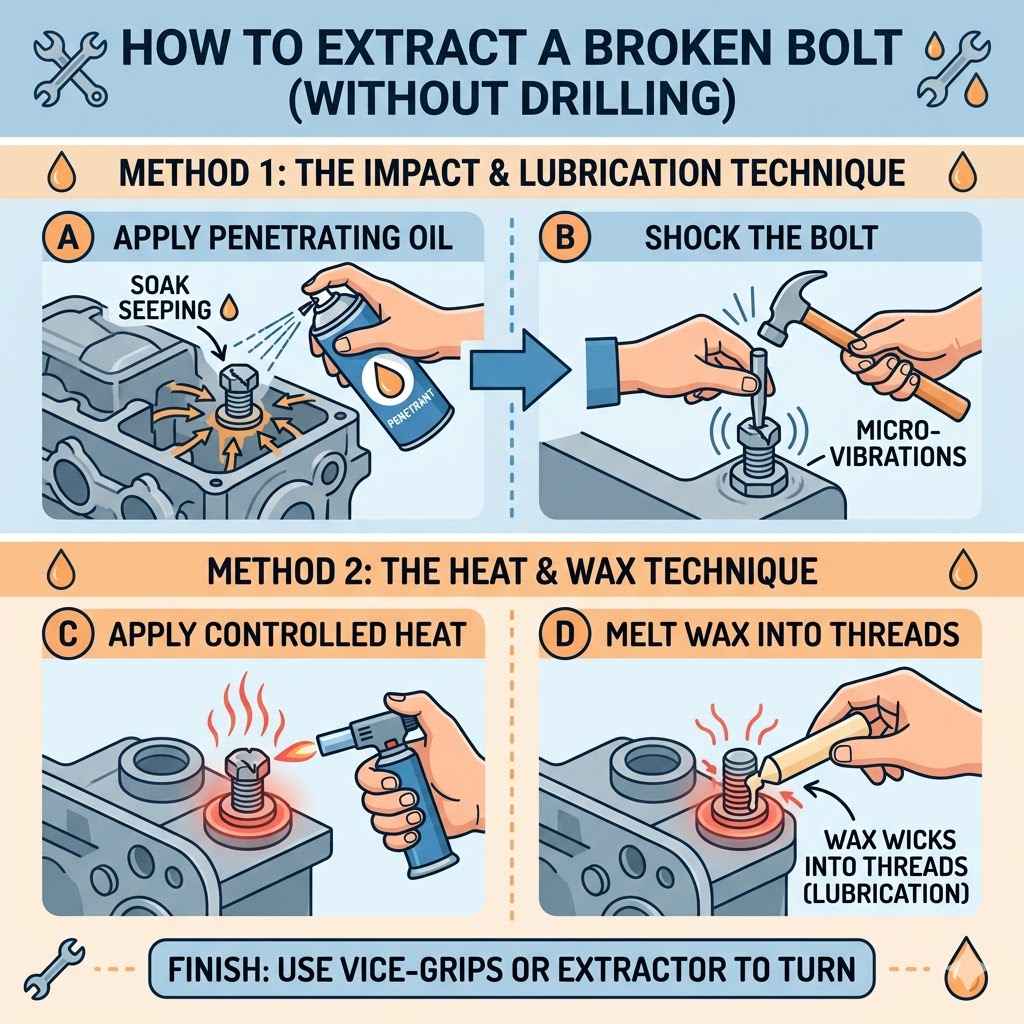
Method 1: Penetrating Oil and Patience
This is often the first and best step. Penetrating oil is a special lubricant. It’s thin and designed to creep into tight spaces.
Think of it as WD-40, but often stronger for seized parts. Brands like PB Blaster or Liquid Wrench are popular. These oils help break down rust.
They also lubricate the threads.
How to use it? First, clean the area. Remove any dirt or debris.
This lets the oil reach the threads. Then, apply a generous amount of penetrating oil. Spray it around the broken bolt.
Try to get it into any gaps you see. You need to let it soak. Patience is key here.
For really stuck bolts, this can take hours. Sometimes, it’s overnight. You might need to reapply the oil.
After soaking, you need a way to grip the broken bolt. If a small bit is sticking out, use locking pliers. Clamp them on very tightly.
Turn slowly and carefully. A slight back-and-forth rocking motion can help. This breaks the rust bond.
If the bolt is flush, you might need a different grip. A Dremel tool can cut a small slot. This allows you to use a flathead screwdriver.
Be very careful not to cut into the surrounding material.
Quick Scan: Penetrating Oil Tips
Clean First: Wipe away debris.
Soak Time: At least 30 minutes, often hours.
Reapply: Don’t be shy with the spray.
Gentle Force: Slow, steady turns work best.
Method 2: Heat and Cold Expansion
Metal expands when heated and shrinks when cooled. You can use this to your advantage. The idea is to heat the material around the bolt.
This makes it expand slightly. Then, the bolt might loosen. Or, you can heat the bolt itself.
Then, when it cools, it might shrink just enough.
How to apply heat? A heat gun is a good tool. A propane torch can also work, but be very careful.
You don’t want to melt anything or start a fire. Heat the metal surrounding the bolt. Heat it evenly.
Then, try to turn the bolt. Sometimes, applying penetrating oil after heating is effective. The heat can help draw the oil in.
Another approach is heat and then quick cooling. Heat the area around the bolt. Then, quickly spray it with water or use an upside-down can of compressed air (which sprays a very cold liquid).
This rapid cooling can cause the metal to contract. This might break the bond. Always use safety gear.
Heat can be dangerous. Wear gloves and eye protection.
Heat & Cold: What You Need
- Heat Source: Heat gun or propane torch.
- Cooling Agent: Water spray or compressed air duster.
- Safety Gear: Gloves, eye protection.
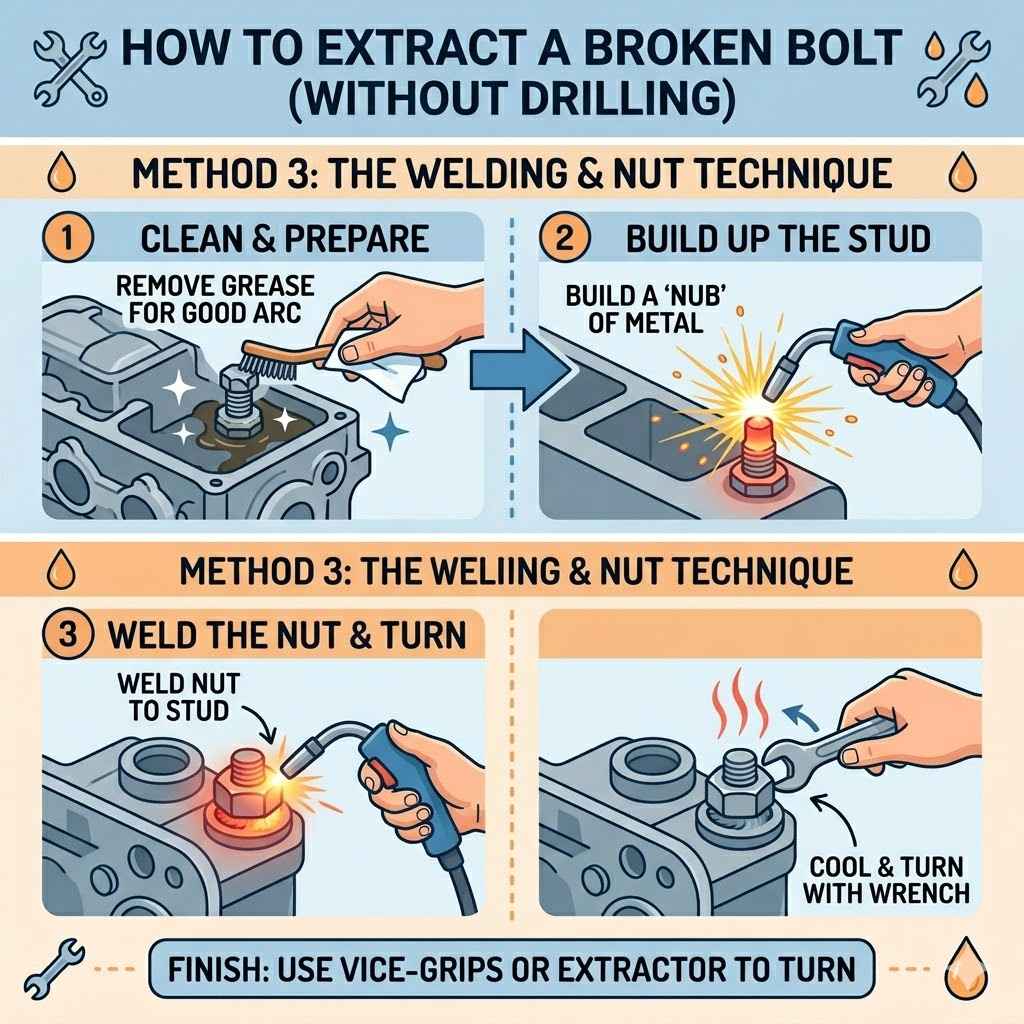
Method 3: The Nut and Weld Trick
This method is for bolts where the head has broken off. It requires a welder. You take a nut that fits the broken bolt.
Place the nut over the broken bolt. Then, you weld the inside of the nut to the top of the broken bolt. You want to create a strong bond.
The heat from welding is intense. This helps break rust and seize. It also fuses the nut to the bolt.
Once it cools slightly, you can use a wrench on the welded nut. Turn it slowly. The goal is to spin the broken bolt out.
This is a very effective method. It provides a strong grip. It also adds heat for loosening.
This method needs skill. If you’re not a welder, find someone who is. You need to be careful.
You don’t want to weld the nut to the surrounding material. That would make the problem worse. Make sure the nut is centered.
Use the right welding settings. After welding, let it cool for a moment. Then, try to turn the nut.
It might take some force.
Weld & Nut: Key Steps
Find the Right Nut: Should fit snugly.
Center it: Align the nut over the bolt.
Weld Securely: Fuse the nut to the bolt top.
Cool and Turn: Let it set, then use a wrench.
Method 4: Using a Bolt Extractor (When Other Methods Fail)
If the above methods don’t work, a bolt extractor is the next step. These are specialized tools. They are designed to grab and remove broken bolts.
Most commonly, they are screw-like. You drill a small hole into the center of the broken bolt. Then, you insert the extractor into the hole.
The extractor has reverse threads. As you turn the extractor counter-clockwise, its threads bite deeper into the bolt. This creates a strong grip.
You keep turning. The extractor should then unscrew the broken bolt. There are different types of extractors.
Some are tapered. Others are spiral-shaped.
Drilling for an extractor needs care. You must drill straight down the center. Use a drill bit smaller than the bolt’s core.
If you drill off-center, the extractor won’t grip well. It might break. Using a center punch first helps.
This creates a small indentation. It guides the drill bit. Always use sharp drill bits.
They cut cleaner and are less likely to slip.
Bolt Extractor Types
- Spiral Flute Extractors: Look like reverse-threaded screws.
- Straight Flute Extractors: Have straight grooves and are tapped in.
- Square Head Extractors: Used with a tap wrench.
Method 5: Creating a Grip with Epoxy or J-B Weld
For bolts that are mostly broken off, but not entirely gone, epoxy can work. This is similar to the welding method. You need a way to create a solid grip on the broken piece.
J-B Weld is a strong two-part epoxy. It’s very durable. You can use it to attach something to the broken bolt.
The trick here is to find something that can act as a handle. Maybe a washer, a small nut, or even a piece of metal rod. Clean the broken bolt end and the item you’ll attach.
Mix the J-B Weld. Apply it carefully to both surfaces. Press them together firmly.
Let it cure completely. This can take many hours, or even 24 hours, depending on the product.
Once cured, the J-B Weld should create a strong bond. You can then try to turn the attached item with a wrench or pliers. This transfers the turning force to the broken bolt.
This method works best when the bolt isn’t too seized. If it’s heavily rusted, the bond might break. It’s a good option when you don’t have welding equipment.
Epoxy Grip: Tips for Success
- Clean Surfaces: Essential for a strong bond.
- Use a Sturdy Grip Piece: A nut or washer works well.
- Full Cure Time: Don’t rush this step.
- Gentle Force First: Test the bond before applying full pressure.
Method 6: Cutting a Slot for a Screwdriver
This is a common trick for bolts that have broken off just at the surface or slightly above. You need a Dremel tool or a small hacksaw. The goal is to cut a slot into the top of the broken bolt.
This slot should be deep enough for a flathead screwdriver.
First, clean the area around the bolt. Use penetrating oil if you have any. Then, carefully use your cutting tool.
Spin the tool slowly. Cut a straight line across the bolt. Try not to cut into the surrounding material.
You want to create a solid notch for the screwdriver to grip.
Once the slot is cut, choose a flathead screwdriver that fits snugly. Apply firm downward pressure. Turn the screwdriver slowly.
If the bolt starts to move, great! If it’s still stuck, you might need to apply more penetrating oil. You could also try a little heat.
This method is best for bolts that aren’t severely seized.
Slotting a Bolt: What to Watch Out For
Tool Choice: Dremel with a cut-off wheel is ideal.
Center the Cut: Aim for the middle of the bolt.
Depth: Make the slot deep enough for a good screwdriver fit.
Surrounding Material: Avoid damaging it.
Real-World Context: Where Do Bolts Break?
Broken bolts are more than just an annoyance. They happen in places where stress is high. Or where corrosion is common.
Think about car engines. Bolts hold parts together under constant vibration and heat. The exhaust system bolts often rust badly.
They can break when you try to remove them.
In homes, furniture can have bolts that break. Especially if it’s assembled and disassembled often. Outdoor equipment like grills or swings are exposed to weather.
This leads to rust. Even simple things like a loose doorknob might have a tiny screw that breaks. The environment plays a huge role.
User behavior also contributes. Overtightening is a frequent mistake. People think tighter is better.
But metal has limits. Not using the right tool can also cause problems. A worn-out wrench might slip.
This can round off a bolt head. Then, it’s harder to grip. This increases the chance of breaking.
Common Locations for Broken Bolts
- Automotive: Engine parts, exhaust systems, brake components.
- Outdoor Gear: Lawn mowers, grills, garden furniture.
- Construction: Structural bolts, deck screws.
- Household: Furniture assembly, appliance repair.
What This Means for You: Knowing When It’s a Problem
Most of the time, a broken bolt is just a repair job. You can fix it. But sometimes, it signals a bigger issue.
If a bolt breaks because of a design flaw, or very poor material, that’s different. It might mean other bolts in the same area are also weak.
When is it normal? If you’re working on something old. Or something that has been exposed to harsh weather.
Rust is a big reason bolts break. It’s expected. If a bolt breaks because you forced it too hard, that’s on the user.
But it’s still fixable.
When should you worry? If a critical bolt breaks. For example, a bolt holding a wheel on a car.
Or a structural bolt in a deck. In these cases, safety is the main concern. You need to fix it correctly.
You might also worry if multiple bolts break in the same area. This could point to a manufacturing defect or an ongoing stress issue.
Simple checks can help. Look at the bolts around the broken one. Do they show signs of rust?
Are their heads worn down? Are they slightly loose? If you see these things, address them.
Use anti-seize compound on new bolts. This helps prevent future problems.
Broken Bolt Checklist
Normal Scenarios:
- Old, rusty fasteners.
- Forced removal due to seized threads.
- Exposure to elements (rain, salt).
Causes for Concern:
- Critical safety component bolt fails.
- Multiple bolts breaking in the same area.
- Bolt breaks under normal operating stress.
Quick Fixes and Tips
If a bolt breaks, don’t panic. Take a moment to assess. See what’s left of the bolt.
Is there anything sticking out? Can you get a grip on it?
Use the Right Tools: Always use tools that fit well. This reduces the chance of stripping or breaking. Good quality tools make a difference.
Locking pliers (like Vice-Grips) are very useful. They provide a strong, adjustable grip.
Penetrating Oil is Your Friend: Keep a can handy. Apply it liberally. Let it soak.
This is often the most crucial step for stubborn bolts.
Gentle and Steady: When trying to turn a broken bolt, slow and steady wins the race. Avoid jerky movements. These can break the bolt further or strip the threads.
Heat Can Help: A little bit of heat from a heat gun can loosen things up. Be careful not to overheat or damage surrounding materials.
If You Must Drill: If you have to drill, use a center punch. Drill slowly and straight. Use sharp bits.
Drill just deep enough to insert an extractor or relieve pressure.
Frequently Asked Questions
What is the easiest way to remove a broken bolt?
The easiest method usually involves penetrating oil and locking pliers if there’s enough of the bolt sticking out to grip. Apply the oil generously and let it soak for a while. Then, clamp the pliers on as tightly as possible and try to turn the bolt slowly.
Can I remove a broken bolt without any special tools?
Sometimes, yes. If a small part of the bolt is sticking out, you might be able to grip it with regular pliers or even a small vise. If it’s flush, you might be able to cut a slot with a hacksaw and use a flathead screwdriver.
However, special tools often make the job much easier and safer.
How much penetrating oil should I use on a broken bolt?
Use plenty! Penetrating oil is designed to seep into tight spaces. Don’t be shy with it.
Apply it all around the broken bolt. Let it sit for at least 30 minutes, but often several hours or even overnight for very stubborn bolts. Reapply it if needed.
What should I do if the broken bolt is really stuck and won’t turn?
If it won’t turn, try applying heat carefully to the area around the bolt. Then try again. If that doesn’t work, and you can’t get a grip, you might need to consider drilling.
If you have welding equipment, welding a nut onto the broken bolt is a very effective method. Otherwise, a bolt extractor kit might be your next best bet.
How do I avoid breaking bolts in the future?
To avoid breaking bolts, always use the correct size wrench or socket. Don’t overtighten fasteners; use a torque wrench if possible for critical applications. Apply anti-seize compound to threads, especially in areas prone to corrosion or high heat.
If a bolt feels like it’s going to break, stop and try using penetrating oil.
Is it safe to use heat to remove a broken bolt?
Using heat can be very effective, but you must be cautious. Always wear safety glasses and heat-resistant gloves. Ensure there are no flammable materials nearby.
Avoid overheating the part, especially if it’s made of aluminum or plastic. A heat gun is safer than a torch for most DIY tasks.
Conclusion
Dealing with a broken bolt is never fun. It can feel like a project-ending disaster. But with the right approach, you can often remove that stubborn piece without needing to drill.
Patience, penetrating oil, and the right tools are your best allies. Remember to assess the situation. Start with the least destructive methods first.
You’ll likely find a way to get your project back on track. Keep trying, and you’ll get that bolt out!
Sponsored / affiliate links. As an Amazon Associate I earn from qualifying purchases. I may earn additional commission from eligible campaigns.