Why Is My Space Heater Cord Hot to the Touch?
A space heater cord should feel only slightly warm; if the plug, outlet, or cord is hot to the touch, shut the heater off and unplug it, then check for overload, a loose outlet, or a damaged cord. Heat like that can melt insulation, damage the receptacle, or start a fire. This guide shows how to tell normal warmth from a bad connection, an overloaded circuit, a faulty cord, or a failing heater.
High power draw and safety warning signs
A portable space heater often draws 1,500 watts on high, which is about 12.5 amps on 120 volts. That is close to the practical limit of a 15-amp circuit when other devices are already on the same branch. Heat at the cord end often means resistance at the plug, outlet, or cord, not heat from the room air.
Why the load matters
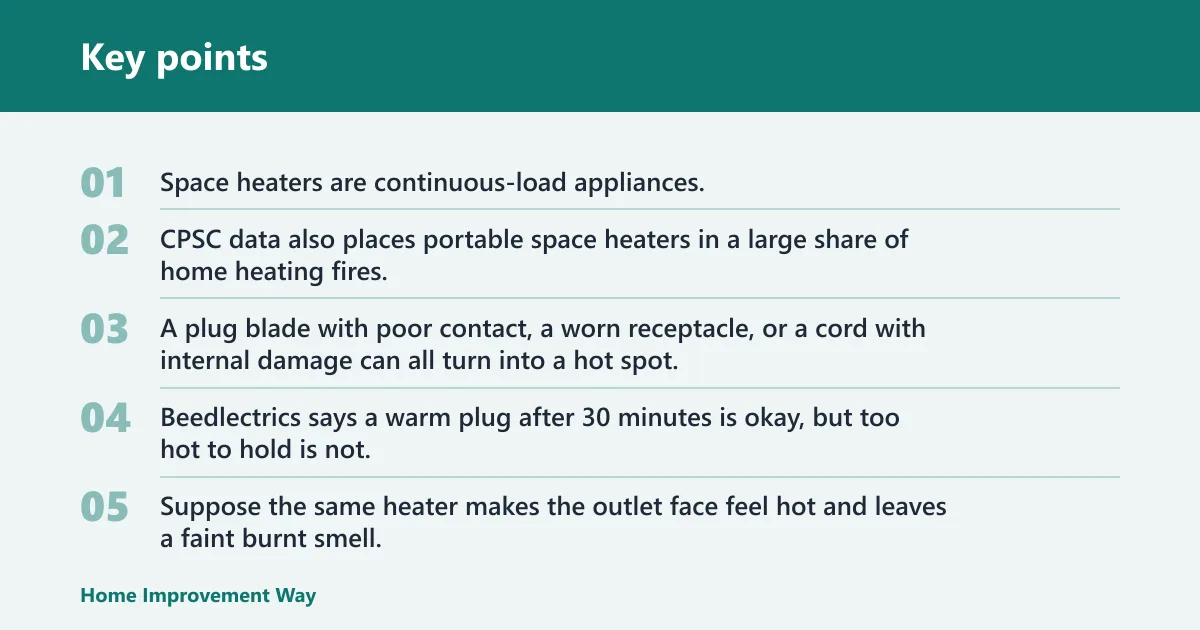
Space heaters are continuous-load appliances. They can run for long stretches, so any weak contact has time to warm up. Consumer Reports says portable space heaters caused an average of 1,600 house fires a year from 2019 to 2021, and those fires caused an average of 70 deaths annually. CPSC data also places portable space heaters in a large share of home heating fires. (Consumerreports)
That is why a heater that seems “fine” for a few minutes can still reveal a problem after 20 to 30 minutes. Heat builds where current meets resistance. A plug blade with poor contact, a worn receptacle, or a cord with internal damage can all turn into a hot spot.
When warmth points to a fault
A slightly warm plug can be normal after extended use, but heat that is hard to tolerate with your fingers is a warning sign. Beedlectrics says a warm plug after 30 minutes is okay, but too hot to hold is not. Melting, discoloration, scorch marks, or a burning odor move the problem from “monitor” to “stop using now.”
Say your 1,500-watt heater warms a bedroom for half an hour and the plug feels only mildly warm. That can fit normal operation. Suppose the same heater makes the outlet face feel hot and leaves a faint burnt smell. That points to a connection problem, not a harmless warm cord.
📊 Consumer Reports advises keeping a space heater at least 3 feet from combustible materials. Source: How to Use Your Space Heater Safely.
Warm, hot, or stop using now
Use touch and damage signs together. Warm means the cord or plug feels slightly above room temperature and you can still hold it comfortably. Hot means it is uncomfortable to hold for more than a moment. Stop using now if you see melting, discoloration, a loose fit, scorch marks, arcing, or any burning odor.
Simple decision rule
- Feel the plug and outlet. If they are only warm after extended use, unplug the heater and let everything cool. Then inspect the outlet and cord end for loose fit, dirt, or visible wear.
- Look for damage. If you see frayed insulation, melted plastic, darkened blades, or a browned outlet face, stop using the heater immediately. A damaged connection can worsen fast.
- Act on heat level. If the plug is too hot to hold comfortably, treat it as a fault. Move to another properly rated wall outlet only after the cord, plug, and receptacle have been checked.
One more rule helps: if the heater is underheating at the same time the cord end is warm, suspect voltage loss or a bad connection. Low delivered power and extra heat can happen together when the cord, plug, or receptacle is resisting current flow.
Hot cord diagnosis for space heaters
| Symptom location | Likely cause | Immediate action | Who to call next |
|---|---|---|---|
| Plug blades | Poor contact at the receptacle, oxidation, or a loose plug fit | Unplug the heater, let it cool, and inspect for darkening or a loose grip | Electrician if the outlet feels loose or shows scorch marks |
| Outlet face | Worn receptacle, loose internal contact, or overload on the branch circuit | Stop using the outlet for the heater until it is checked | Electrician for receptacle replacement and circuit check |
| Entire cord | Damaged insulation, internal conductor fault, or overheating from extra resistance | Unplug and do not reuse the cord if it is warm along its length | Heater manufacturer or appliance repair service |
| Cord near heater | Strain relief stress, loose plug connection, or heater-side wiring issue | Check for softening, cracking, or discoloration near the heater body | Manufacturer support or qualified repair technician |
Can you use a space heater on an extension cord?
No. CNET says space heaters should never be plugged into an extension cord, and that is the safest default. Extra connections add resistance and heat. A 14-gauge cord can handle up to 1,800 watts, or 15 amps, but that does not make it suitable for a heater. The same caution applies to power strips and surge protectors.
Why extra connections overheat
Every extra plug, socket, or connector is another place for resistance to build. A heater already draws a heavy load, so the added resistance can warm the cord ends, soften plastic, and loosen the grip even more. That is one reason a hot cord often starts at the connection rather than the middle of the wire.
Why power strips are the wrong tool
Power strips and surge protectors are built for small electronics, not heaters with heating elements. Consumer Reports advises not to plug another electrical device or an extension cord into the same outlet as a heater. Keep the heater directly in a wall outlet whenever possible.
- Unplug the heater now. If it is on an extension cord, move it out of service at once. Do not test again through the same cord or strip.
- Find a wall outlet. Use a direct receptacle on a wall circuit that is not already carrying heavy loads. This reduces extra heat from added connections.
- Check the heater rating. If the heater is a 1,500-watt model, treat it as a high-draw appliance. Use the outlet only if the plug fits firmly and the receptacle does not feel loose.
What to check at the outlet and circuit
A hot plug can be the outlet’s fault. Loose receptacles, worn contacts, and shared branch circuits are common in older homes and apartments. Cold-weather use can also expose voltage drop or a weak connection, especially when the heater is on high and other devices are already on the same circuit.
Loose receptacles and worn contact
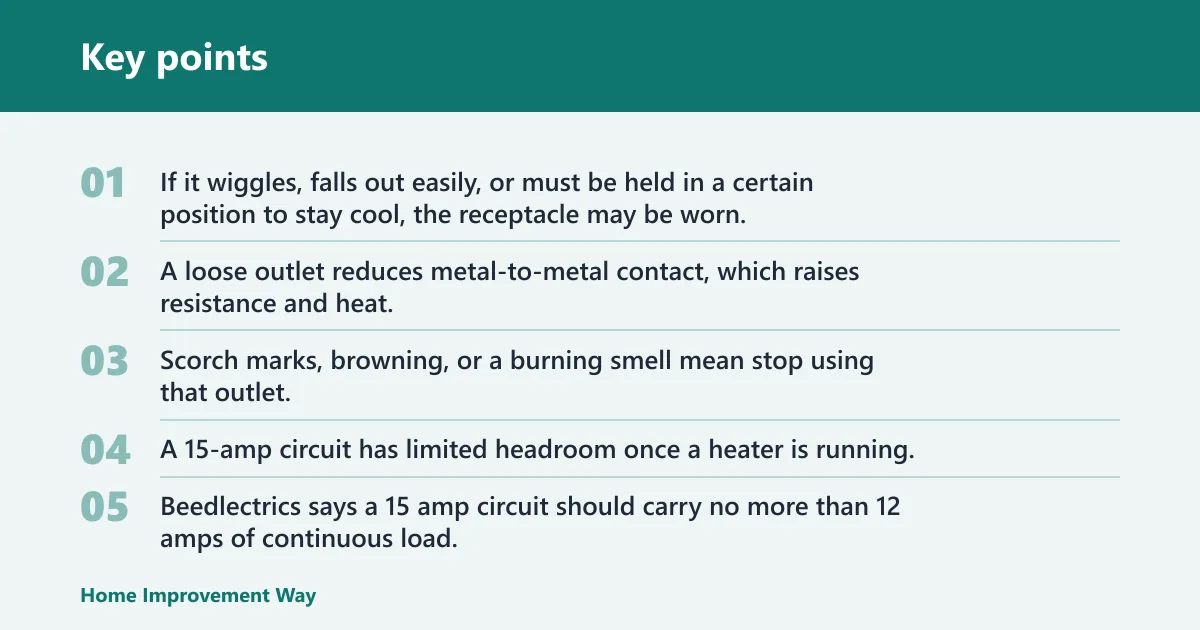
Push the heater plug in firmly. If it wiggles, falls out easily, or must be held in a certain position to stay cool, the receptacle may be worn. A loose outlet reduces metal-to-metal contact, which raises resistance and heat. Scorch marks, browning, or a burning smell mean stop using that outlet.
A 15-amp circuit has limited headroom once a heater is running. The same source says a 15 amp circuit should carry no more than 12 amps of continuous load. A 1,500-watt heater on high already uses about 12.5 amps, so a lamp, charger, or other appliance on the same circuit can push it past a safe margin.
Martinez recommends any appliance using more than 1,500 watts should be on a dedicated circuit. That is a practical target for space heaters because many home models run at the top end of a 15-amp branch. If the breaker trips, the lights dim, or the plug gets hot, the circuit is telling you it is crowded.
Cold-weather voltage drop and underheating
When voltage sags from a weak receptacle, long run, or overloaded branch, the heater may seem weaker than normal. The cord end can still warm because the problem is resistance, not useful heating. In that case, the heater may underheat the room while the plug or outlet overheats.
Picture a 1,500-watt heater in an older apartment outlet that also feeds a TV and a lamp. The room stays cool, the heater fan runs, and the plug feels warm in 20 minutes. That combination points to power-delivery loss, not a heater that is simply “small for the room.”
What to look for on the heater itself
Check the cord, plug, and heater body for damage before each use. The cord should have intact insulation, a snug strain relief, and no flattening, cuts, or melted spots. A heater with tip-over switch, overheat protection, and thermostat control is preferable, but those features do not cancel a bad cord or outlet.
Cord damage, strain relief, and plug condition
The strain relief is the part where the cord enters the heater or plug housing. If that area is cracked, soft, or bent sharply, heat may be coming from mechanical stress or internal damage. Frayed insulation, worn outer jacket, or a loose plug fit are all reasons to stop using the heater until it is repaired or replaced.
Safety features and listing marks
Look for independent safety listing marks such as UL, ETL, or CSA on the heater label. Wirecutter says many space heaters need independent safety lab approval such as ETL or UL, and most home space heaters available today need ETL or UL approval. That is a listing check, not a guarantee of safe use.
Room-use guidance
Use the heater only while you are awake and in the room. Turn it off when leaving the room or going to bed. Keep it at least 3 feet from curtains, bedding, furniture, and other combustible materials, as Consumer Reports advises. Do not leave it unattended.
Frequently asked questions
Why is my space heater cord hot to the touch?
The cord is usually hot because current is meeting resistance at the plug, outlet, strain relief, or internal wiring. A slightly warm plug after extended use can be normal, but a cord or plug that is hot to the touch is a warning sign. Unplug it and check the connection points first.
Is it normal for a heater cord to get warm?
Yes, slight warmth can be normal after the heater has run for a while, especially on high. What is not normal is a plug or outlet that is too hot to hold comfortably, smells burnt, or shows discoloration. Warm is one thing; hot and damaged is another.
Why does an electrical cord get hot?
Electrical cords get hot when resistance turns electrical energy into heat. That can happen in a loose receptacle, a worn plug blade, a damaged cord, or a connection that is carrying too much current. With a space heater, the load is high enough that small contact problems show up fast.
Can I use a space heater with an extension cord?
No. Space heaters should not be plugged into an extension cord or power strip. The added connection points increase resistance and heat, and a heater already draws a large current. Use a direct wall outlet instead, and move the heater to another circuit if the outlet or plug heats up.
What should I do if my space heater plug gets hot?
Unplug the heater and let it cool. Then inspect the plug blades, outlet face, and cord near the plug for melting, browning, looseness, or a burning smell. If the receptacle is worn or the plug still fits poorly, stop using that outlet and have it checked by an electrician.
Is my outlet overloaded if the heater cord is hot?
Not always, but it is one strong possibility. A hot cord can come from overload, a loose receptacle, or both. If the heater is on a 15-amp circuit with other devices already running, the circuit may be too crowded for a 1,500-watt load, especially in older homes or apartments.
Why is my space heater not getting hot and the cord is warm?
That combination often points to voltage loss or a poor connection. The heater may be receiving less power than it should, so the room stays cool while the plug or outlet heats up. Check for a loose receptacle, an extension cord, or another load sharing the same circuit.
Sponsored / affiliate links. As an Amazon Associate I earn from qualifying purchases. I may earn additional commission from eligible campaigns.
 Faryuan Bladeless Heater Fan, 25inch Heating & Cooling & Filter Combo Tower Fan 80° Oscillating with Remote, 9H Timer, 8 Speeds, Portable Quiet for Indoor, Bedroom, Home Office Room, White&Sliver
 MEGAWISE Portable Air Conditioner and Heater, 420W 110V Compact AC Unit with Remote Control, 1400W Cooling Capacity, 800W Heating, Dehumidifier, Fan, Sleep Timer, Champagne