Window Heat Loss Calculator
A window heat loss calculator typically estimates annual loss by multiplying window area, U-factor, and heating degree days, then dividing by 1,000. If air leaks are the real issue, sealing can beat replacement. Bad math can make a cheap window swap look better than it is and leave you paying for comfort that a weatherstrip could have fixed. This guide shows how to estimate conductive loss, separate it from draft-driven loss, and decide between replacement, storm windows, or sealing.
How is this calculated?
Press Calculate to see the math with your numbers.
What this calculator estimates
The calculator estimates conductive heat loss through the glass and frame using U-factor, area, and climate input. It does not replace a blower-door test or a whole-home heat-load calculation, and you should not use it to size a boiler or HVAC equipment.
What it counts
Use it to estimate annual BTUs lost through windows, then turn that number into fuel cost. That works best when you know the window area, the likely U-factor, and the local heating degree days. The result helps you compare one window package against another, or decide whether a modest retrofit is enough.
What it does not count
Drafts, leaky sash joints, failed weatherstripping, and loose trim can add heat loss that the glass-only math will miss. If air leakage is the real problem, a calculator based only on U-factor will overstate the value of new glass and understate the value of sealing.
When the result is useful
It works well for a room-by-room comparison, especially in homes with mixed window types. It is also useful when you want a simple payback estimate before choosing between sealing, secondary glazing, storm windows, or full replacement.
What affects window heat loss?
Three inputs drive most of the estimate: U-factor, window area, and heating degree days. Indoor temperature matters too, but for seasonal estimates the calculator usually rolls that into the degree-day method instead of asking you to model every hour of winter.
U-factor and R-value
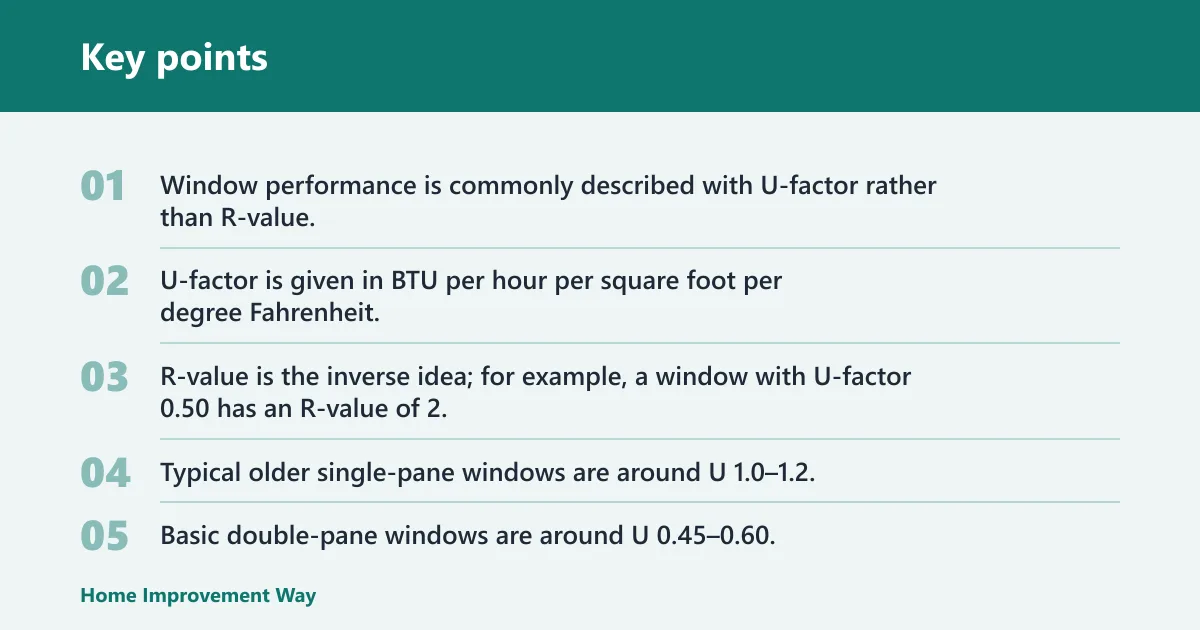
Window performance is commonly described with U-factor rather than R-value. U-factor is given in BTU per hour per square foot per degree Fahrenheit, and lower values mean less heat transfer. R-value is the inverse idea; for example, a window with U-factor 0.50 has an R-value of 2.
Typical older single-pane windows are around U 1.0–1.2. Basic double-pane windows are around U 0.45–0.60. High-efficiency double- or triple-pane windows are around U 0.20–0.35.
Window area and glazing type
Area matters because heat loss scales with exposed surface. A large older picture window can lose far more heat than a small bedroom unit, even if both have the same U-factor. For mixed homes, measure or estimate each window by room, then total the areas by type.
Start with the glazed opening, not the rough framing size. If the frame is wide, or the sash is smaller than the opening, the exact glazing area matters most for the calculation.
Heating degree days and indoor temperature
Heating degree days, or HDD, convert a per-hour loss into a seasonal estimate. A colder climate with more HDD will produce larger annual losses from the same window. KilowattKit lists NYC at 4,800 HDD and Chicago at 6,500 HDD, which shows how climate alone can shift the result.
If you keep some rooms cooler than others, the loss estimate changes a bit, but HDD remains the practical input for a homeowner-level calculation. It is a standard climate input, not a guarantee of exact fuel use.
How to calculate annual loss
The annual heat-loss formula used is Q = U × A × HDD × 24. It estimates conductive loss in BTU, then you can divide by 1,000,000 to get MMBtu because one MMBtu equals 1,000,000 BTU. From there, you can adjust for heating system efficiency and fuel cost.
Step 1: Find or estimate U-factor
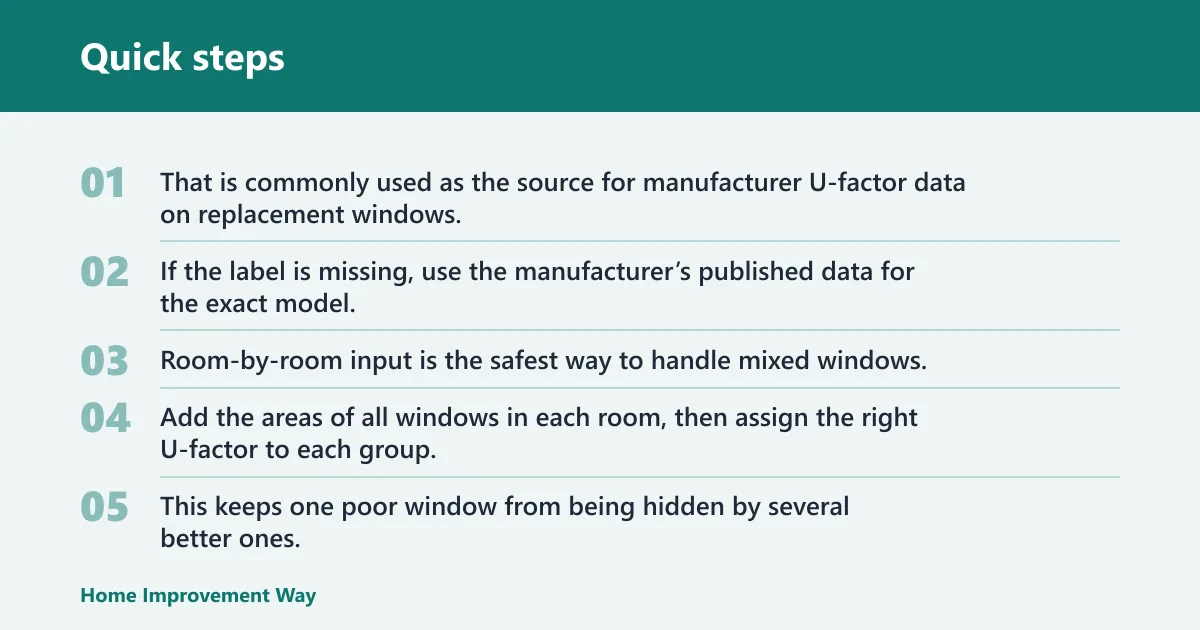
Use the NFRC label when you have it. That is commonly used as the source for manufacturer U-factor data on replacement windows. If the label is missing, use the manufacturer’s published data for the exact model, or estimate from window age and type only as a fallback.
Step 2: Measure total glazed area room by room
Room-by-room input is the safest way to handle mixed windows. Add the areas of all windows in each room, then assign the right U-factor to each group. This keeps one poor window from being hidden by several better ones.
Say your living room has two 12-sq-ft double-pane windows and one 18-sq-ft old single-pane unit. Treat them as separate inputs. That gives you a cleaner result than averaging the room and pretending every window performs the same.
Step 3: Use HDD to estimate seasonal BTUs
Once you have U-factor, area, and HDD, the formula gives annual conductive loss in BTU. The bigger the climate number, the more the same window costs you over the season. This is why a window that looks acceptable in a mild city can perform poorly in a colder one.
Step 4: Convert BTUs into fuel cost
The calculator adjusts savings by heating system efficiency. That matters because 100,000 BTU saved at the window does not always equal 100,000 BTU of fuel avoided. A boiler, furnace, or heat pump converts energy differently, so the fuel bill savings depend on AFUE, boiler efficiency, or COP.
To convert savings, first turn BTU into MMBtu, then divide by the heating system efficiency expressed as a decimal. After that, multiply by your heating cost per MMBtu. You can derive that cost from utility bills by dividing the fuel charge by the delivered energy amount.
How do you get the right inputs?
Good inputs matter more than fancy formulas. If the U-factor is wrong, or if failed seals and frame leaks are ignored, the calculator can make a weak window look stronger than it is. Mixed glazing, rentals, and historic homes need a more careful setup.
Read the NFRC label
The NFRC label is the cleanest way to confirm U-factor on a new or replacement window. If the label is available, use that number rather than a sales sheet summary. That keeps the calculation tied to the actual product installed, not a generic product family.
Use manufacturer data for replacement windows
If the label is missing, the manufacturer’s technical data sheet is the next best source. Look for the exact size, glass package, spacer type, and frame material. Small construction differences can change the U-factor enough to matter in a payback estimate.
Estimate unknown windows from age and type
When a window has no documentation, estimate carefully from type and age. Typical older single-pane windows are around U 1.0–1.2, while basic double-pane windows are around U 0.45–0.60. High-efficiency double- or triple-pane windows are around U 0.20–0.35.
A common first-timer mistake is to call every older window “single pane” and every newer one “good enough.” A failed seal, loose sash, or damaged frame can change real-world performance enough that the label-style assumption is too optimistic.
Handle mixed windows and failed seals
For mixed windows, break the house into zones or rooms and input each one separately. For failed seals, keep the glass performance estimate but add a note that draft-driven loss may be higher than the formula suggests. That way, you do not mistake a leak problem for a glass problem.
Window heat loss decision table
This table compares the same 200 sq ft of window area in a climate with about 6,500 HDD and a heating cost of about $30 per MMBtu. It uses an assumed 80% heating system efficiency and shows simple payback against a baseline of older single-pane windows. The savings are only for conductive loss through the window assembly, not for drafts elsewhere in the house.
| Scenario | U-factor | Estimated annual heat loss | Annual savings vs. old single-pane | Example upgrade cost | Simple payback | When it falls short |
|---|---|---|---|---|---|---|
| Old single-pane | 1.10 | 3,432,000 BTU | Base case | — | — | Drafty frames, failed sash seals, and poor comfort can make the real loss worse than the glass-only estimate. |
| Existing double-pane | 0.50 | 1,560,000 BTU | 1,872,000 BTU, about $70 per year | . | . | Old spacers, cloudy seals, or loose frames can shrink the gain if air leakage is high. |
| Low-E double | 0.30 | 936,000 BTU | 2,496,000 BTU, about $94 per year | $6,000 | About 64 years | Poor value if you are replacing only for energy savings, especially in a rental or short-term ownership. |
| Triple-pane low-E | 0.15 | 468,000 BTU | 2,964,000 BTU, about $111 per year | $8,500 | About 77 years | Cold-climate use can justify it better, but the extra cost is hard to recover in mild climates or leaky homes. |
| Secondary glazing | 0.35 | 1,092,000 BTU | 2,340,000 BTU, about $88 per year | $1,500 | About 17 years | May not suit historic restrictions, frequent window use, or frames that cannot accept an added layer. |
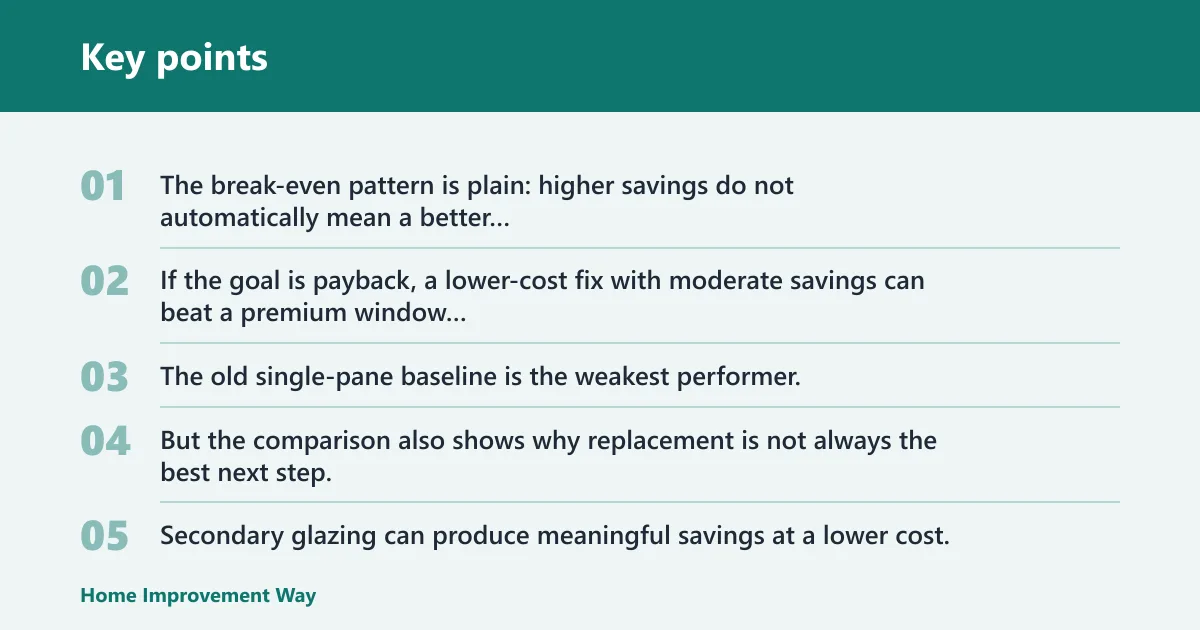
The break-even pattern is plain: higher savings do not automatically mean a better purchase if the upfront cost is steep. If the goal is payback, a lower-cost fix with moderate savings can beat a premium window package.
How to read the table
The old single-pane baseline is the weakest performer, and the conductive loss is much higher than a modern unit. But the comparison also shows why replacement is not always the best next step. Secondary glazing can produce meaningful savings at a lower cost, while triple-pane windows often need a long horizon to pay back.
Suppose you own a 1920s rental with worn double-hung windows and one room that still leaks around the sash. If the frame is sound, storm windows or secondary glazing may deliver a better return than a full tear-out, especially if you need to keep the original look.
Do triple-pane windows pay off?
Triple-pane windows make the most sense when you live in a cold climate, plan to stay in the house for a long time, and already have a tight envelope. They reduce conductive loss more than double-pane windows, but the extra purchase cost can be hard to recover if the house still leaks air elsewhere.
Where triple-pane usually makes sense
Triple-pane can be a rational choice for north-facing exposures, very cold regions, or homes that already have good air sealing and insulation. In those cases, the lower U-factor can translate into comfort and energy benefits that are easier to notice.
Where the extra cost is harder to recover
In a mild climate, or in a house with major frame leaks, the added cost often outpaces the fuel savings. If the calculator shows only a modest annual dollar benefit, the payback stretches far beyond what most homeowners expect.
Why air sealing may beat glass upgrades
If the problem is draft-driven loss, air sealing often returns more comfort per dollar than a glass upgrade. Weatherstripping, sash repairs, caulk, and better trim sealing can shrink the hidden loss that a U-factor calculator does not capture.
Replacement, storms, or sealing?
Choose the least expensive fix that solves the actual problem. If the window is mostly sound and the issue is conductive loss, storm windows or secondary glazing can be a good middle ground. If the frame is rotten or the sash will not close right, replacement starts to make more sense.
When storm windows are the better value
Storm windows can reduce heat loss enough to matter when you want better performance without full replacement. They are often a practical choice for older homes where the existing windows still operate and the main goal is to cut conductive loss at a lower cost.
When secondary glazing fits historic homes
Secondary glazing is often useful where the original window must stay in place. It can improve performance while preserving the existing unit, which helps in historic homes or properties with appearance limits. It is also a good fit when replacement is restricted by ownership rules.
When frame condition points to replacement
Replacement makes the most sense when the frame is damaged, the sash no longer closes well, or moisture has already ruined parts of the assembly. At that point, the issue is bigger than heat loss alone. A new window may solve comfort, operation, and durability at the same time.
Frequently asked questions
What percentage of heat is lost through windows?
There is no single percentage that applies to every home. Window loss depends on area, U-factor, climate, and air leakage around the frame. Older single-pane windows can lose several times more heat than modern double- or triple-pane windows, but drafty walls or roofs can also dominate the total.
How much heat is lost through single-pane windows?
Typical older single-pane windows are around U 1.0–1.2, which is much higher than modern options. That means they lose heat much faster over the season, especially in a climate with high HDD. A calculator can show the annual BTU impact for your exact area and climate.
How do I calculate heat loss from windows?
Use Q = U × A × HDD × 24. Enter the window’s U-factor, the glazed area, and your local heating degree days. Then divide by 1,000,000 to convert the result to MMBtu, and adjust for heating system efficiency before turning it into fuel cost.
What U-factor should I use for my windows?
Use the NFRC label when available. If not, use the manufacturer’s exact data for replacement units. For older windows with no paperwork, a type-based estimate is better than guessing, but it should be treated as approximate. Mixed homes should be handled room by room.
How do heating degree days affect window heat loss?
Heating degree days are the climate input that turns hourly loss into a seasonal estimate. More HDD means more time spent heating against the outdoor temperature gap, so the same window loses more total BTUs in a colder city than in a milder one.
Are triple-pane windows worth it for heat loss?
Sometimes, but not always. Triple-pane windows reduce conductive heat loss more than double-pane units, yet the extra cost can be hard to recover if the house is leaky or the climate is mild. They make more sense in cold regions and tight envelopes.
Do storm windows reduce heat loss enough to matter?
Yes, often enough to matter when you want a lower-cost upgrade. Storm windows can cut conductive loss and help with comfort without replacing the original unit. They are especially useful when the existing frame is sound but the glass package is weak.
How do I turn window heat loss into annual dollar savings?
Convert the BTU reduction into MMBtu, then divide by heating system efficiency and multiply by your heating cost per MMBtu. That gives a dollar estimate for annual savings. The result is only as good as the input data, especially U-factor, area, HDD, and fuel price.
Sponsored / affiliate links. As an Amazon Associate I earn from qualifying purchases. I may earn additional commission from eligible campaigns.