Best Shutoff Valves for Leak Protection (2025): We Compared
The best smart water shutoff valve for leak protection is one with local auto-shutoff, battery backup, and manual override. If your home is hard to wire or the internet is shaky, pick a valve that still closes without Wi-Fi. A weak setup can leave a burst pipe running long enough to damage floors, drywall, and cabinets, and the repair bill can climb fast. This guide compares smart shutoff valves by failure mode so you can choose one that still protects your home when Wi-Fi, power, or install conditions are less than ideal.
Top picks for whole-home and point-of-use leak protection
For whole-home protection, Moen Flo is the strongest default pick because it learns water-use patterns and can shut water off automatically. For homes where Wi-Fi may drop out, YoLink’s offline device-to-device shutoff is the safer design choice. For a washing machine, FloodStop and Watts IntelliFlow belong in the short list.
Quick comparison
| Product | Badge | Best for | Price | ||
|---|---|---|---|---|---|
 |
E-SDS Automatic Water Leak Shut Off Valve System with 2E-SDS | Our pick | 3/4" · automatic shutoff · two-valve system | $159.99
Price as of 5 Nov 2026
|
View |
 |
EcoNet Controls EVC200-WLS1M Bulldog Valve Robot with WiredEcoNet Controls | Also great | Z-Wave · leak sensor · over-valve robot | $215.00
Price as of 5 Nov 2026
|
View |
This is the fast pass: whole-home monitors, retrofit robots, and appliance-specific valves solve different failure modes. The right choice depends less on app polish and more on what still happens when the internet, power, or pipe layout stops cooperating.
Water shutoff valve decision table
| Option | Pipe size or install method | Detection method | Internet / power / hub dependence | Shutoff trigger | Likely labor cost band | Best-fit home scenario |
|---|---|---|---|---|---|---|
| Moen Flo Smart Water Shutoff | Whole-home inline; 3/4-inch to 1-1/4-inch depending model | Water-use pattern learning and flow monitoring | App alerts use internet; automatic shutoff is the key protection layer | Anomalous water use or leak pattern | High, because professional installation is commonly recommended | Main line protection in a house with compatible pipe size |
| Phyn Plus Smart Water Monitor | Whole-home inline; premium install | Advanced flow analytics and pressure-wave analysis | Connected monitoring; best treated as a premium monitoring system | Abnormal flow behavior or leak signature | High | Owners who want high-end whole-home monitoring |
| Haozee Smart Water Main Shutoff Valve | Whole-home inline | Flow, pressure, and temperature monitoring | No hub required; remote control supported | Anomaly detected in monitored conditions | Medium to high | Buyers who want fewer ecosystem parts and app control |
| Frizzlife LP365 / LPG365 | 3/4-inch and 1-inch pipe fitment | Ultrasonic micro leak detection; 0.01 GPM sensitivity | Wi-Fi remote control | Very small flow change or temperature alarm | Medium | Smaller main lines and buyers who want sensitive flow alerts |
| YoLink Wireless Smart Valve Control Kit | Retrofit control kit with valve automation | Leak sensor pairing plus motorized control | Hub-based, but can work offline through device-to-device shutoff | Leak sensor signal or automation rule | Medium | Weak Wi-Fi areas, long-range setups, and hard-to-reach installs |
| LeakSmart Leak Detector and Shutoff Valve System | Inline leak shutoff with sensors | Leak sensors | Z-Wave connectivity with battery backup in the system | Sensor-triggered shutoff | Medium to high | Homes where sensor-triggered closure matters more than analytics |
| Bulldog Valve Robot | No plumbing work; fits 3/4-inch to 1.5-inch ball valves | Works with a wired leak sensor | Z-Wave hub support required | Leak sensor signal | Low to medium | Retrofit projects and rentals where cutting the line is not ideal |
| FloodStop Washing Machine Leak Detector Kit | Appliance-specific washer install | Leak detector with automatic valve closure | Independent appliance protection | Leak detection at the washer | Low | Laundry rooms and washer hoses that need quick protection |
| Watts IntelliFlow Smart Shutoff | Washing-machine inlet shutoff | Leak protection with alerts | Wi-Fi connectivity | Leak detection or alert condition | Low to medium | Homes that want washer-focused shutoff plus alerts |
| E-SDS Automatic Water Leak Shut Off Valve System | 3/4-inch, two-valve system | Automatic shutoff on leak detection | Not positioned as a cloud-first system | Leak detection | Medium | Basic whole-home shutoff where a 3/4-inch fit works |
How we chose
Leak protection only matters if the system still behaves well when something goes wrong. These picks were judged on failure-mode coverage, install constraints, detection method, and the hidden cost of getting the system working.
- Failure-mode reliability: whether the valve can still close during Wi-Fi loss, hub loss, or power loss.
- Install difficulty and compatibility: whether it fits the pipe size you actually have, and whether it needs a plumber.
- Detection and alert quality: whether it uses pattern learning, flow analytics, or simple sensors.
- Ownership cost: labor, hub purchase, sensor expansion, replacement parts, and any add-on ecosystem parts.
- Home fit: whole-home main line, laundry room, retrofit ball valve, or mixed old-house plumbing.
Moen Flo Smart Water Shutoff: best for whole-home protection
Moen Flo is the best overall pick for whole-home leak protection because it learns household water-use patterns and can shut water off automatically. It also sends alerts by app, phone, and email, so you can catch a leak before water spreads under flooring or into wall cavities.
It fits the main line better than appliance-only devices, and the whole-house version fits 1-inch to 1-1/4-inch pipes only. That size limit matters in older homes, because a 3/4-inch branch or a mixed-plumbing layout may need a different approach.
One drawback is the install burden. Professional installation is commonly recommended, so the real cost includes labor, not just the valve. Smart-home integrations with Alarm.com, Ring, Google Assistant, and NICE are useful, but they are secondary to getting the shutoff working correctly.
Picture a house with a 1-inch main and a basement mechanical room. A whole-home valve like Flo can protect the entire supply line, while a washer-only device would miss a leak in a bathroom supply tube or a failed water heater connection.
Do smart water shutoff valves work without Wi-Fi?
Yes, some do, but not all of them fail the same way. A smart shutoff valve can still protect the home without Wi-Fi if the shutoff decision happens locally or through a device-to-device link. Cloud-only alerts may disappear during an outage, but the valve itself may still close.
That difference matters more than app polish. If the system needs the internet to recognize a leak and trigger closure, a router failure can leave you exposed. If the valve can act on a paired sensor or local automation, it can still close when the internet drops.
YoLink Wireless Smart Valve Control Kit: best for offline shutoff
YoLink is the strongest match for homes with weak Wi-Fi because its long-range wireless system is positioned for hard-to-reach installs, and it can work offline through device-to-device shutoff. The hub-based ecosystem also supports leak sensor pairing and backup power, which makes it useful in basements, outbuildings, and awkward mechanical rooms.
Its LoRa coverage is claimed up to 1/4 mile, and that range is a real advantage when Wi-Fi coverage is patchy. YoLink FlowSmart combines an ultrasonic meter with a motorized shutoff valve, so it covers both sensing and closure in the same system.
The drawback is ecosystem dependence. You still need the hub for the broader system, so the savings are not only about the valve price but also about the cost of the hub and extra sensors. For some buyers, that is still a good trade if the alternative is unreliable Wi-Fi.
LeakSmart Leak Detector and Shutoff Valve System: best for sensor-triggered shutoff
LeakSmart is a strong fit when you want a fast, sensor-triggered shutoff rather than a pattern-learning monitor. It pairs leak sensors with automatic closure, and Z-Wave connectivity makes it a better fit for homes already built around a mesh automation platform.
Battery backup is part of why it stays relevant for insurance conversations. Insurers often care less about app features and more about whether the system automatically shuts water off when a leak is detected, even if the power blips.
The drawback is that Z-Wave adds a dependency of its own. You need a compatible hub, and that means one more piece of equipment to buy, place, and maintain.
Bulldog Valve Robot: best retrofit option for existing ball valves
Bulldog Valve Robot is the easiest no-plumbing retrofit option because it mounts over an existing ball valve rather than replacing pipe. It fits 3/4-inch to 1.5-inch ball valves and supports Z-Wave hub control, so it works well where cutting into the main line is a bad idea.
That makes it useful in rentals, older homes, and places where access is cramped. It is also the clearest answer to the question, “Is a retrofit valve robot better than cutting into the main line?” if your main goal is to avoid plumbing work.
The tradeoff is that the robot depends on the condition and accessibility of the existing valve. If the old valve is stiff, partially seized, or mounted awkwardly, the retrofit is less elegant than a new inline valve.
What size pipe do I need for a smart water shutoff valve?
The pipe size has to match the valve, and that is where many buyers get stuck. Common whole-home sizes include 3/4-inch, 1-inch, 1-1/4-inch, and sometimes 1.5-inch for retrofit ball-valve robots. Laundry-room devices usually fit the washer inlet instead of the main line.
If your home has mixed pipe sizes, you may need to choose between a main-line valve for the largest supply and an appliance-specific device for the highest-risk room. Older homes are often the hardest case because the plumbing may not be standardized.
Phyn Plus sits in the premium category because it uses advanced flow analytics and pressure-wave analysis for whole-home monitoring. That makes it a better fit when you want a more analytical monitor rather than a simple sensor-triggered cutoff.
It is aimed at homeowners who want a high-end main-line system and are comfortable with a professional install. The drawback is cost: premium monitoring is useful, but it is not the cheapest path to basic leak protection.
Suppose a home has a 1-inch main and a finished basement below a laundry room. A premium monitor like Phyn Plus can watch the full house, but it still needs the right installation conditions and budget headroom.
Haozee Smart Water Main Shutoff Valve: best no-hub option
Haozee is notable because it monitors flow, pressure, and temperature, and it supports remote control without a hub. That no-hub setup is attractive when you want fewer devices in the chain between the leak and the shutoff.
It is also described as NSF certified, which may matter to buyers who are comparing safety listings and documentation for insurance or code comfort. If a homeowner wants a simpler ecosystem, that can be a practical plus.
The drawback is that it still needs the right main-line fit and installation planning. A no-hub product does not erase plumbing labor, and it does not make an awkward pipe layout go away.
Frizzlife LP365 / LPG365: best for smaller main lines
Frizzlife LP365 / LPG365 is a strong option for smaller main lines because it fits 3/4-inch and 1-inch pipe sizes. Its ultrasonic micro leak detection can pick up flow changes down to 0.01 GPM, and it adds real-time flow and temperature alarms through Wi-Fi control.
That sensitivity is useful where tiny leaks matter, such as slow fixture drips or a line that should be idle overnight. It is also one of the clearer answers for owners who want a more sensitive flow monitor without jumping to a top-tier premium system.
The drawback is that small-pipe fitment narrows the audience. If your main line is 1-1/4-inch or larger, this model may simply not be the right size.
Which one should you buy?
Start with the plumbing you already have, then match the product to the room or failure mode you care about most. Whole-home main-line devices belong in houses where a burst pipe could spread through several floors, while appliance-specific devices are smarter when the biggest risk is the washing machine.
- Best for laundry rooms and washing machines: FloodStop is the most direct washer-focused choice because it is designed for washing-machine leak protection and installs in about 15 minutes. Watts IntelliFlow is the other washer-specific option if you want real-time text and email alerts.
- Best for older homes and mixed pipe sizes: A retrofit robot like Bulldog is often easier than cutting into old plumbing. It is especially useful when the main shutoff valve is in a cramped spot or the pipe layout is irregular.
- Best for rentals and vacation homes: YoLink and Bulldog make the most sense because they address weak Wi-Fi, remote oversight, and install constraints. A landlord or second-home owner usually values a shutoff that still works even when no one is there.
- Best for buyers focused on insurance documentation: Look for automatic shutoff behavior, a battery backup path, and recognized safety listings such as UL or NSF where applicable. An insurer may care more about those traits than about app integrations.
A common first-timer mistake is buying a main-line monitor when the real risk sits under the washer. In that case, a 3/4-inch appliance inlet device can be the better purchase, because it closes the specific hose that fails most often.
Another common mistake is assuming any smart valve will save money on premiums. Some carriers give discounts, some do not, and some only care about the device category and documentation. Ask before you buy.
What is the best smart shutoff valve for insurance discounts?
The best device for insurance purposes is the one your insurer recognizes, but the traits that matter most are usually automatic shutoff, battery backup, and a safety listing such as UL or NSF where applicable. Those features show that the system can stop water at the source, instead of only sending an alert after water has already spread through the structure.
Discounts are insurer-specific, so no product guarantees savings. Still, a valve that closes automatically and does not depend entirely on a live internet connection is easier to document and easier to defend in a claim conversation.
Which product traits insurers care about?
Insurers generally care about whether the device can stop water automatically, whether it keeps working during a power issue, and whether the product has a recognized listing or clear installation record. App alerts are helpful, but they are weaker evidence than a shutoff that closes the line without manual intervention.
Why automatic shutoff and backup power matter
Automatic shutoff is the key protection layer because it cuts off the water before the leak grows. Backup power matters because a leak does not wait for electricity to come back, and a battery-supported system has a better chance of closing the valve when the house is dark.
What to confirm before you buy
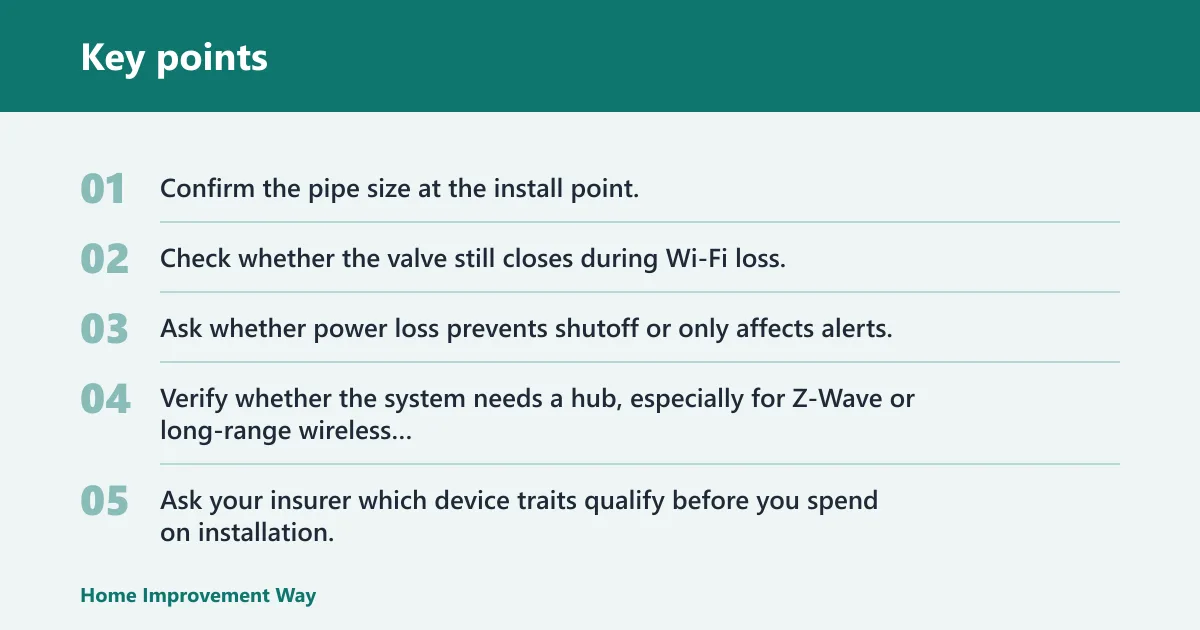
- Confirm the pipe size at the install point.
- Check whether the valve still closes during Wi-Fi loss.
- Ask whether power loss prevents shutoff or only affects alerts.
- Verify whether the system needs a hub, especially for Z-Wave or long-range wireless setups.
- Ask your insurer which device traits qualify before you spend on installation.
How fast do smart water shutoff valves close after a leak?
Speed varies by design. Sensor-triggered systems generally close faster than analytics-based systems because they react directly to water at the leak point. Whole-home monitors that watch flow patterns can still be fast, but they often rely on pattern recognition or a threshold before they shut down.
For practical planning, treat washer kits and direct leak sensors as the quickest responders, while whole-home analytics are better for broader oversight. If speed is the top concern, look for a system that says it closes on sensor signal rather than on long-term pattern analysis.
Do I need leak sensors in addition to a smart water shutoff valve?
Often, yes. A smart shutoff valve protects the main line or appliance line, but sensors find the exact wet spot first. That is useful in basements, under sinks, behind washers, and near water heaters, where a leak can start in one place and travel before the meter sees a big flow change.
Leak sensors also improve false-alarm handling. If the system is seeing only flow data, a long shower or lawn fill can look suspicious. A sensor plus shutoff gives you both the location and the closure trigger.
Can I install a smart water shutoff valve myself?
Some can be installed by a capable DIYer, but not every main-line model should be treated that way. Appliance-specific kits are the easiest DIY projects, while whole-home inline valves often need a plumber because the water has to be cut, fitted, and sealed correctly.
Retrofit robots are the most DIY-friendly option when the home already has a compatible ball valve. If you are not cutting pipe, the install is usually simpler. If you are replacing a section of the main line, plan for more labor and more chances to discover incompatible fittings.
Frequently asked questions
What is the best smart water shutoff valve for leak protection?
Moen Flo is the best default choice for whole-home leak protection because it learns water-use patterns, can shut water off automatically, and sends alerts by app, phone, and email. If your main concern is Wi-Fi loss or weak coverage, YoLink is the stronger resilience pick because it can work offline through device-to-device shutoff.
Can a smart shutoff valve help with insurance discounts?
Possibly, but it depends on the insurer. The traits that usually matter most are automatic shutoff, backup power, and recognized safety listings such as UL or NSF where applicable. Ask the carrier first, because a discount is not guaranteed just because the valve has an app.
Is a retrofit valve robot better than cutting into the main line?
It can be, especially in older homes or rentals where you do not want plumbing changes. A retrofit robot like Bulldog fits over an existing ball valve, so there is no pipe cutting. The tradeoff is that it depends on the condition and placement of the existing valve.
Which smart water shutoff valve is best for a washing machine?
FloodStop is the most direct washing-machine pick because it is designed for that use case and installs in about 15 minutes. Watts IntelliFlow is another good washer-specific option if you want real-time text and email alerts. Both make more sense than a whole-home main-line valve for a single laundry risk.
Sponsored / affiliate links. As an Amazon Associate I earn from qualifying purchases. I may earn additional commission from eligible campaigns.