Hardwired vs. Battery Smoke Detectors: Which Is Better?
Hardwired smoke detectors fit new construction, major remodels, and code-driven replacement because they interconnect and usually include battery backup. Battery alarms can suit fast, low-disruption installs in older homes or rentals. Choosing the wrong setup can mean failed inspections, dead alarms, or gaps in coverage when one unit alarms but others do not. This guide compares hardwired, battery, and mixed systems so you can choose the right option for your home.
| Decision factor | Hardwired | battery smoke detectors | Winner |
|---|---|---|---|
| Upfront install cost | Higher, because wiring, box work, and electrician labor may be needed | Lower, because many units mount with basic DIY tools | battery smoke detectors |
| Maintenance burden | Lower routine work, but backup batteries still need attention | Higher for standard batteries; lower if you choose a sealed 10-year battery unit | tie |
| Power outage behavior | Usually keeps working on backup battery if the circuit is lost | Keeps working because it does not depend on house power | tie |
| Interconnect support | Common and often practical for whole-home warning | Limited unless you buy a system designed for wireless or linked operation | Hardwired |
| Best fit for a new build | Matches NFPA guidance for hardwired, interconnected alarms in new homes | Usually a weaker fit unless code or layout creates a special case | Hardwired |
| Best fit for a renter or older home without wiring | Possible, but often disruptive or impractical | Easy to place where needed | battery smoke detectors |
Hardwired smoke detectors: the real trade-off
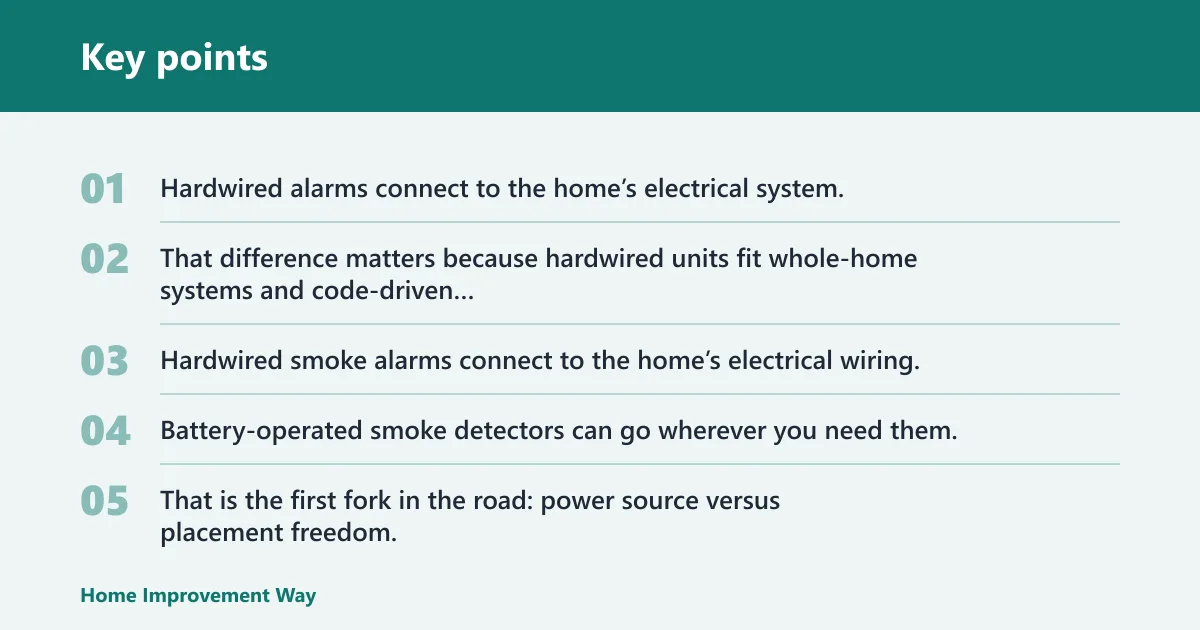


Hardwired alarms connect to the home’s electrical system, while battery alarms are self-contained. That difference matters because hardwired units fit whole-home systems and code-driven installs, while battery units fit quick replacements, rentals, and older homes without usable wiring.
What each type powers from
Hardwired smoke alarms connect to the home’s electrical wiring, and many also have a backup battery. Battery-operated smoke detectors can go wherever you need them, which helps when a room has no wiring or no easy path to an electrical box.
That is the first fork in the road: power source versus placement freedom. If the home already has a compliant alarm circuit, hardwired units may be the better system choice. If not, battery units usually solve the problem faster.
Why the best choice depends on wiring, code, and layout
Safety is only part of the answer. You also need a setup that works with the home’s wiring, local code, and floor plan without turning the job into major electrical work.
Suppose a two-story home has bedrooms upstairs, a finished basement, and alarms only in the hall. A hardwired, interconnected layout can sound every unit at once. A few standalone battery alarms may still meet a basic need, but they do less for whole-home warning.
📊 Keep kitchen smoke alarms at least 10 feet from cooking appliances. Source: Hunker.
How hardwired smoke alarms work
Hardwired smoke alarms draw power from the home’s electrical circuit and often include a backup battery. They fit new construction and many remodels because they can be interconnected, which means all alarms sound at the same time when one detects smoke.
Electrical connection and backup battery
Hardwired does not mean battery-free. The backup battery keeps the alarm operating if the circuit loses power, and many hardwired units still need that battery to prevent a gap during an outage or a tripped breaker.
If the circuit fails and the backup battery is dead, the alarm can fail completely. That is the failure case to avoid: one problem in the electrical path plus one ignored battery can silence a unit that should protect a bedroom or hall.
Interconnected alarm systems
Interconnected means all alarms sound at the same time. That matters in larger or multi-level homes because a smoke event in a basement can be heard upstairs, and a bedroom alarm can wake people on the opposite side of the house.
NFPA recommends hardwired and interconnected dual-sensor alarms in new homes and recent remodels. The code logic is simple: whole-home warning is better than a single isolated alarm in a distant hallway.
Installation needs, including electrician work and circuit requirements
Hardwired detectors should be connected to an AFCI-protected circuit. Some jurisdictions require a dedicated circuit for smoke detectors, and hardwired systems commonly use a 15-amp or 20-amp circuit. That is why installation may call for an electrician rather than a quick DIY swap.
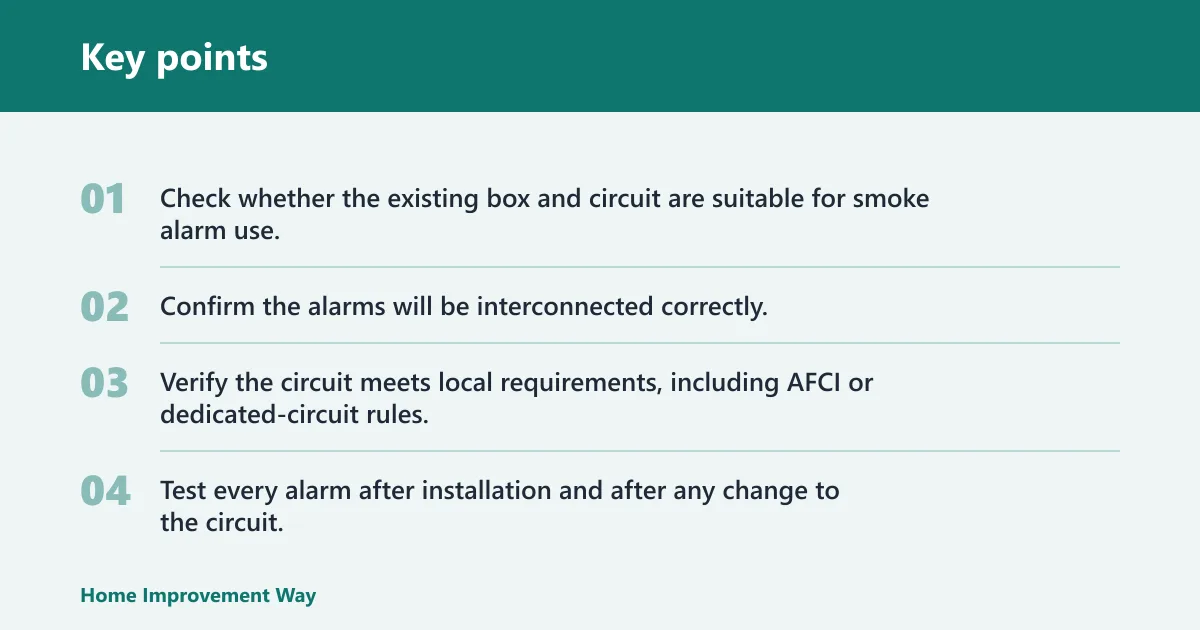
- Check whether the existing box and circuit are suitable for smoke alarm use.
- Confirm the alarms will be interconnected correctly.
- Verify the circuit meets local requirements, including AFCI or dedicated-circuit rules.
- Test every alarm after installation and after any change to the circuit.
How battery smoke alarms work
Battery alarms run from a self-contained power source and do not depend on the home’s electrical wiring. They are the practical choice when you need flexible placement, a fast replacement, or coverage in a home that has no alarm wiring.
Standard battery alarms
Standard battery alarms are the simplest option to install. They are often the right answer for renters, older homes, detached spaces, and rooms where pulling cable would cost more than the alarm itself.
The trade-off is maintenance. Regular battery replacement is usually part of the deal unless you choose a sealed long-life battery model, and a dead battery can leave the unit silent if the low-battery warning is missed.
Sealed 10-year battery alarms
Sealed 10-year lithium-ion battery smoke alarm models reduce routine battery changes. They are a maintenance-reducing option for homeowners who want battery-only installation without frequent battery swaps.
They are especially useful in places where a wired install is not practical, but they do not erase the limits of battery-only systems. They still are not the same as a hardwired, interconnected home network.
Which is better during a power outage?
Battery smoke detectors are the simplest answer during an outage because they do not depend on house power at all. Hardwired alarms can also keep working if their backup battery is good, but a dead backup battery or failed circuit creates a real risk of no protection.
Hardwired alarms with backup batteries
Hardwired alarms usually keep running on backup battery power when the home loses electricity. That makes them more resilient than a wired-only device would be, but the backup battery still has to be present and functional.
Battery alarms with no dependence on house power
Battery alarms keep operating whether or not the breaker is on. That makes them a reliable fit for outages, remodel disruptions, and homes where circuits are in flux.
Failure cases to think about
A common first-timer mistake is assuming “wired” means immune to failure. A disconnected interconnect line, a tripped breaker, or a dead backup battery can reduce the value of an otherwise good hardwired system. With battery units, the failure mode is usually simpler: the battery is dead, low, or missing.
Which type is easier to install and maintain?
Battery alarms win on installation speed, while hardwired alarms win on whole-home integration once they are in place. Over 10 years, the maintenance picture depends on whether you choose standard batteries or sealed 10-year units, and whether the hardwired system needs professional service.
DIY friendliness and replacement speed
Battery alarms are easier and cheaper to install because they are self-contained. That is especially true when you are replacing a single failed unit in an older home or adding temporary coverage during a remodel.
Hardwired replacements can still be straightforward if the box and wiring are already there, but they are not always a simple swap. If the unit is part of an interconnected system, the replacement has to match the network and the circuit conditions.
Upfront cost vs. 10-year maintenance burden
Upfront cost is not the whole story. Hardwired installs often cost more because of electrician labor, unit price, and circuit work, but they may reduce routine battery checks. Standard battery alarms are cheap to start, yet they can cost more in attention over time.
Sealed 10-year battery models sit in the middle. They reduce upkeep without requiring wiring, which is useful when the home layout favors battery placement but you want fewer battery changes.
When electrician labor is worth it
Electrician labor is worth it when the goal is a code-driven, interconnected system in a new home or remodel. It is also worth it when you are already opening walls, replacing ceiling boxes, or correcting a partial wiring layout that leaves dead zones.
Comparison matrix
This matrix separates required, recommended, and practical choices. That distinction matters because a setup can be legal in one home and a poor fit in another.
| Scenario | Hardwired | Standard battery | 10-year sealed battery | Winner |
|---|---|---|---|---|
| New build | Best fit for code-driven whole-home wiring and interconnection | Usually not the first choice for primary coverage | Useful only in limited spots where wiring is impractical | Hardwired |
| Remodel | Strong fit if ceilings and wiring are already open | Works for fast coverage during phased work | Good for rooms that are hard to wire now | Hardwired |
| Renter | Often not practical without landlord approval | Best for fast, reversible installation | Best if you want less upkeep than standard batteries | battery smoke detectors |
| Older home without wiring | Possible, but usually expensive and invasive | Simple answer for immediate coverage | Better if you want fewer battery changes | battery smoke detectors |
| Large multi-level home | Best for interconnected whole-home warning | Works only if you accept standalone coverage limits | Helpful for add-on rooms, but not a full replacement for interconnection | Hardwired |
New build and remodels
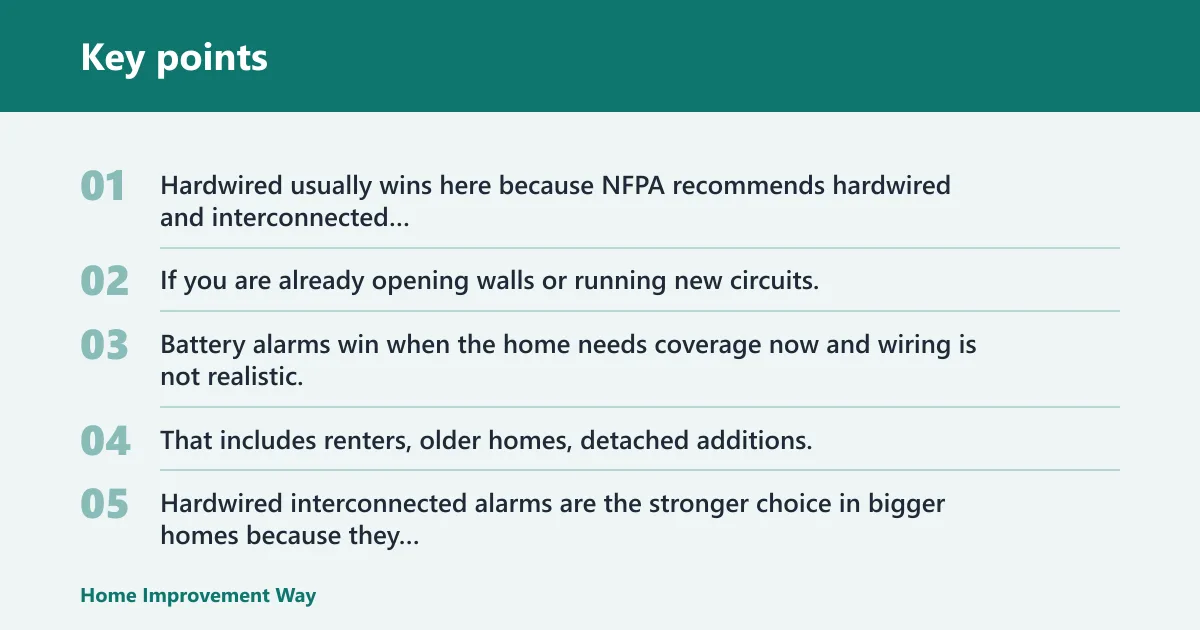
Hardwired usually wins here because NFPA recommends hardwired and interconnected dual-sensor alarms in new homes and recent remodels. If you are already opening walls or running new circuits, the added labor can buy you better whole-home notification.
Renter, older home, and partial wiring
Battery alarms win when the home needs coverage now and wiring is not realistic. That includes renters, older homes, detached additions, and unfinished areas where you need alarms in place without an electrical project.
Large multi-level homes
Hardwired interconnected alarms are the stronger choice in bigger homes because they improve audibility. A basement alarm sounding at the same time as upstairs units is better than relying on someone hearing a single detector through doors and floors.
What do NFPA guidance and building codes favor?
NFPA guidance favors hardwired interconnected alarms in new homes and recent remodels, and it also gives placement rules that matter more than the power source alone. Local building code still controls the final answer, so the safest plan is to treat NFPA as the baseline and verify jurisdiction rules before installation.
Placement requirements and recommended locations
Current NFPA guidance calls for alarms inside bedrooms, outside sleeping areas, and on each level of the home. It also recommends keeping kitchen smoke alarms at least 10 feet from cooking appliances, which helps reduce nuisance alarms without leaving the kitchen uncovered.
Smoke alarm placement should also account for flammable storage areas like a garage or basement where applicable. A home with a finished basement and attached garage often needs more thought than a simple one-level layout.
Why local code still matters
Some jurisdictions require a dedicated circuit for smoke detectors, and hardwired detectors should be connected to an AFCI-protected circuit. That means a compliant installation is not only about buying the right device; it is also about meeting local electrical rules.
The traveler wire in alarm wiring is red, but wire color alone does not confirm a correct installation. The circuit has to be right, the interconnect has to function, and every unit has to sound as intended.
Choose hardwired smoke alarms if… / choose battery smoke alarms if…
Hardwired alarms are the better pick when the home can support a code-driven, interconnected system. Battery alarms are the better pick when you need flexible placement, faster installation, or a low-disruption solution in a home without usable wiring.
Choose hardwired smoke alarms if…
- You are building new or doing a major remodel.
- You want all alarms to sound together in a large or multi-level home.
- Your local code or inspector expects hardwired, interconnected alarms.
- You are already paying for electrical work and can add smoke alarm circuits while walls or ceilings are open.
Choose battery smoke alarms if…
- You rent, or you need a reversible install.
- Your older home has no practical alarm wiring.
- You need coverage in a shed, addition, or unfinished space.
- You want the fastest path to compliant placement while you plan a larger upgrade.
When a mixed system makes more sense
A mixed system can be a practical option, with hardwired alarms on main floors and in sleeping areas, and battery units for additions or hard-to-wire rooms. Hardwired alarms can cover the main floors and sleeping areas, while battery or sealed 10-year battery units fill additions, basements under renovation, or rooms that are difficult to wire right now.
Say your home has hardwired alarms in the main hallway and bedrooms, but a newer family room addition has no ceiling wiring yet. A battery unit there is better than leaving the room unprotected while you wait for a full electrical project.
Frequently asked questions
Are hardwired or battery smoke detectors better?
Hardwired alarms are better for new homes, major remodels, and whole-home interconnected warning. Battery alarms are better for renters, older homes, and fast installs. The right choice depends on code, wiring, and how much interruption you can tolerate during installation.
Smoke detector battery vs wired: what’s the difference?
Wired alarms connect to the home’s electrical system; battery alarms are self-contained. Hardwired units often include a backup battery, while battery-only units rely entirely on their own battery source and do not depend on house power.
Do hardwired smoke detectors still need batteries?
Yes, many do. The backup battery keeps the alarm working if the circuit loses power. If the backup battery fails at the same time as the circuit, the alarm can stop protecting that area, which is why battery checks still matter.
Are battery smoke detectors okay for renters or older homes?
Yes. They are often the most practical choice because they do not require wiring, can be placed wherever needed, and are easy to remove later. A sealed 10-year battery model can reduce routine battery changes in these homes.
Can I replace a hardwired smoke alarm with a battery one?
Sometimes, but not always in a way that makes sense for the whole home. Replacing one failed hardwired unit with a battery unit may solve a single location, yet it can break interconnection or leave part of a code-driven system incomplete.
How long do smoke detector batteries last?
Standard batteries vary by model and usage, so replacement schedules differ. Sealed 10-year lithium-ion battery smoke alarm units are designed to reduce routine battery changes and are often used where homeowners want less maintenance without moving to a hardwired system.
Do building codes require hardwired smoke alarms in new homes?
Often yes, especially for new homes and recent remodels, but local code controls the final requirement. NFPA recommends hardwired and interconnected dual-sensor alarms in those settings, and many jurisdictions follow that direction with their own rules.
Sponsored / affiliate links. As an Amazon Associate I earn from qualifying purchases. I may earn additional commission from eligible campaigns.