Photoelectric vs. ionization smoke detectors: which buy?
Buy photoelectric smoke detectors for bedrooms, hallways, and living areas; use dual-sensor or mixed coverage for whole-home protection; choose ionization only for faster-flame-risk areas. The wrong sensor type can mean nuisance alarms, delayed warning, or missing the kind of fire most likely in that room. This guide breaks down photoelectric vs. ionization by room and shows you how to buy the right setup the first time.
Recommended Smoke Detectors and Key Differences
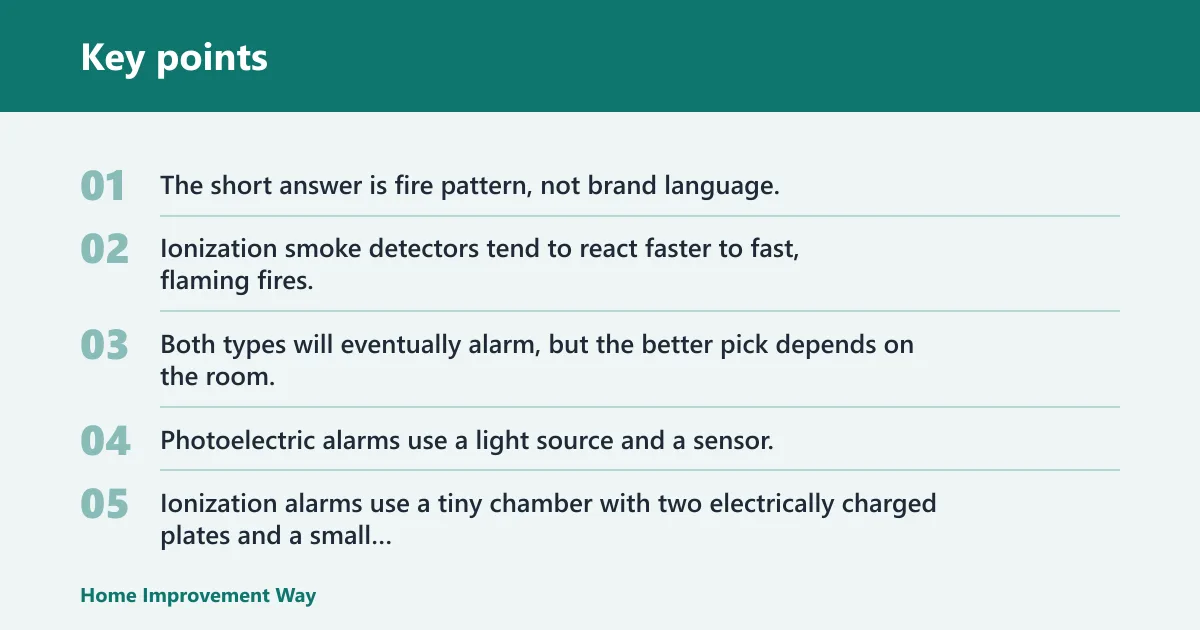


The short answer is fire pattern, not brand language. Ionization smoke detectors tend to react faster to fast, flaming fires, while photoelectric smoke detectors tend to react faster to slow, smoldering fires. Both types will eventually alarm, but the better pick depends on the room, the likely ignition sources, and how much nuisance alarm risk you can tolerate.
| Decision factor | Photoelectric | Ionization smoke detectors | Winner |
|---|---|---|---|
| Fast flaming fire response | Slower than ionization for this fire pattern | Generally quicker on fast, flaming fires | Ionization smoke detectors |
| Slow smoldering fire response | Generally quicker on slow, smoldering fires | Usually slower than photoelectric for this fire pattern | Photoelectric |
| Nuisance alarms near cooking or steam | Often preferred near kitchens and bathrooms; fewer cooking-related nuisance alarms | Can be more nuisance-prone in those spots | Photoelectric |
| Whole-home best-practice fit | Strong part of a mixed plan | Strong part of a mixed plan | Tie |
| End-of-life handling | Standard disposal and replacement rules | Contains americium-241, so disposal instructions matter | Photoelectric |
Fire pattern is the main difference
Photoelectric alarms use a light source and a sensor; they detect smoke when particles scatter light. Ionization alarms use a tiny chamber with two electrically charged plates and a small amount of americium-241. That design makes ionization quicker on tiny smoke particles from flaming fires, while photoelectric is quicker on larger particles from smoldering fires.
Both types still matter in a home
A house does not produce only one fire type. A wiring fault, candle, upholstered chair, pan, or appliance can create different smoke patterns at different times. That is why the NFPA recommendation is best protection with both technologies, either through separate alarms or dual-sensor units.
📊 Ionization alarms use a tiny amount of americium-241. Source: Ionization vs Photoelectric Smoke Detectors: Which to Buy.
How ionization smoke detectors work
Ionization smoke detectors sense changes inside a charged chamber. They contain americium-241 and two electrically charged plates; when smoke enters, it changes the current and triggers the alarm. That setup tends to react faster to fast, flaming fires, but it still alarms on smoke from other fire types.
Why ionization responds faster to flaming fires
Fast flaming fires produce very small smoke particles. Those particles interact with the ionization chamber in a way that can trigger the alarm sooner than a photoelectric unit in the same situation. That speed is useful when the fire grows quickly and visibility drops fast.
Where ionization can make sense
Ionization is the better match only when your main concern is a fast flame event, and the room is not prone to nuisance triggers from cooking aerosols or steam. It can fit some utility spaces or locations with a specific, identified flaming-fire risk. It is not the default choice for kitchens or bathrooms.
Suppose a garage work area has stored fuels and a concern for rapid flame spread. An ionization unit may fit that risk better than a photoelectric alarm, but placement still has to follow manufacturer instructions and local code.
How photoelectric smoke detectors work
Photoelectric smoke detectors use an LED shining across a sensing chamber and a light sensor. When smoke particles scatter the light, the alarm sounds. This design tends to react faster to slow, smoldering fires and is often a better fit near kitchens and bathrooms because it is less prone to cooking-related nuisance alarms.
Why photoelectric responds faster to smoldering fires
Smoldering fires produce larger visible smoke particles. Those particles scatter light efficiently, which makes photoelectric alarms a strong early-warning choice for that fire pattern. This matters in bedrooms, hallways, and living areas where a slow-starting fire may develop before it flashes over.
Why it fits kitchens and bathrooms better
Kitchen placement and bathroom placement both create nuisance-alarm pressure. Steam, humidity, and cooking aerosols can cause alarms that do not indicate fire. Photoelectric units are often preferred in those rooms because they tend to produce fewer cooking-related nuisance alarms.
Which smoke detector is best for each room?
For many homes, photoelectric is a practical room-by-room default. Bedrooms, hallways, living rooms, and stairs usually benefit from its stronger smoldering-fire response and lower nuisance-alarm tendency near everyday household activity. Use ionization only where the fire scenario is specifically about fast flaming spread.
Bedrooms and hallways
Bedrooms and hallways are usually best served by photoelectric alarms. These locations are part of the sleep path, so you want strong response to smoldering fires that may start quietly and create more visible smoke before full flame. Lower nuisance-alarm risk also matters because repeated false starts can lead people to silence the unit.
Kitchens
Kitchens can be a common nuisance-alarm location, so photoelectric is often the more practical choice there. The sensor is less likely to react to normal cooking aerosols than ionization, though it can still alarm if smoke reaches the chamber. Keep it placed according to the manufacturer’s clearance rules, not right above the stove.
Bathrooms
Bathrooms also favor photoelectric in practical guidance because steam and humidity can create nuisance alarms. A unit too close to a shower can be noisy without adding useful warning value. If the bathroom is small, location matters as much as sensor type.
Living rooms, basements, and stairways
These spaces are usually better served by photoelectric or by a dual-sensor approach. Living rooms and basements can develop smoldering fires from furniture, electrical gear, or stored items. Stairways matter because smoke movement can change quickly there, so good placement and interconnection matter as much as sensor choice.
Which should you buy for your home?
Buy photoelectric if your main goal is fewer nuisance alarms and better coverage for the fire types most likely in bedrooms, hallways, kitchens, and bathrooms. Buy ionization only if you have a specific flame-heavy risk and a room where nuisance alarms are not the main concern. For most whole-home setups, dual-sensor or mixed coverage is the stronger buy.
Choose photoelectric if…
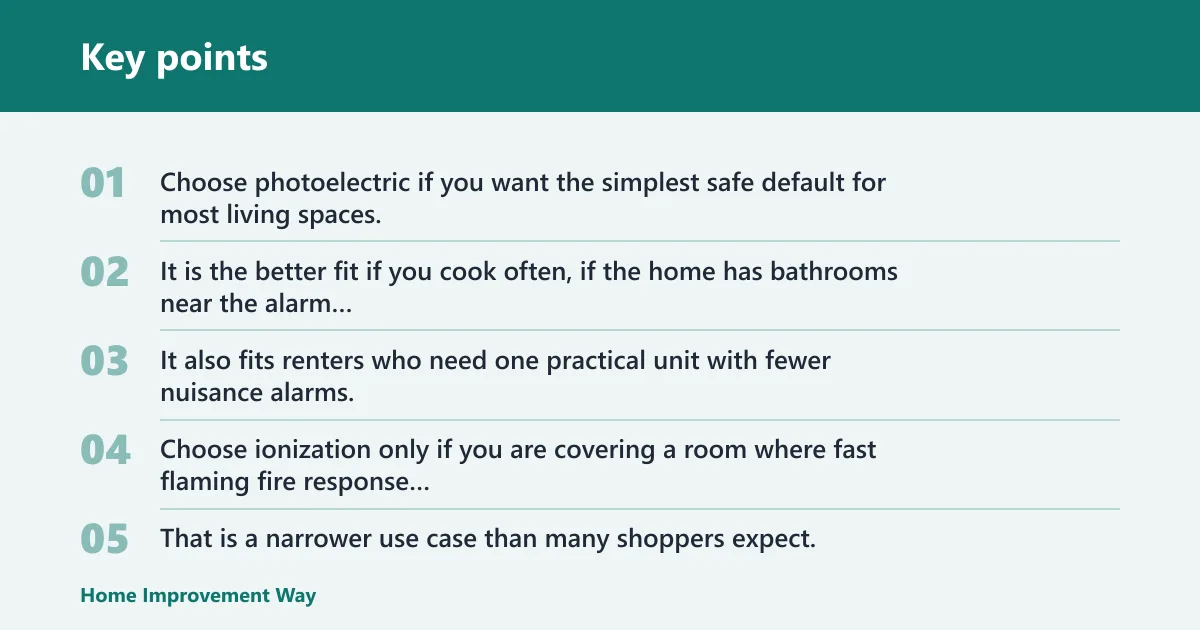
Choose photoelectric if you want the simplest safe default for most living spaces. It is the better fit if you cook often, if the home has bathrooms near the alarm location, or if you are replacing just one alarm in a bedroom or hallway. It also fits renters who need one practical unit with fewer nuisance alarms.
Choose ionization if…
Choose ionization only if you are covering a room where fast flaming fire response matters enough to justify it. That is a narrower use case than many shoppers expect. If the room also sees cooking smoke, steam, or frequent aerosols, ionization is usually the harder choice to live with.
Choose dual-sensor if…
Choose dual-sensor if you want one housing to cover both fire patterns. Dual-sensor alarms contain both sensing methods in one unit, so they are the simplest way to satisfy both-technologies guidance. They are a strong pick for a whole-home replacement when you want one product type everywhere.
Choose a mixed-home setup if…
Choose a mixed setup if you are replacing alarms room by room or matching each space to its risk. Photoelectric can go in bedrooms and kitchens, with dual-sensor or interlinked coverage across the rest of the home. This approach gives you room-specific tuning without losing broad protection.
Room-by-room smoke alarm decision table
The cleanest buying rule is to map the room to the smoke pattern and nuisance risk. If the room is a sleep space or a cooking-adjacent space, photoelectric usually wins. If the room has a documented flame-heavy risk, ionization can be justified, but dual-sensor is often the easier whole-home answer.
| Location | Preferred sensor | Nuisance-alarm risk | Why this choice |
|---|---|---|---|
| Bedrooms | Photoelectric | Low to moderate | Better for smoldering fires and sleep-area warning |
| Hallways | Photoelectric | Low | Strong general coverage for smoke moving toward sleeping areas |
| Kitchen | Photoelectric | Moderate to high | Less prone to cooking-related nuisance alarms than ionization |
| Bathroom | Photoelectric | Moderate to high | Steam and humidity make nuisance alarms more likely |
| Living room | Photoelectric or dual-sensor | Low | Common household fire sources can smolder before flaming |
| Basement | Dual-sensor or photoelectric | Low to moderate | Flexible choice for mixed fire patterns and storage-related risks |
| Garage or flame-heavy utility space | Ionization or dual-sensor | Variable | Fast flaming fires may justify ionization if placement rules allow |
Simple buying rules for renters, budget buyers, and older adults
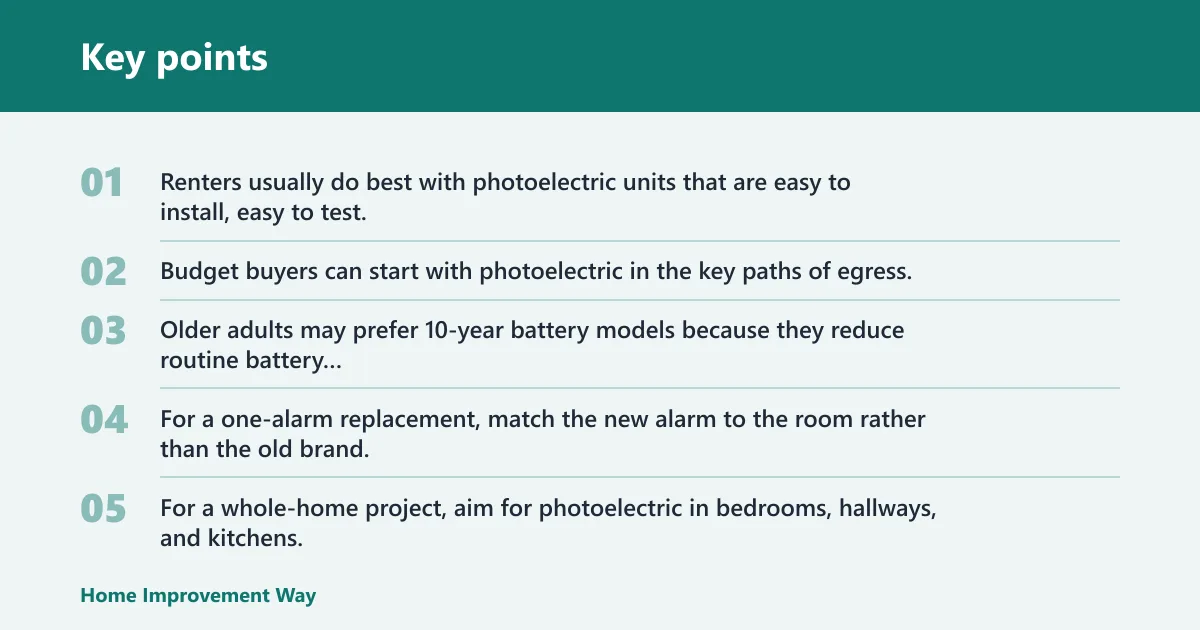
Renters usually do best with photoelectric units that are easy to install, easy to test, and less annoying in sleeping areas. Budget buyers can start with photoelectric in the key paths of egress, then expand to dual-sensor units later. Older adults may prefer 10-year battery models because they reduce routine battery changes, but the sensor choice still comes first.
What a mixed-home shopping path looks like
For a one-alarm replacement, match the new alarm to the room rather than the old brand. For a whole-home project, aim for photoelectric in bedrooms, hallways, and kitchens, then use dual-sensor or interconnected coverage where you want broader protection. That path keeps nuisance alarms under control while still covering both fire patterns.
Do you need both photoelectric and ionization smoke alarms?
For best protection, yes, but not necessarily as two separate boxes in every room. NFPA guidance favors homes that include both technologies, and homeowners can meet that guidance with separate alarms or combination units. A dual-sensor alarm is the easiest way to get both sensing methods in one housing.
Separate alarms versus combination units
Separate alarms let you place the right sensor in the right room. Combination units simplify shopping and installation because one device covers both fire patterns. The trade-off is flexibility versus simplicity, not safety versus no safety.
When a dual-sensor alarm is the simplest choice
Choose dual-sensor if you want one purchase path for most of the house, especially during a full replacement project. It reduces the chance that one room ends up with the wrong sensor type. It also fits homeowners who want a straightforward way to satisfy both-technologies guidance.
Placement, interconnection, and maintenance basics
Placement matters as much as sensor type. Follow manufacturer instructions for ceiling or wall mounting, keep alarms away from dead air pockets and direct cooking flow, and do not treat a sensor choice as a substitute for correct installation. Interconnection is a major safety upgrade because one alarm should trigger all alarms, improving whole-home warning.
Testing and replacement timing
Test alarms regularly and replace units at the interval listed by the manufacturer, which is often around 10 years for many modern smoke alarms. A long-life battery smoke alarm can reduce routine battery changes, but it does not replace proper placement or the right sensor type. The guide also covers batteries, testing, and 10-year replacement because upkeep affects whether an alarm will still protect you when needed.
End-of-life handling matters for ionization units
Ionization alarms contain americium-241, so disposal instructions matter at end of life. Do not treat them like generic plastic trash without checking the manufacturer’s disposal steps. That is a buying consideration, especially for homeowners who want low-maintenance replacement and simpler end-of-life handling.
A common first-timer mistake is hanging a smoke alarm right outside a bathroom where steam keeps setting it off and then assuming the detector type is defective. Often the issue is location, not the detector type. Photoelectric may be the better sensor there, but proper mounting still decides whether it behaves well.
Which is better, photoelectric or ionization smoke detector?
For most homes, photoelectric is the better buy because it handles smoldering fires well and is usually less nuisance-prone near kitchens and bathrooms. Ionization is better only when your main concern is fast flaming fire response. The right answer depends on the room, not a single universal winner.
Which smoke detector is best for bedrooms?
Photoelectric is usually the best pick for bedrooms because it responds faster to smoldering fires, which are a serious bedroom risk during sleep hours. It is also a good fit where you want fewer nuisance alarms that could tempt someone to silence the device. Hallways near bedrooms should usually match that choice.
Which smoke detector is best near the kitchen?
Photoelectric is usually best near the kitchen because it tends to produce fewer cooking-related nuisance alarms. That does not mean it ignores fire; it still detects smoke and alarms appropriately. Keep it placed according to manufacturer guidance so cooking vapor does not trigger avoidable alerts.
Are photoelectric smoke alarms less likely to false alarm?
They are often less likely to nuisance alarm in places with cooking smoke or steam, especially near kitchens and bathrooms. That is not the same as saying they never false alarm. Placement, dust, steam, and installation quality still matter for any smoke alarm type.
What kind of smoke alarm detects smoldering fires faster?
Photoelectric smoke detectors generally respond faster to slow, smoldering fires. They detect smoke by light scattering, which fits the larger visible particles that smoldering fires produce. That makes them a strong choice for bedrooms, hallways, and living areas where smoldering risk is important.
What kind of smoke alarm detects flaming fires faster?
Ionization smoke detectors generally respond faster to fast, flaming fires. Their charged chamber design is more responsive to the very small smoke particles that flaming fires produce. That advantage can matter in specific flame-heavy risk areas, but it does not make ionization the default for the whole house.
Should I buy a dual-sensor smoke alarm instead?
Buy a dual-sensor alarm if you want one unit to cover both fire patterns with less room-by-room sorting. It is the simplest way to satisfy both-technologies guidance and is a strong choice for whole-home replacement. If you are fine mixing sensor types by room, separate alarms can be more targeted.
How do I choose a smoke detector for each room?
Start with the fire pattern and nuisance risk in that room. Use photoelectric for bedrooms, hallways, kitchens, and bathrooms; consider dual-sensor for general living areas and basements; reserve ionization for a clearly flame-heavy scenario. Then confirm placement, interconnection, and replacement timing before you buy.
Do smoke detectors with 10-year batteries matter?
Yes, but as a maintenance choice, not a sensor choice. A 10-year battery smoke alarm reduces routine battery changes, which helps with upkeep and compliance, especially for hard-to-reach ceilings. It does not change the core decision between photoelectric, ionization, or dual-sensor coverage.
Sponsored / affiliate links. As an Amazon Associate I earn from qualifying purchases. I may earn additional commission from eligible campaigns.
 SITERLINK Smoke Detectors 10 Year Battery Operated,UL217-9th Listed Smoke Alarm with Test-Silence Button,Photoelectric Sensor Fire Alarms Smoke Detectors with LED Lights for Home, GS525A (6 Pack)
 COWAY Air Purifiers for Home Large Room Up to 1,860 ft², Washable Pre-Filter and HEPA Filter for Smoke, Allergies, Pet Dander, Odor, AQI, Smart & Rapid Mode, Timer, 3yr Warranty, Airmega 250