Best Smart Motion Sensors for Halls & Garages (2026):We Compared
For hallways, choose a simple PIR smart motion sensor; for garages, pick a wired or lux-aware model; use mmWave only if you need presence detection when people stay still. A poor match leads to lights switching off too early, false triggers from door movement, or a garage light that ignores daylight and wastes power. This guide compares PIR, lux-aware, and mmWave sensors by room, then explains which sensing stack fits your layout.
Quick comparison
| Product | Badge | Best for | Price | ||
|---|---|---|---|---|---|
 |
SONOFF Zigbee Human Presence SensorSONOFF | Our pick | Zigbee · mmWave · presence sensor | $17.90
Price as of 4 Nov 2026
|
View |
 |
Aqara Zigbee 3.0 Motion Sensor P1 3 PackAqara | Also great | Zigbee 3.0 · 3-pack · motion sensor | $49.99
Price as of 4 Nov 2026
|
View |
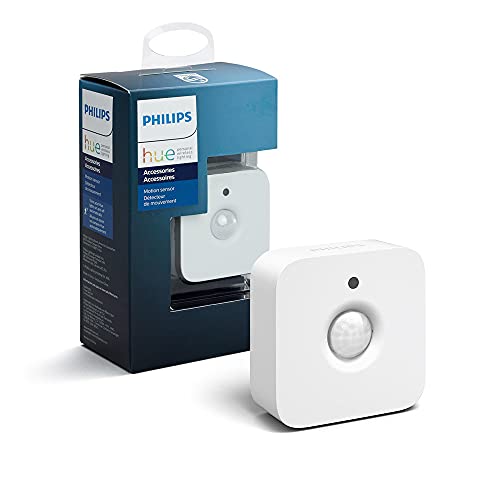 |
Philips Hue Indoor Motion Sensor for Smart LightsPhilips Hue | Pair with it | Indoor · smart lights · motion sensor | $64.99
Price as of 4 Nov 2026
|
View |
 |
Zooz 800 Series Z-Wave Long Range S2 Motion Sensor ZSE18ZOOZ | Budget pick | Z-Wave LR · S2 · motion sensor | $37.95
Price as of 4 Nov 2026
|
View |
 |
Aqara Presence Sensor FP300 Wireless 5-in-1 Motion SensorAqara | Upgrade pick | Wireless · 5-in-1 · mmWave sensor | $46.99
Price as of 4 Nov 2026
|
View |
Start with the room, then the sensor type. Hallways usually need fast PIR detection, short off timers, and a daylight lockout. Garages need wider coverage, longer hold times, and better control over ambient light.
How we chose
The comparison below focuses on four points: sensing type, power and wiring, ecosystem fit, and how well the sensor handles blind corners, pets, adjacent doorways, and daylight. It also favors models that can keep lights on while motion continues and extend the off timer when fresh motion appears.
For most apartments, a PIR motion sensor with light-level data is enough. mmWave belongs in spaces where someone may stand still, such as a laundry nook, utility bench, or work area inside a garage.
Placement matters more than spec-sheet range. A ceiling sensor can cover a hallway or garage entry cleanly, while a wall sensor can work better for a long run or a corner that needs directional coverage.
Should you choose PIR or mmWave?
For a hallway, PIR is usually the better first choice because it reacts to movement and keeps automation simple. mmWave is worth the higher cost only when you need presence detection while someone stays still, such as at a desk, workbench, or in a garage zone where the person pauses for a long task.
Why PIR fits hallways
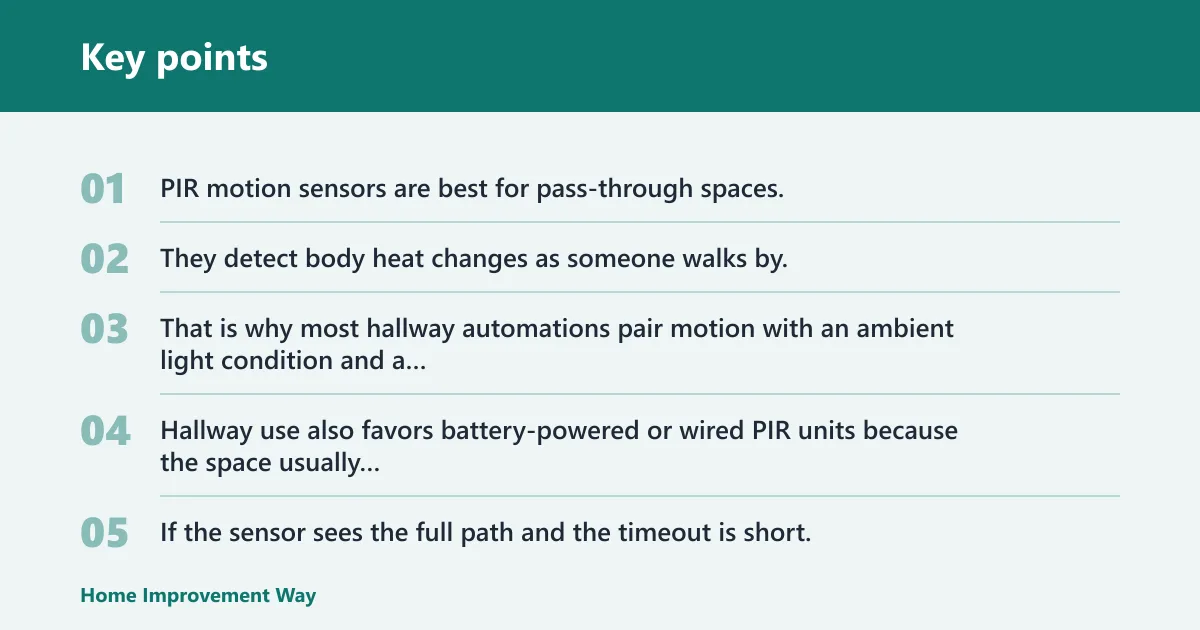
PIR motion sensors are best for pass-through spaces. They detect body heat changes as someone walks by, so they match the way hallways are used. That is why most hallway automations pair motion with an ambient light condition and a short delay, then turn off after the path clears.
Hallway use also favors battery-powered or wired PIR units because the space usually does not need radar-level sensitivity. If the sensor sees the full path and the timeout is short, you avoid lights staying on after someone has already moved on.
When mmWave is worth it
mmWave presence sensing is better when people remain still in the space. It can keep a light on while someone is paused, which helps in garages, utility rooms, and work zones where a standard motion sensor might time out too early.
The tradeoff is cost and complexity. mmWave often needs continuous power, and it can be more sensitive to placement and setup than PIR. That makes it a better fit for specific jobs than for a simple hallway.
Presence detection vs motion detection
Motion detection notices activity. Presence detection tries to notice that a person is still there. For a hallway, motion is enough. For a garage bench, a long task, or a doorway where you may stand in place, presence sensing can prevent false-offs.
Do you need a lux sensor?
Yes, in most cases. A hallway motion-light automation should use motion as the trigger and ambient light as a condition, so the lights do not switch on in daylight. In garage lighting, a lux threshold is even more useful because the same space may be bright enough during the day and dark at night.
Daylight lockout for hallways
Hallway lights should allow switch-on time and ambient light threshold settings. The ambient light threshold is often called LUX. Set it low enough that the light stays off during daytime but still comes on after dusk, especially near entry halls with windows or transoms.
A common mistake is using motion only. That causes daytime activations in spaces that already have enough light.
Garage lights and ambient thresholds
Garages need a stronger daylight lockout than hallways. If the garage door is open during the day, motion alone can keep turning lights on when natural light is already doing the job. A lux-aware sensor or sensor light avoids that waste.
In darker garages, a higher threshold can still help if there is a partial window or a door to the house that leaks light. The right setting depends on whether you want the light to react only after the room is genuinely dim.
Simple on/off vs day-night automation
Simple on/off works when the space is always dark. Day-night automation works better when light levels change. For hallways and garages, the second option usually gives less annoyance because it matches real use instead of every motion event.
Best PIR sensor for hallways
For hallways, a PIR sensor with a short timeout, a modest detection angle, and ambient-light control is the safest default. It should turn on quickly, keep the light on while motion continues, and restart its timer when fresh motion is detected.
Ideal timeout and mounting height
Hallway use usually needs a short off delay. Many motion sensors offer 30 seconds to 30 minutes delay settings, but a hallway typically sits at the lower end of that range. Shorter delays reduce the chance that a light stays on after someone has already passed through.
Mount so the sensor sees the path, not just the doorway. A ceiling unit can work well in the middle of a run; a wall unit can help when the hallway is long or has a turn.
Battery-powered vs wired versions
Battery-powered PIR sensors are easier to place and suit renters or retrofit jobs. Wired versions make more sense when you already have a fixture location or want a ceiling sensor light that covers the corridor without battery changes.
Indoor sensor lights may use PIR or microwave sensing, but PIR is the simpler fit for a pass-through hallway. It is usually easier to tune and less likely to react to activity outside the space.
Where it can fail
PIR can miss a person who stops moving for too long. It can also false-trigger if the sensor looks across a doorway where traffic from another room keeps crossing the beam. Pet-heavy homes need careful placement so floor-level movement does not keep waking the light.
Say your hallway has a side door at the far end and the sensor faces it directly. Every time the door opens, the light may retrigger even if nobody enters the hall. Rotate the sensor or move it to cover the path length instead of the door swing.
Best sensor for garages
For garages, choose a wired or lux-aware sensor with wider coverage and a longer hold time. Garages often need ceiling sensor lights or wall-mounted sensors because the space is broader, the air can be damp, and the light has to cover vehicles, storage, and the entry path.
Wide coverage and longer hold times
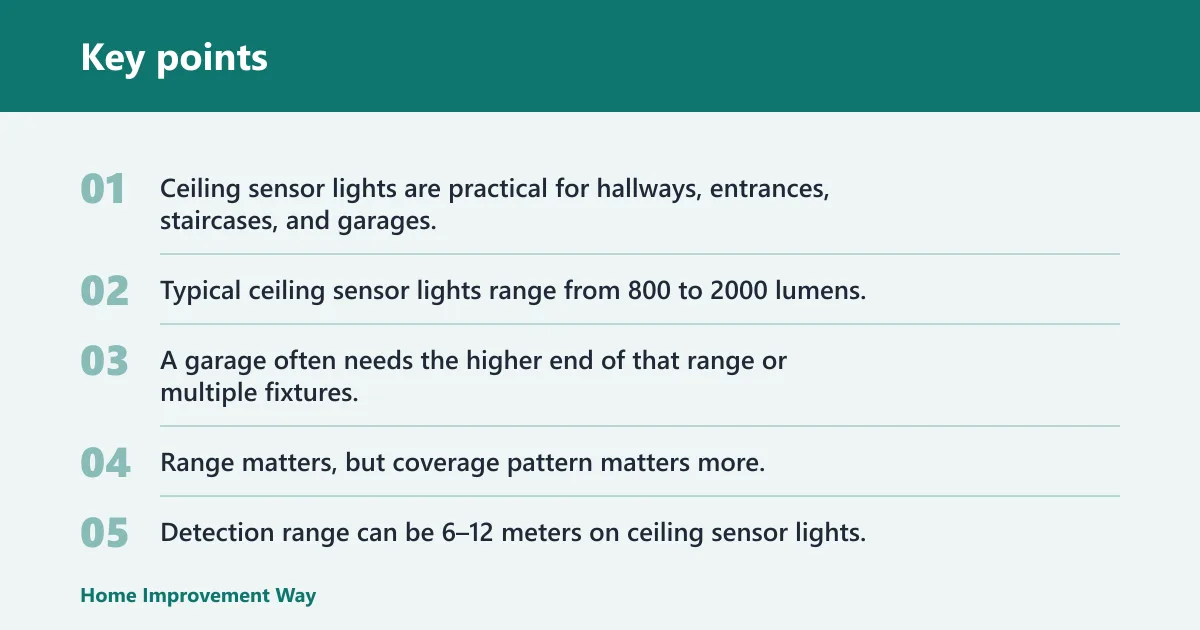
Ceiling sensor lights are practical for hallways, entrances, staircases, and garages. Typical ceiling sensor lights range from 800 to 2000 lumens, and for hallways around 10–15 m², 1000–1500 lm is suggested. A garage often needs the higher end of that range or multiple fixtures.
Range matters, but coverage pattern matters more. Detection range can be 6–12 meters on ceiling sensor lights, while wall motion sensors can provide up to 75 feet coverage. Use the figure that matches the room shape, not the longest number on the box.
Wired ceiling or wall options
Wired sensors are usually better in garages because they avoid battery maintenance and support longer run times. They also work better when you want the light to stay on while you are moving between the car, storage, and the house door.
If the garage has a long bay or a side work area, a wall-mounted sensor can help aim the detection line across the space. A ceiling sensor can be cleaner for a central mount and can reduce blind spots around parked vehicles.
Damp areas, cold rooms, and IP ratings
Garages can be semi-outdoor spaces, so IP rating matters. Indoor models are often fine at around IP20–IP44, while garage or damp areas are generally better served by about IP44–IP54. That does not make a sensor waterproof, but it gives more margin for humidity and splashes.
For colder garages, avoid placing a battery sensor where temperature swings are harsh if a wired option is available. Continuous power also makes mmWave more realistic when the garage is used as a workshop or hobby space.
Can it work with Matter or HomeKit?
Yes, but the right protocol depends on what you want the sensor to do. Matter, Thread, Zigbee, and Wi‑Fi can all work, yet they differ in hub needs, device response, and which automations your platform exposes. Apple HomeKit and Google Home support also vary by device and bridge.
Matter, thread, Zigbee, and wi‑Fi
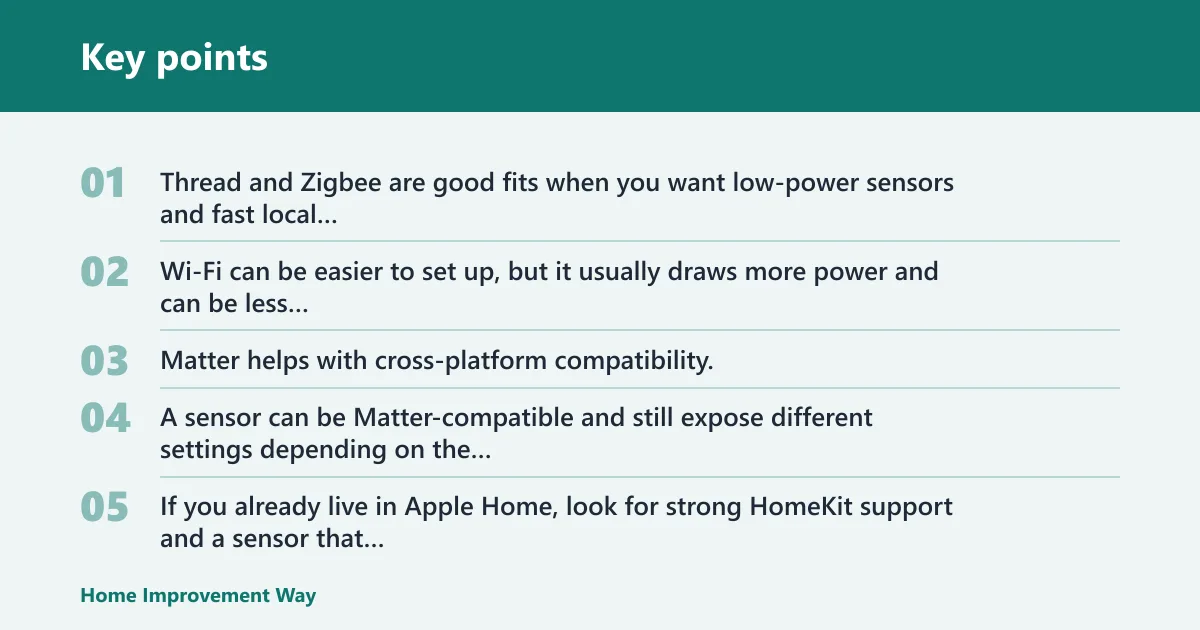
Thread and Zigbee are good fits when you want low-power sensors and fast local automations through a hub. Wi‑Fi can be easier to set up, but it usually draws more power and can be less attractive for battery sensors.
Matter helps with cross-platform compatibility, but app features may not match perfectly across ecosystems. A sensor can be Matter-compatible and still expose different settings depending on the hub you use.
Apple HomeKit and google Home fit
If you already live in Apple Home, look for strong HomeKit support and a sensor that exposes motion, occupancy, and light conditions cleanly. Google Home users should check whether the automations support both motion and ambient-light rules, not just a basic trigger.
A hub-based setup often gives better control than a direct Wi‑Fi device, especially when you want reliable local automations and less dependence on cloud timing.
When hub-based control is the better call
Hub-based control is the better call for multi-sensor homes, garages with several zones, or any setup where the off timer should restart on new motion. It also tends to handle mixed devices better when the hallway and garage use different sensor types.
Hallway garage sensor comparison table
| Scenario | Best sensor type | Mounting height | Timeout | Lux setting | Power source | Ecosystem fit |
|---|---|---|---|---|---|---|
| Short corridor | PIR motion | Ceiling, centered | 30–60 seconds | Low, day/night lockout | Battery or wired | HomeKit, Matter, Zigbee |
| Dark entry hall | PIR with light sensing | Wall, aimed down the run | 1–2 minutes | Moderate, dusk-only | Battery | Matter, HomeKit, Wi‑Fi |
| Long garage | Wired ceiling sensor light | Ceiling, central bay | 5–10 minutes | Higher threshold for daylight lockout | Wired mains | Zigbee, Wi‑Fi, Hub-based |
| Shared corridor | PIR motion | Wall, away from cross-traffic | 1–3 minutes | Low to moderate | Battery or wired | Thread, Zigbee, HomeKit |
| Pet-heavy home | PIR with narrow aim | Ceiling or higher wall mount | 30–90 seconds | Moderate | Battery | Matter, Zigbee |
| Ceiling-mounted garage | Wired PIR or mmWave | Ceiling, clear line of sight | 5–15 minutes | Medium, dusk-aware | Continuous power | Zigbee, Thread, Hub-based |
| Wall-mounted hallway | PIR motion | Wall, mid-height | 30–60 seconds | Low | Battery | HomeKit, Matter, Wi‑Fi |
| Utility nook | mmWave presence | Wall or ceiling | 3–10 minutes | Light-aware | Continuous power | Thread, Zigbee, Home Assistant |
| Garage side door zone | Lux-aware PIR | Wall, aimed away from the door | 2–5 minutes | Higher threshold | Wired | Google Home, Matter, Zigbee |
Which one should you buy?
For a hallway, buy the simplest PIR sensor that supports ambient light threshold settings, a short timeout, and the ecosystem you already use. That combination covers the most common use case without extra cost or setup complexity.
For a garage, choose a wired or ceiling-mounted lux-aware sensor first, then consider mmWave only if the space includes a workbench or another area where someone may stay still. The garage is where wider coverage, damp tolerance, and longer hold times matter most.
For tight budgets, a battery PIR sensor with a narrow, well-aimed field is the safer buy than an overfeatured presence sensor. For smart-home automations, a hub-friendly model in Zigbee, Thread, or Matter is usually easier to tune than a Wi‑Fi-only device.
Say your hallway is 12 m² and leads past two bedroom doors. A PIR sensor with a short delay, ceiling placement, and a low lux threshold will usually work better than a radar-style unit that keeps reacting to movement across those doorways.
Suppose your garage doubles as storage and a workshop. A wired ceiling sensor light with a dusk-aware threshold and a longer timeout is more practical than a battery sensor that may miss stillness at the workbench.
Frequently asked questions
What is the best smart motion sensor for a hallway or garage?
For hallways, the best default is a PIR sensor with light-level control and a short timeout. For garages, a wired or lux-aware model is usually the better pick because it handles wider coverage, longer hold times, and daylight changes more reliably. Choose mmWave only when stillness detection matters.
Should I buy PIR or mmWave for a hallway?
Buy PIR for most hallways. It is simpler, cheaper, and well matched to pass-through movement. mmWave is useful only if the hallway doubles as a standing area, such as a small landing or utility spot, and you need the light to stay on while someone is still.
Do motion sensors need a lux sensor for garage lights?
Yes, if the garage sees daylight or has a bright entry door. A lux sensor prevents the light from turning on when the space is already bright enough. That matters most in garages, where natural light can change a lot between morning, afternoon, and night.
What detection range is best for a hallway motion sensor?
Range should match the layout more than the largest number on the box. Ceiling sensor lights often cover 6–12 meters, which is enough for many hallways. If the hall has corners or side doors, mount for line of sight and use the sensor’s field of view to avoid blind spots.
Can a smart motion sensor work with Apple HomeKit or Matter?
Yes, many can. The important part is whether the motion, light threshold, and timer settings are exposed in the platform you use. Matter can improve cross-platform support, but a hub-based Zigbee or Thread setup may still give better automation control in a hallway or garage.
How long should a hallway or garage light stay on after motion is detected?
Hallways usually need a short delay, often 30 seconds to 2 minutes. Garages often need longer, commonly several minutes, so the light does not switch off while you are unloading or working. The right setting should also restart when new motion is detected.
Where should I place a motion sensor in a hallway or garage?
Place it where it sees the route, not the traffic source. In hallways, ceiling placement or a wall mount aimed along the path reduces blind spots. In garages, use a ceiling or high wall position that avoids direct views of exterior doors, moving doors, or adjacent walkways.
Are wired sensor lights better than battery motion sensors for garages?
Usually yes. Wired sensor lights are better for garages because they support longer run times, wider coverage, and more reliable operation in a space that may be damp or cold. Battery sensors still work for smaller, lighter-duty spots, but they are less ideal for a full garage.
What features reduce false triggers in a motion sensor?
Look for adjustable sensitivity, a sensible detection angle, an ambient light threshold, and a timeout that can restart on new motion. Good placement matters just as much. Keeping the sensor away from pet traffic, open doorways, and exterior movement cuts down false triggers fast.
Sponsored / affiliate links. As an Amazon Associate I earn from qualifying purchases. I may earn additional commission from eligible campaigns.