Which Home Safety Detectors Does Every House Need?
Every home needs smoke alarms. If you have fuel-burning appliances or an attached garage, add carbon monoxide alarms on every level and outside sleeping areas. Missing one can delay warning, raise fire or poisoning risk, and lead to avoidable loss. This guide ranks which home safety detectors matter most, where to place them, and when combination units are enough.
Which detectors every house needs?
Smoke alarms are the baseline device for every home. Carbon monoxide alarms are the next priority in any home with fuel-burning appliances, an attached garage, or sleeping areas near those risks. Combination smoke and carbon monoxide alarms can simplify installation, but they do not replace correct coverage in the right rooms.
Smoke alarms: the baseline for every home
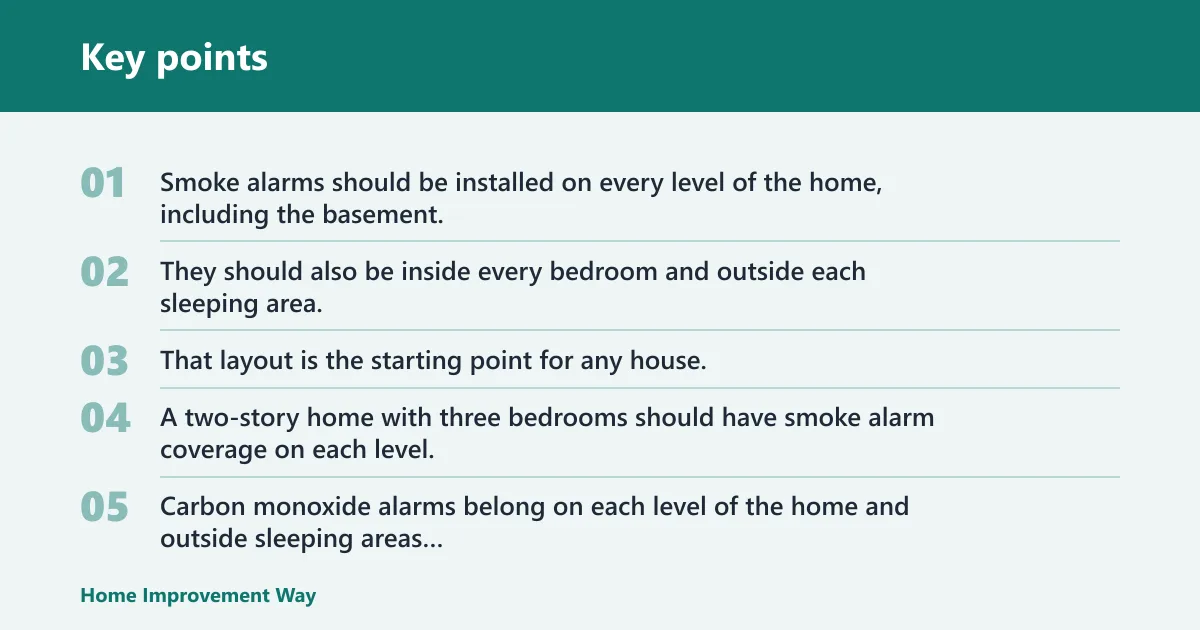
Smoke alarms should be installed on every level of the home, including the basement. They should also be inside every bedroom and outside each sleeping area. That layout is the starting point for any house, whether it is all-electric or filled with gas appliances.
A two-story home with three bedrooms should have smoke alarm coverage on each level, in each bedroom, and outside sleeping areas as needed for the floor plan.
Carbon monoxide alarms: when they are essential
Carbon monoxide alarms belong on each level of the home and outside sleeping areas whenever fuel-burning appliances or an attached garage can create CO risk. Place them according to the manufacturer’s instructions, since carbon monoxide mixes with air in ways that depend on the home’s layout and air movement.
Illinois-specific guidance advises installing carbon monoxide detectors on each level of the home and within 15 feet of all bedrooms. That is a practical benchmark for homes with furnaces, gas ranges, fireplaces, water heaters, or attached garages.
What combination alarms can and cannot replace
Combination smoke and carbon monoxide alarms provide single-unit dual protection. They are useful where wiring is limited, wall space is tight, or you want to simplify installation. They are not a substitute for correct placement, and they do not make up for missing alarms in bedrooms, halls, basements, or on other levels.
Where should smoke alarms go?
Smoke alarms need broad coverage first, then careful placement. Put them on every level, inside every bedroom, and outside sleeping areas. After that, keep them high on walls or ceilings, away from airflow problems, and far enough from cooking that normal meal prep does not trigger nuisance alarms.
Every level, every bedroom, and outside sleeping areas
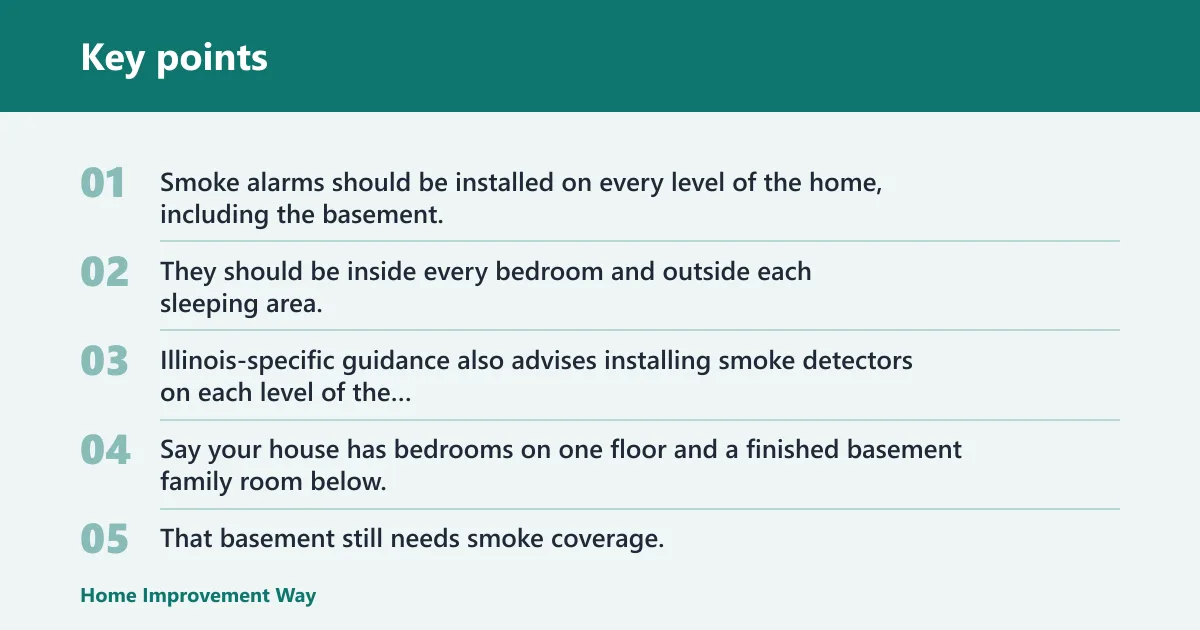
Smoke alarms should be installed on every level of the home, including the basement. They should be inside every bedroom and outside each sleeping area. Illinois-specific guidance also advises installing smoke detectors on each level of the home and within 15 feet of all bedrooms, which is a useful placement guide for many layouts.
Say your house has bedrooms on one floor and a finished basement family room below. That basement still needs smoke coverage, because fires can start there and block escape paths before the rest of the house knows what is happening.
Ceiling and wall placement rules
Mount smoke alarms high on walls or ceilings. If you use a wall-mounted unit, place the top of the alarm no more than 12 inches from the ceiling. Keep alarms away from vents, ceiling fans, corners, and windows, since those spots can slow smoke entry or create nuisance alarms.
Kitchen distance and nuisance alarm reduction
Kitchen smoke detectors should be at least 10 feet away from cooking appliances. That distance helps reduce false alarms from toast, steam, and normal pan smoke. If a bedroom opens near the kitchen, use placement that protects the sleeping area without putting the alarm directly in the cooking plume.
Photoelectric smoke detectors are usually the better choice in living areas near kitchens because they respond better to smoldering fires and are less likely to nuisance alarm from everyday cooking. Ionization smoke detectors respond faster to flaming fires, but they are more likely to nuisance alarm from cooking or steam.
Where should carbon monoxide alarms go?
Carbon monoxide alarms should go on each level of the home and outside sleeping areas, with placement based on the manufacturer’s instructions. That matters because CO can spread through hallways, stairwells, and return-air paths, so the alarm has to be where it can warn sleeping people in time.
Each level of the home
Install a CO alarm on every level, including finished basements. That placement helps catch a problem from a furnace, water heater, attached garage, or other fuel-burning source before the gas travels only to one part of the house. If a level has no bedrooms, it still needs a detector when CO risk exists.
Near sleeping areas
Carbon monoxide detectors should be outside sleeping areas so they can wake people during overnight exposure. A hallway outside bedrooms often works well if it follows the manufacturer’s spacing and mounting guidance. Illinois-specific guidance advises placing CO detectors within 15 feet of all bedrooms, which is a practical target for many homes.
Follow the manufacturer’s placement instructions
Do not assume a smoke alarm spot also works for carbon monoxide. Follow the manufacturer’s placement instructions for the model you buy, especially for ceiling versus wall mounting and any clearance from vents, windows, or combustion appliances. Local rules can differ, so the product instructions and local code both matter.
When are combination alarms enough?
Combination smoke and carbon monoxide alarms are enough in some rooms, but not in every layout. They work best where you need both protections in one device and the room location already satisfies both smoke and CO placement rules. They do not replace a full plan for the house.
Where space or wiring is limited
Combination units make sense in bedrooms, hallways, and utility-adjacent areas where adding separate devices would be hard or where wiring is limited. They can also simplify replacement in older homes that need an upgrade without major electrical work.
Why combination units still need correct placement
A combination alarm still has to be mounted where it can detect both hazards properly. If you place it too close to the kitchen, the smoke side can nuisance alarm. If you place it too far from sleeping areas, the CO side may not warn people in time. One device cannot fix a bad location.
When separate alarms are the better choice
Separate smoke and CO alarms are often better when you need to match different placement rules in different parts of the house. That lets you choose photoelectric smoke protection near cooking areas and a CO alarm placed for sleeping-area warning, instead of forcing one dual-purpose unit to do both jobs in a poor spot.
Detector checklist by home type
This checklist separates minimum coverage from practical upgrades. Start with the minimum set, then add the preferred type and placement notes that fit the house layout. The goal is clear: match detector type to hazard, room, and wiring reality.
| Home scenario | Minimum detector set | Preferred detector type | Placement note |
|---|---|---|---|
| All-electric home | Smoke alarms on every level, inside every bedroom, and outside sleeping areas | Photoelectric smoke alarms in living areas | Use smoke alarms high on walls or ceilings; add CO alarms if any fuel-burning appliance or attached garage exists |
| Home with gas appliances | Smoke alarms plus CO alarms on each level and near sleeping areas | Separate smoke and CO alarms in key rooms | Keep smoke alarms at least 10 feet from cooking appliances; follow CO placement instructions closely |
| Attached garage | Smoke alarms throughout the home and CO alarms on each level | Separate CO alarm near sleeping areas | Do not rely on a garage-adjacent hallway alone; protect bedrooms and the level above or beside the garage |
| Basement | Smoke alarm in the basement and on every other level | Interconnected smoke alarms if the home is larger or multi-story | Basement coverage matters even when it is unfinished, because fire can start near stored items or mechanical equipment |
| Split-level home | Smoke alarms on every level and CO alarms near sleeping areas | Interconnected alarms across levels | Split levels can leave stairs and landings unprotected unless alarms are tied together and placed on each floor |
| Bedrooms near kitchen | Smoke alarms in bedrooms and outside sleeping areas, plus CO alarms if needed | Photoelectric smoke alarms near the kitchen side of the layout | Keep kitchen-near smoke alarms at least 10 feet from cooking appliances to reduce nuisance alarms |
How do you keep detectors working?
Install the right alarms, then keep them working. Test them monthly, replace batteries as needed for the model you own, and replace aging alarms when the manufacturer’s time limit is reached. A dead or disabled alarm is the same as no alarm at all.
- Test each smoke and carbon monoxide alarm monthly.
- Replace batteries as needed for the alarm type and manufacturer instructions. (Illinois)
- Vacuum dust from alarm openings when the manufacturer allows it.
- Replace any alarm that fails testing or shows end-of-life warnings.
- Upgrade battery-powered units if frequent battery checks are becoming a problem.
Monthly testing
Test alarms monthly using the built-in test button. That check confirms the sounder and power source are working. Interconnected smoke alarms should be tested too, because all alarms should sound together in a larger or multi-story home.
Battery replacement every six months
Illinois recommends changing detector batteries every six months for alarms that use replaceable batteries. That schedule is a practical way to stay ahead of low-power failures in battery-backed alarms and combination units. Sealed 10-year alarms are designed differently and are not meant to have their batteries replaced on that schedule.
When to replace aging alarms
Replace alarms that reach the manufacturer’s end-of-life date, fail repeated tests, or no longer hold a battery properly. Hardwired smoke detectors can provide reliable coverage when properly installed and maintained, while battery-powered smoke detectors can also provide reliable coverage when properly installed and maintained.
Frequently asked questions
Which home safety detectors does every house need?
Every house needs smoke alarms, and any home with fuel-burning appliances or an attached garage also needs carbon monoxide alarms. Smoke coverage comes first because fire can spread quickly through sleeping areas. CO coverage then fills the poisoning risk that smoke alarms cannot detect.
Do I need both smoke and carbon monoxide detectors?
Yes, if your home has fuel-burning appliances, an attached garage, or any other CO source. Smoke alarms warn about fire, while carbon monoxide alarms warn about invisible gas. One device does not replace the other, and both should be placed where they can protect sleeping areas.
How many detectors do I need in a house?
At minimum, you need smoke alarms on every level, inside every bedroom, and outside each sleeping area. Carbon monoxide alarms belong on each level and outside sleeping areas when CO risk exists. The exact number depends on the number of sleeping areas and the home’s floor plan.
Should detectors go on every level of the home?
Yes. Smoke alarms should be installed on every level of the home, including the basement. Carbon monoxide alarms should also be on each level when CO risk exists. That layout gives warning no matter where a fire or gas problem starts.
What type of detector should I use near a kitchen or furnace?
Near kitchens, photoelectric smoke detectors are usually the better choice because they handle smoldering smoke and nuisance alarm risk better. Near furnaces or other fuel-burning equipment, use carbon monoxide alarms placed according to the manufacturer’s instructions, and keep smoke alarms at least 10 feet from cooking appliances.
How often should smoke and carbon monoxide detectors be tested?
Test both smoke and carbon monoxide alarms monthly. Replace batteries as needed for the alarm type and manufacturer instructions. If an alarm chirps, fails the test button, or reaches end of life, replace it promptly. Monthly testing is the simplest way to catch a problem before an emergency does.
Sponsored / affiliate links. As an Amazon Associate I earn from qualifying purchases. I may earn additional commission from eligible campaigns.
 POWAW Smart Air Purifier for Pet House Upgrade, Eliminator with Infrared Protection, 4 Modes, Air Ionizer, Indoor Pet Care Solution, White
 SITERLINK Smoke Detectors 10 Year Battery Operated,UL217-9th Listed Smoke Alarm with Test-Silence Button,Photoelectric Sensor Fire Alarms Smoke Detectors with LED Lights for Home, GS525A (6 Pack)