Water Leak Detectors vs. Smoke Detectors: What Each One Catches
Smoke detectors catch airborne fire hazards; water leak detectors catch moisture at floor level, so you need both in different parts of the home for different failure points. Miss that split and you can lose fire warning time or let a slow leak rot cabinets, subfloors, and drywall before you notice. This guide maps where each detector belongs, what it senses, and which rooms need one more than the other.
| Decision factor | leak detectors | smoke detectors | Winner |
|---|---|---|---|
| What it catches | Water where it should not be: pooled moisture, drips, or a leak that has reached the floor | Smoke from fire, not water | tie |
| Best mounting position | On the floor, near the leak source or likely puddle path | On the ceiling, away from dead-air pockets and airflow problems | tie |
| Alert path | Local alarm, smartphone notification, or both, depending on type | Local alarm, often hardwired or battery-powered | tie |
| Best room fit | Kitchens, bathrooms, laundry rooms, basements, near water heaters and appliances | Bedrooms, hallways, and common areas | tie |
| Failure mode if placed wrong | Misses water if it is too far from the floor, hidden behind a cabinet, or lost in a loud house | Misses smoke if mounted too close to steam, cooking, or strong airflow | tie |
Smoke and water catch different hazards
These devices do different jobs. Smoke detectors watch for airborne fire byproducts, while leak detectors watch for water that has reached a surface and should not be there. That difference decides where each one goes and what kind of failure it can catch early.
A burst pipe or a slow drip can cause thousands of dollars in damage, so water sensing matters in rooms where plumbing or appliances can fail. Fire warning matters in sleeping and living areas, where smoke can spread before flame reaches you.
📊 One TOH pick uses a loud 100-decibel alarm plus phone notifications. Source: Best Water Leak Detectors (2026 Guide).
Smoke detector vs. water leak detector
Smoke detectors sense smoke, not water. Water leak detectors sense moisture or pooled water, not smoke, so they are not substitutes for one another.
Smoke detectors are commonly photoelectric, ionization, or multi-criteria models. Water leak detectors are often placed on the floor near sinks, toilets, laundry machines, water heaters, and appliance bases, where the first puddle appears.
What each one senses
Smoke detectors respond to airborne fire risk. Water leak detectors respond to water that is happening now, which is why InspectandTest separates leak sensors from moisture meters and shutoff systems as different tool categories.
That split matters because the wrong device can look “installed” while still missing the hazard you actually want to catch.
How each one alerts
A leak detector may sound a local alarm, send a smartphone notification, or do both. Security.org notes that basic leak detectors typically cost between $15 and $50, while smart Wi-Fi leak detectors range from $50 to $150.
A smoke detector usually alarms locally. Consumer Reports also lists combination smoke and carbon monoxide detectors, including hardwired and battery-powered options, but that still does not make them water sensors.
Common mistake with each type
The usual leak-detector mistake is placement. If the sensor is not on the floor near the likely puddle path, it may never trip in time.
The usual smoke-detector mistake is bad mounting. Put it too close to kitchens, steam, or strong airflow, and nuisance alarms rise while useful coverage drops.
What does each detector catch?
Smoke detectors catch smoke, not water. Water leak detectors catch water, not smoke. That simple split is why a bathroom leak sensor does nothing for a hallway fire, and a bedroom smoke alarm does nothing for a dripping supply line under a sink.
A common first-timer mistake is assuming one alert covers every hazard in the room. In reality, the room can have both risks at once, but each risk needs its own detector type.
Leak detector room map
The best leak sensor locations are the places where water is most likely to show up first: kitchens, bathrooms, laundry rooms, basements, and near water heaters or appliances. This Old House says leak detectors are typically placed near water supply lines in kitchens, bathrooms, and laundry rooms, and Security.org recommends placing them on the floor near appliances and fixtures.
| Room | Primary hazard | Best detector type | Placement rule | Common mistake |
|---|---|---|---|---|
| Kitchen | Leaking dishwasher, sink supply line, refrigerator line | leak detectors | Put the sensor on the floor near the sink base, dishwasher, or fridge water line | Mounting it inside a cabinet where a small puddle may never reach it |
| Bathroom | Toilet seal, vanity supply, tub or shower spillover | leak detectors | Place it where a floor leak would collect, not up on the vanity shelf | Using a moisture-prone room as if one alarm covers both steam and leaks |
| Laundry room | Washer hose failure, drain overflow, drain pan leak | leak detectors | Set the sensor beside the washer base or in the drain pan if one is used | Hiding the sensor behind the machine where a hose burst can pool before it is seen |
| Basement | Seepage, sump overflow, water heater leak, pipe failure | leak detectors | Put sensors on the floor near low points, the water heater, and plumbing runs | Using only one sensor in the dry center of the room |
| Near water heaters and appliances | Tank failure, condensation drip, supply-line leak | leak detectors | Place the sensor where the first drips or puddles would land | Waiting until a stain appears on drywall before adding coverage |
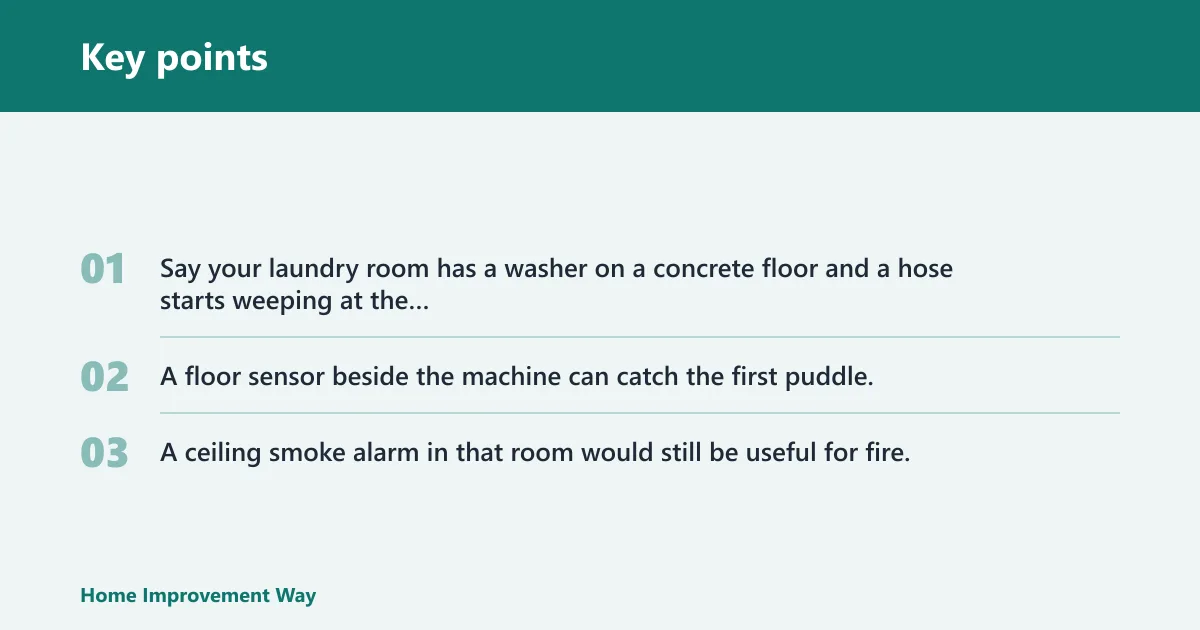
Say your laundry room has a washer on a concrete floor and a hose starts weeping at the wall connection. A floor sensor beside the machine can catch the first puddle. A ceiling smoke alarm in that room would still be useful for fire, but it would not see the water.
Where should you put them?
Smoke detectors belong on the ceiling. Leak detectors belong on the floor. That is the core placement rule, and it does not change because both devices can send alerts to a phone.
For smoke alarms, keep them out of steam-heavy spots and away from strong airflow that can push smoke away from the sensor. For leak sensors, keep them where water will first pool, because a sensor that is not touching the puddle may never trigger.
Smoke detector placement rules
Use smoke coverage in bedrooms, hallways, and common areas. Ceiling placement is the default because smoke rises, but kitchens need clearance from cooking areas so routine meal prep does not create nuisance alarms.
Do not treat a kitchen smoke alarm as the same thing as a kitchen leak sensor. One watches for fire byproducts overhead; the other watches for water at the floor.
Leak detector placement rules
Use leak coverage on the floor near sinks, toilets, washers, dishwashers, water heaters, and other appliances with supply lines. If the room has cabinets or equipment that can hide a leak path, place the sensor where water would spread first.
Whole-home systems typically monitor water flow and may shut off the main supply. They monitor water flow and may shut off the main supply, but they usually cost more and are often professionally installed.
Do smart leak detectors need Wi-Fi?
No. A leak detector can be a standalone battery alarm, a smart Wi-Fi sensor, or part of a whole-house shutoff system. The right choice depends on whether someone will be nearby to hear it, whether you want off-site alerts, and how much the room can tolerate a missed warning.
Standalone battery leak alarms are cheaper and local-only, so someone nearby has to hear them. Smart units connect to Wi-Fi or a hub and send push notifications, and some add temperature monitoring or freeze alerts. Whole-house systems go further by watching water flow and closing the main supply when needed.
Standalone battery alarms
These fit small homes, occupied spaces, and rooms where someone is usually close enough to hear a loud alarm. They keep the job simple and the cost lower, but they depend on a person being nearby.
One TOH pick uses a loud 100-decibel alarm plus phone notifications, which shows how some devices pair local sound with remote alerts. That mix is useful when a leak starts while nobody is home.
Smart Wi-Fi or hub-based sensors
Smart leak sensors suit basements, vacation homes, and any room that can stay unattended for long stretches. They send push notifications and may include temperature or freeze alerts, which helps when a pipe risk is tied to cold weather.
They also add maintenance. Batteries still need attention, the app still needs setup, and the sensor still needs network access to do its job.
Whole-house shutoff systems
These systems fit homes where a burst line or hidden leak could cause major damage before anyone notices. Tom’s Guide includes a leak detector category with a shutoff valve option, and that category is aimed at stopping a leak from continuing after detection.
They are usually the highest-cost option, but they give the strongest response when nobody is on site.
Choose leak detectors if… / Choose smoke detectors if…

Choose leak detectors if the room has plumbing, appliance connections, or a history of drips and puddles. Choose smoke detectors if the room needs fire warning, especially in bedrooms, hallways, and common areas.
Choose leak detectors if…
- The room sits near a sink, toilet, washer, dishwasher, water heater, or refrigerator water line.
- A leak would pool on the floor before anyone notices a stain or odor.
- The home may be empty for long stretches, and you want a phone alert or shutoff option.
- The room is a basement, laundry room, bathroom, or kitchen with a clear water-failure point.
Choose smoke detectors if…
- The goal is fire warning in sleeping areas or main living paths.
- You need ceiling-mounted coverage that responds to smoke in the air.
- The room is not a moisture sensor problem but a life-safety fire path.
- You are trying to reduce the risk from a fire that starts quietly and spreads upward first.
Choose both if…
- The room has both fire risk and plumbing or appliance risk, such as a kitchen or laundry room.
- Water could damage cabinets, flooring, or drywall before anyone sees it.
- Smoke could move through the room while a leak could start below it.
Suppose a basement has a furnace, a water heater, and a floor drain. That room can need both detector types: smoke coverage above for fire risk and leak coverage at floor level for water that may pool around the heater or drain.
- List rooms with fire risk: bedrooms, hallways, and main living areas.
- List rooms with water risk: kitchen, bathroom, laundry room, basement, and spaces near water heaters or appliances.
- Mark each room as smoke only, leak only, or both.
- Place smoke detectors on the ceiling with kitchen and airflow clearance.
- Place leak detectors on the floor where the first puddle would appear.
- Choose standalone, smart, or shutoff-based leak coverage based on how fast you need to know about a leak.

Frequently asked questions
What is the difference between a water leak detector and a smoke detector?
A water leak detector watches for moisture or pooled water where it should not be, while a smoke detector watches for smoke from fire. They solve different hazards and belong in different places, so one does not replace the other in a home that has both fire and plumbing risk.
Can a smoke detector detect water leaks?
No. Smoke detectors are built to sense smoke, not water, so they will not alert you to a leak under a sink or behind a washer. If the problem is water, you need a leak detector on the floor near the likely puddle path.
Where should I put water leak detectors in my house?
Put them on the floor near the most likely leak sources: under sinks, beside toilets, behind or beside laundry machines, near water heaters, and near appliances with supply lines. The sensor should sit where water would reach first, not where it would be easiest to hide.
Do water leak detectors need Wi-Fi or can they just beep?
They can just beep. Basic battery alarms sound locally and are cheaper, while smart Wi-Fi models send push notifications and may add temperature or freeze alerts. If nobody is usually home, a phone alert is often the more useful choice.
What areas of a home are most likely to need leak sensors?
Kitchens, bathrooms, laundry rooms, basements, and spots near water heaters or appliances are the common leak-prone areas. Those rooms combine water supply lines, drains, and equipment that can fail without much warning, so floor-level sensing matters most there.
Can water leak detectors help prevent mold and water damage?
Yes, if they catch the leak early enough. Water leak detectors help alert you when plumbing issues begin, which can cut off the time a leak has to soak cabinets, subfloors, and drywall. That early warning is what helps reduce mold and repair costs.
Sponsored / affiliate links. As an Amazon Associate I earn from qualifying purchases. I may earn additional commission from eligible campaigns.
 SITERLINK Smoke Detectors 10 Year Battery Operated,UL217-9th Listed Smoke Alarm with Test-Silence Button,Photoelectric Sensor Fire Alarms Smoke Detectors with LED Lights for Home, GS525A (6 Pack)
 Water Flow Control Shut Off Valve with Brass Adjustable Hand Level Water Pressure Regulator for Hand Held Shower Head & Bidet Sprayer, Brushed Nickel Water Saver G1/2