Smoke detector vs. carbon monoxide detector: difference
A smoke detector senses smoke from fire. A carbon monoxide detector senses CO gas from incomplete combustion. You need both because one cannot replace the other. Mixing them up can leave you unprotected from fire or poisoning. This guide explains what each device detects, where to install it, and what to trust in each room.
This guide is part of our Home safety detectors: types, placement, and upkeep series.
| Factor | Smoke detector | carbon monoxide detector: what’s the difference | Winner |
|---|---|---|---|
| Hazard detected | Smoke particles from flaming or smoldering fires | CO gas from incomplete combustion | Tie |
| What it cannot do | Does not detect CO or explosive gases like natural gas, propane, and methane | Does not detect smoke or explosive gases | Tie |
| False-alarm pattern | Can react to burnt food, steam, dust, or bathroom humidity, depending on sensor type | Far less likely to nuisance alarm from cooking steam, but can still alarm for actual CO from appliances or vehicles | carbon monoxide detector: what’s the difference |
| Best room fit | Bedrooms, hallways, living areas, and other fire-risk spaces | Near sleeping areas and near fuel-burning appliances or attached garages, following label instructions | Tie |
| Installation focus | Install where fire could spread into sleeping spaces and where people need early warning | Install where CO exposure could happen or where people sleep | Tie |
| Maintenance / room sensitivity | Needs sensor-type matching for kitchens, bathrooms, and laundry rooms because steam and cooking smoke can trigger alarms | Less affected by cooking steam; placement still matters near fuel-burning appliances and garages | carbon monoxide detector: what’s the difference |
| Cost | Basic smoke detectors cost as little as $15 | No cost information given in the article | Smoke detector |
| Combination-unit role | Can be part of a combination smoke and CO detector, but smoke sensor type still matters | Can be part of a combination smoke and CO detector, simplifying mounting and reducing the number of devices | carbon monoxide detector: what’s the difference |
| Overall purpose | Fire warning device | Warning for poisonous CO gas you cannot see or smell | Tie |
What is the difference between a smoke detector and a carbon monoxide detector?


A smoke detector is built to sense smoke particles from a fire. A carbon monoxide detector is built to sense CO gas from incomplete combustion. That difference changes where each unit belongs, what alarms it can catch, and what risks it leaves untouched.
Smoke detector: what it is designed to catch
Smoke is an aerosol of particulates and gases emitted when a material undergoes combustion or pyrolysis. Because smoke inhalation is the primary cause of death in victims of indoor fires, smoke alarms need to respond fast enough to warn you before conditions become deadly.
Smoke detectors do not detect carbon monoxide. They also do not catch explosive gases such as natural gas, propane, or methane. Put plainly, a smoke alarm is a fire warning device, not a general gas detector.
Carbon monoxide detector: what it is designed to catch
Carbon monoxide detectors use sensors to detect the presence of CO in your home. CO is produced by incomplete combustion, which is why fuel-burning appliances, attached garages, and blocked vents matter so much.
CO alarms do not detect smoke or explosive gases. That limitation is easy to miss, and it is the main reason a smoke alarm cannot stand in for a CO alarm, even if both devices look similar on the wall or ceiling. (consumerreports.org)
📊 Basic smoke detectors cost as little as $15. Source: Smoke & Carbon Monoxide Detector Buying Guide.
How do smoke detector types differ?
Smoke detector type matters because fire behavior changes by room and by ignition source. Some sensors react sooner to fast, flaming fires. Others are better for slow, smoky, smoldering fires. The right choice depends on whether you want the fastest response in a hallway, less nuisance in a kitchen-adjacent area, or broader coverage in a mixed-risk room.
Ionization smoke detectors
Ionization smoke detectors are best at detecting small particles from fast, flaming fires. They are prone to false alarms from burnt food and steam, so they can be a poor fit near kitchens, bathrooms, and laundry rooms.
Use them where a fast-flame response matters more than nuisance resistance. A common first-timer mistake is placing one too close to the kitchen and then disconnecting it after repeated alarms.
Photoelectric smoke detectors
Photoelectric smoke detectors are best at detecting large particles from smoky, smoldering fires. They are less prone to false alarms from burnt food, which makes them a better choice for many living spaces and for locations closer to a kitchen.
If your main concern is a slow, smoky fire that may build before bursting into flame, photoelectric sensors usually make more sense. They are not perfect for every fire type, but they reduce nuisance alarms in many homes.
Dual-sensor and multicriteria smoke detectors
Dual-sensor smoke detectors combine ionization and photoelectric technology. They aim to detect both flaming and smoldering fires, which can reduce the need for two separate detectors in one spot.
Multicriteria smoke detectors use multiple sensor types and algorithms. They are better at distinguishing fire from cooking smoke and reflect newer industry standards, so they are a strong option when you want fewer false alarms without giving up broad fire sensing.
Do I need both a smoke alarm and a CO detector in my house?
Most homes need both because the hazards are different. Smoke alarms warn you about fire, while CO alarms warn you about a poisonous gas you cannot see or smell. If your home has fuel-burning appliances, an attached garage, or sleeping areas away from the main living space, both devices are important.
Where separate devices make sense
Separate devices make sense when you want the best detector for each hazard in each room. Smoke alarms belong in fire-warning locations such as bedrooms, hallways, and living areas. CO alarms belong near sleeping areas and near sources of combustion.
This split lets you choose sensor type for the room. For example, a kitchen-adjacent hallway may benefit from a photoelectric or multicriteria smoke alarm, while a hall near a furnace may need a CO alarm as well.
When a combination unit is a practical fit
A combination smoke and CO detector combines both functions in one unit. It can be a practical fit where you want fewer devices, simpler installation, or a single alarm point in a bedroom or hallway.
That said, a combination unit still depends on the smoke-detection technology inside it. If the smoke side is not the right type for the room, the combination unit does not fix that problem.
Can one combination alarm replace separate detectors?
A combination alarm can replace separate smoke and CO units only when its smoke sensor type and placement suit the room. It covers both hazards in one housing, but it does not automatically solve false alarms, placement limits, or every code requirement in every location.
What combination alarms cover
Combination smoke and CO detectors are available in conventional and smart forms. They can simplify mounting and reduce the number of devices on the ceiling or wall, which is useful in bedrooms, hallways, and some common areas.
They are a convenience product, not a universal substitute. If you need a photoelectric response near a kitchen, or a specific CO alarm location near a fuel-burning appliance, separate units may still be better.
Where smoke technology still matters
Combination alarms do not erase the smoke-sensor choice inside the unit. A combination alarm that uses ionization technology still behaves like an ionization alarm for smoke, including a stronger response to fast flaming fires and more nuisance alarms from steam or burnt food.
That is why the label matters. You should read whether the smoke side is ionization, photoelectric, dual-sensor, or multicriteria before you assume the unit will fit the room.
Where should smoke and CO detectors be installed in a home?
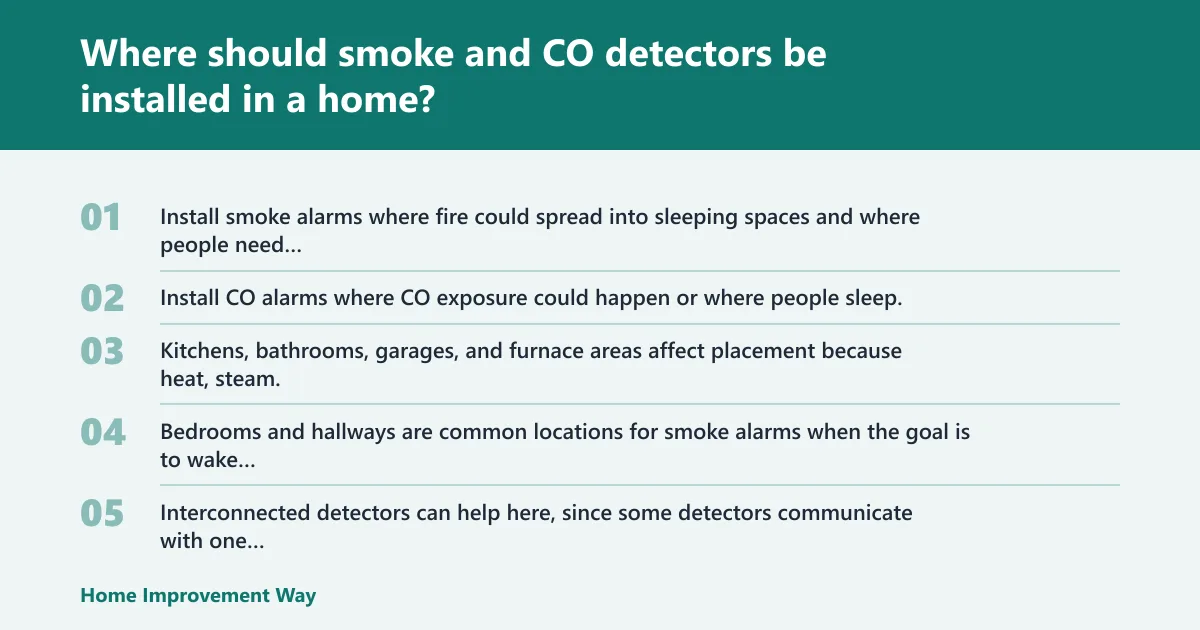
Install smoke alarms where fire could spread into sleeping spaces and where people need early warning. Install CO alarms where CO exposure could happen or where people sleep. Kitchens, bathrooms, garages, and furnace areas affect placement because heat, steam, and combustion sources change how alarms behave.
Bedrooms, hallways, and sleeping areas
Bedrooms and hallways are common locations for smoke alarms when the goal is to wake occupants quickly. Interconnected detectors can help here, since some detectors communicate with one another for whole-house protection, and when one detects smoke or carbon monoxide, all of them sound.
That matters at night. If a hallway alarm sounds, bedroom units also sound, giving sleeping occupants a better chance to wake up in time.
Kitchens, bathrooms, and laundry rooms
These rooms create nuisance triggers. Steam from showers, cooking smoke, and burnt food can trigger some smoke alarms, depending on the alarm type. Photoelectric and multicriteria alarms usually handle these spaces better because they are less likely to react to brief cooking events.
Do not treat a nuisance-prone alarm as “too sensitive” and remove it. Instead, match the sensor type to the room and keep the alarm far enough from direct steam and cooking sources.
Furnaces, attached garages, and fuel-burning appliances
CO alarms belong near fuel-burning appliances and in areas where exhaust can collect, following manufacturer placement instructions. Attached garages also matter because vehicle exhaust can create CO risks quickly if doors are open or if fumes enter the home.
Do not assume a smoke alarm covers this zone. A smoke detector does not detect CO, and a CO detector does not detect smoke from a fire starting in the same area.
One-page decision matrix: choose the right detector for each room
This matrix turns hazard type, room, nuisance trigger, and device type into one quick decision tool. It also shows what each alarm cannot do, which is the simplest way to avoid blind spots.
| Hazard type | Room or location | Likely false-alarm trigger | Best detector type | What this alarm cannot do |
|---|---|---|---|---|
| Flaming fire smoke | Bedrooms, main hallways, living rooms | Dust or steam, depending on sensor and placement | Photoelectric, dual-sensor, or multicriteria smoke detector | Does not detect CO or explosive gases |
| Smoldering fire smoke | Hallways near sleeping areas, family rooms | Burnt toast, cooking aerosol | Photoelectric or multicriteria smoke detector | Does not detect CO |
| CO from incomplete combustion | Near sleeping areas, near fuel-burning appliances, attached garage entry | Generally fewer kitchen-style nuisance triggers | Carbon monoxide detector | Does not detect smoke or explosive gases like natural gas, propane, and methane |
| Both smoke and CO | Bedroom or hallway where one device is preferred | Depends on the smoke sensor inside the combo unit | Combination smoke and CO detector | May not be the best choice for every room-specific smoke condition |
| Whole-house warning | Homes with sleeping areas spread across floors | Alarm burden is shared across all units | Interconnected detector system, hardwired or wireless | Does not replace correct sensor type or correct placement |
How many smoke and carbon monoxide detectors do I need?
Most homes need several smoke alarms and at least one CO alarm, with the exact number depending on layout, sleeping areas, and any fuel-burning equipment. The safest approach is to protect every bedroom, the hall outside sleeping areas, and each level of the home, then add CO coverage where combustion risk exists.
A practical checklist for buying and replacing
- Check whether the label says smoke, CO, or combination smoke and CO.
- Confirm the smoke technology: ionization, photoelectric, dual-sensor, or multicriteria.
- Look for stand-alone, interconnected, wired, wireless, or smart features that match the home.
- Place smoke alarms for fire warning and CO alarms for combustion-gas exposure, not as substitutes for each other.
- Replace any unit that is past the manufacturer’s replacement date or no longer meets current home needs.
Basic smoke detectors cost as little as $15, and carbon monoxide detectors cost as little as $20. That low entry price makes separate protection realistic for most homes, especially when the goal is to remove blind spots rather than save one ceiling square foot.
Are smart or interconnected detectors worth it?
Smart and interconnected detectors are worth it when you want faster whole-house alerting, fewer missed alarms, and easier maintenance reminders. They do not detect hazards that a basic sensor cannot, but they can change how quickly you hear the alarm and how much attention you give it.
What smart and interconnected features change in practice
Interconnected detector systems can be hardwired or wirelessly connected. Some detectors communicate with one another for whole-house protection, and when one detects smoke or carbon monoxide, all of them sound.
Smart models may add app alerts, hush controls, and voice announcements. Those features can reduce nuisance from brief cooking events and can tell you which alarm triggered, which is useful in larger homes or on multiple floors.
What they do not fix
Smart features do not make the wrong sensor type right for the room. A connected ionization alarm near a kitchen can still nuisance alarm, and a connected CO alarm still cannot detect smoke or explosive gases.
Think of smart and interconnected gear as response tools, not hazard substitutes. They help you hear the alarm and manage it, but the detector still has to match the risk.
Verdict: choose based on the hazard, then the room
Choose a smoke detector if your main concern is fire, especially in bedrooms, hallways, and living areas. Choose a carbon monoxide detector if the risk is CO from fuel-burning appliances, an attached garage, or other incomplete-combustion sources. For many homes, the right answer is both, with a combination unit used only where its smoke technology and placement also fit the room.
If you want the least blind spots, start with separate protection for smoke and CO, then use combination alarms where a single device truly fits. If nuisance alarms are a problem near kitchens or bathrooms, favor photoelectric or multicriteria smoke detection. If you need the whole house to sound at once, add interconnected devices rather than assuming one alarm covers every room.
Frequently asked questions
What does a carbon monoxide detector detect that a smoke detector doesn’t?
A CO detector detects carbon monoxide gas, which a smoke detector cannot sense. That matters because CO can accumulate without visible smoke, odor, or flame. A smoke alarm gives no warning for that hazard, and it also cannot detect explosive gases such as natural gas, propane, or methane.
Which smoke detector type is better: photoelectric or ionization?
Photoelectric is usually better for smoky, smoldering fires and is less prone to false alarms from burnt food. Ionization is better for fast, flaming fires but is more prone to false alarms from steam and cooking. Many homes use dual-sensor or multicriteria units to cover more situations.
Sponsored / affiliate links. As an Amazon Associate I earn from qualifying purchases. I may earn additional commission from eligible campaigns.