Where Should Carbon Monoxide Detectors Be Placed?
Place carbon monoxide detectors on every level of the home, outside each sleeping area, and near attached garages or fuel-burning appliances. Follow the unit’s instructions. Bad placement can delay an alarm long enough for CO to build up. This guide covers room-by-room placement, floor-by-floor coverage, and how to choose high or low mounting when advice conflicts.
Where should carbon monoxide detectors go?
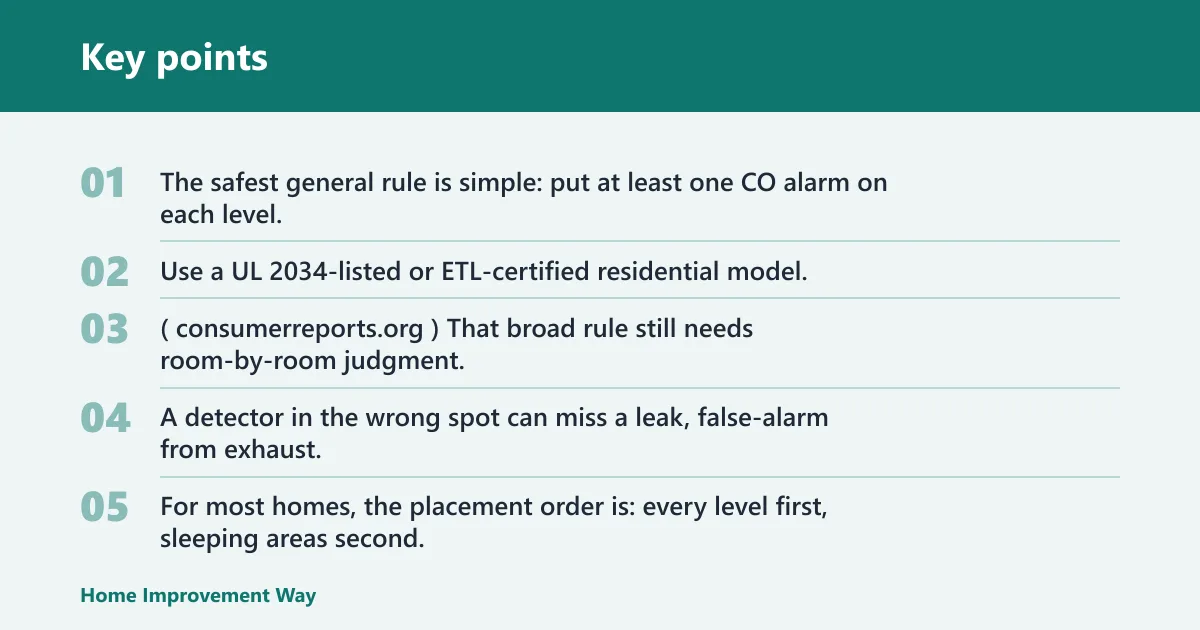
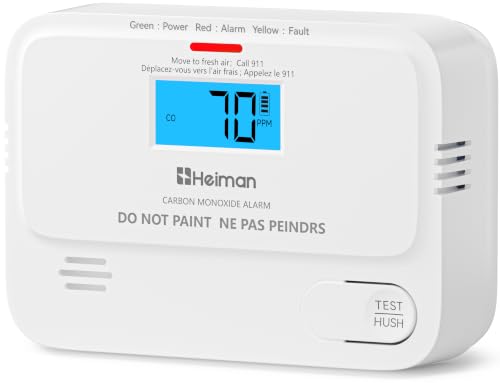


The safest general rule is simple: put at least one CO alarm on each level, keep one near sleeping areas, and place alarms where they can hear people before CO reaches them. Use a UL 2034-listed or ETL-certified residential model, since third-party certification is the key check for consumer units. (Consumerreports)
That broad rule still needs room-by-room judgment. A detector in the wrong spot can miss a leak, false-alarm from exhaust, or sit in a dead-air corner where gas mixing is poor.
The one-rule answer for most homes
For most homes, the placement order is: every level first, sleeping areas second, then specific hazard sources such as a furnace room, water heater closet, attached garage entry, or fireplace area. EPA guidance says each floor needs a separate detector, and consumer guidance also places alarms near sleeping areas so they can wake occupants. (EPA)
How sleeping areas change the plan
Sleeping spaces need extra attention because you may not notice CO symptoms while asleep. Place an alarm outside each sleeping area, such as in the hallway serving bedrooms. Consumer guidance also supports one inside each bedroom, especially if doors stay shut at night or the hallway is far from the beds.
What to do in split-level and open-plan layouts
Split-level homes can create confusing air movement, so a single alarm per floor is often not enough unless each level is truly open to the next. Put alarms on the level where people sleep, on the level with fuel-burning equipment, and near the path from attached garage to living space. In an open-plan home, avoid placing the alarm beside vents or in a corner that does not get normal air mixing.
Carbon monoxide detector placement matrix
| Home zone | Recommended detector type | Mounting surface | Minimum setback | Do not place if |
|---|---|---|---|---|
| Bedroom hallway | Battery, plug-in, or hardwired CO alarm | Wall or ceiling | Outside the sleeping area; keep clear of supply vents | It opens into a bathroom or sits in a dead-air corner |
| Inside bedroom | Battery CO alarm or combo smoke/CO alarm | Wall or ceiling, per label | Near the bed path, but not next to HVAC vents | The room is humid, or the device would be blocked by furniture |
| Basement | Hardwired, plug-in, or battery CO alarm | Wall or ceiling | Near stairs or the route to sleeping areas | It would sit directly above a furnace, water heater, or boiler exhaust |
| Near furnace | Hardwired or plug-in CO alarm | Wall | At least 15 feet away from the appliance is common consumer guidance | It is beside the combustion chamber, draft hood, or vent outlet |
| Near water heater | Hardwired or plug-in CO alarm | Wall | At least 15 feet away is a common rule of thumb | It would be directly above the heater or in the flue path |
| Attached garage entry | Battery, plug-in, or hardwired CO alarm | Wall | Near the door from garage to house, away from exhaust wash | Cars idle there or the door opens into a direct exhaust zone |
| Kitchen-adjacent hallway | Hardwired or battery CO alarm | Wall or ceiling | Outside the kitchen, away from cooking exhaust | It sits right above a range, cooktop, or hood vent |
| Living room | Battery, plug-in, or combo smoke/CO alarm | Wall or ceiling | Clear of fireplaces and supply vents | It is beside a fireplace, grill access door, or heat register |
| Finished attic | Battery or hardwired CO alarm | Wall or ceiling | Use local code and manufacturer guidance for attic-like spaces | It is a hot, dusty, or poorly ventilated dead-air corner |
| Utility room | Hardwired or plug-in CO alarm | Wall | Outside the appliance’s immediate exhaust zone | It is directly above or beside a furnace, boiler, or water heater |
Should carbon monoxide detectors go high or low?
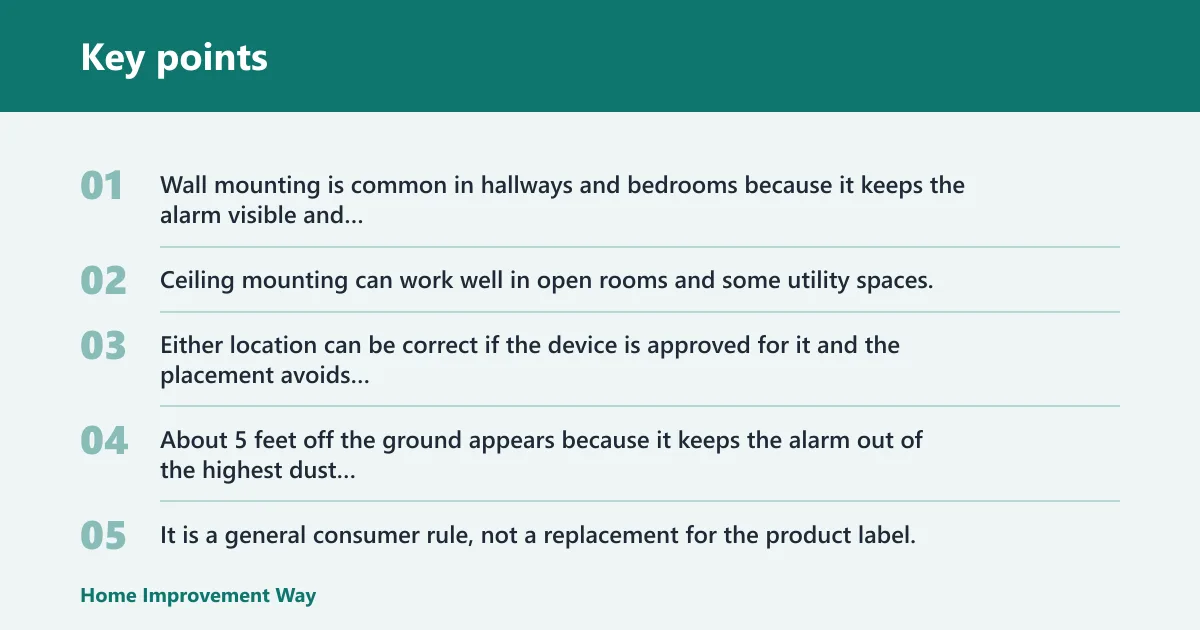
Mounting depends on the model and the label. Many CO alarms can go on a wall or ceiling, and consumer guidance often places them about 5 feet off the ground. That is a common placement rule, not a universal one. The unit’s instructions control when the label and general advice differ.
Wall mounting versus ceiling mounting
Wall mounting is common in hallways and bedrooms because it keeps the alarm visible and away from furniture. Ceiling mounting can work well in open rooms and some utility spaces. Either location can be correct if the device is approved for it and the placement avoids vents, corners, and appliance exhaust.
Why about 5 feet appears in consumer guidance
About 5 feet off the ground appears because it keeps the alarm out of the highest dust and humidity zones while still placing it where people will hear it. It is a general consumer rule, not a replacement for the product label. Some units are designed specifically for ceiling mounting, while others are better on a wall.
When manufacturer instructions override general advice
If a detector label says wall only, ceiling only, or a specific distance from the floor, follow that wording exactly. A plug-in model may also need a particular outlet orientation, and a hardwired unit may have a preferred mount based on its bracket. Local code can be stricter than the package directions, so verify both.
Suppose a renter buys a plug-in alarm for a bedroom hallway. The outlet is near the floor, but the hallway also has a supply vent beside it. In that case, the outlet location is not enough on its own; the alarm still needs a spot that is clear of moving air and outside the bathroom zone.
How far should a detector be from appliances?
Keep CO alarms far enough from fuel-burning appliances to avoid false alarms and poor sampling. First Alert warns against placing them too close to fuel-burning appliances, and common consumer guidance uses at least 15 feet away as a practical target. That distance is not universal, so the label and local code still control.
Fuel-burning appliances and setback distance
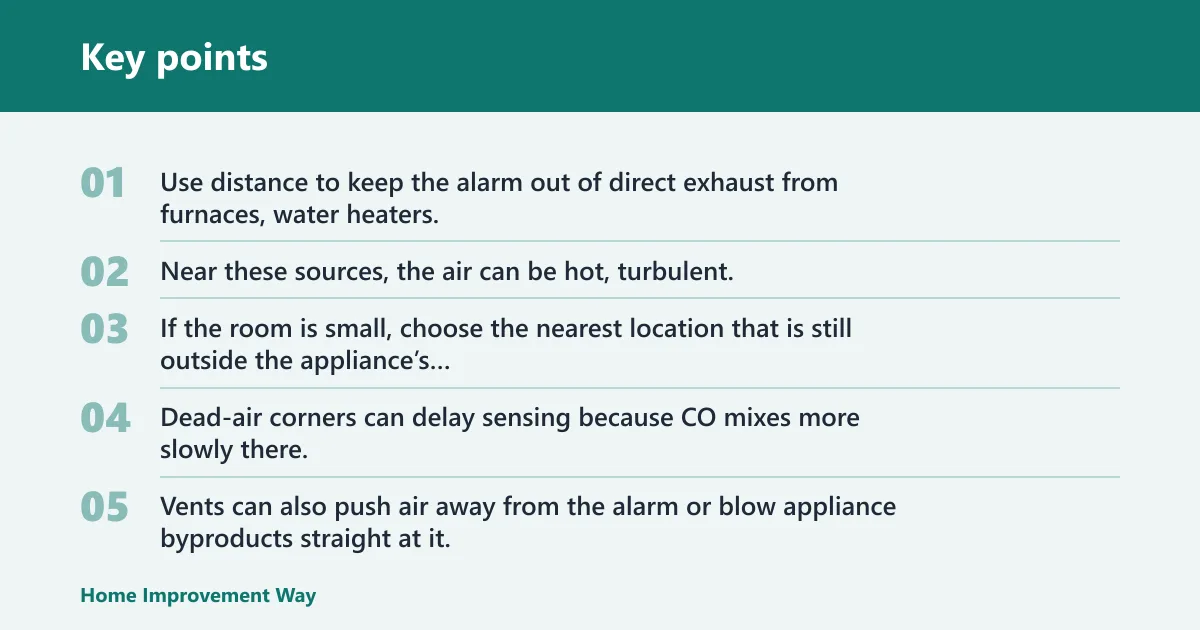
Use distance to keep the alarm out of direct exhaust from furnaces, water heaters, ranges, cooktops, fireplaces, and grills. Near these sources, the air can be hot, turbulent, or diluted in a way that skews the reading. If the room is small, choose the nearest location that is still outside the appliance’s direct exhaust path.
Why dead-air corners and vents cause problems
Dead-air corners can delay sensing because CO mixes more slowly there. Vents can also push air away from the alarm or blow appliance byproducts straight at it. A detector should be near the path people use, not hidden behind trim, at the top of a stair, or pinned to a spot with weak circulation.
Attached garage entry placement
Consumer guidance often puts a detector near an attached garage, especially near the door into the home. That location helps catch exhaust that drifts in after a car starts or idles. Do not mount it where car exhaust hits directly, because direct exhaust can cause nuisance alarms and reduce confidence in the device.
A common first-timer mistake is placing the alarm right over a garage-to-house doorway, since that location can seem like the nearest option. A better choice is nearby on the house side, but far enough from the exhaust wash that a vehicle starting in the garage does not blow directly into the sensor.
Which detector type fits each location?
Battery, plug-in, hardwired, and combo smoke/CO alarms can all work, but location drives the choice. Battery models are flexible. Plug-in units need an outlet. Hardwired units suit permanent installs. Combo smoke/CO alarms save wall space, but they still need correct placement for CO and do not replace room-by-room judgment.
Battery-powered alarms
Battery models can be placed nearly anywhere, according to CNET, which helps in rentals and in rooms with no nearby outlet. That flexibility matters in hallways, finished basements, and older homes. CNET also notes that battery models may not comply with all building codes, so check local rules before relying on them alone.
Plug-in alarms
Plug-in alarms work well near hallways, utility areas, and sleeping zones where a wall outlet is already available. They simplify placement in apartments and rentals. Keep them away from outlets that are behind furniture or exposed to appliance heat, and make sure the cord or unit does not hang in a dead-air pocket.
Hardwired and combo smoke/CO alarms
Hardwired alarms fit permanent installations and can be a good choice for whole-home coverage. Combo smoke/CO alarms are useful where you want one device instead of two, but they still need the same placement logic for CO. A combo unit in the wrong spot can still miss a garage leak or an appliance fault.
Smart features that affect placement
Digital displays, voice alerts, and smart connectivity can improve awareness, but they do not change basic placement. A smart alarm in a bathroom, above a furnace, or in a vent stream is still in the wrong place. Treat those features as extras after the location is correct.
How many carbon monoxide detectors do you need?
Most homes need one on each level, plus coverage near sleeping areas and any attached garage or fuel-burning appliance. EPA says each floor needs a separate detector, and Consumer Reports and First Alert both point to every-level coverage with sleep-area focus. Add more units if room layout leaves gaps.
One per level
Every floor placement is the baseline. That includes finished living levels, sleeping levels, and basements where people spend time or where fuel-burning equipment sits. Popular Mechanics notes that consumer guidance often treats basements and attics differently, so check the device instructions and local code for those spaces.
Sleeping-area coverage
Put alarms outside sleeping areas so the sound can wake occupants. EPA recommends a single detector near sleeping areas, and Consumer Reports also recommends one outside each sleeping area. Some consumer guidance goes further and suggests one inside each bedroom, which can make sense in homes with shut doors or long hallways.
Rental homes and homes with limited wiring
Renters often cannot add hardwired units, so battery or plug-in models are the practical answer. Start with every-floor coverage, then add units near bedrooms and garage access. In a rental, check the lease and local code before mounting anything permanent, and use units that can be installed without rewiring.
Where should carbon monoxide detectors be placed in a bedroom?
Place a CO alarm inside each bedroom only if the room layout and the manufacturer allow it, or place it just outside the bedroom in the adjoining hallway. Consumer guidance supports both approaches, with the outside-the-bedroom location being the safer default for most homes because it covers the sleeping zone without crowding the bed area.
Keep the unit loud enough to wake people. That means it should not be hidden behind a closet door, drape, or headboard. Avoid the bathroom wall next to the bedroom, since humidity can interfere with placement and nuisance alarms can train occupants to ignore the device.
Frequently asked questions
Where should carbon monoxide detectors be placed in a home?
Place them on every level, near sleeping areas, and near attached garages or fuel-burning appliances. EPA says each floor needs a separate detector, and consumer guidance adds coverage outside sleeping areas. Follow the unit’s instructions for wall or ceiling mounting, then check local code for any stricter rule.
Should carbon monoxide detectors be placed high or low?
Neither answer is universal. Many models can mount on a wall or ceiling, and consumer guidance often uses about 5 feet off the ground. The correct height depends on the alarm label, the room’s airflow, and local code. If the manufacturer specifies a position, that instruction controls.
How close can a carbon monoxide detector be to a gas appliance?
Not too close. Keep it out of direct exhaust and away from appliance hot spots, with at least 15 feet away often used in consumer guidance. Do not place it above a furnace, beside a water heater draft hood, or in the direct path of a range or cooktop vent.
Can you put a carbon monoxide detector near an attached garage?
Yes, and that is often a smart choice. Put it near the door from the garage to the home, but not where vehicle exhaust points directly at it. This placement helps catch idling or startup fumes before they move deeper into the house, while reducing nuisance alarms.
Should carbon monoxide alarms go on every floor?
Yes. EPA says each floor needs a separate detector, and Consumer Reports and First Alert both recommend every-level coverage. If a floor has bedrooms, that level matters even more because the alarm must be able to wake sleeping occupants. Basements and attics still need code and layout checks.
Where should a carbon monoxide detector be put in an electric home?
An all-electric home still may need CO alarms if it has any combustion source, an attached garage, shared-wall exposure, or nearby equipment such as a generator. Place alarms by sleeping areas and on each level as needed. Electric heat alone does not remove the need if other CO sources are present.
Sponsored / affiliate links. As an Amazon Associate I earn from qualifying purchases. I may earn additional commission from eligible campaigns.
 COWAY Air Purifiers for Home Large Room Up to 1,860 ft², Washable Pre-Filter and HEPA Filter for Smoke, Allergies, Pet Dander, Odor, AQI, Smart & Rapid Mode, Timer, 3yr Warranty, Airmega 250
 RKUVPAE Smart Bedroom Home Small Air Purifier, Mini Basement for Home Basement Bathroom Wardrobe Dehumidification