How to Choose Detectors for an Apartment vs. a Single-family Home
Choose interconnected, hardwired alarms for a single-family home when you control the wiring and want whole-home warning. For apartments and condos, use battery or plug-in units only where building rules allow, and cover each level and sleeping area. Wrong placement or the wrong power source can leave dead zones, nuisance alarms, or a setup that fails inspection. This guide shows how to choose a detector setup by property class, layout, and installation limits.
| Decision factor | How to choose detectors for an apartment | a single-family home | Winner |
|---|---|---|---|
| Installation freedom | Usually limited by landlord or HOA rules; battery or wireless units are often the practical choice. | More control over wiring, device type, and coverage plan. | a single-family home |
| Coverage scope | Smaller footprint, fewer rooms, and shorter hallways usually need fewer devices. | More doors, windows, floors, and outdoor access points increase coverage needs. | a single-family home |
| Interconnection options | Wireless interconnection is often the easiest fit for rentals and existing units. | Hardwired or mixed hardwired-plus-wireless systems fit better in permanent installs. | a single-family home |
| Maintenance burden | Fewer devices can mean simpler testing and battery replacement. | More devices and more zones raise the testing and replacement load. | How to choose detectors for an apartment |
| Best-fit use case | Best for renters, condo owners, and small units with limited wiring changes. | Best for homeowners who want broad coverage, interconnection, and long-term planning. | Tie |
Apartment, home, or condo setup
Property class changes the alarm plan more than brand does. A studio or condo usually rewards simple, removable devices, while a detached house needs a broader layout that accounts for more sleeping areas, more exits, and more places where smoke or carbon monoxide can reach people too late.
Why layout matters more than brand
NFPA 72 chapter 29 covers single-station and multiple-station smoke alarms, so the question is not whether to buy a “better” label. It is whether the home needs a small, flexible setup or a system that warns the whole dwelling unit at once.
Smoke alarms are required in every sleeping room, outside each separate sleeping area, and on every level of the dwelling unit, including the basement. That rule changes the layout first, then the product choice.
Where renters and owners make different choices
Renters usually need landlord-friendly installation, which makes battery-powered or wireless devices practical. Homeowners can plan for hardwired power, mixed systems, and future remodels, so a permanent install often makes more sense.
A common first-timer mistake is putting one alarm in a central hall and calling the job done. In a two-bedroom apartment with a closed hallway, that can leave a bedroom door between the alarm and the person sleeping.
Detector setup decision matrix
This matrix maps the property type to the detector architecture, power source, interconnection method, and placement priorities. Use it as a buying filter before you look at product labels.
| Property type | Detector type | Power source | Interconnection | Placement priorities | Choose this if |
|---|---|---|---|---|---|
| Studio / 1BR apartment | Smoke alarm, plus carbon monoxide detector if the unit has fuel-burning appliances or a shared fuel source nearby | Battery-powered or plug-in where allowed | Wireless interconnection if the unit has more than one alarm | Sleeping area, outside the sleeping area, and near the unit’s main path of travel | You need a low-impact setup that can move with you or fit rental rules. |
| Condo / townhome | Smoke alarm and carbon monoxide detector, often in a mixed setup | Battery, plug-in, or hardwired if the building allows it | Wireless interconnection is practical; hardwired works in some owner-controlled units | Every sleeping room, outside sleeping areas, and any level with fuel-burning equipment | You own the unit but still have HOA or shared-building limits. |
| Detached single-family home | Smoke alarm on every level, plus carbon monoxide detector near fuel-burning equipment | Hardwired with battery backup, or a mixed hardwired-and-wireless plan | Interconnected alarms are the preferred architecture for whole-home warning | Sleeping rooms, hallways, stairs, basement, and any level with an attached garage or fuel-burning appliance | You can plan for a long-term system that covers more rooms and exits. |
| Home with attached garage | Smoke alarm and carbon monoxide detector, with extra attention to garage-adjacent areas | Hardwired or mixed system with battery backup | Interconnected alarms help warning spread beyond the garage-adjacent side of the home | Entry from garage, nearby hallway, sleeping area above or beside the garage, and nearby furnace or water heater zones | Car exhaust, storage fumes, and extra pathways make coverage more important. |
Studio and 1BR apartment
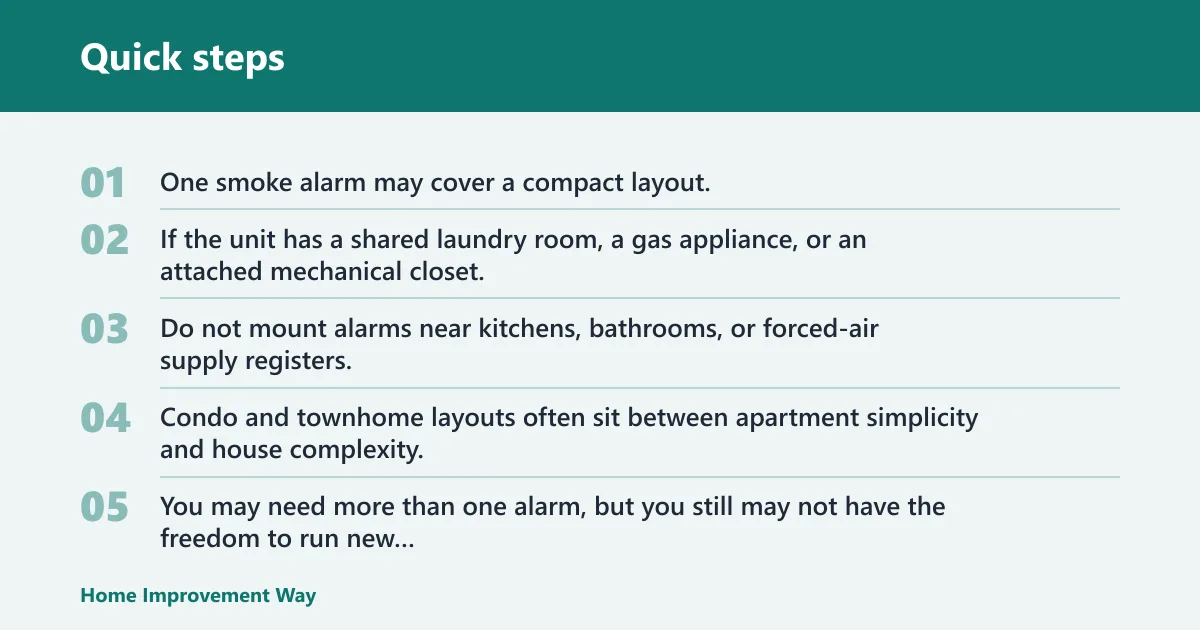
Keep the setup small and compliant. One smoke alarm may cover a compact layout, but the placement still has to respect sleeping areas, hallways, and any fuel-burning equipment in or near the unit.
If the unit has a shared laundry room, a gas appliance, or an attached mechanical closet, add carbon monoxide protection where it belongs and avoid nuisance spots. Do not mount alarms near kitchens, bathrooms, or forced-air supply registers.
Condo or townhome
Condo and townhome layouts often sit between apartment simplicity and house complexity. You may need more than one alarm, but you still may not have the freedom to run new cable through walls or ceilings.
Wireless interconnection is often the cleanest fit because it pairs devices by radio-frequency signal and does not require cables between units. That matters when the building envelope and HOA rules limit permanent changes.
Detached single-family home
A single-family home is a residential property built for one household, usually with its own entrance, utilities, and land. It does not share walls with another dwelling, so alarm planning usually has to cover more rooms, more access points, and more travel distance from one side of the house to the other.
That is where a mixed plan works well: hardwired smoke alarms where you can run cable, plus wireless devices where the finished space makes wiring impractical. The goal is whole-home warning, not a single alarm in a convenient spot.
Home with attached garage
An attached garage changes the risk profile because exhaust and storage fumes can drift toward the living space, and the garage often sits close to a hallway, mudroom, or stairwell. Put alarms so they protect the path from the garage into the house, not inside the garage itself unless a specific device is rated for that location.
Suppose a three-bedroom house has an attached garage, a furnace in the basement, and bedrooms upstairs. One alarm in the hallway is not enough; the upstairs sleeping area and the basement level both need planned coverage, and interconnection helps everyone hear the first alarm.
Do apartments need hardwired alarms?
Not usually, and often not as the first choice. In many apartments, battery-powered or wireless alarms are more practical because they avoid permanent changes and still let you cover sleeping areas, exits, and any fuel-burning appliance zone without opening walls.
When battery power is the practical choice
Choose battery power when the lease, condo rules, or building policy limits wiring changes. Battery backup is required so alarms continue during power outages, and that matters even more in a unit that depends on a small number of devices.
When wireless interconnection fits better
Wireless interconnection works well in rentals and older buildings because it adds whole-unit warning without running cables. Multiple alarms can still sound together, but they do it by radio-frequency signal rather than hardwiring. (Drexel)
When to ask the landlord or HOA first
Ask first if the unit has fixed electrical boxes, shared systems, or any instruction that limits device changes. A landlord or HOA may allow plug-in or battery units but not permanent hardwiring, and that can decide the whole setup before you buy anything.
What single-family homes need
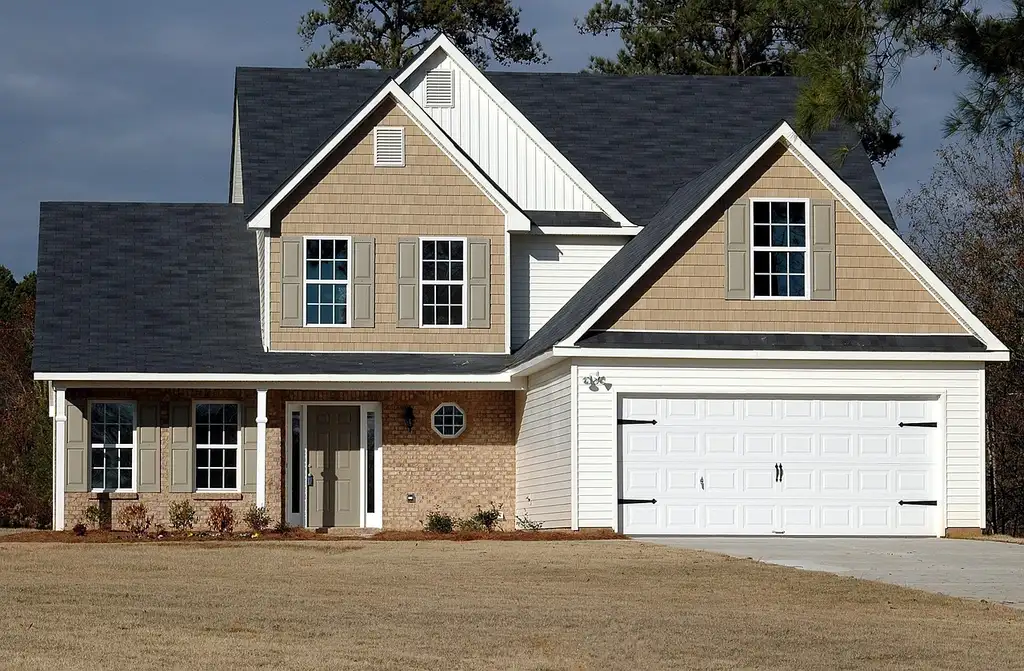
A detached home often needs more than a basic alarm pair. Smoke alarms belong in every sleeping room, outside each separate sleeping area, and on every level of the dwelling unit, including the basement, while carbon monoxide protection becomes important near fuel-burning equipment and other likely sources.
Smoke coverage on every level and in sleeping areas
Start with the required locations, then look at the doors between them. A hall alarm can miss a closed bedroom door, and a basement alarm may not warn the upstairs fast enough without interconnection.
Ceiling-mounted smoke alarms must be at least 4 inches from any wall. Wall-mounted smoke alarms must be between 4 and 12 inches from the ceiling. Those placement limits matter because a bad mount can blunt the alarm’s first warning.
When interconnected alarms improve warning time
Interconnected alarm systems make every alarm sound when one activates, which helps in larger homes and in any layout where someone may sleep far from the first alarm. NFPA 72 treats interconnection as an important part of residential alarm planning, especially where the house has several levels or long travel paths.
Why mixed hardwired and wireless systems work well
Hardwired smoke detectors get primary power from the building wiring, and battery backup keeps them active during outages. Wireless units can fill in hard-to-reach zones after a remodel, in a finished attic, or where pulling cable would mean opening finished walls.
That mixed plan is often the best answer for a homeowner who wants broad coverage without a full rewire. It keeps the core system permanent and adds flexibility where the house makes wiring difficult.
Where to place smoke and CO alarms
Placement does as much work as the device choice. Poor placement can cause nuisance alarms near kitchens or bathrooms, or it can leave a sleeping room too far from the first alert to matter.
Bedrooms and hallways
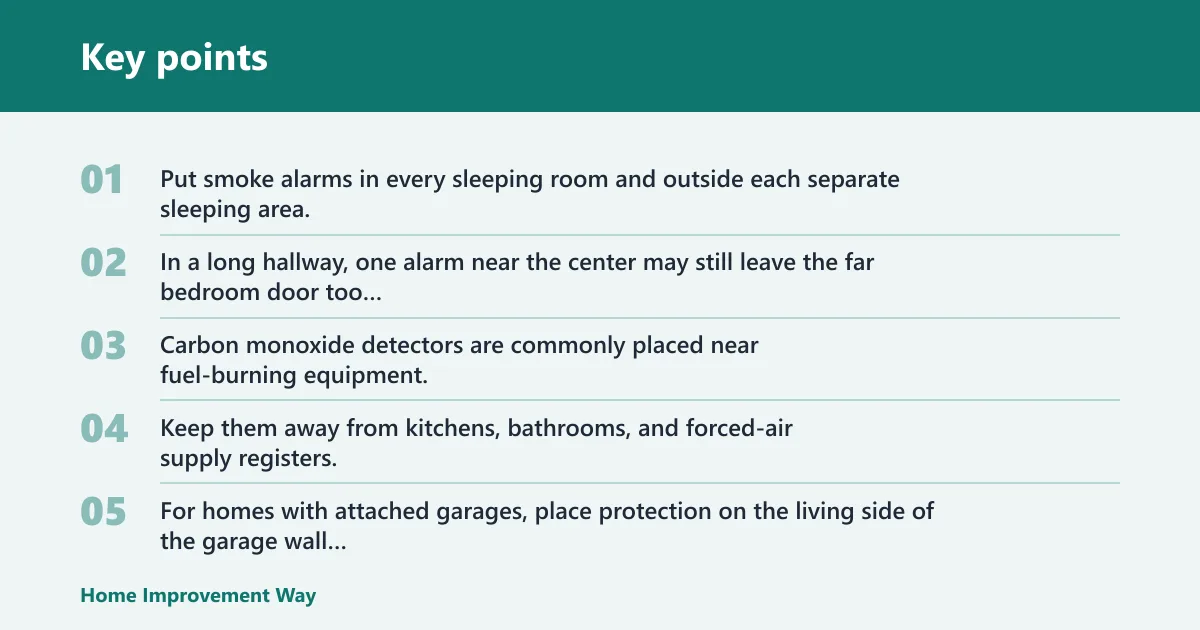
In a long hallway, one alarm near the center may still leave the far bedroom door too isolated, so think about the path smoke would take as well as the path people would use to leave.
Near furnaces, water heaters, and attached garages
Carbon monoxide detectors are commonly placed near fuel-burning equipment, but not in locations that may create avoidable nuisance alarms. Keep them away from kitchens, bathrooms, and forced-air supply registers, then follow the manufacturer’s instructions for the exact mounting height and spacing.
For homes with attached garages, place protection on the living side of the garage wall or nearby hall, not inside the garage unless the device is made for that environment. The idea is to catch migration into the house early.
Places that create nuisance alarms
Do not place smoke alarms near kitchens, bathrooms, or forced-air supply registers. Those locations can push steam, cooking particles, or moving air into the sensor and make the alarm less trustworthy over time.
Should you choose battery or hardwired?
Battery is the practical answer when you need flexibility, minimal installation work, or a setup that stays within rental rules. Hardwired is usually the stronger long-term choice when you own the home, can control the wiring, and want a permanent, interconnected system with backup power.
Battery backup and outage planning
Battery backup is not optional in the planning sense. Even hardwired alarms need it, because a power outage should not silence the warning system.
Hardwired power for permanent installs
Choose hardwired smoke alarms when the home is under your control and the install is part of a long-term plan. New construction and remodel-based installs often fit this approach best, because cable runs are easier before finishes go back in place.
Wireless interconnection for older homes and rentals
Wireless interconnection is often the best middle ground. It lets older homes and rentals get whole-home warning without opening walls or running new cables between units, and it is especially useful when a house has finished spaces that are expensive to disturb.
How code changes the choice
NFPA 72 is the reference point, but local rules still control the final install. Chapter 29 covers single-station and multiple-station smoke alarms, and the jurisdiction may adopt different versions, add requirements, or apply them differently to new construction and existing homes.
NFPA 72 as the reference point
Use NFPA 72 to understand the standard placement logic, interconnection concepts, and the role of battery backup. That gives you a reliable baseline before you check the local building department or the property manager’s rules.
Why local rules still control the final install
Code adoption varies by area, so a setup that fits one city or county may not fit another. If you are a renter or condo owner, the building rules can matter as much as the code, because permission to wire or replace devices is part of the decision.
New construction versus existing homes
New construction usually favors hardwired, interconnected alarms because the wiring can be planned from the start. Existing homes often benefit from wireless interconnection or a mixed system because the house is already finished and the walls are already closed.
Choose the setup that fits the building
Choose How to choose detectors for an apartment if you need a small, flexible setup, if the landlord or HOA limits permanent wiring, or if you only need a few devices with app control and wireless interconnection. Choose a single-family home if you control the wiring, need wider coverage, or want a permanent interconnected system for multiple floors and more access points.
How to choose detectors for an apartment is the better fit for rentals, small condos, and compact layouts where battery or wireless devices meet the rule set and keep installation simple. a single-family home wins for detached houses, long hallways, basements, and garage-adjacent layouts where hardwired or mixed systems do more of the work.
- Choose How to choose detectors for an apartment if you need removable devices, minimal wiring, and fewer alarms to maintain.
- Choose a single-family home if you want a permanent system with broader coverage and whole-house interconnection.
- Choose How to choose detectors for an apartment if your building rules limit drilling, rewiring, or panel changes.
- Choose a single-family home if you can plan smoke and carbon monoxide coverage room by room and level by level.
Verdict: How to choose detectors for an apartment or a single-family home?
Choose How to choose detectors for an apartment if you are a renter, condo owner, or live in a studio or small unit where landlord, HOA, or building rules limit wiring changes and a battery-powered, plug-in, or wireless setup is the practical choice.
Choose a single-family home if you want interconnected, hardwired alarms for whole-home warning in a detached house with more rooms, more sleeping areas, and coverage that can extend through the basement, stairs, and attached garage zones.

Frequently asked questions
What detectors do I need in an apartment vs. a single-family home?
An apartment usually needs smoke alarms in sleeping areas and along the main path of travel, plus carbon monoxide detection if the unit has fuel-burning equipment or a shared source nearby. A single-family home usually needs smoke coverage on every level and in sleeping areas, with carbon monoxide protection near fuel-burning equipment and attached garages.
Do apartments need hardwired smoke detectors?
Not always. Many apartments work better with battery-powered or wireless alarms, especially when lease terms or HOA rules limit permanent changes. Hardwired units may exist in some buildings, but permission and building policy come first.
Should I choose battery or hardwired alarms for a house?
Choose hardwired alarms when you own the home and want a permanent system with battery backup and interconnection. Choose battery or wireless units when you are working around finished walls, older construction, or a phased upgrade where wiring every room is not practical yet.
What’s the best alarm setup for a rental apartment?
The best setup is usually battery-powered or wireless alarms placed in the sleeping area, outside the sleeping area, and near any fuel-burning appliance zone. Keep the install landlord-friendly, avoid nuisance locations, and use interconnection if more than one device is needed.
Do single-family homes need interconnected smoke detectors?
Interconnection is the stronger choice for many detached homes because it helps alarms sound together across floors and rooms. That is especially helpful in larger layouts, long hallways, and homes with basements or attached garages.
What detectors should I put near a furnace or water heater?
Use a carbon monoxide detector near fuel-burning equipment, then place it where it can warn early without sitting in a nuisance zone. Keep it away from kitchens, bathrooms, and forced-air supply registers, and follow the manufacturer’s mounting guidance for the exact location.
How do alarm choices change in condos versus houses?
Condos often need a more flexible setup because the owner may face HOA rules, shared building systems, or limited wiring changes. Houses usually allow a broader hardwired or mixed system, which makes interconnection and whole-home coverage easier to plan.
Which smoke alarm type works best for a small apartment?
A battery-powered or wireless smoke alarm usually works best in a small apartment because it is easy to install, easy to move, and less likely to conflict with building rules. The key is still correct placement in sleeping areas and outside them, not just the power source.
Sponsored / affiliate links. As an Amazon Associate I earn from qualifying purchases. I may earn additional commission from eligible campaigns.