Best Smart Garage Door Openers for Retrofit Installs: We Compared
Choose Meross MSG200 for most retrofit installs: it adds app and voice control without a subscription and works across the major smart-home platforms. It is the strongest default when you already have a compatible opener and want a low-friction upgrade instead of replacing the whole unit.
Quick comparison
| Product | Badge | Best for | Price | ||
|---|---|---|---|---|---|
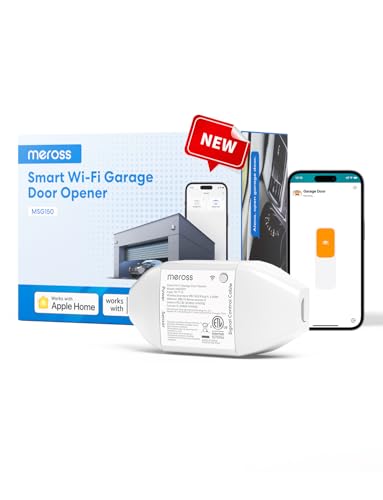 |
meross Smart Garage Door Opener Remotemeross | Our pick | MSG150HK · HomeKit · voice control | $69.99
Price as of 6 Nov 2026
|
View |
 |
Chamberlain MYQ-G0401 myQ Wi-Fi Smart Garage Door OpenerCHAMBERLAIN | Best for myQ users | myQ Wi‑Fi smart garage control | $44.49
Price as of 6 Nov 2026
|
View |
 |
Genie Aladdin Connect Smart Garage Door ControllerGenie | Best budget retrofit | ALKT2-R · single-door smart kit | $49.99
Price as of 6 Nov 2026
|
View |
| Tailwind iQ3 2.0Tailwind | Best for smart arrival automation | Geofenced retrofit control | See maker pricing
Verify current price
|
Check compatibility first | |
| Konnected GDO blaQKonnected | Best for local control | Home Assistant / wired retrofit focus | See maker pricing
Verify current price
|
Check compatibility first | |
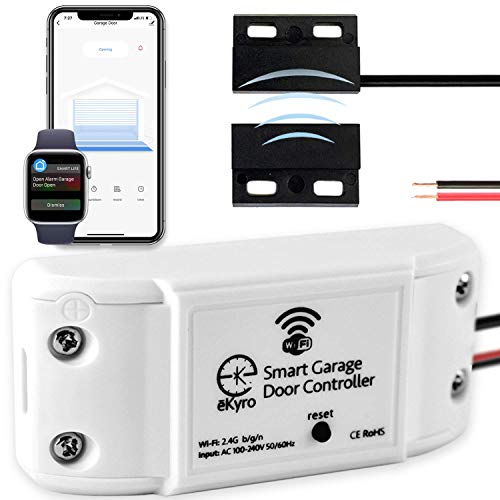 |
eKyro Smart Garage Door OpenereKyro | Budget pick | Universal Wi‑Fi garage controller | $34.99
Price as of 6 Nov 2026
|
View |
Use the table to match the controller to your opener, wiring, and platform first. On retrofit jobs, fit and control style matter more than sticker price.
How we chose
The shortlist is built around retrofit fit, not brand popularity. Opener compatibility, wall-control wiring, garage Wi-Fi quality, and ecosystem support came before feature lists.
Cost also mattered. A controller that looks cheap can become expensive if it needs a hub, a paid plan, or professional help to work reliably.
Platform fit was the third filter. Some homes need HomeKit support, others want Alexa and Google Home, and some users care more about local control than cloud access.
Finally, the list keeps the install path realistic. Retrofit controllers are usually added to an existing opener with a door sensor and wall-button wiring, so the product has to fit the hardware already in place.
Garage opener decision matrix
| Opener age | Drive condition | Wall-control type | Garage Wi-Fi quality | Ecosystem | Recommended product path |
|---|---|---|---|---|---|
| Newer opener, still reliable | Quiet, steady travel, no binding | Standard low-voltage terminals | Strong signal near the opener | Any major ecosystem | Meross MSG200 if you want broad platform support and no subscription |
| Mid-age opener, works well but lacks smart features | Drive and rail are in good shape | Standard wall button wiring | Fair to strong signal | myQ household | Chamberlain myQ Smart Garage Control if you already use myQ |
| Older opener, but still dependable | Noisy but stable, no safety issues | Standard terminals, not proprietary controls | Strong signal or a nearby access point | Google or Alexa home | Genie Aladdin Connect if budget matters most and you can accept fewer platform options |
| Any opener with local-control priorities | Mechanically sound | Compatible low-voltage wall control | Cloud access is unreliable or unwanted | Home Assistant or privacy-first setup | Choose Konnected GDO blaQ if you want a local-first retrofit; confirm manual support before buying |
| Any opener, but you want hands-free use | Reliable travel and safety reversal | Standard wall-button wiring | Consistent signal in the garage | HomeKit, Alexa, or Google | Choose Tailwind iQ3 2.0 if your entry routine matters more than app-only control |
Typical retrofit cost: controllers often land around $25 to $90, and sourced references place retrofit controllers in the $50 to $90 range with install times under half an hour. Device price is only part of the bill if you need a hub, a paid plan, or pro help.
Total-cost row: device price + any hub or subscription + optional pro install. That is the number that matters when you compare a $50 kit to a $90 controller with no recurring fee.
Compatibility check before you buy
Use this checklist before you pick any retrofit controller. The right product is the one that matches your opener hardware, wall control, and smart-home stack.
| Check | Yes/no | What it means |
|---|---|---|
| Opener brand/model lookup | Yes / No | Confirm the controller supports your exact opener before you buy. |
| Standard wall control terminals | Yes / No | Most retrofit kits need simple low-voltage wall-button wiring. |
| Garage door opener learn-button family | Yes / No | Match the opener’s learn-button family and control board to the manufacturer’s support list. |
| Wi-Fi signal in the garage | Yes / No | Weak signal can cause delayed status updates and missed commands. |
| Outlet placement | Yes / No | You need a practical spot for the controller and sensor hardware. |
| Sensor mounting space | Yes / No | The door-position sensor needs a secure mount and clear travel clearance. |
When retrofit is a bad fit
Retrofit is a weak choice when the opener is already unreliable, excessively noisy, or too old for confirmed compatibility. Weak Wi-Fi, detached garages, long wiring runs, and proprietary wall controls can all turn a simple add-on into a frustrating install.
Say your garage sits 40 feet from the house and the signal is weak at the opener. In that case, a controller may connect, then drop offline often enough that alerts and remote control become annoying instead of useful.
When replacement makes more sense
Replacement is the better move when the opener needs mechanical work, the safety features are dated, or you want battery backup that a retrofit kit usually does not add. A full opener swap can also make sense if the existing unit is too old to support a modern controller.
Battery backup is common on some full replacement openers. It is usually not part of a retrofit kit, so do not count on a controller to solve outage performance.
Meross MSG200: best overall retrofit pick
The Meross MSG200 is the strongest all-around choice for most retrofit installs because it supports Apple HomeKit, Alexa, Google Home, and SmartThings, and it does not require a subscription for the core experience. It also supports up to three separate doors, which helps in multi-bay garages. Manufacturer compatibility and platform-support documentation back up those claims, and the install manual shows the controller is designed as a retrofit add-on rather than a full opener replacement.
What stands out is the mix of platform coverage and practical hardware. The hardwired reed sensor gives door-position status, and the external Wi-Fi antenna is useful when the opener sits in a marginal signal area. In the total-cost view, Meross stays attractive because it avoids hub fees and recurring plan costs for core use.
The drawback is simple: compatibility still has to be checked against your opener and wall-button wiring. Broad platform support does not fix a nonstandard opener, weak garage Wi-Fi, or a poor sensor mounting location. Meross is the right default, not a universal fit.
Why it fits many existing openers
This is the product to start with when you want the broadest smart-home support without paying a recurring fee. It suits owners who want app control, voice control, and door alerts from one retrofit package, as long as the opener is on the supported list.
Platform support and no-subscription appeal
Based on the product details and platform-support docs, the MSG200 works with HomeKit, Alexa, Google Home, and SmartThings. That wide support makes it easier to match a house that already uses mixed platforms, and the manufacturer pricing pages do not require a subscription for the core controller function.
What to confirm before buying
Check your opener model, the wall-control wiring, and where the sensor will mount on the door. If your garage Wi-Fi is weak, plan for a stronger access point before you blame the controller. Also verify the opener’s learn-button family against the manufacturer’s compatibility page and manual.
Chamberlain myQ Smart Garage Control: best for myQ users

Choose the Chamberlain myQ Smart Garage Control if your household already lives in the myQ app or you want a familiar Chamberlain path. It is a straightforward retrofit controller for a compatible opener, and its listed price makes it a clear budget-oriented option for myQ households. Chamberlain’s compatibility and support pages are the right place to confirm opener match and app features before buying.
Its main strength is ecosystem fit. The myQ app experience is the reason many owners pick it, and Amazon Key support is part of that broader myQ ecosystem. For a buyer already inside the Chamberlain ecosystem, that can outweigh broader platform support elsewhere.
The drawback is platform variability. Alexa support for some features depends on myQ+, and Google Home support can change with ecosystem shifts, so this is not the best choice if you want the most stable cross-platform story. The total cost can also rise if you need paid features beyond basic app control.
myQ app and Amazon Key support
This controller is built for homeowners who want to stay inside the myQ environment. If your household already uses myQ-compatible gear, the learning curve is lower than with a brand-new platform.
Alexa and Google support caveats
Alexa support may sit behind myQ+ for some functions, and Google Home support has varied as ecosystems change. That means you should verify the current app and assistant support before you buy on the manufacturer’s support and pricing pages.
When myQ is the better choice
Pick this if you value a known brand path and your home already uses myQ products. It is less appealing if you want native HomeKit support or a controller with a stronger local-control angle.
Genie Aladdin Connect: best budget retrofit option
Genie Aladdin Connect is the practical budget pick when you want app control without paying for a premium platform bundle. Its listed price is lower than the higher-end retrofit choices here, and it is positioned as a single-door smart kit. Genie’s compatibility and install docs support that single-door framing.
It supports common voice-assistant use cases and is a sensible first step for a basic retrofit on a compatible opener. That makes it attractive when you mainly want remote open and close, status alerts, and simple app access.
The tradeoff is fewer premium features and weaker appeal for Apple-first homes. It is not the controller to pick if HomeKit support is a must-have or if you want the broadest platform list.
Budget positioning
This is the cheapest named controller in the main comparison here, so it fits the homeowner who wants to keep retrofit costs down. It is the simplest answer when price is the main filter.
Alexa and Google compatibility
Alexa and Google compatibility make it a workable choice for many mixed-platform homes. That said, confirm the exact assistant support in the current listing and app before you order.
What you give up versus higher-end picks
You give up the broader ecosystem spread of the Meross unit and the more privacy-forward options that some buyers want. If you need HomeKit or multi-door flexibility, this is not the best fit.
Tailwind iQ3 2.0: best for smart arrival automation
Pick Tailwind iQ3 2.0 if you want a retrofit controller centered on arrival automation rather than broad platform bragging rights. Tailwind’s compatibility pages are the key source to verify opener support, and the product is usually the most compelling when geofenced open/close is the priority.
Who should choose Tailwind iQ3 2.0?
This is the right choice for a homeowner who wants the garage to behave more like an automation routine than a manual app accessory. It makes the most sense when your household values hands-free arrival behavior and you are willing to check opener family compatibility carefully before purchase.
Where it sits versus Meross, myQ, and Genie
Choose Tailwind over Meross if arrival automation matters more than broad platform coverage. Choose it over myQ if you want a smarter routine layer instead of staying inside the Chamberlain ecosystem. Choose it over Genie if you want the smarter automation path and are willing to spend more time on compatibility checks.
Konnected GDO blaQ: best for local control
Choose Konnected GDO blaQ if you want a retrofit path built around local control and a Home Assistant-style setup. Konnected’s compatibility docs are the deciding source here because this is the most hardware-sensitive option in the roundup.
Who should choose Konnected GDO blaQ?
This is the best fit for privacy-first buyers and smart-home tinkerers who want the garage integrated into a local automation stack. It is the least “plug it in and forget it” choice, but it can be the most satisfying if you want your garage controller to live inside your own system rather than a cloud app.
Which one should you buy?
Choose Meross MSG200 if you want the best all-around retrofit value, the broadest platform support, and no subscription for the core experience. It is the easiest default recommendation for most retrofit installs.
Choose Chamberlain myQ Smart Garage Control if you already use myQ and want to stay in that ecosystem. That is the cleanest fit when the app and account are already part of your home setup.
Choose Genie Aladdin Connect if budget matters most and you only need basic smart control on a compatible opener. It is the most cost-conscious route in this comparison.
Choose Tailwind iQ3 2.0 if your priority is smart arrival automation and you are willing to verify compatibility carefully. Choose Konnected GDO blaQ if you want a local-control setup and are comfortable with a more hands-on install path.
Picture a detached garage with weak Wi-Fi and a 15-year-old opener that still runs smoothly. In that case, the better choice is the controller that tolerates your signal reality, not the one with the longest feature list on paper.
Do you need a subscription? Not always. Meross is the clearest no-subscription option here, while myQ’s paid tier is tied to some advanced features rather than basic app control.
Frequently asked questions
What is the best smart garage door opener for a retrofit install?
For most retrofits, the Meross MSG200 is the best all-around pick because it supports HomeKit, Alexa, Google Home, and SmartThings without a subscription. It also supports up to three doors, which gives it more flexibility than many single-door budget controllers.
Can I add smart control to my existing garage door opener?
Usually yes, if the opener has compatible wall-control wiring and still works reliably. Retrofit controllers add Wi-Fi and app control to an existing opener, use a door sensor for status, and are commonly installed in under 30 minutes on a compatible setup.
Which retrofit garage door opener works with HomeKit?
Meross MSG200 is the clearest HomeKit option in this comparison. The product details for that model explicitly list Apple HomeKit support, while Tailwind, Konnected, myQ, Genie, and other retrofit paths can vary by platform support and should be checked model by model.
Do smart garage door controllers work with Alexa and Google Home?
Some do, but support is not identical across brands. Meross, Genie, myQ, Tailwind, and Konnected can each fit different voice or automation setups, though the exact support depends on current manufacturer docs and ecosystem changes. Check the current support page before buying.
How much does a retrofit smart garage door opener cost?
Retrofit controllers can cost $50 to $90, and some adapter-style retrofit kits are cited around $30 to $80. The real total may be higher if you add a hub, subscribe to a paid plan, or hire a pro for installation.
Will a smart garage door controller work with my old opener?
Sometimes, but age alone is not the deciding factor. The key checks are opener compatibility, standard wall-control terminals, garage Wi-Fi quality, outlet placement, and sensor mounting space. If the opener is noisy, unreliable, or proprietary, replacement may be the better call.
Is a retrofit controller better than replacing the whole opener?
Retrofit is better when the opener is mechanically sound and you only want smart control. Replacement makes more sense when the opener is aging out, needs other repairs, or you want features like battery backup that retrofit kits usually do not add.
Sponsored / affiliate links. As an Amazon Associate I earn from qualifying purchases. I may earn additional commission from eligible campaigns.