Best Smart Thermostats for Homeowners: Research Shows
Choose a smart thermostat by HVAC compatibility first, then room-sensing needs, and look for payback under five years. A feature-heavy model can miss the mark on heat pumps, multi-stage systems, or humidifiers, and that can wipe out savings. This guide compares the best smart thermostats for homeowners by compatibility, sensing options, and likely payback speed.
Quick comparison
| Product | Badge | Best for | Price | ||
|---|---|---|---|---|---|
 |
Amazon Smart Thermostat – Save money and energy – WorksAmazon | Our pick | Amazon Smart Thermostat · Alexa · C-wire required | $79.99
Price as of 27 Oct 2026
|
View |
 |
ecobee Smart Thermostat Premium – WiFi, Siri & Alexaecobee | Also great | ecobee Premium · Wi-Fi · SmartSensor included | $239.91
Price as of 27 Oct 2026
|
View |
 |
Google Nest Learning Thermostat (4th Gen, 2024) with NestGoogle | Also great | Nest Learning Thermostat 4th Gen · Polished Gold | $219.99
Price as of 27 Oct 2026
|
View |
 |
Sensi Touch 2 Smart Thermostat Wi-Fi, Alexa, Energy StarSensi | Also great | Sensi Touch 2 · Wi‑Fi · ST76 | $186.99
Price as of 27 Oct 2026
|
View |
The best overall pick for most homes is the Ecobee Smart Thermostat Premium because it combines broad platform support, an included remote sensor, and a wiring adapter. The best budget pick is the Amazon Smart Thermostat, while the easiest simple-install choice for Apple, Alexa, or Google homes is usually the Nest or Sensi path, depending on wiring and the need for room sensing.
How we chose
The comparison starts with HVAC fit. A thermostat that does not match your heating or cooling setup can create comfort problems faster than it creates savings.
Next is room sensing. A sensor matters most when one room runs hot or cold, or when the thermostat sits in a poor location.
Then comes install risk, including C-wire needs, adapter support, and heat-pump compatibility. Finally, payback speed, privacy tradeoffs, and day-to-day ease of use all matter.
Thermostat decision table
| Scenario | Must-have features | Likely installation hurdles | Estimated total cost with add-ons | Best-fit model |
|---|---|---|---|---|
| Single-zone furnace | Basic scheduling, app control, energy reports | Check for C-wire; verify 24V control | $80 to $240 | Amazon Smart Thermostat |
| Heat pump | Heat-pump support, staging compatibility, clear setup menus | Auxiliary heat wiring and O/B terminal mapping can confuse DIY installs | $180 to $250 | Google Nest Learning Thermostat (4th Gen) |
| No C-wire | Wiring adapter or power extender kit | Power issue if the old thermostat only had batteries or limited conductors | $220 to $260 | ecobee Smart Thermostat Premium |
| Multi-room comfort issues | Included or add-on smart room sensor, occupancy detection, room targeting | Sensor placement and app setup matter more than the main thermostat location | $190 to $260 | Honeywell Home T9 |
| Alexa, Google, or Apple home setup | Platform compatibility, voice control, simple app pairing | Account linking and permissions for each ecosystem | $180 to $240 | ecobee Smart Thermostat Premium |
| Budget under $100 | Essential scheduling, app control, basic energy tracking | C-wire required; limited room-sensing options | About $80 | Amazon Smart Thermostat |
Say your main floor is comfortable but a bedroom above the garage runs colder every evening. A room sensor can help, but only if the thermostat supports room-by-room targeting; otherwise, you will mostly get graphs and notifications, not better comfort.
Ecobee Smart Thermostat Premium: best overall


The Ecobee Smart Thermostat Premium is the strongest all-around choice for homes that need room sensing, broad platform support, and a wiring plan that can handle more than the simplest swaps. It includes a separate smart sensor for precision control and a built-in air quality monitor, which makes it more useful than a thermostat that only shows temperature.
It also works with Amazon Alexa, Apple Home, Google Home, and Samsung SmartThings, so it fits mixed-device homes better than single-ecosystem models. The included wiring adapter is useful when a C-wire is missing, and that matters because Consumer Reports says most smart thermostats require a C-wire for constant power. (Consumerreports)
The drawback is price. At $239.91, it makes sense when you will use the sensor, the voice control, and the wider compatibility, but it is not the leanest buy for a basic furnace with no comfort complaints.
Why the included remote sensor matters
The included sensor is a real comfort tool, not a badge feature. It helps when the thermostat is on a sunny wall, near a draft, or far from the rooms where people spend time.
That matters most in open-plan homes, upstairs bedrooms, and rooms with different sun exposure. It adds less value in a compact apartment or a house where the thermostat already sits in the center of the lived-in area.
Air quality monitoring and voice control
The built-in air quality monitor gives the Premium a broader role than temperature control alone. Voice control can also help in households that want fast adjustments without opening an app.
Those features are useful, but they should not be the main reason to buy. Comfort control and HVAC fit still matter more.
Best-fit homes and likely install hurdles
This model fits homeowners who want one thermostat to cover several ecosystems and a room-sensing need at the same time. It is a strong match for homes with uneven temperatures and for buyers who want a more complete control panel.
The main hurdle is wiring. If the current setup lacks a C-wire, the included adapter may solve it, but heat-pump and multi-stage systems still deserve a terminal-by-terminal check before purchase.
Google Nest Learning Thermostat (4th Gen): best for learning schedules
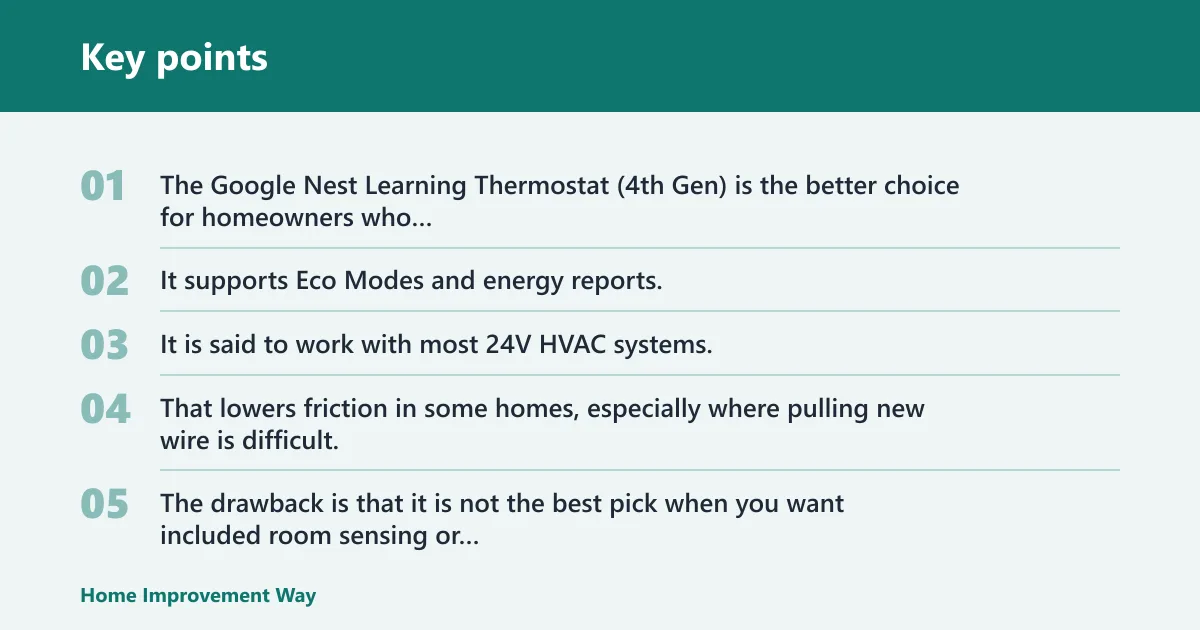
The Google Nest Learning Thermostat (4th Gen) is the better choice for homeowners who want a polished display, learning scheduling, and a thermostat that can run largely on its own after setup. It supports Eco Modes and energy reports, and its presence sensing can help it react when people are home.
It is said to work with most 24V HVAC systems, and the product information here indicates that a C-wire is not required for installation. That lowers friction in some homes, especially where pulling new wire is difficult.
The drawback is that it is not the best pick when you want included room sensing or broad platform compatibility first. It is strong on automation and presentation, less direct on room-by-room control.
Learning features and Eco Modes
The learning feature can reduce routine tinkering if your schedule is regular. Eco Modes and reports help you see when the system backs off, which is useful for homeowners who want a more automatic approach.
That said, learning features are only helpful if the household schedule is stable. A home with erratic shift work may still need manual edits.
Presence sensing and display quality
Presence sensing can help the thermostat move between comfort and energy-saving modes without much input. The display quality also matters because a thermostat should be easy to read at a glance.
That is useful for older adults or anyone who wants fewer menu layers. It is less helpful if your main need is a sensor in a specific room.
C-wire requirement status and setup fit
The absence of a C-wire requirement for installation makes this model easier to consider in older homes. That does not remove the need to verify HVAC compatibility, especially with heat pumps or multi-stage systems.
Suppose your home has a heat pump and the thermostat wall has only four conductors available. A no-C-wire install may still be possible, but terminal mapping and system type need to match before you buy.
Amazon Smart Thermostat: best budget pick
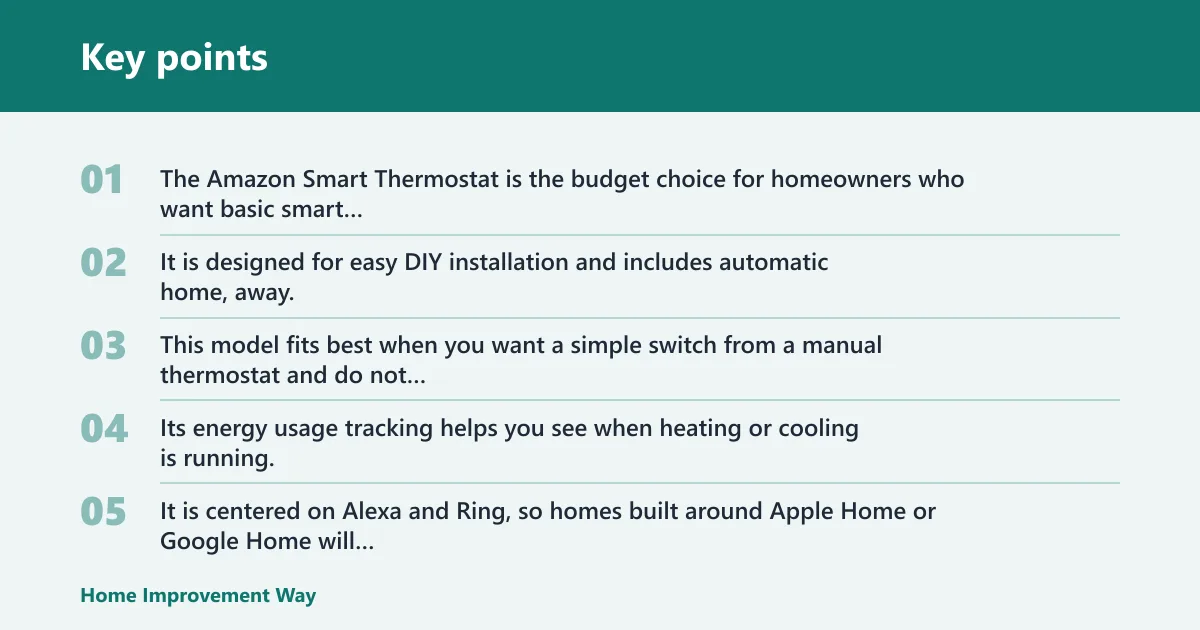
The Amazon Smart Thermostat is the budget choice for homeowners who want basic smart control, Alexa support, and a low entry price. It is designed for easy DIY installation and includes automatic home, away, and sleep temperatures.
This model fits best when you want a simple switch from a manual thermostat and do not need room sensing or broad platform support. Its energy usage tracking helps you see when heating or cooling is running, which is useful for budget-minded buyers.
The drawback is ecosystem depth. It is centered on Alexa and Ring, so homes built around Apple Home or Google Home will likely look elsewhere.
Alexa integration and DIY installation
The clearest strength here is the tight Alexa connection. For an Alexa household, that can make setup and daily use straightforward.
DIY installation is the other selling point. That matters most for a standard 24V system with a clean wire set and a confirmed C-wire.
Home, away, and sleep scheduling
Automatic home, away, and sleep temperatures cover the most common schedule patterns without much setup. For many households, that is enough to avoid heating or cooling an empty house.
The limit is flexibility. If you need room-by-room control or advanced comfort tuning, this model is too basic.
Energy usage tracking and value limits
Energy tracking helps you connect temperature settings to system runtime. That makes it easier to see whether the thermostat is helping or just adding another app.
Still, low price does not erase wiring checks. Most smart thermostats require a C-wire for constant power, and a bargain only helps if the install stays simple.
Honeywell Home T9: best for room sensing
The Honeywell Home T9 is a strong fit when comfort problems are tied to specific rooms rather than the whole house. It uses room sensor support, humidity detection, monthly usage reports, and virtual fencing based on your phone’s GPS.
That mix makes sense in homes where bedrooms, dens, or upper floors need different treatment. The room sensor support is the main reason to choose it over a thermostat that only watches the wall it is mounted on.
The drawback is that the best experience depends on placing sensors well and allowing location permissions if you want geofencing to work. Without that, you lose part of the value you paid for.
Room sensor support and humidity detection
Room sensors matter when comfort varies by occupancy and room use. They are most useful when a thermostat sits in a hallway or another area that does not reflect where people spend time.
Humidity detection adds a second layer of comfort data. In sticky climates, that can help you understand why a room feels warmer than the thermostat setting suggests.
Virtual fencing and monthly usage reports
Virtual fencing uses phone GPS to switch between home and away behavior automatically. That can save energy when everyone leaves regularly and returns on a predictable pattern.
Monthly usage reports help you see trends instead of single-day swings. They are not a substitute for good setup, but they can show whether comfort tweaks are helping.
Where the setup makes sense most
This model fits homes with more than one comfort complaint, especially if the thermostat is not in the main living area. It is a better match for room-targeting than for very simple installs.
A common first-timer mistake is buying a room-sensor model for a small condo with one open living space. In that case, the extra hardware often adds cost without solving a real problem.
Sensi Touch 2: best for simple control
The Sensi Touch 2 is for homeowners who want a clear touchscreen, quick setup, and manual-first control. It works with Alexa and Google, and its maintenance reports can help you track filter reminders and system alerts.
That makes it appealing for users who do not want a crowded interface or a learning algorithm doing too much. The app-guided DIY installation is another plus for straightforward swaps.
The drawback is that it is less ambitious than the more expensive models. If you need Apple Home support or included room sensing from the start, it is not the strongest fit.
Touchscreen usability and quick setup
The touchscreen should appeal to users who want large on-device controls and fewer nested menus. That is useful in multigenerational homes or for anyone who prefers tapping over voice commands.
Quick setup helps when the wiring is standard and the HVAC system is conventional. The more complex the system, the less that a simple interface matters.
Alexa and Google compatibility
Alexa and Google compatibility covers the two biggest voice platforms for many homes. That lets the thermostat fit an existing smart-home setup without forcing a new ecosystem.
It does not cover every platform. If Apple Home is a must-have, another model fits better.
Maintenance reports and manual-first use
Maintenance reports are practical for filters, alerts, and basic system awareness. They help the thermostat stay useful even if you do not lean on automation.
Manual-first users often prefer this style because it does not bury the core temperature controls behind a long setup flow. That said, the lack of an included room sensor means comfort control is less targeted.
Honeywell Home X8S Smart Thermostat: best for whole-house control
The Honeywell Home X8S Smart Thermostat is aimed at homeowners who want a larger interface, included sensing, and broad platform support in one package. It has a 5-inch touchscreen display, includes a room sensor, and works with Apple, Alexa, and Google.
It also adds indoor air quality and humidity monitoring, which gives it a more complete environmental view than basic smart thermostats. That can matter in homes where comfort complaints include dry air, dampness, or uneven temperatures from room to room.
The drawback is that its wider feature set can be more than a simple furnace owner needs. If you only want a cheap schedule and app control, this is not the leanest buy.
5-inch touchscreen and included room sensor
The 5-inch touchscreen makes on-device use easier for households that want large, readable controls. The included room sensor also reduces the need to buy add-ons before you can improve comfort.
That combination matters when the thermostat wall location is not ideal. It also helps buyers who want whole-house control without building a sensor system piece by piece.
Apple, Alexa, and Google compatibility
This model is a better fit for mixed-device homes than many single-platform thermostats. It can sit in an Apple household while still working with Alexa and Google speakers.
That broad compatibility is useful, but it should not hide the wiring check. Ecosystem support does not fix an HVAC mismatch.
Indoor air quality and humidity monitoring
Indoor air quality and humidity monitoring help you see more than temperature alone. That is useful in homes where comfort problems show up as stale air, dry rooms, or damp basements.
The tradeoff is complexity. More readings mean more setup and more data to interpret.
How smart thermostats save money and improve comfort
Smart thermostats save money when they reduce runtime without creating comfort complaints. That usually happens through scheduling, occupancy sensing, geofencing, or clearer control of when the system runs.
Energy Star is a useful benchmark here. Good Housekeeping says homes with an Energy Star-certified smart thermostat save an average of 8% on heating and cooling bills, which is a useful guide for payback math rather than a guarantee.
Payback is easiest to estimate with three inputs: thermostat price, rebate or utility incentive, and annual bill reduction. For example, a $240 thermostat with a $50 rebate has a net cost of $190; if it saves about $40 a year, the simple payback is just under five years.
Room sensors can improve comfort only when the main thermostat location is misleading. They do little in a home where the wall sensor already reflects the rooms you use most.
What to consider before buying
Start with the HVAC type. Consumer Reports tests smart thermostats for boilers, furnaces, and central AC systems, and also for mini-splits, heat pumps, and window ACs, so system fit is not a side note.
Then check for a C-wire. Consumer Reports says most smart thermostats require a C-wire for constant power, though some models include a wiring adapter or power extender kit to solve the problem.
After that, decide whether a smart room sensor will actually change comfort. If the house has one main living zone and no hot or cold spots, a sensor may add cost without much benefit.
Privacy belongs in the decision too. Geofencing and voice control often require app permissions, location permissions, and account linking, and some buyers will prefer a model with fewer data-sharing steps.
Accessibility matters as well. A large display, simple controls, manual override, and clear menus can matter more than deep automation for households that want straightforward daily use.
Which one should you buy?
Pick by wiring first, then by comfort problem, then by ecosystem. If you want the broadest fit and room control in one package, choose the Ecobee Smart Thermostat Premium. If you want a lower price and only need basic app control, choose the Amazon Smart Thermostat.
If your main goal is a clean learning schedule and a polished display, the Google Nest Learning Thermostat (4th Gen) fits well. If the problem is one hot or cold room, the Honeywell Home T9 is the more targeted choice.
If simple on-device control matters more than automation, the Sensi Touch 2 is the straightforward pick. If you want Apple, Alexa, and Google support together with a larger display and included sensor, the Honeywell Home X8S is the most complete control-oriented option.
Pick by payback speed too. The cheapest thermostat is not always the fastest payback if it lacks the sensor or compatibility you actually need, while a pricier model can pay back sooner when a utility rebate and a meaningful comfort fix are both in play.
Frequently asked questions
What are the best smart thermostats?
The best smart thermostats depend on HVAC fit and comfort needs, not just feature lists. For most homeowners, the Ecobee Smart Thermostat Premium is the strongest overall choice, the Amazon Smart Thermostat is the best budget pick, and the Honeywell Home T9 is best when room-by-room comfort matters most.
Which smart thermostat should I buy?
Buy the thermostat that matches your system first. If you have a standard furnace and want a low-cost option, start with Amazon; if you need room sensing and broad ecosystem support, start with ecobee; if you want a learning schedule with a polished display, start with Nest.
Are smart thermostats easy to install?
Many are DIY-friendly, but not all installs are simple. The biggest issue is the C-wire, which Consumer Reports says most smart thermostats require for constant power. Heat pumps, multi-stage systems, and older wiring can also turn a quick swap into a careful wiring check.
How do smart thermostats help save energy?
They help by reducing unnecessary heating and cooling through schedules, occupancy sensing, geofencing, and better control of setpoints. Savings are most likely when the thermostat matches the HVAC system, the household uses the automation features, and a room sensor or geofence actually changes behavior.
Are smart thermostats worth it?
They are worth it when the thermostat solves a real problem, such as high bills, uneven rooms, or manual adjustments you keep forgetting. If your current thermostat already fits your schedule and the house is comfortable, the payback may be too slow to justify a pricier model.
Sponsored / affiliate links. As an Amazon Associate I earn from qualifying purchases. I may earn additional commission from eligible campaigns.