Rim Joist Insulation and Air Sealing: What to Use and Why
For most rim joists, use rigid foam cut and sealed at every edge; choose closed-cell spray foam when you need stronger moisture resistance, or mineral wool plus foam only where drying or fire-code rules require it. If you leave the cavity open, rim joists lose heat, admit moist air, and can support mold or hidden rot. This guide shows how to choose an assembly by exposure, moisture risk, and code limits.
What is a rim joist?


The rim joist, also called the band joist in some homes, is the perimeter framing member that closes off the ends of the floor joists above the foundation. The sill plate sits below it at the top of the foundation wall. Together, those joints often form a major leakage path and a direct thermal bridge.
This area usually shows up in basements and crawl spaces, where the wood framing is exposed to outdoor temperatures or damp foundation walls. Air can move through seams, cracks, and penetrations, then carry moisture with it. That is why rim joist work should address air leakage and insulation as separate tasks.
Why this area leaks air and loses heat
Rim joists leak because the framing often has many small gaps: seams between framing members, openings around wiring, plumbing, HVAC lines, and the joint between the sill plate and foundation. Even if the cavity gets some insulation, uncontrolled air movement can bypass it. Fiberglass does not stop that air movement very well.
Heat loss also happens through thermal bridging. Wood conducts heat better than insulation, and the rim joist area is relatively small but often unbroken from indoors to outdoors. A thin layer of insulation at this location can matter a lot if the air leaks are sealed first.
Where homeowners usually find rim joists
You usually find rim joists at the top of a basement wall or along the outer edge of a crawl space floor framing. In finished basements, the area may be hidden behind drywall or soffits. If drywall is already in place, you may still be able to insulate from the basement side in some locations, but access matters for air sealing quality.
What should you use at the rim joist?
The best choice depends on cavity depth, moisture exposure, and whether the area is exposed to the room or hidden behind a finish layer. Closed-cell spray foam is often considered a strong all-in-one option for air sealing and moisture control. Rigid foam cut-and-cobble is often a good fit for many DIY installs. Fiberglass only makes sense after the cavity is already sealed.
Closed-cell spray foam
Closed-cell spray foam gives high air-sealing performance in one step and has a higher R-value per inch than fiberglass. It also fits thin or uneven cavities well. Depending on thickness and product, it can act as a vapor retarder, which helps in damp basements and many crawl spaces. Manufacturer data sheets commonly show lower perm ratings as thickness increases, so check the specific listing for the installed depth; code treatment should follow the product evaluation report. [IECC climate-zone insulation targets vary by zone; consult the current code tables for your region.]
It is often the easiest answer when the rim joist is irregular, the cavity is shallow, or the area has many penetrations. It also bonds to framing and foundation edges, which reduces the chance of bypass leakage. The tradeoff is cost and the need for proper fire protection if the foam remains exposed. [IRC foam plastics generally require an approved thermal barrier or ignition barrier depending on location and use.]
Rigid foam board
Rigid foam board works well for cut-and-cobble assemblies. Polyiso, XPS, and EPS are the common options. You cut each piece to fit the bay, then seal the perimeter with canned foam or caulk. Done carefully, this can create a good air seal and a continuous thermal break at the rim joist. [DOE and Building America guidance consistently recommends air sealing before insulating and moisture control before closing assemblies.]
This method is a strong option for homeowners who want control over the installation and need to work around uneven framing. It can also work in finished basements if access is available before drywall goes back up. Like spray foam, exposed foam board may need ignition or thermal protection depending on local code and the product listing. [IRC requirements for foam plastic protection apply unless a specific exception or listed assembly is used.]
Fiberglass batt insulation
Fiberglass batt insulation is air permeable, so it usually does not stop drafts by itself. In a leaky rim joist cavity, it can allow convective looping, where moving air reduces the effective thermal performance. That is why fiberglass alone is usually a poor standalone solution for this spot.
Fiberglass can still be part of the assembly after the cavity is already air sealed and, in some cases, after a foam layer has been installed at the perimeter. It is best treated as a secondary insulation layer, not the air barrier. In damp or wet spaces, it is usually the wrong primary choice.
Mineral wool and where it fits
Mineral wool fits rim joists only in limited assemblies, not as a batt-only fix. It can be useful when a project needs noncombustible insulation at the room side or when a foam layer is already providing the air seal at the perimeter. Without that air-sealed foam layer, mineral wool still allows air movement and does not solve the rim joist leakage problem. [EPA/DOE guidance on moisture control still applies: manage bulk water and air leakage first.]
This means mineral wool can supplement a properly detailed rim joist assembly, but it should not replace the air barrier. Batt-only assemblies fail at rim joists because the cavity is too leak-prone and the insulation does not stop bypass airflow. If the goal is drying potential, mineral wool may be chosen as part of a layered approach; if the goal is primary air sealing, it is the wrong lead material.
Rim joist decision matrix
This matrix compares the main choices by function. The most important point: air sealing, insulation, and vapor control are not the same thing. A material can do one job well and still be weak at the others. [IECC climate zone tables set the broader thermal target; the assembly choice should match the zone, exposure, and code path.]
| Material | Air sealing performance | Moisture risk | Install difficulty | Fire protection needs | Best use |
|---|---|---|---|---|---|
| Closed-cell spray foam | High; seals cracks and penetrations well | Low to moderate; can limit inward moisture depending on thickness | Low for the installer, but usually professional work | Often needs ignition or thermal barrier if exposed | Thin, irregular, or damp-prone basement and crawl space rim joists |
| Rigid foam cut-and-cobble | High if every edge is sealed | Low to moderate; depends on foam type and detailing | Moderate to high for DIY, especially in uneven bays | May need covering or another approved protective layer | Dry or moderately damp spaces where you can fit and seal boards carefully |
| Fiberglass batt | Low; does not air seal | Moderate to high if air leaks remain | Low, but poor performance if installed alone | Usually not the main fire-protection issue, but still must follow finish-layer rules | Only as a secondary layer after the cavity is already sealed |
| Mineral wool plus foam layer | Moderate to high only when foam provides the primary air barrier | Moderate; mineral wool tolerates moisture better than fiberglass, but does not stop leakage | Moderate; requires layered detailing | May still need protective covering depending on exposed foam and finish use | Places where a noncombustible inner layer or drying-friendly insulation is desired after foam sealing |
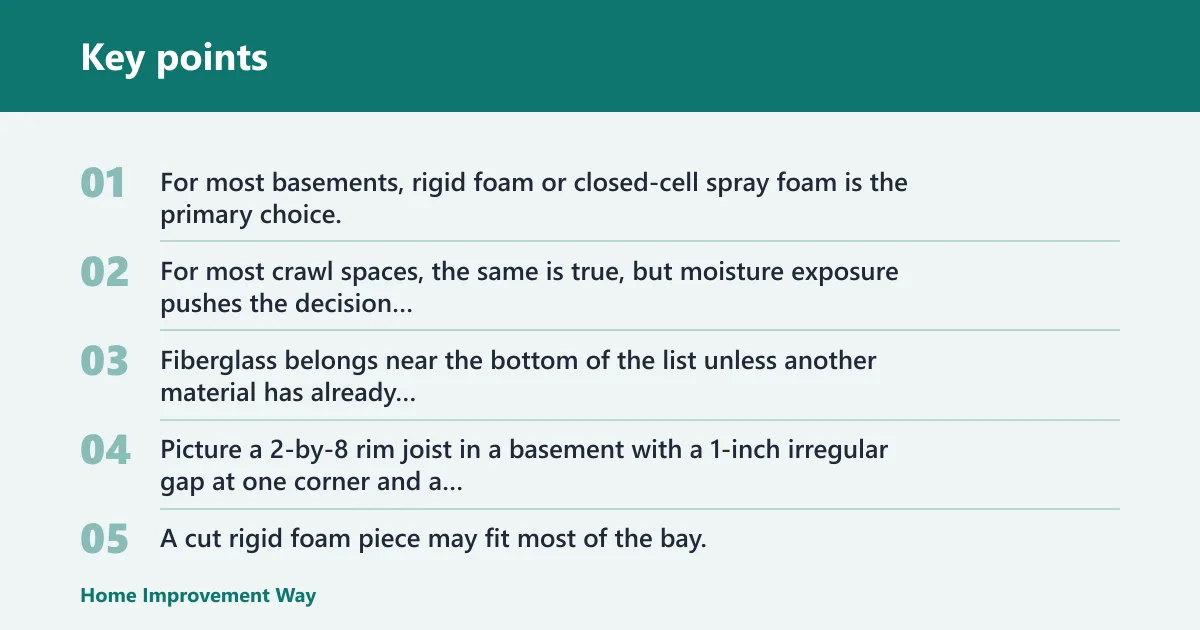
For most basements, rigid foam or closed-cell spray foam is the primary choice. For most crawl spaces, the same is true, but moisture exposure pushes the decision toward closed-cell spray foam or a very well detailed foam board assembly. Fiberglass belongs near the bottom of the list unless another material has already blocked air movement.
Picture a 2-by-8 rim joist in a basement with a 1-inch irregular gap at one corner and a few wire holes. A cut rigid foam piece may fit most of the bay, but the corner gap still needs spray foam or caulk. That small detail matters more than the batt value alone.
Basement, crawl space, or finished basement?
Unfinished basements are often the simplest because the rim joist is visible and accessible. Crawl spaces usually need the strongest moisture strategy, especially if the ground is damp or the space is vented. Finished basements can be trickier because access is limited and the protective covering rules become more important.
If the room is already finished, the decision may hinge on what can be sealed without opening the whole wall. If the space is a crawl space, the decision may hinge on whether moisture control is already in place. The same materials behave differently as the exposure changes.
Dry, damp, irregular, or simple cavities?
Dry, simple cavities are the easiest fit for rigid foam cut-and-cobble. Damp or irregular cavities favor closed-cell spray foam because it conforms better and adds a moisture-resistant layer. Mineral wool may supplement a dry, well-sealed assembly, but it is not a substitute for sealing the cavity face.
When the rim joist is warped, full of wires, or interrupted by piping, the assembly should favor the best air seal first. That usually means spray foam or a carefully detailed foam board perimeter. The simpler the cavity, the more practical cut-and-cobble becomes.
Do you need both air sealing and insulation?
Yes. Insulation slows heat flow, but it does not stop uncontrolled air leakage. If the rim joist cavity leaks, cold air can still move through and around the insulation, reducing performance and bringing moisture into contact with colder surfaces. Seal first or seal as you insulate. [DOE and Building America guidance emphasizes air sealing as the first step before adding insulation.]
Why sealing cracks before insulating matters
The sequence matters because the sealant closes the leakage path while the insulation slows heat transfer. If you install fiberglass into a leaky cavity, the air can move through the batt and strip away much of its value. Even rigid foam works best when its perimeter is sealed tightly to framing and masonry.
Use caulk, canned foam, or spray foam for seams, cracks, and penetrations. Use a separate insulation layer to cover the remaining exposed area of the rim joist cavity. For many homes, the best result comes from combining a perimeter seal with rigid foam or closed-cell spray foam.
Air-sealing-first guidance you should follow
Think of the rim joist as an air barrier problem before it is an insulation problem. The priority is to stop the leakage path at the sill plate, framing joints, and penetrations. Once that path is closed, the insulation can do its job. That is the same logic used in broader whole-house air-sealing guidance.
For readers comparing envelope strategies, it helps to review the broader air leakage and insulation guidance before choosing a rim joist material. This prevents the common mistake of installing the wrong material in the wrong order.
How do you seal rim joists and sill plates?
Start at the obvious leak points: the sill plate, framing seams, plumbing penetrations, electrical wiring holes, HVAC lines, and gaps between joist bays and the foundation. The goal is to make the perimeter as tight as possible before adding insulation. Around anchor bolts, leave enough room for the fastener while sealing the small gaps beside it.
- Clear loose debris from the cavity so sealant can bond.
- Seal the sill plate to the foundation with caulk or foam where access allows.
- Fill larger gaps around pipes, wires, and duct lines with low-expansion canned foam.
- Seal small cracks and seams with caulk or compatible sealant.
- Fit rigid foam or apply spray foam to complete the insulation layer.
- Cover exposed foam if local code requires a protective barrier.
Plumbing, wiring, and HVAC penetrations
Penetrations need careful detailing because each one can leak air around its edges. Use caulk for tight gaps and low-expansion foam where the opening is larger. Do not pack mineral wool or fiberglass into a hole and call it sealed; those materials do not block air movement by themselves.
For multiple wires or pipes in one bay, it is often easier to seal the whole cavity face with rigid foam or spray foam rather than trying to treat each tiny opening separately. That is especially true when the framing is uneven.
Anchor bolts and the foundation-to-framing joint
The sill plate is a common leakage line at the top of the foundation wall. Anchor bolts complicate the joint because they interrupt the seam. Seal around each bolt with foam or a compatible sealant, then seal the plate-to-foundation line where possible. Leave the fastening system intact, but close the small air path around it.
Uneven framing and irregular cavities
Cut-and-cobble works best when the cavity depth is predictable. If the framing is warped, the masonry is uneven, or the bay is full of pipes, spray foam may be the cleaner choice. A common first-timer mistake is cutting rigid foam to the center dimensions of the bay and leaving the edges unsealed. The edge seal is the part that makes the assembly work.
When cut-and-cobble is the better comparison
If you are deciding between board insulation and a sprayed assembly, start with the cavity shape and access. The rigid foam comparison page is most useful when the rim joist is visible, the bay can be measured cleanly, and you want a DIY method that still allows a strong air seal at the perimeter.
Moisture and fire protection at the rim joist
Basements and crawl spaces change the material choice because they can be damp, cool, or both. If the space has seasonal humidity, visible condensation, or signs of past water entry, choose an assembly that resists moisture and does not trap wetness against damaged wood. Closed-cell spray foam often fits that job best. In some cases, foam board with careful sealing can also work well. [EPA guidance on moisture control and indoor air quality supports fixing moisture sources before enclosing assemblies.]
Condensation and damp basement risks
Cold rim joists can condense indoor moisture on their surfaces. If outside air leaks through the cavity, that risk rises. In a crawl space, ground moisture and poor ventilation can add to the problem. Do not cover an actively wet or moldy assembly and hope the moisture disappears.
If the area stays damp, focus on bulk water control first, then air sealing, then insulation. That may mean fixing drainage, adding ground vapor control in the crawl space, or improving dehumidification before insulating the rim joist.
Fireblocking, ignition barriers, and thermal barriers
Foam plastics at exposed basement rim joists often need fire protection. In occupied spaces, that can mean an ignition barrier or a thermal barrier, depending on the product listing and local code. Do not assume exposed spray foam or rigid foam can stay uncovered just because it is above grade or in a basement. [IRC foam plastic protection rules generally require a thermal barrier such as drywall in occupied spaces unless a listed exception applies; ignition barriers may be allowed in certain attic/crawl space conditions.]
Local code and the specific product label can change the requirement. Some assemblies are approved with drywall, some with a listed intumescent coating, and some only in limited situations. Check the product listing before choosing a finish layer. That step matters as much as the foam itself.
What local code can change
Local rules can affect whether you may leave foam exposed, what cover material is allowed, and whether a crawl space counts as occupied space. A finished basement often has stricter requirements than an unfinished utility area. If the project will be covered later with drywall, plan for that cover before selecting the foam type and thickness.
Can you use batt insulation alone in a rim joist cavity?
Usually no. Fiberglass batt insulation alone is not a good rim joist solution because it does not stop air leakage. If the cavity is already sealed and the batt is part of a broader assembly, it can supplement the insulation layer. As a standalone answer, it leaves too much air movement and moisture risk behind.
Can you insulate a rim joist in a basement without removing drywall?
Sometimes, but access is limited by the finished surface. If drywall hides the cavity completely, you may only be able to work from the exposed edge, utility openings, or small access cuts. In many finished basements, the better answer is to seal and insulate before closing the wall again.
If you can reach the rim joist from the basement side, low-expansion foam or injected products may help around penetrations, but they rarely solve every gap behind finished surfaces. The more irregular the cavity, the more likely full access will matter.
What is the best method for a crawl space rim joist?
For a crawl space, the best method is usually the one that handles moisture first and air leakage second, while still giving enough insulation value. Closed-cell spray foam is often the strongest single choice in damp or tight crawl spaces. In drier spaces, sealed rigid foam board can work well if every edge is tight. [Building America guidance typically prioritizes moisture control and air sealing before insulation in crawl spaces.]
If the crawl space has persistent dampness, do not rely on fiberglass alone. Control ground moisture, seal the rim joist, and choose an assembly that will not absorb and hold water. If the area will remain exposed, plan for the needed fire protection before installation.
Frequently asked questions
What should I use to insulate and air seal a rim joist?
For many homes, use rigid foam board cut to fit and sealed at all edges, or closed-cell spray foam when the cavity is irregular, shallow, or moisture-prone. Fiberglass only belongs in the assembly after the air barrier is already in place.
Should I use spray foam, rigid foam, or fiberglass at the rim joist?
Choose spray foam for the best all-in-one sealing in tight or damp areas, rigid foam for a careful DIY cut-and-cobble assembly, and fiberglass only as a secondary layer. If you want one primary material, do not pick fiberglass.
Do I need both insulation and air sealing at the rim joist?
Yes. Insulation slows heat flow, but air sealing blocks the leakage path that creates drafts and moisture movement. A rim joist that is only insulated can still perform poorly if seams, penetrations, and the sill plate remain open.
What R-value should a rim joist insulation assembly have?
There is no single required number that fits every home, but a rim joist assembly should usually match the rest of the basement or crawl space strategy and meet your local energy code. In practice, many assemblies use a few inches of foam because the cavity depth is limited.
How do I prevent moisture problems when insulating a rim joist?
Fix bulk water problems first, then seal air leaks, then insulate with a material suited to the space. Closed-cell spray foam and carefully sealed rigid foam both help manage moisture better than fiberglass alone, especially where the basement or crawl space stays cool or damp.
Is closed-cell spray foam worth the cost for a rim joist?
It can be worth it when you need strong air sealing, uneven cavity coverage, or better moisture resistance in a small area that is hard to detail by hand. If the rim joist is dry, simple, and open, rigid foam may deliver a better value.
Sources
- International Energy Conservation Code (IECC), climate-zone insulation requirements and envelope tables.
- International Residential Code (IRC), foam plastic thermal barrier and ignition barrier provisions.
- U.S. Department of Energy and Building America guidance on air sealing, insulation sequencing, and moisture control.
- U.S. Environmental Protection Agency guidance on moisture control and preventing mold-friendly conditions in building assemblies.
- Manufacturer technical data sheets and evaluation reports for closed-cell spray foam products, including perm ratings and thickness-based vapor-retarder behavior.
Sponsored / affiliate links. As an Amazon Associate I earn from qualifying purchases. I may earn additional commission from eligible campaigns.