How to Choose Insulation for Soundproofing vs Heat Loss
Choose dense, fibrous insulation for absorbing sound inside wall and ceiling cavities, high-R-value batts or foam for cutting heat loss, and a hybrid mineral wool or dense fiberglass layer when you need both. Pick the wrong material and you can spend money on insulation that leaves rooms noisy, floors cold, or both. This guide matches insulation to walls, ceilings, basements, lofts, and exterior walls by noise source, assembly type, and thermal target.
| Decision factor | How to choose insulation for soundproofing | thermal performance | Winner |
|---|---|---|---|
| Primary job | Reduce airborne sound transmission and cavity resonance | Slow heat loss and improve energy retention | Depends on the problem |
| Best assembly | Interior walls, basement ceilings, party walls, studios | Exterior walls, attic rooflines, lofts | Depends on the assembly |
| Best material class | Mineral wool, fiberglass batts, acoustic plasterboard | Insulated plasterboard, fiberglass batts, open-cell spray foam | Depends on the target |
| Rating to verify | STC, and NRC for absorption inside the assembly | R-value | Depends on the goal |
| Common failure mode | Compression, gaps, and ignoring flanking paths | Air leaks, thin coverage, and thermal bridges | Tie |
Soundproofing vs thermal performance at a glance
Sound control and heat retention solve different problems, even when the same cavity fill can help with both. If the complaint is voices through a wall or footsteps through a ceiling, you need an assembly that slows vibration and airborne transmission. If the complaint is heat loss, you need insulation that resists heat flow and limits air leakage.
Mineral wool and fiberglass are common cavity fills for both jobs, but they do not behave the same way in every assembly. Sound control depends heavily on full cavity fill, airtightness, and decoupling. Thermal performance depends more on continuous coverage, correct thickness, and stopping bypasses around the insulated area.
What sound control solves
Soundproofing focuses on the path noise takes through a wall, ceiling, or floor. Voices, HVAC noise, and pipe sounds are airborne; footsteps are impact noise; rattles and pipe knock often travel through framing and connected surfaces. A dense cavity fill helps, but it is only one part of the fix.
STC is the rating to watch for wall, ceiling, and floor soundproofing. NRC matters when you want the material itself to absorb sound inside the cavity or room, but it does not tell you enough about low-frequency control.
What heat retention solves
Thermal insulation focuses on slowing heat flow. That is why insulated plasterboard and air-sealing foams are common on exterior walls and rooflines. If a room is cold because heat escapes through the envelope, a sound-first assembly may not give you the comfort gain you want.
Thermal performance should override acoustic gains when the main problem is energy loss through a roofline, exterior wall, or leaky rim area. In those spots, the best sound product is often the wrong buy if it steals thickness from the thermal layer.
Where one material helps both
Mineral wool is a strong cavity absorber in walls and ceilings, and it also adds thermal resistance. Fiberglass can perform well in wall tests and is often the practical thermal choice, while still helping with sound absorption when fitted correctly. Open-cell spray foam helps most when gaps and cracks are part of the problem.
A common first-timer mistake is treating density as the whole answer. Denser material can help higher frequencies, but low-frequency control often depends more on decoupling, sealing, and the rest of the assembly than on mass alone.
Insulation decision matrix
Use this matrix to match the assembly to the main problem. It separates sound, heat, and mixed cases so you do not overbuy specialty acoustic material for a heat problem, or use a thermal board where sound transmission is the real complaint.
| Assembly | Primary goal | Best insulation class | Rating to verify | Common failure mode to avoid |
|---|---|---|---|---|
| Interior wall | Sound | Mineral wool cavity fill plus acoustic plasterboard | STC | Compressed batts, gaps around boxes, weak framing joints |
| Interior wall | Both | Mineral wool or fiberglass in the cavity with acoustic plasterboard on the noisy side | STC and R-value if the wall borders a cold space | Overfilling the cavity and ignoring air sealing |
| Basement ceiling | Sound | Mineral wool or fiberglass batts in the joist bay, with acoustic board if needed | STC | Leaving gaps around pipes, can lights, and joist edges |
| Basement ceiling | Both | Fiberglass, mineral wool, or spray foam depending on leakiness and access | R-13 to R-30 and STC | Using a tight thermal fill while ignoring flanking noise paths |
| Attic roofline | Heat | Insulated plasterboard or a roofline thermal system | R-value | Thin coverage and unsealed joints |
| Exterior wall | Heat | Insulated plasterboard with continuous cavity insulation | R-value | Thermal bridges and interrupted coverage |
Which insulation is best for soundproofing?
For soundproofing, mineral wool is usually the stronger cavity choice, especially in interior walls and ceilings where airborne noise is the main issue. Fiberglass can also do well in wall tests, but the result depends more on fit and installation quality than on chasing the highest density. Open-cell spray foam is better when air leakage is part of the sound problem, not when you need the strongest standalone absorber.
Mineral wool in cavities
Mineral wool is a strong fit for party walls, bedrooms, offices, and basement ceilings because it absorbs sound in the cavity and keeps its shape well. It is also valued for fire resistance. For sound control, the key is full cavity fill without compression.
Rockwool and fiberglass batts are often compared in 2×4 wall cavities. In the cited wall data, an empty 2×4 wall was STC 35, the same wall with a fiberglass batt was STC 39, and a 2×4 wall with 3½-inch Comfortbatt was STC 40. That kind of result shows why cavity fill matters more than brand language.
Fiberglass in open walls
Fiberglass is often the practical choice when the wall is open and the main goal is thermal insulation with some sound absorption. It can perform as well as mineral wool in wall tests, so it should not be dismissed for noise control. The fit matters more than extreme density.
Use fiberglass when you need a straightforward batt in a standard cavity and the budget matters. It is a sound-supporting material, not a dedicated soundboard. If the noise source is low-frequency footsteps or machinery, the rest of the assembly still matters more than the batt label.
Open-cell spray foam when air leaks matter
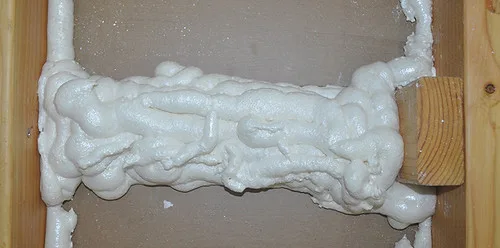
Open-cell spray foam helps seal gaps and reduce energy loss. It is useful when the issue is a leaky rim, irregular framing, or a wall full of small bypasses. It is not the strongest stand-alone sound absorber, so it should not be chosen as the only answer for a loud shared wall.
Use it when air sealing is part of the fix. If the noise is voices through a shared wall, pair the foam or batt with a board choice that addresses transmission loss.
Which insulation is best for thermal performance?
For thermal performance, choose the product that gives you the highest practical R-value for the assembly and keeps the building envelope continuous. Insulated plasterboard is common on exterior walls and lofts because it combines board and insulation in one layer. Fiberglass batts and spray foam are often better when you need to fill a cavity or seal irregular spaces.
Insulated plasterboard on exterior walls
Insulated plasterboard primarily improves thermal efficiency and reduces heating costs. It commonly uses polystyrene, PU foam, or similar insulation layers. That makes it a common choice on exterior walls and lofts where heat loss is the main issue.
Its sound reduction is secondary. If you need quiet as well as warmth, it can help, but it should not be treated as a soundproofing board first.
Loft and roofline applications
On lofts and rooflines, thermal continuity usually matters more than acoustic gain. If you are trying to keep a room warmer, choose a system that covers the thermal bridge and the gaps around the framing. A partial acoustic gain does not make up for a weak thermal layer.
That is why thermal performance should win on rooflines, attic slopes, and exterior walls where heat loss is the dominant complaint. A sound-first layer there is often poor value unless the space also faces noise from rain, aircraft, or adjacent mechanical equipment.
When thermal gains should win
Thermal gains should win when the room is cold, the utility bill is the main complaint, or the assembly is part of the building envelope. In those cases, choose the insulation that most reliably limits heat loss and air leakage. Sound control can be added later with board, sealing, or decoupling if needed.
Say your upstairs bedroom is quiet enough but sits under an uninsulated roof slope. Insulated plasterboard is the better first move. A sound-focused layer would not fix the cold ceiling.
NRC vs STC: which rating should you check?
Check STC when you want to know how well a wall, ceiling, or floor blocks airborne sound. Check NRC when you want to know how well a material absorbs sound in the cavity or room. They answer different questions, and neither one gives the whole picture by itself.
What NRC tells you
NRC, or Noise Reduction Coefficient, is measured between zero and one. It describes how much sound a material absorbs at normal speech frequencies. That makes it useful for comparing absorptive materials, but it does not fully describe low-frequency control.
For a home office or bedroom wall, a higher NRC in the cavity material can help reduce echoes and cavity resonance. It will not, by itself, turn a thin wall into a quiet one.
What STC tells you
STC, or Sound Transmission Class, measures airborne sound transmission loss. The cited range runs from 25 to 65. That is the rating most homeowners should watch for wall, ceiling, and floor soundproofing.
If you are comparing assemblies for voices between rooms, STC is the clearer number. It says more about what you hear on the other side of the wall than about how absorbent the insulation feels in your hand.
Why neither rating tells the whole story
Neither rating replaces good installation. Gaps around electrical boxes, unsealed edges, compressed batts, and connected framing can reduce real-world performance. Low-frequency noise from bass, footsteps, or pipes can also behave differently from speech.
Suppose a basement ceiling gets a batt with good absorption but the pipes are left unsealed and the rim joist is leaky. The rating may look fine on paper, yet the room can still carry pipe noise and cold drafts.
Basement ceiling insulation for sound and heat
Basement ceilings often need both sound control and thermal protection. That is why the common guidance range is R-13 to R-30. Fiberglass batts are often chosen because they are affordable, while mineral wool is a strong pick when sound control matters more or fire resistance is a priority.
Best material choices
Use fiberglass when the joist bays are standard, the budget matters, and you need a simple thermal layer with some sound absorption. Use mineral wool when you want stronger cavity absorption and a firmer fit in the bay. Use open-cell spray foam when the basement has many air leaks and the main loss is through gaps as much as through the cavity.
If the basement ceiling separates a finished space from living space above, sound can matter as much as heat loss. In that case, choose the cavity fill first, then add board or sealing measures if the noise source is still a problem.
Typical performance range to check
Check both R-value and the sound result. The thermal target commonly cited for basement ceilings is R-13 to R-30, while the sound target should be judged by the assembly’s STC, not by the batt alone. A thermal-only decision can leave the basement quieter but still underperforming for heat.
Common mistakes in basement ceilings
The biggest mistakes are compressing batts, leaving gaps around utilities, and assuming dense material alone will stop footsteps. If pipes, ducts, or recessed lights create flanking paths, the cavity fill cannot solve the whole problem. Seal and detail the penetrations before assuming the insulation choice failed.
A common first-timer mistake is to stuff a cavity too tightly. That can hurt fit and reduce the real benefit. A clean, full cavity is better than a cramped one.
Choose acoustic plasterboard if… / Choose insulated plasterboard if…
Choose acoustic plasterboard when noise control is the main problem and the wall or ceiling already has enough thermal performance. Choose insulated plasterboard when warmth is the main problem and you want a board that adds thermal resistance with only secondary sound reduction. If both goals matter, combine the cavity fill and the board type instead of asking one product to do everything.
Choose acoustic plasterboard if…
Choose acoustic plasterboard if the problem is voices through a party wall, a bedroom wall, a shared office partition, or a studio ceiling. It is commonly used to help reduce sound transmission between rooms and is often paired with mineral wool in the cavity. That pairing improves transmission loss more than thermal performance.
Use it when the main complaint is transmission, not heat. It is the sound-focused board, so it belongs where STC matters most.
Choose insulated plasterboard if…
Choose insulated plasterboard if the wall is part of the thermal envelope, such as an exterior wall or loft lining. It is made with insulation layers such as polystyrene or PU foam and is aimed primarily at energy performance. It can reduce some sound, but that is secondary.
Use it when heat loss is the dominant complaint. It is the better board when warmth matters more than speech privacy.
When to combine layers
Combine layers when a wall needs quiet and warmth. A typical approach is a cavity fill such as mineral wool or fiberglass, then a board choice that matches the dominant goal. If the wall faces both street noise and cold air, the cavity fill handles most of the practical work, and the board refines the result.
Do not let the board choice hide a weak cavity. The insulation inside the wall usually does more than the facing layer alone.

Frequently asked questions
What insulation is best for soundproofing and thermal performance?
Mineral wool is usually the strongest all-around cavity choice when both goals matter, especially in walls and ceilings. Fiberglass is also a good option when fit and budget matter more. If the assembly is leaky, open-cell spray foam can help, but it should not be treated as the best stand-alone sound absorber.
Is mineral wool better than fiberglass for soundproofing?
Often, yes, but not by default in every assembly. Mineral wool is widely used for acoustic absorption in cavities and can offer high-density benefits, yet fiberglass can perform as well as mineral wool in wall tests. Full cavity fill and careful installation matter more than chasing density alone.
Does denser insulation block more sound?
Not always. Denser material can help higher frequencies, but low-frequency control depends heavily on the full assembly, including decoupling, sealing, and cavity depth. A dense batt in a leaky wall may perform worse than a well-fitted standard batt in a better-built assembly.
Can thermal insulation also work for soundproofing?
Yes, especially in cavities. Fiberglass and mineral wool both help absorb sound while also improving thermal performance. The key is to match the material to the assembly and noise source, because a product chosen only for R-value may not give enough reduction in voices, pipes, or HVAC noise.
What is the difference between NRC and STC?
NRC measures how much a material absorbs sound, from zero to one, mainly at speech-range frequencies. STC measures airborne sound transmission loss through an assembly, and the cited range is 25 to 65. Use NRC for absorption inside a space; use STC for blocking sound between spaces.
What insulation works best in a basement ceiling for both sound and heat?
Fiberglass or mineral wool in the joist bays is usually the best starting point, with R-13 to R-30 as the common thermal target range. Fiberglass is often chosen for affordability, while mineral wool is often preferred when sound control is more important. Spray foam helps when air sealing is a major issue.
Sponsored / affiliate links. As an Amazon Associate I earn from qualifying purchases. I may earn additional commission from eligible campaigns.