Why Does My Dehumidifier Keep Freezing Up in Winter?
A dehumidifier that freezes up in winter usually means the room is too cold for the unit, the intake or exhaust is blocked, or the coil is dirty; if the room stays below about 65°F, many compressor models will frost or shut down. Ignoring it can leave you with no moisture control and repeated defrost cycles or compressor strain. This guide explains the symptoms, the likely cause, and whether cleaning, warmer air, stronger airflow, moving the unit, or replacing it is the right fix.
What freeze-up means
Freeze-up usually starts on the evaporator coil, where warm indoor air gives up moisture and passes over a cold surface. If the coil gets too cold, water turns to frost instead of draining away. Once that happens, the unit removes less humidity and may run longer without collecting water.
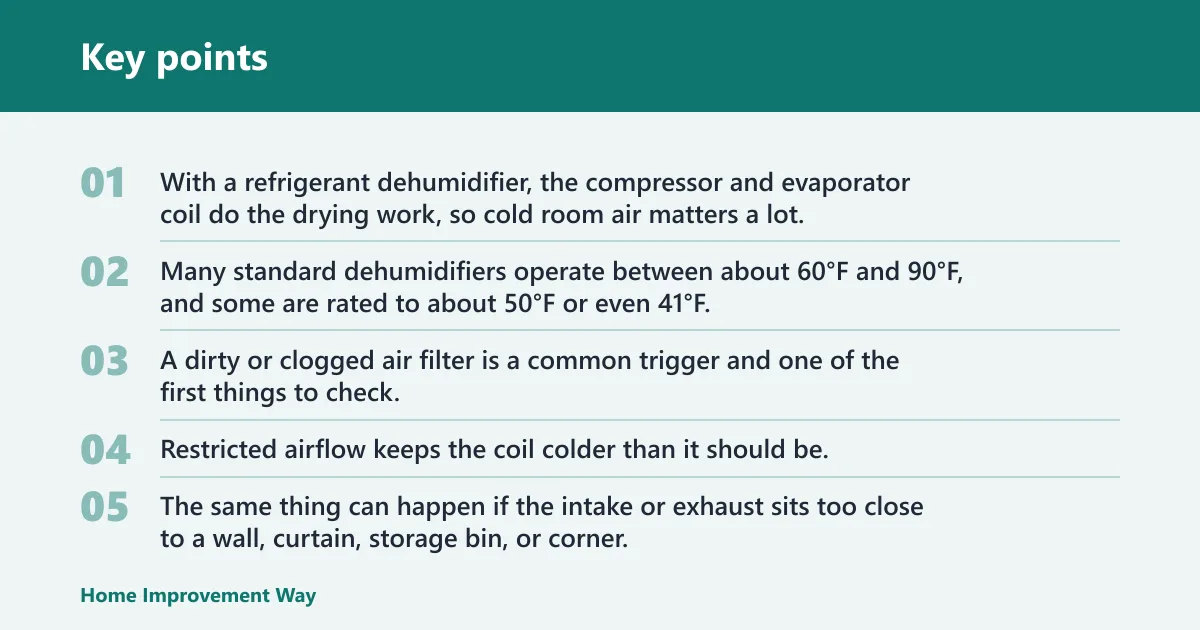
With a refrigerant dehumidifier, the compressor and evaporator coil do the drying work, so cold room air matters a lot. Many standard dehumidifiers operate between about 60°F and 90°F, and some are rated to about 50°F or even 41°F. That means frost can be a design limit, not just a maintenance problem.
A dirty or clogged air filter is a common trigger and one of the first things to check. Restricted airflow keeps the coil colder than it should be. The same thing can happen if the intake or exhaust sits too close to a wall, curtain, storage bin, or corner. If you are already cleaning the filter regularly, dehumidifier filter cleaning is still worth revisiting before you assume the unit has failed.
Signs the coil is icing over
Look for white frost on the coil area, a fan that keeps running with little water in the bucket, or a unit that cycles into defrost again and again. If the room feels damp but the tank stays nearly empty, the machine may be pulling moisture from the air very slowly or not at all.
Some units show an error code when the defrost sensor or thermistor cannot read coil temperature correctly. Others simply stop cooling the coil for a while, then restart. Either way, repeated icing points to a diagnosis issue, not just a full bucket or a random hiccup.
Why does my dehumidifier keep freezing up?
A dehumidifier keeps freezing up when one of three things changes: the room is colder than the unit can handle, air moving across the evaporator coil is weak, or a control part is stopping defrost at the wrong time. In winter, those causes often overlap, which is why the same symptom can have different fixes.
Cold room air and model limits
Refrigerant dehumidifiers are more likely to freeze in cold rooms because their coils need enough surrounding heat to keep frost from building. For many compressor models, practical frost risk begins around 65°F, even though some units are rated lower. The exact freeze-up point depends on humidity, airflow, coil condition, and model design, so the printed minimum is not the only factor.
If the room temperature sits below the model’s minimum, stopping dehumidification is often the safest answer. A unit that is not rated for the space may keep frosting no matter how often it is cleaned. In that case, warming the room or switching to a different type makes more sense than repeated repairs.
Blocked airflow and dirty filters
Airflow problems are a major winter cause because the coil needs moving air to stay above freezing. A clogged filter, blocked grille, dirty coil fins, or poor clearance around the cabinet can all create the same result. Keep the unit out in the open and give the intake and exhaust enough room to move air freely, especially in a basement where dust and storage clutter can build up.
Check the fan too. If the fan is weak, noisy, or not moving air through the outlet, the coil can stay cold long enough to frost over. That is especially common after the filter has been neglected for several weeks during heavy use.
Settings, sensors, and defrost faults
A humidistat set too low can keep the compressor running continuously. That makes the coil work harder and can push it into icing, especially in a cool room. The setting can look like a parts failure because the machine keeps running, but the real issue is a demand level the space cannot support.
Auto-defrost should pause the compressor and run the fan to melt ice. If the sensor, thermistor, or control board fails, the unit may miss that cycle and stay iced. Some models also use error codes to point to a failed defrost sensor or temperature reading problem.
At what temperature does a dehumidifier freeze up?
There is no single freezing point for every dehumidifier. The practical frost-risk range for many refrigerant units starts around 65°F, while some manufacturers rate their products to 50°F or even 41°F. That difference matters because a room can be cold enough to frost a coil even when it is still above the printed minimum.
For a cold basement or garage, the best question is not only “What temperature is the room?” but also “What temperature does this model tolerate while still drying well?” A unit rated for cooler use may run farther into winter, while a standard compressor model may shut down or ice long before the room feels truly cold.
The key point is that a general temperature range and a model-specific minimum are not the same thing. A room that is fine for one unit may be too cold for another, and frost can start earlier if the air is humid, circulation is weak, the coil is dirty, or the cabinet is tucked into a tight corner. If you are comparing options for a cool basement, basement humidity conditions matter as much as temperature.
Basements, garages, and other cool rooms
Basements are the most common winter problem area because they are often cooler than living rooms and less insulated from outdoor air. Garages can be even colder. If the space cannot stay within the unit’s working range, a desiccant dehumidifier is usually the better fit because it is designed for lower temperatures.
Suppose a basement sits at 48°F and the compressor model ices every night. Cleaning the filter may help for a while, but the more durable fix is usually a different dehumidifier type or a warmer space. A heater can help, but only when the space can be warmed safely and consistently enough to keep the unit above its practical frost-risk point.
How to thaw a frozen dehumidifier
Unplug the unit first and let the ice melt before any troubleshooting. That protects the compressor and gives you a clean starting point. Do not chip at the ice or force the fan blades.
-
Turn the unit off. Unplug it and empty the bucket so meltwater does not overflow later. Leave the tank out if the design allows easier drainage.
-
Let the ice melt. Leave the unit at room temperature until visible frost and hidden ice are gone. Depending on how much ice formed, this can take several hours.
-
Inspect the coil area. Check for dust, lint, or bent fins once the unit is thawed. If the coil is packed with debris, clean it gently before restarting.
-
Restart in warmer air. Put the unit back only after the room is warm enough for the model. If the room still feels cold, move the unit or raise the temperature before testing again.
How do I fix a dehumidifier freezing up?
Fixing freeze-up starts with the simplest causes first: filter, airflow, room temperature, and settings. If the unit still frosts after those checks, the issue may be a sensor, defrost system, fan, or a mismatch between the model and the room. Do not skip the room-temperature check, because that is often the deciding factor.
Clean or replace the air filter
A dirty filter is common enough that it should be checked first. Clean or replace it every 2 to 4 weeks during heavy use, and more often in dusty rooms. If the filter is packed with lint or gray dust, airflow is already low enough to cause icing.
-
Remove the filter. Take it out according to the unit’s design and inspect both sides for dust buildup. If light cannot pass through easily, clean or replace it.
-
Wash or swap it. Rinse washable filters with clean water and let them dry fully before reinstalling. Replace disposable filters when cleaning no longer restores open airflow.
-
Restart and watch. Run the dehumidifier for a short cycle and check for normal water collection. If frost returns quickly, move on to room temperature and defrost checks.
Check airflow clearance and fan operation
Give the unit room to breathe. Keep the intake and exhaust clear, and avoid pressing the cabinet against walls, furniture, or stored boxes. The clearance advice varies by model, but a common range is about 8 inches to 18 inches.
If the fan seems weak, the coil may not get enough moving air to stay above freezing. A fan that starts and stops oddly, rattles, or does not move much air can point to a motor or control fault rather than a simple placement problem.
Raise the room temperature or move the unit
If the room is near or below the model’s minimum, warmer air may be the correct fix. That can mean running a safe space heater for a short period, opening a conditioned adjoining room, or moving the dehumidifier to a warmer area. The goal is not to force every machine to work everywhere.
When the room stays cold enough that frosting returns after cleaning, replacement or relocation is usually more practical than repeated defrosting. A compressor model that lacks a low-temperature rating will keep fighting the space.
Check humidistat settings and defrost behavior
Set the humidistat to a realistic target. If it is too low for the room conditions, the compressor may run too long and freeze the coil. A more moderate setting can stop the endless run cycle and let the unit recover.
Watch for auto-defrost behavior. The compressor should pause and the fan should run long enough to melt ice. If the cycle never happens, or if the same frost returns immediately after a short thaw, the thermistor, defrost sensor, or control board may need service.
Winter freeze-up decision table
Use this table as a printable winter diagnosis sheet. Match the symptom pattern first, then check the likely cause, quick test, and next move. The last column helps you decide whether repair makes sense or whether replacement is the better call.
| Symptom pattern | Likely cause | Quick check | Next action | Replace vs. repair |
|---|---|---|---|---|
| Ice forms within hours | Room too cold for a refrigerant unit, or airflow is heavily restricted | Check room temperature and filter condition; confirm the fan is moving air | Warm the room, clean the filter, and increase clearance | Replace if the room stays below the model minimum, the coil refreezes after one cycle, or the unit has no auto-defrost |
| Ice only in basements | Cool-room mismatch | Compare the basement temperature with the unit’s rated minimum | Move the unit to warmer air or switch to a desiccant dehumidifier | Replace if the compressor model keeps icing after relocation and cleaning, or if the basement remains below the operating range |
| Unit runs but collects no water | Frosted evaporator coil, dirty filter, or low humidistat setting | Inspect for frost, then raise the humidistat slightly | Thaw the unit, clean the filter, and retest in warmer air | Repair if airflow or a setting caused it; replace if cooling never returns after thawing |
| Frost returns after cleaning | Defrost sensor, thermistor, or control fault | Look for repeated defrost failure or a brand error code | Service the defrost system or check the control board | Repair if the room temperature is within range and the unit has auto-defrost; replace if the fault repeats within one cycle |
| Frost appears after the filter is replaced | Clearance too tight or fan problem | Measure space around intake and exhaust; listen for weak airflow | Open the area around the unit and verify fan operation | Repair if the fan is faulty; replace if the fan is not moving air or the unit lacks a suitable cold-room rating |
When to choose a desiccant dehumidifier
A desiccant dehumidifier is often the better answer for cold basements and garages because it is designed to work in lower temperatures. If a refrigerant model freezes even after cleaning and proper spacing, the problem may be the type of dehumidifier, not the maintenance routine.
Choose the switch sooner if the room regularly stays below the model’s lower limit, if the unit lacks auto-defrost, or if frost returns as soon as winter weather settles in. In those spaces, the right fix is often to stop forcing a compressor model to do a job it was not built for.
How to prevent recurring icing
Prevention is mostly routine care and better placement. Keep the filter clean, leave proper space around the cabinet, and watch the first few winter cycles closely. If the unit starts to frost again after a simple cleanup, treat that as a warning sign rather than a one-off event.
-
Set a filter schedule. Clean or replace the filter every 2 to 4 weeks during heavy use. In dusty spaces, check it even sooner.
-
Keep clearance open. Leave the intake and exhaust unobstructed and avoid tight corners. If the model’s guidance is available, follow the larger spacing number.
-
Watch the first week. After cleaning or moving the unit, check for frost, weak airflow, or long compressor runs. Catching the problem early helps separate a placement issue from a failing part.
Say your 50-pint compressor dehumidifier sits in a 52°F basement and frosts after one night. Cleaning the filter may improve airflow, but the room is still cold enough to push the coil toward ice. In that case, warming the room or moving to a desiccant model is the more durable fix.
A common first-timer mistake is changing the humidity setting lower and lower when the bucket stays empty. If the coil is already icing, a more aggressive setting can make the compressor run longer and worsen the freeze-up. Start with the room and airflow first, then adjust the target.
Frequently asked questions
What makes a dehumidifier freeze up?
Cold air, poor airflow, a clogged filter, and defrost faults are the main causes. Frost forms on the evaporator coil when the surface gets cold enough and moisture in the air condenses there instead of draining away. If the room is below the unit’s practical working range, freezing can happen even when the machine is otherwise healthy.
Should a dehumidifier run in winter?
Yes, but only if the room stays within the model’s working range. Many compressor units work better above about 60°F to 65°F, while some are rated lower. In a cold basement or garage, a desiccant dehumidifier is often the better choice. If the room is too cold, stop running the compressor unit.
Can a dirty filter make a dehumidifier freeze?
Yes. A clogged filter is a common cause because it reduces airflow across the evaporator coil and lets frost build faster. Clean or replace the filter every 2 to 4 weeks during heavy use. If the same freeze-up returns right after cleaning, the room temperature or defrost system may be the real problem.
Sponsored / affiliate links. As an Amazon Associate I earn from qualifying purchases. I may earn additional commission from eligible campaigns.
 Faryuan Bladeless Heater Fan, 25inch Heating & Cooling & Filter Combo Tower Fan 80° Oscillating with Remote, 9H Timer, 8 Speeds, Portable Quiet for Indoor, Bedroom, Home Office Room, White&Sliver
 MEGAWISE Portable Air Conditioner and Heater, 420W 110V Compact AC Unit with Remote Control, 1400W Cooling Capacity, 800W Heating, Dehumidifier, Fan, Sleep Timer, Champagne