Does Closing Interior Doors Keep a Room Warmer?
Yes, a closed interior door can make a room feel warmer, especially if it cuts drafts and room-to-room mixing; but if the room has no return-air path, it can also reduce heating airflow and pressure balance. Closed too tightly, the room may warm unevenly, strain the HVAC, or leave the rest of the house colder. This guide explains when closing the door helps, when it does little, and how to keep airflow working.
How closed doors change heat flow
Reduced mixing between rooms
An interior door changes how air moves, not how heat vanishes. When the door is open, warm air from a heated room mixes more freely with cooler air from hallways or nearby rooms. When the door is closed, that mixing slows, so the room can feel warmer for a time.
That does not always mean the whole house is using less heat. The room may simply hold onto the air it already has while the rest of the house gets less of it. If the closed room also has solar gain, a nearby kitchen, or a warm hall, the door may trap that extra warmth and make the room feel more comfortable.
Warm air, cooler air, and room boundaries
Heat moves through walls, the door itself, gaps under the door, and air leakage around the frame. A closed door slows the air part of that exchange more than the solid surface part. So the biggest change often comes from reduced airflow, not from the door acting like insulation.
That is why a closed door can matter more in a weakly heated room. If a room was already borderline warm, cutting off mixing can leave the room feeling steadier. If the room depends on shared air movement to stay conditioned, the same door can cause a comfort drop instead.
Supply vents, return vents, and closed doors
What supply vents do
HVAC systems move conditioned air through supply vents and return vents. Supply vents deliver heated or cooled air into the room. If a supply vent is strong, it can bring in enough warm air to help the room stay comfortable even with the door closed, as long as the air can also leave the room and return to the system.
If the supply vent is small or weak, closing the door may trap only a limited amount of warm air in the room. That can still help the room feel warmer for a short period, but it may not support steady whole-room heating.
What return vents do
Return vents pull air back to the system for conditioning. They complete the loop. When a room has both supply and return airflow, closing the door is less likely to cause trouble because the room can still breathe.
When a room lacks a dedicated return vent, closing the door can restrict airflow. The room may pressurize, the supply air may have trouble moving, and the heating system may not deliver the room’s full share of conditioned air.
Why blocked return paths matter
A closed door does not need to be airtight to cause problems. Even a modest restriction can create pressure imbalance. That means air builds up in the room faster than it can leave, or the room cannot draw enough replacement air as supply air enters.
Pressure imbalance can reduce system efficiency and increase energy costs. It can also contribute to short-cycling, where the system turns on and off too often because airflow is not behaving as designed. The result is often less comfort, not more.
When a closed door helps
Rooms with balanced supply and return airflow
A closed door is most likely to help when the room already has a clear return path, enough supply air, and a reasonable undercut gap under the door. In that case, the door can limit mixing with colder adjoining space without choking off the HVAC path.
That setup can make a room feel warmer in winter and quieter in busy parts of the home. It can also help if the room is usually underused and you want to keep its temperature a little more steady.
Zoned HVAC systems
Closed doors can be useful in a multi-zone system. Zones are designed to control certain parts of the home separately, so door position can work with the system instead of fighting it. In that setup, closing an unused room can reduce the amount of conditioned air drifting where you do not need it.
That same logic can apply to guest rooms, offices, and bonus rooms that do not need full-time heating. The benefit is stronger when the zone itself is already balanced and the room still has a workable return path.
Unused rooms and low-traffic spaces
Closed doors often help most in rooms that sit idle for long stretches. If a door blocks hallway drafts or keeps warm air from slipping into a colder adjoining space, the room may feel more comfortable with the door shut.
Say your home has a small office of about 110 square feet with a supply vent, a return vent, and about a one-inch undercut gap. Closing the door during the workday may make the room feel steadier because the air can still circulate while the door limits mixing with the rest of the house.
Door warmth matrix
| Visible home features | Likely result with door closed | Why it tends to behave that way |
|---|---|---|
| Return vent present, supply vent reasonably sized, undercut gap present, room is small to medium, home is zoned | Likely warmer | Air can still move in and out, so the door limits mixing more than it limits HVAC delivery. |
| Return vent present, supply vent reasonably sized, room is small to medium, home is not zoned | Likely neutral | The door may change comfort a little, but the room still has a workable airflow path. |
| No return vent, supply vent small or weak, little undercut gap, room is small or enclosed, home is not zoned | Likely harmful to HVAC | Restricted airflow raises the chance of pressure imbalance and poor heat delivery. |
| No return vent, supply vent large, wide undercut gap, home is zoned | Likely neutral | The zone and gap can reduce the airflow penalty, though the room still needs monitoring. |
| Room is large, has a return vent, but the door seals tightly and the supply is modest | Likely neutral to harmful to HVAC | Large rooms need more air movement, so a tight door can start to interfere with balance. |
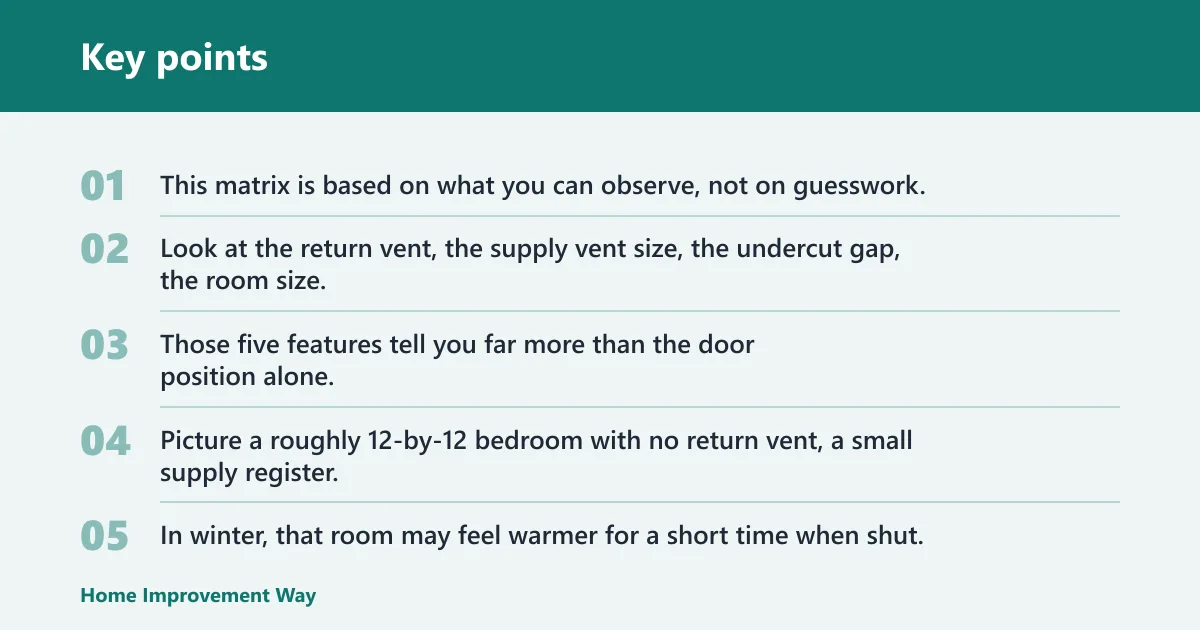
This matrix is based on what you can observe, not on guesswork. Look at the return vent, the supply vent size, the undercut gap, the room size, and whether the home is zoned. Those five features tell you far more than the door position alone.
Picture a roughly 12-by-12 bedroom with no return vent, a small supply register, and a tight door that barely clears the floor. In winter, that room may feel warmer for a short time when shut, but the same setup can also restrict airflow enough to make the HVAC work harder and leave the room uneven.
When a closed door causes problems
Pressure imbalance in closed rooms
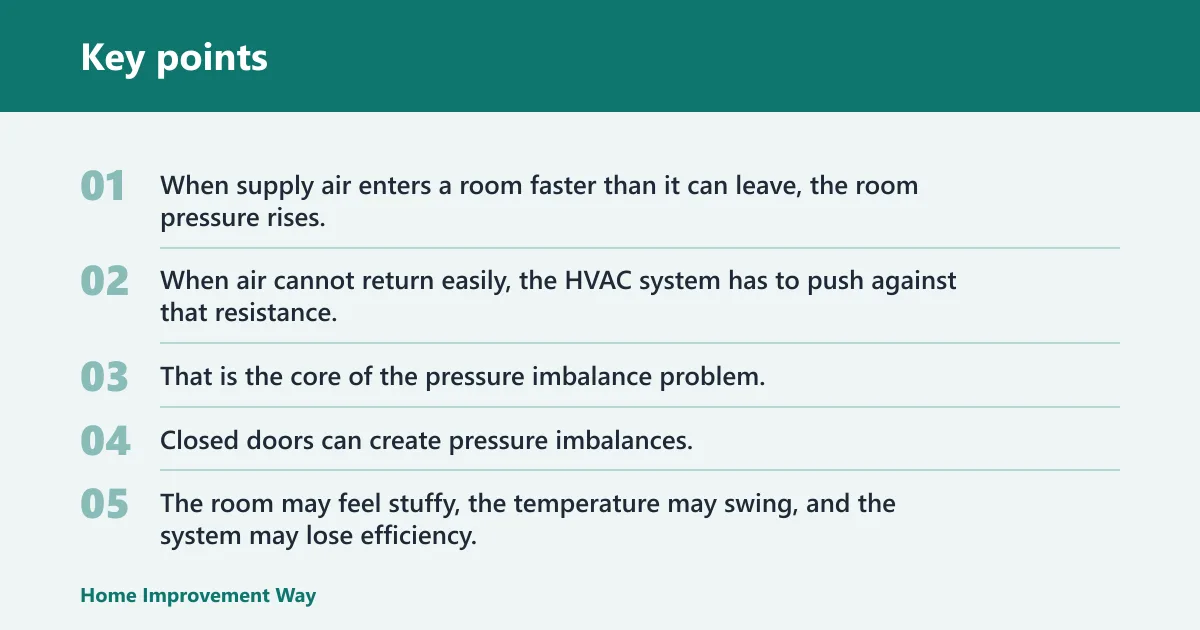
When supply air enters a room faster than it can leave, the room pressure rises. When air cannot return easily, the HVAC system has to push against that resistance. That is the core of the pressure imbalance problem.
Closed doors can create pressure imbalances, especially in bedrooms and offices without return vents. The room may feel stuffy, the temperature may swing, and the system may lose efficiency. In some cases, you may hear more whistling at the door gap or feel a stronger draft when the door opens.
Short-cycling and comfort swings
Restricted airflow can shorten runtime and contribute to short-cycling. Short-cycling is frequent on/off operation, and it can happen when the system cannot move air the way it was designed to. That pattern can increase wear and reduce comfort.
A common first-timer mistake is closing a bedroom door because the room feels cold, then assuming the HVAC will simply push harder. If the room has poor return airflow, the opposite can happen: the room warms unevenly, the rest of the house may drift cooler, and the equipment may cycle in a less steady pattern.
Signs the room needs a return path
If the closed room heats poorly, feels stuffy, or gets a noticeable temperature swing when the door opens, the room may need a return path. A return vent is the cleanest fix. If that is not practical, a transfer grille or jump duct can help air move between rooms while the door stays closed.
These fixes matter most in rooms that are expected to stay closed for long periods, such as nurseries, home offices, and bonus rooms. They are less important in rooms that stay open most of the day.
How to keep the door closed without hurting airflow
Transfer grilles and jump ducts
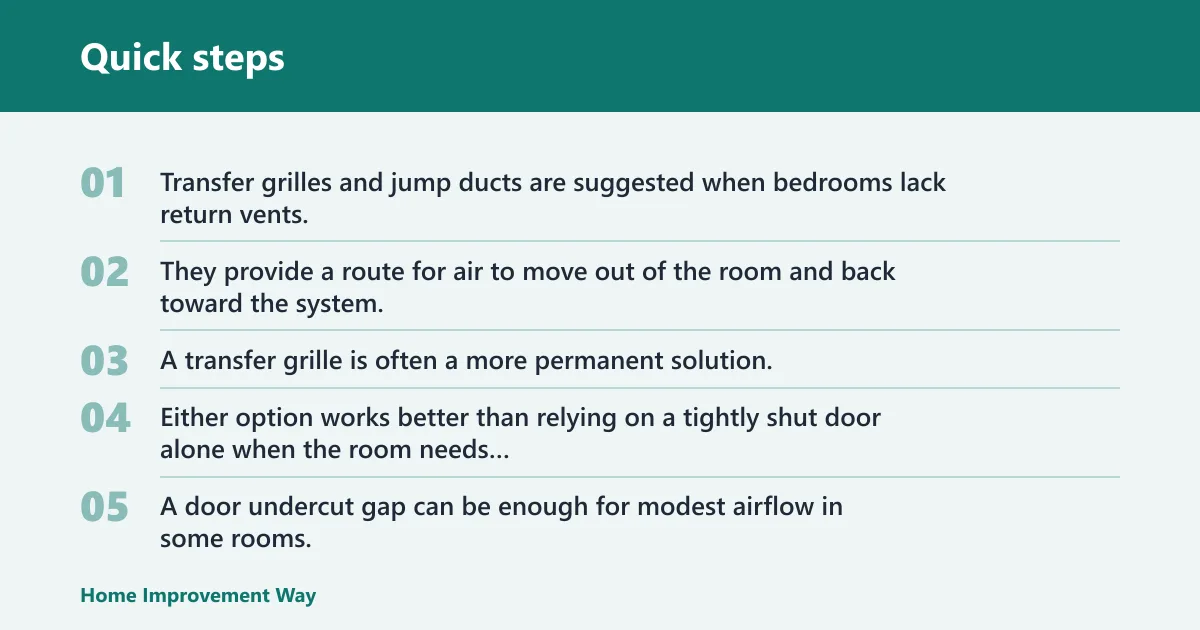
Transfer grilles and jump ducts are suggested when bedrooms lack return vents. They provide a route for air to move out of the room and back toward the system, which helps balance pressure while keeping the door closed.
A transfer grille is often a more permanent solution, while a jump duct bridges air movement between spaces through ductwork. Either option works better than relying on a tightly shut door alone when the room needs to stay closed.
Door undercut, fans, and door seals
A door undercut gap can be enough for modest airflow in some rooms, especially when the supply and return are already balanced. Fans can improve circulation in a closed room by moving air across the space and softening hot and cold spots.
Door gasket or weather seal can help when the problem is leakage around the door edges, but that is usually a secondary fix for interior rooms. It matters more for exterior-style sealing problems than for a normal privacy door inside the house. If the room lacks a return path, sealing the door tighter can make the airflow problem worse.
Winter and summer are different
The same closed-door setup can help in winter and hurt in summer, or the reverse. In heating season, a closed door may keep warm air from drifting away from a room. In cooling season, that same closed door may trap heat gains from people, electronics, or sunlight and make the room harder to cool if airflow is weak.
Closed bedroom doors may help prevent conditioned air from flowing into those zones in some homes, but that only helps when the system and room layout can handle it. If the door blocks the only usable path back to the air handler, the comfort gain can turn into a performance problem.
Frequently asked questions
Does closing interior doors keep house warmer?
Sometimes, but usually only in the room with the closed door. It can reduce mixing and make that room feel warmer, while the rest of the house may stay the same or get slightly cooler if airflow is restricted. The whole-house effect depends on return paths and zoning.
Does a room stay warmer with the door closed?
Often, yes, if the room was losing warmth to drafts or mixing with a colder hallway. The gain is usually modest and depends on airflow. A room with a supply vent, a return vent, and a normal undercut gap is more likely to stay comfortable than a tight room with no return.
Does closing doors keep house cooler?
It can in some cases, especially in rooms that get sun, electronics heat, or warm air from other parts of the house. But if closing the door blocks airflow, the room can overheat or cool poorly. In cooling season, the same airflow rules still apply.
Can closing doors make my HVAC work harder?
Yes. If the room does not have a dedicated return vent or enough path for air to get back, the closed door can create pressure imbalance and restricted airflow. That can reduce efficiency, increase energy costs, and in some systems contribute to short-cycling.
What if a closed room has no return vent?
That is the setup most likely to cause trouble. A transfer grille, jump duct, or a properly sized return path can help restore airflow. If those are not possible, a wider door undercut or a more open door position may be safer than keeping it fully shut.
How can I improve airflow if I want the door closed?
Start with the visible basics: check for a return vent, make sure the supply vent is not blocked, and look at the undercut gap under the door. If airflow still seems weak, a transfer grille, jump duct, or fan can help. A door seal should be a last step, not the first.
Sponsored / affiliate links. As an Amazon Associate I earn from qualifying purchases. I may earn additional commission from eligible campaigns.
 Door Draft Blocker 32 Inches Door Sweep for Interior Doors Wind Blocker Door Bottom Seal Weather Stripping Black Door Draft Stoppers for Bottom of Door 32 Inch Block Cold Air Noise Smoke Stopper
 Cat Door for Interior Doors with Secure Package & Food Delivery Access, 4-Way Locking Pet Door for Cats & Small Dogs, Magnetic Closure, Easy Install, Durable ABS Plastic