How Far Should a Space Heater Be From Walls and Beds?
Keep a portable space heater at least 3 feet from curtains, bedding, furniture, and other combustibles. Give wall clearance exactly as the maker’s manual states, with extra room for airflow around intake and exhaust openings. Too little space can overheat nearby materials and start a fire. This guide explains safe placement by heater type, room layout, and material.
Space heater clearance table
The manual and the label control the final clearance for your exact model. A common rule of thumb is 3 feet, or about 1 meter, from anything combustible, but rear, side, front, and top spacing can differ. If the model needs more space, follow that requirement.
| Heater type | Nearby item | Practical minimum distance | Stop-use if you cannot meet it? |
|---|---|---|---|
| Fan-forced | Wall | Follow the rear and side clearance in the manual; many models call for about 3 feet from combustibles | Yes, if the listed rear or side clearance cannot be met |
| Fan-forced | Bed | Keep at least 3 feet from bedding, pillows, and blankets, plus a clear path so nothing can fall or drift into the unit | Yes |
| Fan-forced | Curtain | Keep at least 3 feet away, and more if the curtain can move in airflow or touch a shelf above the heater | Yes |
| Fan-forced | Furniture | Keep at least 3 feet from chairs, dressers, upholstered pieces, and paper items | Yes |
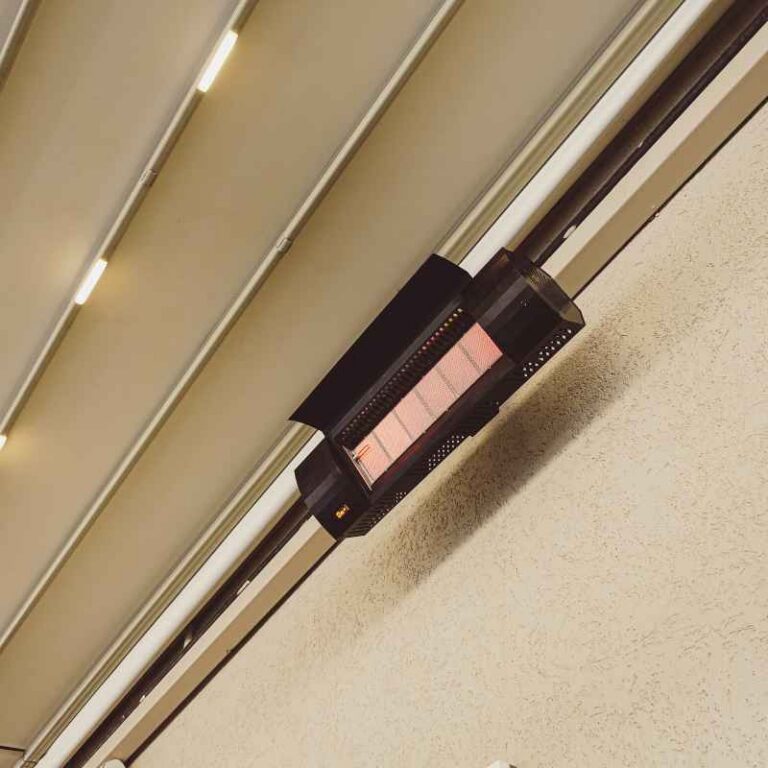
| Radiant or infrared | Wall | Use the model’s required rear, side, and top clearance; radiant heat can project forward while still needing open space around the housing | Yes, if the stated clearance cannot be met |
| Radiant or infrared | Bed | Keep bedding, pillows, and blankets outside the manufacturer’s minimum clearance, usually at least 3 feet | Yes |
| Radiant or infrared | Curtain | Keep a larger buffer than a fixed wall would need, since warm air and window drafts can move fabric into the heat path | Yes |
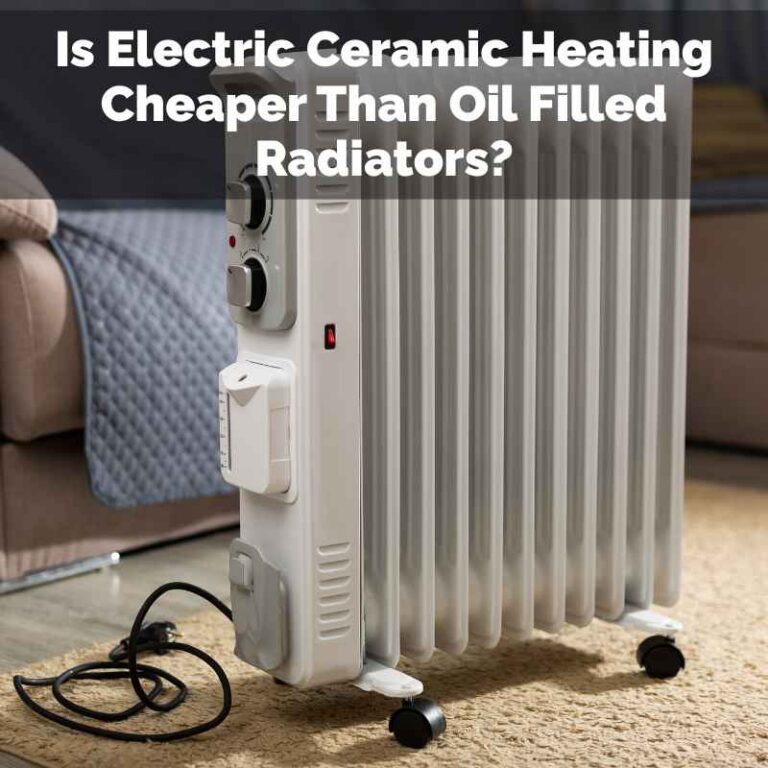
| Oil-filled radiator | Wall | Use the manual’s spacing, especially at the top and rear; many models still call for about 3 feet from combustibles | Yes |
| Oil-filled radiator | Bed or furniture | Keep bedding, clothing, and upholstered furniture outside the listed clearance | Yes |
| Electric fireplace-style heater | Curtain or shelf | Follow the top and front clearance in the manual; decorative housings still need airflow | Yes |
Bedroom yes/no checklist
- Does the label show a recognized safety listing, such as UL, ETL, or another mark named on the unit?
- Does the manual give a clearance diagram for rear, side, front, and top spacing?
- Can you keep the heater away from bedding, pillows, blankets, curtains, furniture, paper, rugs, and clothing?
- Will the heater sit on a stable surface and not block the exit path?
- Will you plug it directly into a wall outlet if the manual requires that?
- Will you turn it off before sleeping and never leave it unattended?
If any answer is no, do not use the heater in that setup.
How far should a space heater be from a wall?
Give the wall clearance listed in the owner’s manual, and do not assume a cool-touch shell makes wall contact safe. Rear, side, front, and top spacing can all be different. Many heaters call for about 3 feet from combustibles, though some models may require a bit more or less.
Rear, side, front and top clearance are not the same
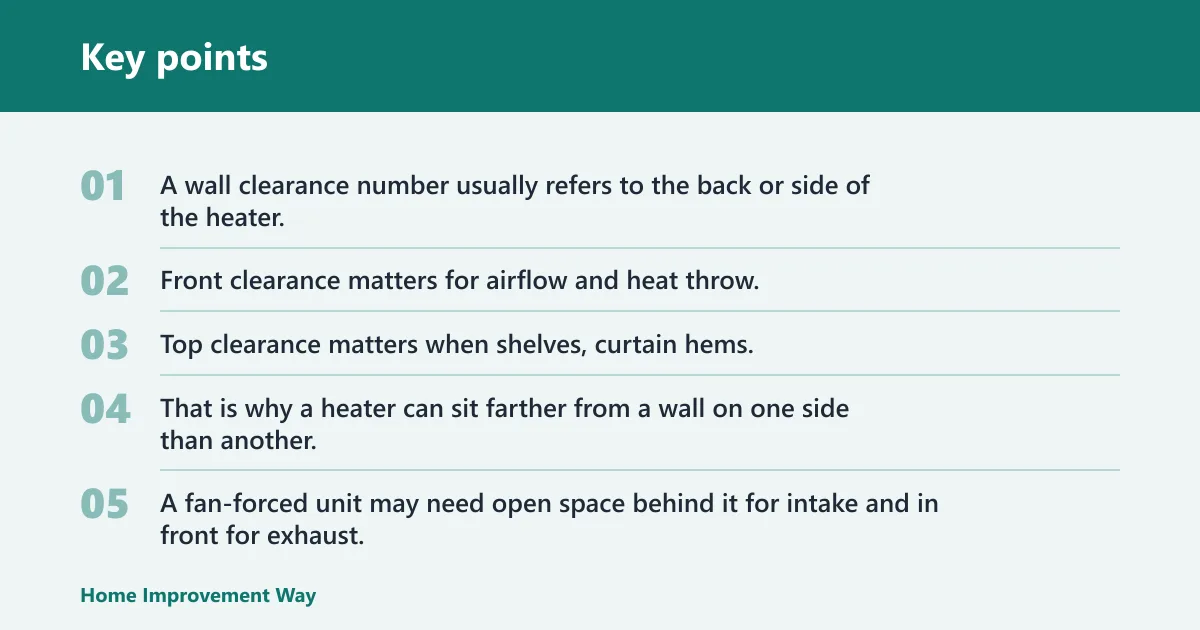
A wall clearance number usually refers to the back or side of the heater, not the entire unit. Front clearance matters for airflow and heat throw. Top clearance matters when shelves, curtain hems, or wall décor could collect heat above the unit.
That is why a heater can sit farther from a wall on one side than another. A fan-forced unit may need open space behind it for intake and in front for exhaust. A radiant unit may need less front space in some manuals, but the side and top limits still control.
Noncombustible walls versus nearby fabric, shelves and cords
Tile, concrete, brick, stone, and metal are noncombustible surfaces, but they do not erase clearance rules. A painted drywall wall can be the least of the issue if a shelf, cord, curtain, or pile of clothes sits above or beside the heater. Those nearby items still count.
Say your heater is 18 inches from a brick wall but a hanging curtain brushes the side when the window opens. That setup is still unsafe, because the fabric is the problem, not the brick.
What to do with models that sit close to the wall
Some electric fireplace-style heaters and low-profile radiators are built to sit nearer a wall than a tall fan heater, but only within the spacing shown on the label. If the manual shows a rear grille, intake, or top vent, leave the listed open space even when the cabinet looks compact.
If the room cannot give the heater its listed rear and top clearance, choose another location or another heating method. Do not shrink the gap to make it fit.
How far should a space heater be from a bed?
Keep the heater outside the manufacturer’s clearance from bedding, pillows, and blankets, and treat 3 feet as the common minimum when the manual does not give a larger number. Bedside placement is risky because bedding moves, pillows shift, and people can kick covers toward the unit during sleep.
Bedding, pillows and blankets can move into the heat path
A bed is not a fixed object like a cabinet. Blankets drape over the edge, sheets bunch up, and pillows slide. A heater that looks clear at bedtime may be much closer after the bedding shifts, especially if the unit sits low to the floor.
A common first-timer mistake is placing a heater beside the bed because the side clearance looks fine from the doorway. A pillow or comforter can drift into the warm zone later, which is exactly why bedroom placement needs more than a quick glance.
Keep the heater out of foot traffic and the exit route
Put the heater where you will not kick it, trip over it, or block the path to the door. Keep it away from the foot of the bed, from narrow aisles between furniture, and from anything that could fall onto it when you stand up in the dark.
If the heater sits near a nightstand, make sure cords, books, chargers, and lamps stay outside the clearance envelope. Bedroom clutter can become part of the fire load very quickly.
Why bedside placement is riskier than it looks
Bedroom use often combines soft materials, low lighting, and limited space. That makes clearance harder to judge. A heater that is safe in an open living room may be a poor fit beside a bed because the same 3 feet can be eaten up by a nightstand, curtains, and the mattress edge.
How far should a space heater be from curtains?
Keep curtains and drapes at least as far away as the manual says for combustibles, and treat 3 feet as the common starting point. Fabric can move with airflow, window drafts, and HVAC cycling. That movement can pull drapes into the heat path even when they look clear at first.
Curtain movement, drafts and air circulation
Curtains are one of the easiest things to miss because they do not stay still. A heater near a window can warm the air enough to make drapes flutter, and cold drafts can swing them toward the unit. That is a bad combination for any heater with a hot front or top.
Suppose a fan-forced heater sits below a window where the curtain hem hangs just outside the room clearance. When the heating cycle starts, the fabric shifts inward. The setup is too close even if it seemed fine while the room was still.
Why top clearance matters near drapes and shelves
Top clearance matters when curtains hang above the unit or when a shelf, windowsill, or valance sits over it. Warm air rises. If fabric or stored items sit too close overhead, they can heat up even when they are not touching the front grille.
Room layouts that make curtain placement a bad fit
Do not put the heater between a bed and a window curtain unless you can keep both clearances at once. In tight bedrooms, curtains often compete with the bed, a dresser, and the walking path. If one of those forces the curtain into the heater zone, move the heater elsewhere.
Which surfaces and materials count as combustible?
Anything that can burn, char, melt, or smolder counts as combustible near a heater. That includes bedding, pillows, blankets, paper, books, clothing, rugs, upholstered furniture, and many decorative items. Even a small stack of mail can matter if it is close enough to the heater’s exhaust or radiant face.
Bedding, paper, clothing, rugs and upholstered furniture
Soft goods are the first concern in bedrooms because they can drape, pile up, or fall against the heater. Paper and clothing are easy to overlook. Rugs matter too if the heater sits low enough that hot discharge or a tipped unit could contact them.
Walls, shelves and décor near the heater
A wall is not automatically a safe backstop. A bare masonry wall is noncombustible, but shelves, frames, cords, fabric wall hangings, and the items stored on top of a dresser can still sit inside the heat zone. Treat the whole area, not only the wall surface.
Noncombustible surfaces that still need spacing
Tile, concrete, brick, stone, and metal do not burn, but they can reflect heat or hide nearby combustibles. A heater can still be too close if a towel bar, outlet cord, or curtain is within the clearance zone. Noncombustible does not mean no-clearance.
What heater type changes the clearance?
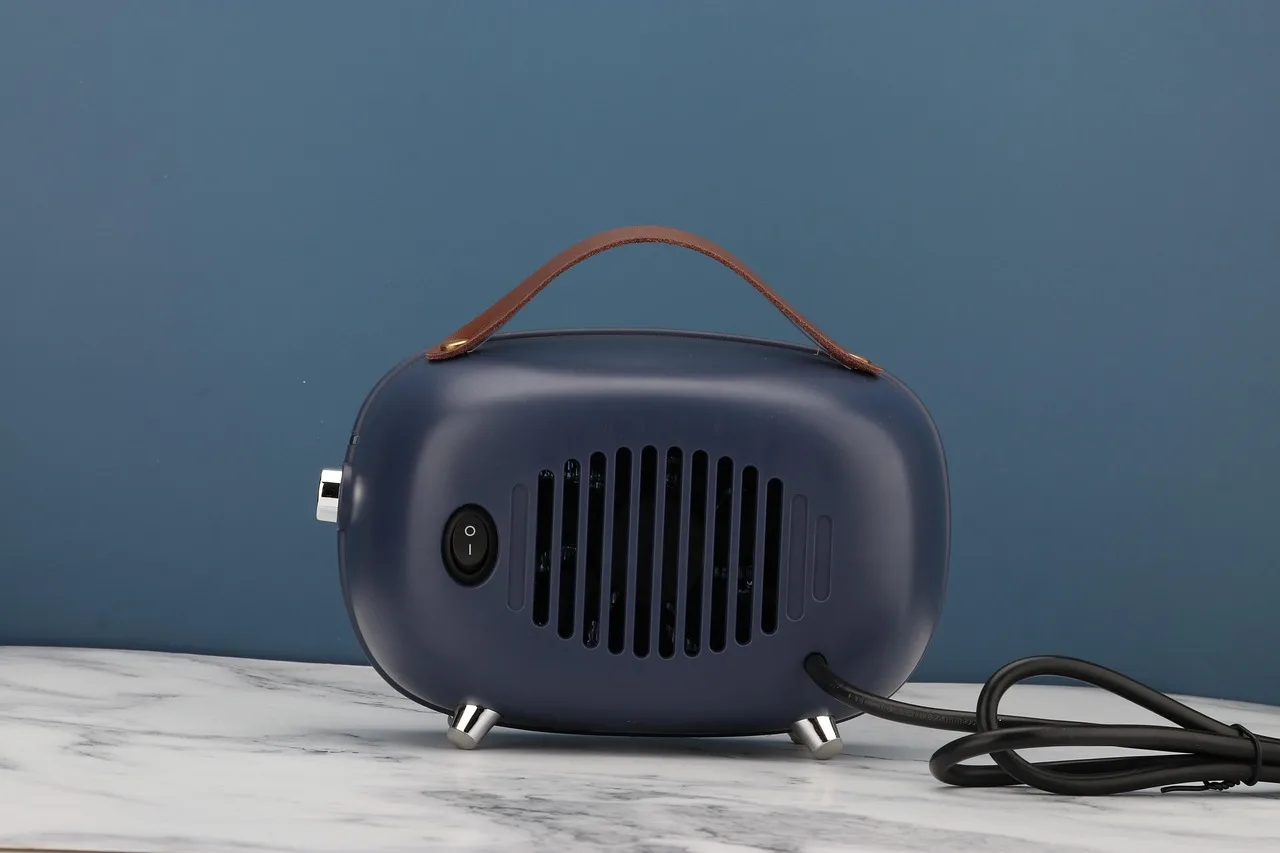
Heater type changes how you think about the open space. Ceramic and fan-forced models need strong airflow clearance. Infrared and oil-filled radiators may project heat differently, but they still need the spacing shown on the label. Electric fireplace-style units often need top and side space even when the cabinet looks decorative.
Ceramic and fan-forced heaters
Ceramic heaters and other fan-forced models push air through intake and exhaust openings. That means rear and front clearance matter a lot, and side clearance can matter too. Do not crowd the back against a wall or the front against bedding or curtains.
Infrared and oil-filled radiator heaters
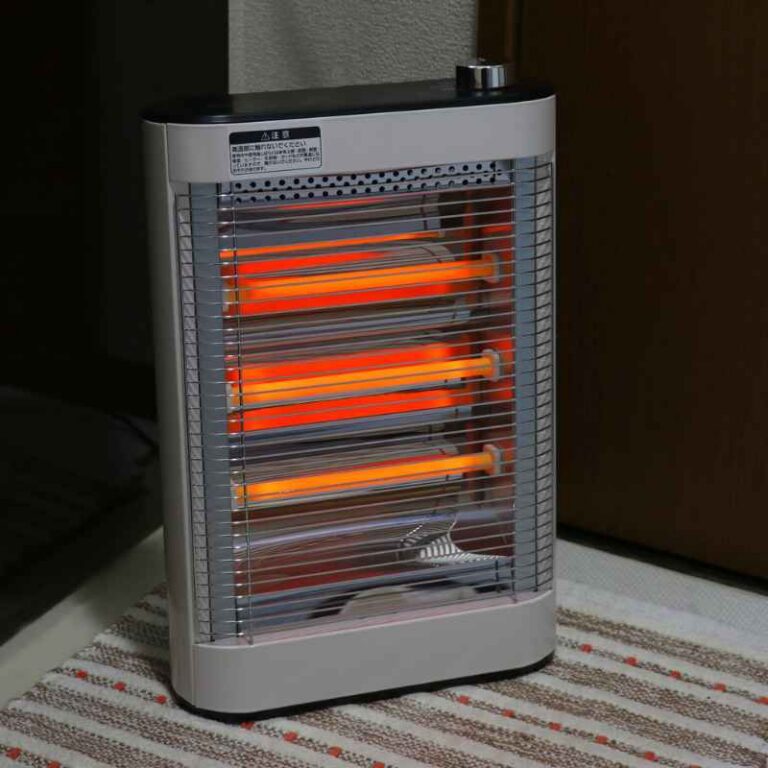
Infrared heaters can feel warm at a distance because they project heat forward, but they still need open space around the face and housing. Oil-filled radiators may have hotter surfaces than a fan heater and can need generous top clearance. Check the model label, not just the marketing name.
Electric fireplace-style heaters and model-specific labels
Electric fireplace-style heaters vary widely. Some are built for wall-adjacent placement within a narrow envelope, while others need more breathing room than they appear to. The model-specific label is the controlling rule, and the clearance diagram is the part to trust.
Overheat protection, tip-over switches, thermal cutoffs, and automatic shutoff are useful safety features. They do not replace clearance. They also do not make it acceptable to place the heater against a wall, bed, or curtain.
Plug and outlet safety
Use a direct wall outlet when the manual requires it. Do not use an extension cord or power strip if the manual forbids them. Heater current draw can overheat undersized cords, loose connections, or overloaded strips. Use the exact setup the maker allows.
Check the cord for damage and the plug for heat or discoloration before each use. If the outlet is loose, the plug gets warm, or the manual says not to share the circuit with other loads, stop and move the heater.
What should I do if my room is too small for the heater?
Do not use the heater in that room if you cannot meet the manual’s clearance from combustibles, bedding, curtains, and traffic paths. Move it to a larger space or choose another heating method. Shrinking the distance is not a safe workaround.
If the heater cannot sit clear of the bed, drapes, dresser, and door path at the same time, it is the wrong heater for that room. That is especially true in small bedrooms where a single appliance can crowd both the sleeping area and the exit.
- Measure the clear space the manual requires on all sides that apply.
- Check the bed, curtain, dresser, and door swing in the actual room.
- If any listed clearance cannot be met, do not place the heater there.
- Pick a different room, a different heater type, or another heating method.
- Keep the heater on a stable surface with the cord routed so no one can trip on it.
Portable space heaters should be turned off before sleeping and should not be left unattended. That rule applies even if the heater has tip-over protection and automatic shutoff.
Frequently asked questions
Can I put a space heater on carpet?
Only if the manual allows it and the heater remains stable on the carpet pile. Carpet is combustible, so the unit still needs the same clearance around bedding, furniture, and cords. If the carpet is thick enough to block airflow or make the heater wobble, do not use it there.
Can a space heater touch the wall if it has a cool-touch exterior?
No. Cool-touch refers to the housing surface, not the spacing rule. The manual still controls rear, side, front, and top clearance, and nearby fabric, cords, or shelves can still overheat even when the case feels cooler to the touch.
Can I use a space heater in a bedroom overnight?
No. Portable space heaters should be turned off before sleeping and never left unattended. If you need heat overnight, use a heating method designed for continuous operation and follow that product’s manual and safety listing, not a portable heater setup.
What materials count as combustible near a heater?
Common combustibles include curtains, bedding, pillows, blankets, paper, books, clothing, rugs, and upholstered furniture. Decorative fabric, stored laundry, and cords can also matter if they sit in the clearance zone. Noncombustible surfaces like tile or brick do not remove the need for spacing.
How much clearance does a ceramic space heater need?
It varies by model. Many ceramic heaters are listed for about 3 feet from combustibles, but the rear, side, and top clearance can differ. Check the manual and the label for the exact spacing, especially around intake and exhaust openings.
Do infrared space heaters need the same clearance?
They need the clearance the manual calls for, which is often similar to other portable heaters but not always identical. Infrared heat can feel more direct, yet the housing, cord, and nearby materials still need open space. Follow the model-specific label.
Sponsored / affiliate links. As an Amazon Associate I earn from qualifying purchases. I may earn additional commission from eligible campaigns.
 AZEUS Portable AC and Heater Unit, 420W 110V Compact Air Conditioner for Tent RV Truck Cabin and Small Room, 1400W Cooling, 800W Heating, Remote Control, Dehumidifier, Sleep Timer, ChampagneMEGAWISE Portable Air Conditioner and Heater, 420W 110V Compact AC Unit with Remote Control, 1400W Cooling Capacity, 800W Heating, Dehumidifier, Fan, Sleep Timer, Champagne