How to Tell If Your Septic Tank or Septic Pipe Is Frozen
If toilets, sinks, or tubs back up after several hours of cold weather, the freeze may be in the outlet side, pump chamber, or drain field; if everything backs up right away, suspect the inlet pipe or tank. Ignoring it can crack pipe, overload the tank, and send sewage into the home. This symptom pattern can help narrow the freeze location before you call for service.
What are the first signs of a frozen septic system?


The first signs are usually slow drainage in more than one fixture, gurgling in toilets or floor drains, and a backup pattern that worsens as the cold keeps going. Sewage odor raises the urgency, but odor does not tell you the exact freeze location by itself.
Start by noting what is slow and where it starts. One slow sink can be a local clog; multiple slow fixtures on the same drain path point toward the septic side of the system.
Early symptom pattern
- Slow drains in several fixtures: often means the blockage is past the home plumbing.
- Gurgling toilets or floor drains: an early warning that air and wastewater are fighting a downstream restriction.
- Sewage odor: suggests a backup situation that needs faster action.
A common first-timer mistake is to keep flushing “to see if it clears.” That adds water to a system that may already be trapped by ice.
Which part freezes first?
The inlet pipe is often the first to freeze, especially if it is shallow, lightly used, or hit by a hard cold snap. The tank itself usually does not freeze solid because it holds thermal mass, but the inlet, outlet baffle, effluent filter, pump chamber, and drain field are all more exposed to frost and low flow.
Why the inlet pipe fails first
A 4-inch schedule 40 PVC pipe can freeze relatively quickly during a hard cold snap when flow is low, but freeze time depends on burial depth, slope, exposure, wastewater volume, and soil conditions. That makes a shallow inlet line the first place to suspect after a long stretch of low usage or very cold weather.
Where outlet pipes and filters fail
The outlet pipe can ice at the baffle or filter and send sewage back toward the house. An effluent filter can ice up too, and because it sits at the tank outlet, service may require tank access.
When drain fields and pump chambers freeze
Drain fields freeze when frost reaches the laterals. Frost depth varies widely by region, soil type, snow cover, and local code assumptions, while laterals often sit at 18 to 36 inches depending on state code. Pressure-dosed systems add a pump chamber that can alarm if it freezes or loses function.
Septic freeze triage matrix
Use this table as a symptom-to-location check before you spend money on service. Match the symptom pattern first, then look at the likely freeze location and the best homeowner-safe next step.
| System type | Symptom pattern | Likely freeze location | Homeowner-safe check | Urgency | Is pumping worth trying? |
|---|---|---|---|---|---|
| Gravity | One or two fixtures slow first, then more backups after cold weather sets in | Inlet pipe | Check whether the home side is still draining at all; look for recent low use or shallow exposed pipe sections | Moderate to high if more fixtures join in | Usually no, unless the tank is truly full |
| Gravity | Toilets and floor drains gurgle, then sewage backs up inside | Outlet pipe, baffle, or effluent filter | Stop adding water and watch whether symptoms worsen after several hours | High | Sometimes, if the outlet area is backed up by solids near the tank |
| Gravity | Whole house drains slowly in a hard freeze, with little or no odor | Drain field | Check for prolonged cold, little snow cover, and known shallow laterals | High | Usually no; pumping is often wasted money on a frozen field |
| Gravity | Backup appears soon after a long period of low water use | Tank outlet side or inlet side | Compare the timing to your household water use and last pumpout | Moderate to high | Maybe, if the tank is truly overfull |
| Pressure-dosed | Alarm sounds and fixtures slow at the same time | Pump chamber or pressure line | Check the alarm panel and note whether the pump is running or silent | High | Usually no, unless the chamber is overfull from a downstream blockage |
| Pressure-dosed | Alarm plus no dispersal after a cold snap | Frozen pump chamber or frozen distribution line | Look for exposed lids, shallow lines, or dead-zone freezing near the chamber | High | No, thawing is the real fix |
How do you tell if the tank, pipe, or drain field is frozen?
The tank itself usually is not the problem if the home drains for a while and then slows only after cold weather builds. A frozen pipe or frozen field creates a clearer pattern: the tank may still hold liquid, but wastewater cannot move where it should, so backups appear at predictable points.
Signs the tank is probably not the problem
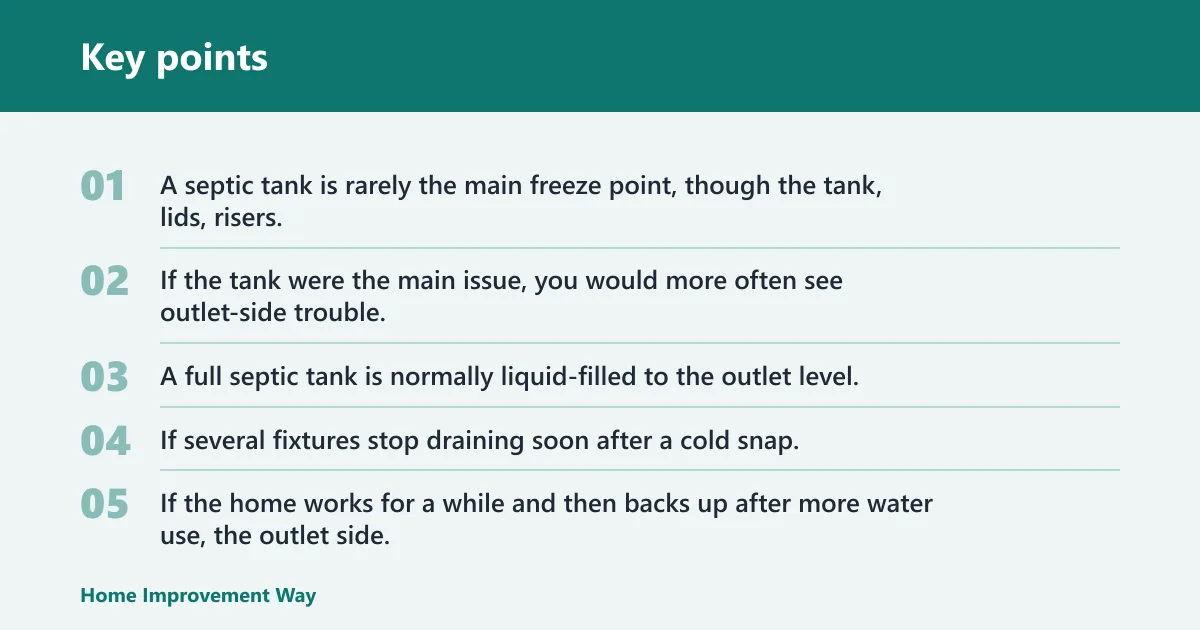
A septic tank is rarely the main freeze point, though the tank, lids, risers, or contents near the inlet or outlet can freeze enough to impair function. If the tank were the main issue, you would more often see outlet-side trouble, not a tank full of ice. A full septic tank is normally liquid-filled to the outlet level, so “full” is not the same as “frozen.”
The more useful question is whether the tank is backing up because it is overfull or because the outlet side is blocked. Those are different problems.
Signs the inlet or outlet line is blocked
If several fixtures stop draining soon after a cold snap, the inlet pipe is a strong suspect. If the home works for a while and then backs up after more water use, the outlet side, baffle, or effluent filter is more likely.
Say your basement toilet gurgles first, then the laundry sink starts to rise when the washer drains. That pattern points farther downstream than a simple sink clog.
Signs the drain field is frozen
When the drain field freezes, the whole system slows down. You may see widespread sluggish drainage without a single obvious choke point, and pumping the tank will not solve the freeze in the soil.
Picture a home with normal flow in the morning and backups by evening after a hard cold week, even though no fixture is visibly blocked. That points more toward the field than the tank.
Why gravity and pressure-dosed systems fail differently
Gravity systems fail by flow restriction. Pressure-dosed systems add a pump chamber, alarm, and pressurized distribution line, so a freeze can show up as an alarm before the house backs up. That difference changes where you look first and whether the alarm matters.
Gravity system symptom patterns
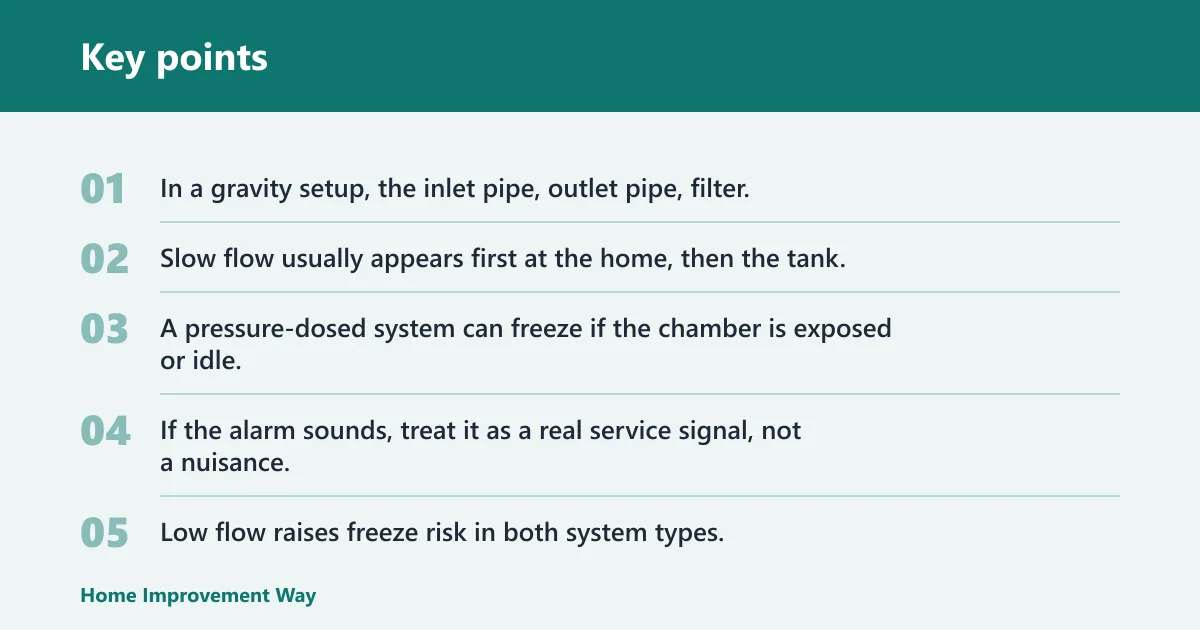
In a gravity setup, the inlet pipe, outlet pipe, filter, and drain field are the main freeze points. Slow flow usually appears first at the home, then the tank, then the field as the restriction grows.
Pump chamber alarms and idle lines
A pressure-dosed system can freeze if the chamber is exposed or idle. If the alarm sounds, treat it as a real service signal, not a nuisance, because the pump chamber may be frozen or the line from the chamber may be blocked.
What changes the likely freeze location
Low flow raises freeze risk in both system types. Vacation homes, long weekends away, and very light winter use let cold pipes sit with little warm wastewater moving through them.
Can you thaw a frozen septic line yourself?
You can check a few safe clues yourself, but you should not try aggressive heat or repeated flushing. More stubborn freezes need a licensed plumber or septic contractor with thawing equipment.
What homeowners can check safely
- Stop adding extra water as soon as backups appear.
- Note whether one fixture, several fixtures, or the whole house is affected.
- Check for an alarm on pressure-dosed systems.
- Look at recent weather, snow cover, and whether the home has had low winter use.
What not to do
Do not keep flushing to “push through” the freeze. Do not pour boiling water into drains, because that can damage piping and does not reliably thaw the blocked section. Do not ignore an alarm on a pump chamber.
When a pipe-thawing machine is needed
Licensed pros use pipe-thawing machines that apply hot water or electric resistance heating. Most thaw jobs take one to three hours, and the method depends on access, pipe depth, and how far the ice extends.
Thaw costs vary by access and severity. A frozen drain field can be significantly more expensive than a pipe thaw, so it matters a lot whether you are paying for a pipe thaw or a field repair.
How to prevent septic freezing
Snow cover matters. About 6 inches of snow over the tank and field can help buffer ground temperature and reduce frost penetration, which may help protect shallow components during cold snaps.
Snow cover over the tank and field
Keep heavy equipment off the system and avoid scraping snow away from the septic area in winter. Snow is insulation here, not clutter.
Why low flow raises freeze risk
Low flow is a freeze trigger because warm wastewater helps keep pipes and chambers above freezing. The standard national pumping interval is every three to five years, but a recently pumped tank still needs regular water use in winter so lines do not sit cold and dry.
Simple cold-weather habits that help
- Spread laundry and dishwashing through the week instead of doing one large burst.
- Fix dripping fixtures that keep a line wet but do not provide enough warm flow.
- Protect exposed lids, risers, and shallow pipe sections.
- Watch for warning signs early instead of waiting for a full backup.
Frequently asked questions
How do you tell if a septic tank is frozen?
A septic tank is rarely the part that freezes solid. If the home backs up only on the outlet side, or if the system works for a while and then stops after cold weather, the inlet pipe, outlet baffle, effluent filter, or drain field is more likely than the tank itself.
How do you know if a septic pipe is frozen or the tank is full?
A frozen pipe usually appears after a cold snap and may affect more than one fixture at once. A truly full tank tends to build problems more gradually, and pumping may help if the tank has simply been left too long between service intervals.
Can a septic tank freeze solid?
It is very uncommon for the tank itself to freeze solid because it holds thermal mass of liquid. The more common freeze points are the inlet and outlet pipe sections, the baffles, the effluent filter, the pump chamber, and the drain field.
Does a frozen septic line smell like sewage?
It can, but it does not always. Odor depends on where the freeze sits, how much wastewater is trapped, and whether gases are pushed back into the home. Treat odor as a warning sign, not as proof of one exact freeze location.
How do you know if the drain field is frozen?
A frozen drain field usually slows the whole system, not just one fixture. If the home drains poorly after prolonged cold, especially with shallow laterals or little snow cover, the field may be frozen and pumping the tank will not fix the soil freeze.
Sponsored / affiliate links. As an Amazon Associate I earn from qualifying purchases. I may earn additional commission from eligible campaigns.
 Fuller Brush Drain Line & Septic Tank Cleaner – 32 oz Enzyme-Based Drain Cleaner for Slow Drains, Grease & Food Buildup, Safe for PVC/Metal Pipes & Septic Systems (Pack of 1)
 Bio-Safe One Inc - BIO-112 - Septic Tank Treatment - Drainfield Treatment - Heavy Duty Sludge Digester - Septic Cleaner - Drain Clog Remover - Toilet Drain Clog Remover - 5 Gal - Exxon Valdez Patented