Does Insulating Paint Really Work?
Insulating paint can trim heat gain or loss on problem wall surfaces, but it cannot replace insulation or air sealing, and most homes will see little winter change from it alone. If you skip the real fix, drafts, cold walls, and higher heating bills can stay in place. Guidance from the U.S. Department of Energy and the Energy Saving Trust is consistent: prioritize air sealing and insulation before specialty coatings. This guide explains where insulating paint helps, where it fails, and what to do instead.
Evidence box: Dry-film thickness is typically only a few tens to a few hundreds of microns per coat, depending on the product datasheet and number of coats. At that scale, the film is far too thin to materially raise wall R-value the way bulk insulation does. Any measurable comfort gain is more likely on sunny exterior surfaces, where radiant heat matters, or on cold walls near occupants, where surface temperature affects comfort. Bill savings are usually small unless the product is paired with proper insulation and draft proofing. Manufacturer datasheets are the right place to verify application thickness, coverage, and curing instructions; thermal-performance claims are better judged against building-physics guidance and independent energy-advice sources.
What insulating paint
Thermal paint, also called insulating paint or thermal barrier coating, is sold as a product that may help reduce heat transfer through a surface. Some versions contain ceramic particles, glass microspheres, or reflective additives. The core idea is to reduce surface heat flow, not to act as a replacement for a full insulation layer.
Thermal paint vs. thermal wallpaper
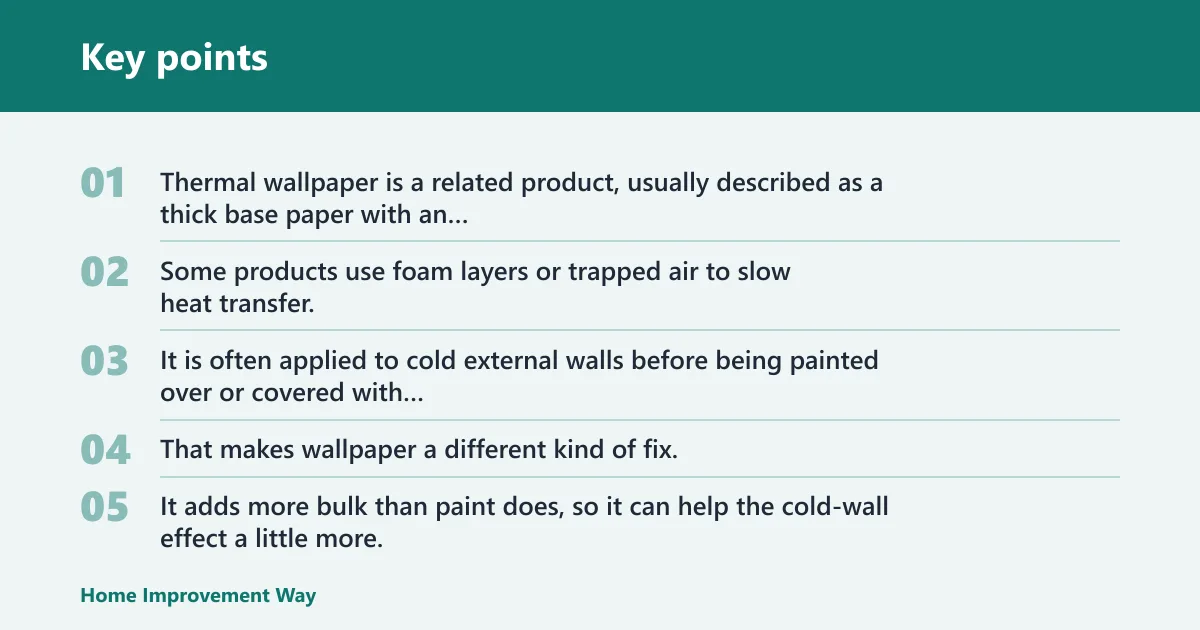
Thermal wallpaper is a related product, usually described as a thick base paper with an insulating or reflective backing. Some products use foam layers or trapped air to slow heat transfer. It is often applied to cold external walls before being painted over or covered with decorative wallpaper.
That makes wallpaper a different kind of fix. It adds more bulk than paint does, so it can help the cold-wall effect a little more, especially on solid external walls in older homes or flats. It still does not match proper wall insulation.
What the ingredients are supposed to do
These coatings claim to work by reducing radiant heat transfer and, in some cases, slowing conduction through the surface. Building-physics references distinguish radiant transfer from conductive transfer, but both matter only when the layer is thick enough to meaningfully change the heat path. Reflective additives matter most on sunny exterior surfaces.
Ceramic and glass microspheres are used to create tiny air pockets and to change how heat moves across the coating. Manufacturer datasheets may describe coating solids, spreading rate, and recommended dry-film build, but they do not change the basic constraint: the layer is still thin.
Why coating thickness matters
The key tradeoff is simple: a thin coating can change surface behavior, but it cannot deliver bulk insulation performance. More coats may change the result a little, yet each coat still adds only a small amount of thickness. That is why thermal paint works best as a supplemental layer, not a wall-insulation substitute.
Think of it as a comfort upgrade for a surface, not a building envelope fix. If your wall is losing heat because of missing insulation or air leaks, paint cannot solve that problem. DOE-style home-energy guidance consistently places insulation and air sealing ahead of specialty finishes for that reason.
Does insulating paint really work?
Yes, but only in a narrow sense. Thermal paint may slightly reduce heat transfer on some surfaces, especially external walls or sun-exposed areas. It usually cannot change room temperature much, and it should not be expected to fix drafts, poor insulation, or high energy bills by itself. Independent energy-advice sources and building-physics references support that limited view.
What it can change on a wall surface
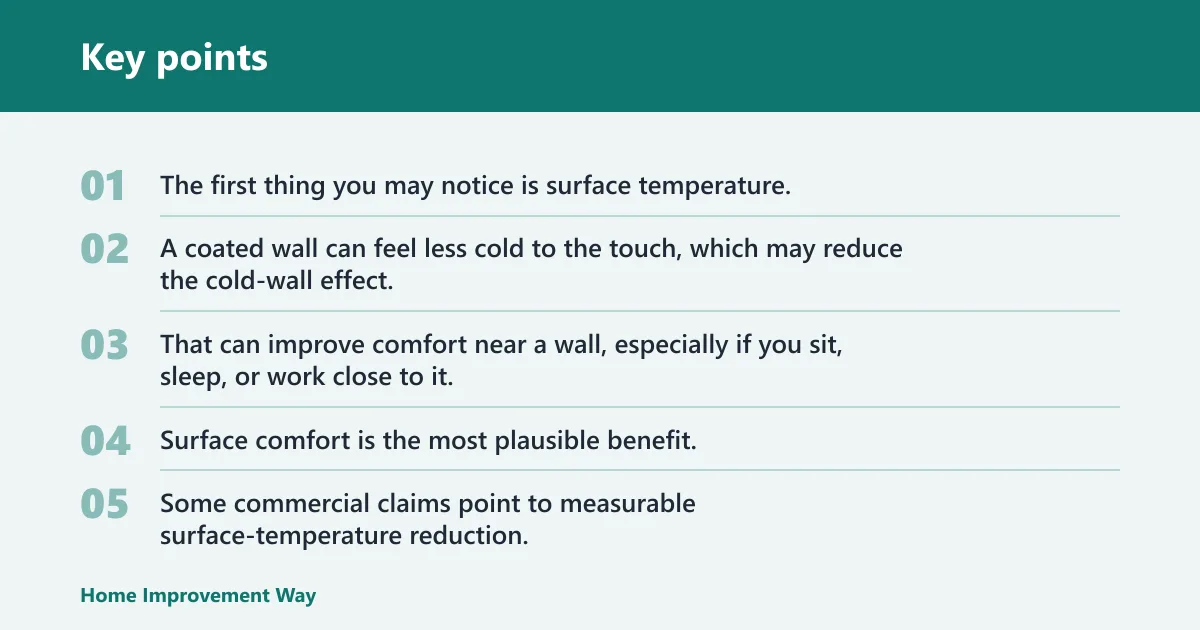
The first thing you may notice is surface temperature. A coated wall can feel less cold to the touch, which may reduce the cold-wall effect. That can improve comfort near a wall, especially if you sit, sleep, or work close to it. Surface comfort is the most plausible benefit.
Some commercial claims point to measurable surface-temperature reduction, but those are best interpreted as localized effects, not whole-house energy savings. The result is more noticeable where the wall itself is the discomfort source.
What it usually cannot change in a room
Room temperature depends on the whole building, not one coating. If heat is escaping through the roof, through gaps around openings, or through a poorly insulated wall, thermal paint will not change the main loss path. The Independent has described the effect as limited because paint is still only a thin surface layer.
So the right question is not whether it works at all. The better question is whether it solves the specific complaint you have. If the complaint is a cold wall, maybe. If the complaint is a chilly room with drafts, no.
Where the claims are strongest and weakest
The strongest claims are for external walls, especially solid masonry walls, and for sunny exterior surfaces. The weakest claims are for already insulated walls, humid rooms, and rooms with obvious air leaks. North-facing walls often have less solar benefit than south-facing walls, so orientation matters.
Say your upstairs bedroom has one exterior wall that feels icy in winter, but the room holds temperature fairly well otherwise. Thermal paint might make that wall feel less harsh near the bed. It will not turn that room into a well-insulated one.
Where thermal paint works best
Thermal paint works best as a low-disruption comfort fix on external walls, especially solid masonry walls in older homes. It can also make sense in rented properties, where major insulation work may not be possible. The best results are usually seen where the problem is surface discomfort, not whole-room heat loss.
External walls and solid masonry
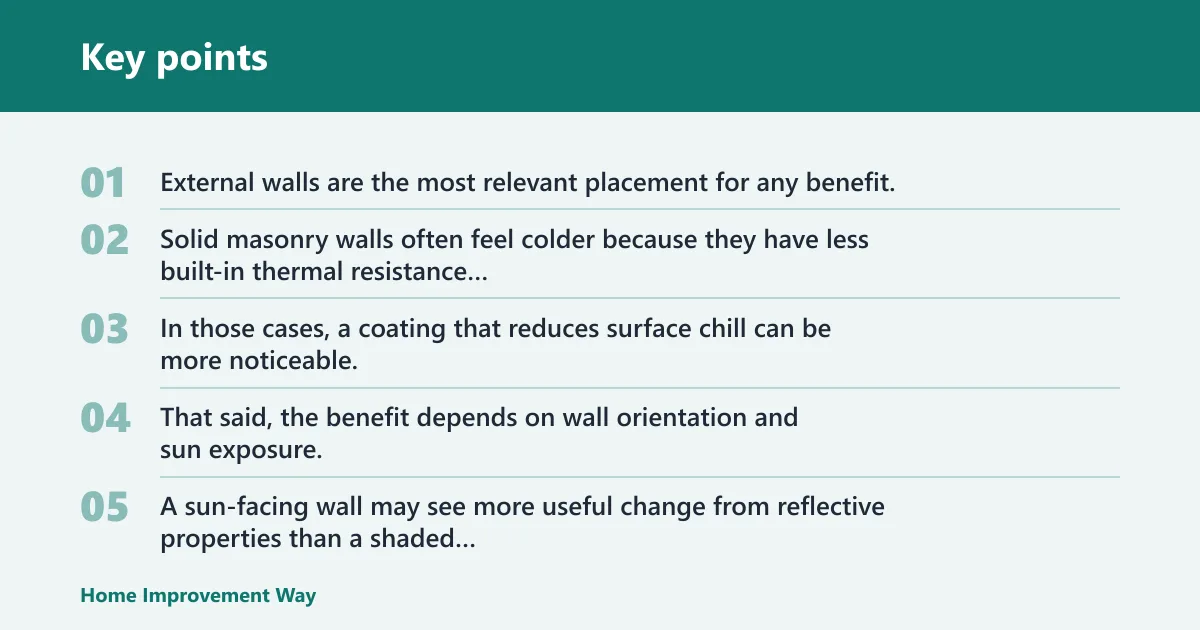
External walls are the most relevant placement for any benefit. Solid masonry walls often feel colder because they have less built-in thermal resistance than insulated cavity walls. In those cases, a coating that reduces surface chill can be more noticeable.
That said, the benefit depends on wall orientation and sun exposure. A sun-facing wall may see more useful change from reflective properties than a shaded wall on the cold side of the house.
Sunny exterior surfaces
Sunny exterior surfaces are where reflective coatings have the clearest logic. Products sold for roof or façade use often emphasize reflection, infrared control, and reduced solar gain rather than true winter insulation. That lines up with building-science guidance: reflective layers are most relevant where radiant heat from the sun is a major factor.
For that reason, thermal paint is often more believable as a summer comfort product than as a winter heating fix. On roofs and sun-facing walls, it may help reduce solar heat gain more than it helps with heat loss in cold weather.
Older homes and rented properties
Older homes often have solid walls, limited access for major work, or both. Thermal wallpaper can be a useful low-disruption option there, especially when a cold external wall is the main issue. Rented homes can also be a fit when you need something reversible and do not control the structure.
But renters should still check the actual problem first. If the room is cold because of leaky windows, thin glazing, or gaps at skirting boards, paint is the wrong starting point.
What the decision table shows
This table compares thermal paint with common winter fixes by problem type. The point is not to rank every product in the same way. It is to show when thermal paint is worth a try, when draft proofing or glazing fixes are better, and when proper insulation should come first.
| Problem type | Thermal paint | Thermal wallpaper | Draft sealing | Secondary glazing | Proper insulation | Best first move | Expected comfort gain | Likely energy impact | Cost band | Installation difficulty | Addresses air leaks? | Addresses radiant loss? | Addresses conduction? |
|---|---|---|---|---|---|---|---|---|---|---|---|---|---|
| Cold wall | 3/5 | 4/5 | 1/5 | 2/5 | 5/5 | Thermal wallpaper or insulation if practical | Low to moderate on the surface | Low | Low to moderate | Low | No | Partly | Partly |
| Drafty window | 1/5 | 1/5 | 4/5 | 5/5 | 3/5 | Draft sealing, then secondary glazing | Moderate to high | Moderate to high | Low to moderate | Low to moderate | Yes | No | Partly |
| Single-pane glass | 1/5 | 1/5 | 3/5 | 5/5 | 2/5 | Secondary glazing first | Moderate | Moderate | Low to moderate | Low to moderate | Partly | Partly | Partly |
| Rented home | 3/5 | 4/5 | 4/5 | 3/5 | 2/5 | Draft sealing and removable measures | Low to moderate | Low | Low to moderate | Low | Partly | Partly | Partly |
| Basement | 1/5 | 1/5 | 2/5 | 1/5 | 5/5 | Moisture control and insulation | Low unless moisture is solved | Low to moderate | Moderate to high | Moderate | Sometimes | Limited | Yes |
| Detached exterior wall | 2/5 | 2/5 | 2/5 | 2/5 | 5/5 | Proper wall insulation | High with proper insulation | High | High | High | Sometimes | No | Yes |
The table shows the decision rule plainly: use insulating paint only when the main issue is a cold surface and you want a low-disruption fix. If the main issue is air leakage, window loss, or missing insulation, choose the real fix first.
How much warmer can it feel?
Insulating paint can make a wall surface feel less cold, but that is different from warming an entire room. Surface temperature is the measurable outcome users may notice first. Room temperature changes, if any, are usually small and hard to notice without proper insulation in place.
Surface temperature vs. room temperature
A warmer-feeling wall matters most when you sit or sleep close to that surface. The comfort gain comes from reducing the temperature difference between your skin and the wall. That can feel meaningful, even if the thermostat barely moves.
Energy-bill savings are usually smaller than the comfort gain. Energy-saving guidance generally puts the biggest savings in air sealing and insulation, not coatings. That is the right frame for buying decisions.
Why orientation and sun exposure matter
Orientation changes the result because sun exposure changes how much radiant heat reaches the wall. South-facing or west-facing exterior surfaces may benefit more from reflective behavior than north-facing ones. Sunny exterior surfaces are the clearest place where thermal paint can do something measurable.
Suppose a flat has a north-facing bedroom wall that feels cold all winter. Thermal paint may soften that chill a little. If the same flat has a south-facing wall that gets direct sun, a reflective coating may matter more in summer than in winter.
When it is not worth buying
Thermal paint is often a poor buy when the real problem is moisture, air leakage, or missing insulation. It also has limited value on already insulated walls, because the wall is no longer a major heat-loss path. In those cases, spend the money elsewhere first.
Humid rooms and condensation issues
Humid rooms need moisture control before any coating choice. If condensation is forming because of poor ventilation or cold bridging, paint will not fix that. You need to deal with the cause, or the wall may still feel cold and damp.
Already insulated walls
If a wall already has good insulation, thermal paint has less room to help. The remaining heat loss may be too small for a coating to matter. Traditional insulation has much higher thermal resistance, so it belongs ahead of any specialty paint in the budget.
Drafts and air leaks
Drafts are an air-sealing problem, not a coating problem. If you feel moving air near a window, door, floor edge, or outlet, start there. Paint cannot stop leakage through gaps.
A common first-timer mistake is buying thermal paint for a chilly room with a loose window sash. The wall may feel slightly different after painting, but the draft will still be there. That is money spent on the wrong layer.
Situations that need real insulation first
Prioritize loft insulation, cavity insulation, spray foam, fiberglass, and air sealing when you want real energy savings. Those measures materially change the building’s thermal performance. Thermal paint does not come close.
- Check for drafts first.
- Check whether the wall is external and uninsulated.
- Fix air leaks before buying specialty coatings.
- Use thermal paint only if the remaining issue is a cold wall surface.
- Choose thermal wallpaper or a coating based on how permanent the fix needs to be.
Pros and cons of thermal paint and thermal wallpaper
Both products have a place, but only in the right situations. They are most useful when you want a modest comfort upgrade without major construction, and least useful when you are trying to solve a real insulation or draft problem.
Pros
- Low-disruption option for cold external walls.
- Useful in older homes and rented properties.
- Can improve how a wall feels to the touch.
- Some products may help with sunny exterior surfaces.
- Thermal wallpaper can be applied before paint or decorative wallpaper.
Cons
- Thin coating thickness limits thermal performance.
- Energy-bill savings are usually small.
- Does not stop drafts or fix air leaks.
- Cannot replace proper insulation.
- Results vary with wall type, orientation, and sun exposure.
How much does insulating paint cost?
Cost depends on room size, the number of coats, surface prep, and whether you need a finish coat. Thermal paint is usually a small-to-moderate project cost rather than a major renovation cost, but value depends on whether it addresses the right problem. If you need primer, prep work, or several coats, the price climbs fast.
For a small room, the material bill may look manageable. For a larger room or an exterior wall, the total can rise once you add prep, masking, and time. That is why thermal paint makes most sense when you are solving a narrow comfort issue and not trying to rewrite the whole thermal envelope.
Frequently asked questions
Does thermal paint really work?
Yes, but only for specific problems. Thermal paint is most believable as a surface comfort upgrade, especially on sunny exterior surfaces or cold walls. It is not a winter weatherproofing fix, and it will not solve drafts, missing insulation, or major energy loss.
Is there such a thing as insulating paint?
Yes. The product category exists, and it is usually sold as thermal paint, insulating paint, or thermal barrier coating. Many versions contain ceramic or glass microspheres, or reflective additives. The label is real, but the performance is modest compared with traditional insulation.
Does paint help insulate a room?
Only a little, and usually not enough to notice in the thermostat reading. Paint can change how a wall surface feels, which may improve comfort near that wall. It does not provide enough thermal resistance to replace loft insulation, cavity insulation, spray foam, or air sealing.
Can insulating paint replace proper wall insulation?
No. It can be a supplemental layer, but it cannot replace proper wall insulation. Thin coatings cannot match the thermal resistance of bulk insulation products. If your goal is real energy savings, start with standard insulation and air sealing before considering specialty paint.
Where does thermal paint work best?
It works best on external walls, especially solid masonry walls in older homes, and on sunny exterior surfaces where radiant heat matters. It can also make sense in rented homes or where you need a low-disruption fix. It is weakest where drafts, humidity, or missing insulation are the real issue.
Sponsored / affiliate links. As an Amazon Associate I earn from qualifying purchases. I may earn additional commission from eligible campaigns.