3 Best Window Insulation for Bedrooms (2026): We Compared
The bedroom problem is usually one of three things: sunrise waking you too early, cold air at the window, or both. The best window insulation for bedrooms is usually a layered setup: cellular shades for draft control, blackout curtains for darkness, and clear shrink film for the cheapest cold-weather fix. Poor window insulation can leave you with light leaks, cold spots, higher heating or cooling bills, and worse sleep. This guide breaks bedroom window insulation into darkness, draft control, and temperature stability so you can pick the right product for the problem that matters most.
Quick comparison
| Product | Badge | Best for | Price | ||
|---|---|---|---|---|---|
 |
SimpleHome Cream 100% Blackout Curtains Room DarkeningSimpleHome | Our pick | 52 x 84 in · 100% blackout · 2 panels | $19.99
Price as of 26 Oct 2026
|
View |
 |
3M Indoor Window Insulator Kit – Five Pack | Indoor Window3M | Pair with it | Five pack · indoor film · draft blocking | $17.70
Price as of 26 Oct 2026
|
View |
 |
No Drill No Tools Blackout Cellular Shades,Cordless BlindsChangshade | Upgrade pick | 34.5" x 64" · blackout · cordless | $53.35
Price as of 26 Oct 2026
|
View |
 |
PONY DANCE Black Curtains 84 inches Long for Bedroom, 2PONY DANCE | Also great | 52 x 84 in · blackout · 2 panels | $16.19
Price as of 26 Oct 2026
|
View |
 |
Alien Draft Seal Insulation Tape Transparent SiliconeAlien | Our pick | $11.99
Price as of 19 Nov 2026
|
View |
Start with the bedroom problem, not the product type. A shade that blocks sunrise may still leave a cold perimeter at the window frame, while a film kit can stop drafts yet still let in a lot of light.
For sleep, the best setup is often different from the best thermal fix. That is why the table below compares darkness, draft reduction, summer heat control, winter heat retention, and operability side by side.
How we chose
This guide weighs five things that matter in bedrooms: darkness, draft control, summer heat control, winter heat retention, and whether you can still open the window. It also separates light blocking from real insulation, because those are not the same job.
R-value matters here because it gives a direct thermal comparison for treated windows. Edge sealing matters too, since light and air usually leak in around the sides before they pass through the fabric.
Operability changes the answer. If you need fresh air or a quick exit path, a fixed film kit has different tradeoffs than a shade that you can raise every day.
Cellular shades: best overall insulation
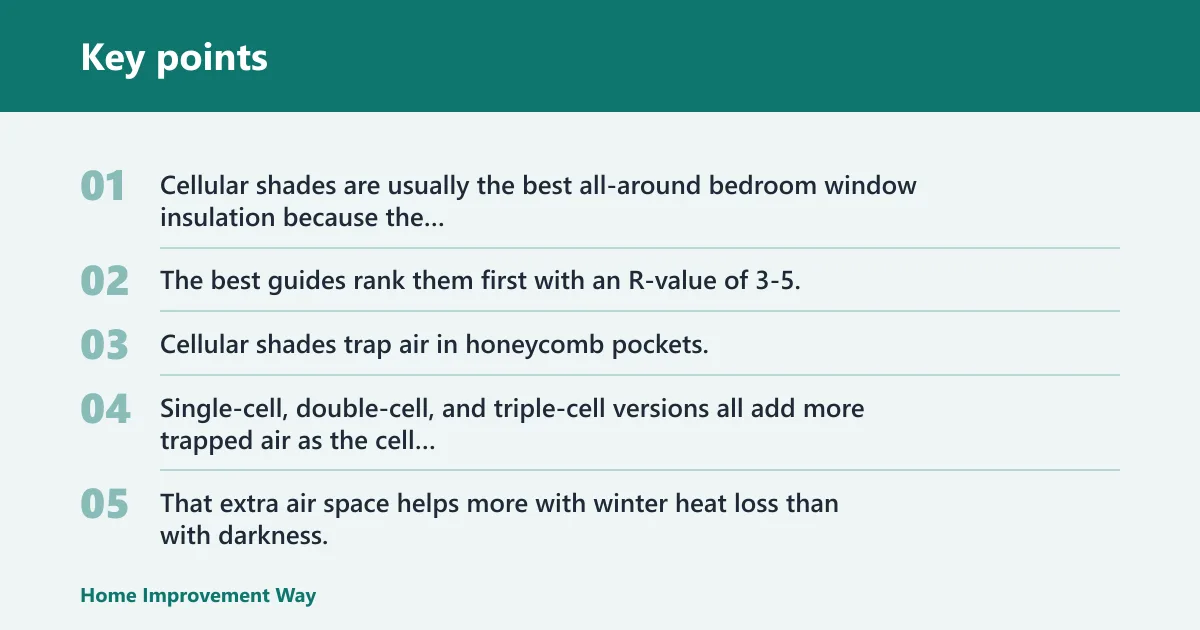
Cellular shades are usually the best all-around bedroom window insulation because the honeycomb air pockets slow heat transfer in both winter and summer. The best guides rank them first with an R-value of 3-5, and they can reduce heat loss through windows by up to 40%.
Honeycomb air pockets and cell count
Cellular shades trap air in honeycomb pockets. Single-cell, double-cell, and triple-cell versions all add more trapped air as the cell count rises, which is why they are the strongest choice for temperature stability.
That extra air space helps more with winter heat loss than with darkness, so pair the shade with blackout fabric if sunrise is the main sleep problem. Many models come in light-filtering or blackout versions.
Single-cell vs double-cell vs triple-cell
Single-cell shades are the lighter, simpler option. Double-cell and triple-cell versions add more trapped air pockets, which usually improves insulation, but the thicker stack can also make the shade bulkier at the top.
If your bedroom window is already shallow or sits close to trim, check the stack depth before you buy. Bulky shades can interfere with shallow frames or limit how cleanly an inside mount fits.
Where blackout liners fit
Cellular shades can be blackout or light-filtering. A blackout cellular shade gives you both insulation and sleep darkness, while a light-filtering version mainly helps with temperature and privacy.
If your room gets early morning glare, a blackout cellular shade is usually the better match than a plain thermal shade. If your main issue is winter chill, insulation may matter more than total blackout.
When cellular shades beat window film
Choose cellular shades when you want a permanent-looking upgrade that still lets you raise the window treatment. They are a better long-term answer than film if you need a bedroom window you can open for ventilation.
They also make more sense than film when both winter and summer comfort matter. A common first-timer mistake is buying a cheap film kit for a bedroom that also needs darkness all year.
Are blackout shades enough for a bedroom?

Blackout shades are enough for many bedrooms if your top problem is light, but they are not automatically the best insulator. A blackout shade can make the room much darker while still leaving some heat loss at the edges unless you improve the mount and seal.
Room-darkening versus true blackout
Room-darkening shades cut most light, but true blackout shades are built to stop far more of it. The Lone Star guide says room-darkening shades are the sweet spot for most bedrooms, while true blackout makes more sense for shift workers or very early sunrise.
For sleep, that difference matters. For temperature, it matters less than the fabric construction and edge seal.
Outside mount overlap and edge gaps
An outside mount extends past the window opening and overlaps on each side. That overlap reduces edge light gaps and improves darkness, especially around uneven trim or shallow frames.
It also helps with draft feel because the fabric can cover more of the opening. The tradeoff is size: you need room around the window, and the shade may project farther into the bedroom.
Side channels for better light control
Side channels are edge-sealing accessories that help block light leaks along the sides of blackout shades. The Lone Star guide recommends blackout plus side channels or an outside mount for maximum darkness.
They are most useful when streetlight glow or sunrise creeps in at the edges. They do not turn a shade into a full window seal, but they can close the gaps that usually ruin sleep darkness.
Blackout curtains and drapery as a layer on top
Blackout curtains add another insulating layer and give the room a softer look. They work well over shades, especially when the goal is to cut light further and add some extra thermal help.
Do not treat curtains as a full replacement for insulation at the glass. They help most when layered with a shade that already fits the window well.
Say your bedroom faces a streetlamp and gets a strong glow around the curtain edges. A blackout roller shade with an outside mount and side channels will usually stop more light than a loose curtain panel alone, while a curtain layered over it can improve the final result.
Thermal-backed roller shades: best for summer heat
Thermal-backed roller shades use a reflective backing to cut radiant heat. They are a solid choice for sunny rooms that overheat in the afternoon, but they insulate less than cellular shades overall.
Reflective backing and radiant heat control
The reflective surface helps bounce solar heat away from the room. That makes thermal-backed rollers most useful on windows that get strong direct sun and feel hot before evening.
They are often a practical middle ground when summer heat gain is the main issue and you still want a clean, simple look.
Why they insulate less than cellular shades
Thermal-backed rollers are listed with an R-value of 1.5-2.5, which is lower than the R-value of 3-5 listed for cellular shades. That gap matters in cold weather, where trapped air does more work than a reflective layer alone.
In plain terms, thermal-backed rollers are better at reducing summer heat gain than at fighting winter chill. If winter draft control is the main need, cellular shades usually win.
Best use cases for hot sunny rooms
Choose this type when the bedroom overheats in late afternoon or the window faces strong sun for hours. It also makes sense when you want a simpler look than a honeycomb shade and do not need maximum winter insulation.
For a bedroom that is both sunny and drafty, a cellular shade still gives the better all-season answer.
Window insulation kits: best seasonal fix

Window insulation kits are the cheapest way to insulate bedroom windows for short-term cold weather. They use interior shrink film, tape, or magnetic strips to reduce drafts, but they are seasonal and usually limit window operation.
Interior shrink film, tape, and magnetic strips
The common interior kit uses clear shrink film held with double-sided tape. Some versions use magnetic strips, which can make seasonal removal easier on certain window setups.
Bob Vila identifies the 3M Indoor Window Insulator Kit as best overall, and notes its length is 17.5 feet. Bob Vila also lists the Duck Brand Max Strength Window Kit thickness at 1.5 mil.
Indoor versus outdoor versions
Indoor kits are the standard choice for bedrooms because they are simple to install from the room side. Outdoor versions exist for some windows, but they are less common for a bedroom wall where access from inside is easier.
Pick the version that matches your access and the season. Interior film is usually the most practical short-term fix for renters or anyone waiting on a bigger repair.
What you give up in operability
Bob Vila says insulated windows treated with kits usually cannot be opened. That is the biggest downside in a bedroom, because it affects fresh air and can matter for exit access or routine ventilation.
If you need to open the window often, a kit is usually the wrong long-term choice. It is a good temporary seal, not a daily-use system.
When a kit beats a shade on cost
A kit beats an insulated shade when the problem is a drafty window and the goal is to spend as little as possible for one heating season. It is also useful when you need a quick fix before replacing weatherstripping or upgrading the window treatment.
If you need darkness too, the kit alone will not do the job. You may still need blackout curtains or shades on top.
Suppose a renter has a 30-inch-wide bedroom window that leaks cold air in January but must still open for ventilation in spring. A seasonal film kit can be the cheapest fix for winter, while a removable shade can handle darkness without staying sealed to the frame all year.
Bedroom insulation decision table
This table scores each option across the five criteria that matter most in bedrooms. Higher scores mean better performance for that row, and the final column translates the choice into a practical bedroom scenario.
| Option | Darkness | Draft reduction | Summer heat control | Winter heat retention | Operability | Best bedroom scenario |
|---|---|---|---|---|---|---|
| Cellular shades | 4/5 | 4/5 | 4/5 | 5/5 | 5/5 | Homeowner seeking permanent improvement |
| Blackout roller shades with outside mount and side channels | 5/5 | 2/5 | 3/5 | 2/5 | 5/5 | Shift worker who needs the darkest sleep setup |
| Thermal-backed roller shades | 3/5 | 2/5 | 4/5 | 2/5 | 5/5 | Sunny bedroom that runs hot in summer |
| Blackout curtains and drapery | 4/5 | 2/5 | 2/5 | 2/5 | 5/5 | Room that needs darkness plus a softer look |
| Window insulation kit | 1/5 | 5/5 | 2/5 | 3/5 | 1/5 | Renter with drafty windows |
Which one should you buy?
Pick cellular shades if you want the best all-around bedroom window insulation. They are usually the strongest answer for winter and summer comfort, and they can still be made dark enough for sleep.
Pick blackout roller shades with outside mount and side channels if the main problem is sunrise, streetlight glow, or shift-work sleep. That setup is about darkness first, not thermal performance.
Pick a thermal-backed roller shade if the bedroom overheats from sun and you want a simpler look than a honeycomb shade. It helps with radiant heat, but it is not the strongest winter insulator.
Pick blackout curtains if you want more darkness and a softer room, especially on top of another shade. They work best as a layer, not as the only fix.
Pick a window insulation kit if you are dealing with a drafty window and need the cheapest winter fix. It is the best short-term answer, but it usually means the window cannot be opened while it is installed.
Choose by sleep problem first
If early sunrise is the issue, go for blackout roller shades with an outside mount and side channels. If the room feels cold at the glass, cellular shades are usually the better first buy. If both are true, cellular blackout shades are the most balanced choice.
Choose by budget second
If the budget is tight, a clear shrink-film kit is the cheapest way to reduce draft from a leaky window. That said, the kit gives up operability, so it works best as a seasonal patch rather than a year-round answer.
Choose by whether you need to open the window
If you need regular ventilation, avoid a fixed film kit as your only treatment. A cordless cellular shade, blackout shade, or thermal-backed roller keeps the window usable and gives you a more permanent setup.
Frequently asked questions
What is the best window insulation for bedrooms?
Cellular shades are usually the best overall window insulation for bedrooms because they combine temperature control with everyday use. The best guide data puts them at an R-value of 3-5, which is stronger than the listed thermal performance of lined Roman shades or thermal-backed roller shades.
What is the best window insulation kit for a bedroom?
The 3M Indoor Window Insulator Kit is a strong starting point for a bedroom because it is listed as best overall and is built for indoor draft control. It is a seasonal fix, though, and Bob Vila notes that treated windows usually cannot be opened.
Are cellular shades better than blackout shades for bedroom insulation?
For insulation, yes, usually. Cellular shades are the better thermal pick because their honeycomb air pockets trap more air, while blackout shades are better at blocking light. If you want both, a cellular blackout shade is often the better match.
Do blackout shades insulate bedrooms well enough for winter?
They can help, but they are usually not the strongest winter insulator. Blackout shades are best when darkness is the main goal; cellular shades do more for heat loss reduction, especially in cold weather.
What window treatment keeps a bedroom dark and warmer?
A cellular blackout shade is usually the best single treatment for both darkness and warmth. If you need even more light control, add blackout curtains on top, and use an outside mount or side channels to reduce edge light leaks.
How do I stop drafty bedroom windows without replacing them?
Use a clear shrink-film insulation kit for the cheapest seasonal fix, or add a tightly fitted cellular shade if you want a more permanent answer. If the leak is at the frame, weatherstripping or draft seal tape can also help, but the treatment must still match your need to open the window.
Should I use window film or insulated shades in a bedroom?
Use window film if your main goal is low-cost draft control for one season. Use insulated shades if you want the window to stay usable and want better year-round performance. Film is cheaper; shades are more flexible.
What is the cheapest way to insulate bedroom windows?
The cheapest way is usually an interior shrink-film kit. It is a practical short-term answer for cold weather, but it reduces operability and does little for darkness compared with a blackout shade or curtain.
Can I insulate bedroom windows and still open them?
Yes, if you choose shades or curtains instead of a fixed film kit. Cellular shades, blackout roller shades, thermal-backed rollers, and drapery all let you keep the window operable, while most insulation kits do not.
What bedroom window option gives both privacy and insulation?
A cellular shade gives the best mix of privacy and insulation for most bedrooms. If privacy means total darkness too, choose a blackout cellular shade or a blackout roller shade with side channels and an outside mount.
Sponsored / affiliate links. As an Amazon Associate I earn from qualifying purchases. I may earn additional commission from eligible campaigns.