How Often Should You Clean a Humidifier?
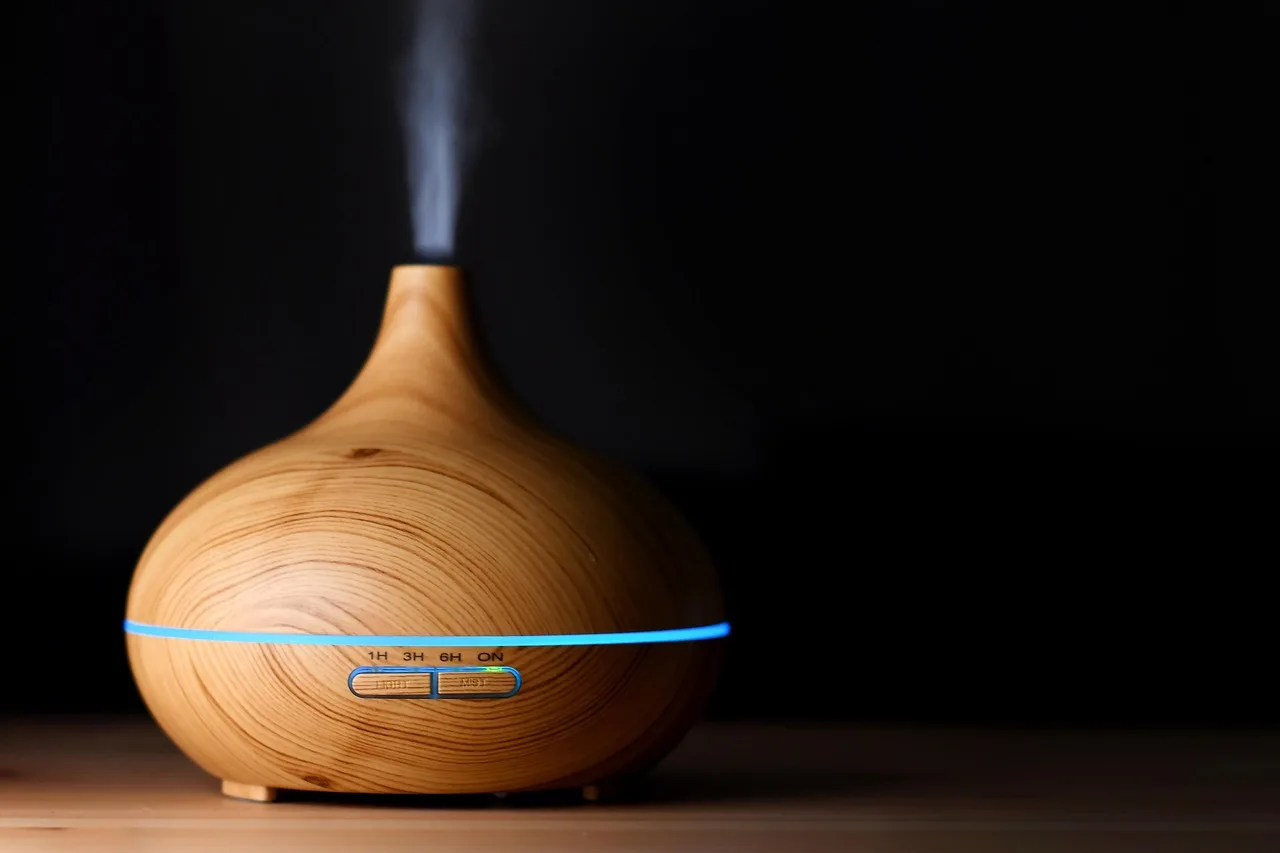
Clean a portable humidifier weekly if you use it daily; with distilled water and light use, every 1–2 weeks is usually enough, while any mold, slime, or odor means clean it now. Skipping cleaning can spread mineral dust and microbes, clog parts, and shorten the unit’s life. This guide gives a practical schedule by water type, humidifier type, runtime, and household risk level.
Why humidifier cleaning matters
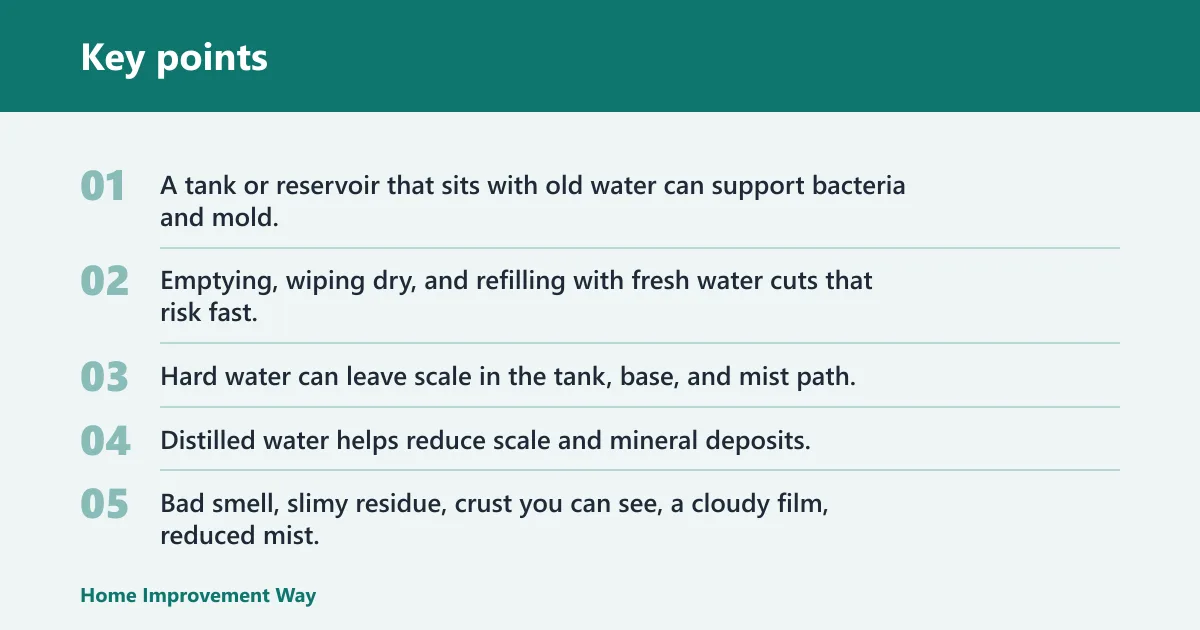


Standing water is the main problem. A tank or reservoir that sits with old water can support bacteria and mold, and bacteria can grow in as little as one to two days. Emptying, wiping dry, and refilling with fresh water cuts that risk fast.
Mineral buildup is the other issue. Hard water can leave scale in the tank, base, and mist path, and that buildup can turn into white dust or reduce mist output. Distilled water helps reduce scale and mineral deposits, but it does not remove the need for cleaning.
What counts as overdue cleaning
Bad smell, slimy residue, crust you can see, a cloudy film, reduced mist, or white dust all mean the unit needs attention sooner than the usual schedule. If the humidifier smells stale after emptying, or the base feels slippery, treat that as an immediate-clean signal.
A hygrometer helps you keep indoor humidity below about 50 percent, which can help reduce the chance of mold growth from over-humidification. If the room stays damp on windows or walls, the humidifier may be running too long or set too high.
Humidifier cleaning matrix
This matrix gives a usable schedule, but the owner’s manual still wins. If the manual says a cleaner, filter, or interval is different, follow that model-specific guidance.
| Humidifier type | Water type | Runtime | Household risk level | Daily action | Weekly wash | Monthly descaling | Immediate-disinfect trigger | Filter or wick interval | Clean sooner if you notice |
|---|---|---|---|---|---|---|---|---|---|
| Ultrasonic | Distilled | Light use, a few hours at night | Standard | Empty, wipe dry, refill daily | Wash weekly | Descale monthly, or sooner if crust appears | Any odor, slime, or visible film | No wick; check plates and transducer for buildup | White dust, lower mist, cloudy tank, sour smell |
| Ultrasonic | Tap water or hard water | Daily, long runtime | Baby, allergy, asthma, or immunocompromised occupant | Empty and dry every day | Wash at least weekly; sooner if used heavily | Descale monthly, sometimes sooner with hard water | Any slime, odor, or visible mineral crust | No wick; inspect every cleaning cycle | White dust, reduced output, faster scale return |
| Evaporative | Distilled preferred | Daily, moderate to heavy runtime | Standard | Empty reservoir daily | Wash weekly | Descale monthly if scale shows | Filter smell, dark buildup, or tank slime | Check wick every few days; replace per manual, often every 30 to 60 days | Musty filter odor, weak output, visible clogging |
| Steam vaporizer / warm mist | Distilled preferred | Daily use | Baby, allergy, asthma, or immunocompromised occupant | Empty and dry daily after cooling | Wash weekly | Descale monthly or sooner if deposits form | Any crust inside the chamber or odor after heating | No wick; inspect heating chamber and cap seals | Mineral ring, slow heating, residue on the chamber |
By water type and runtime
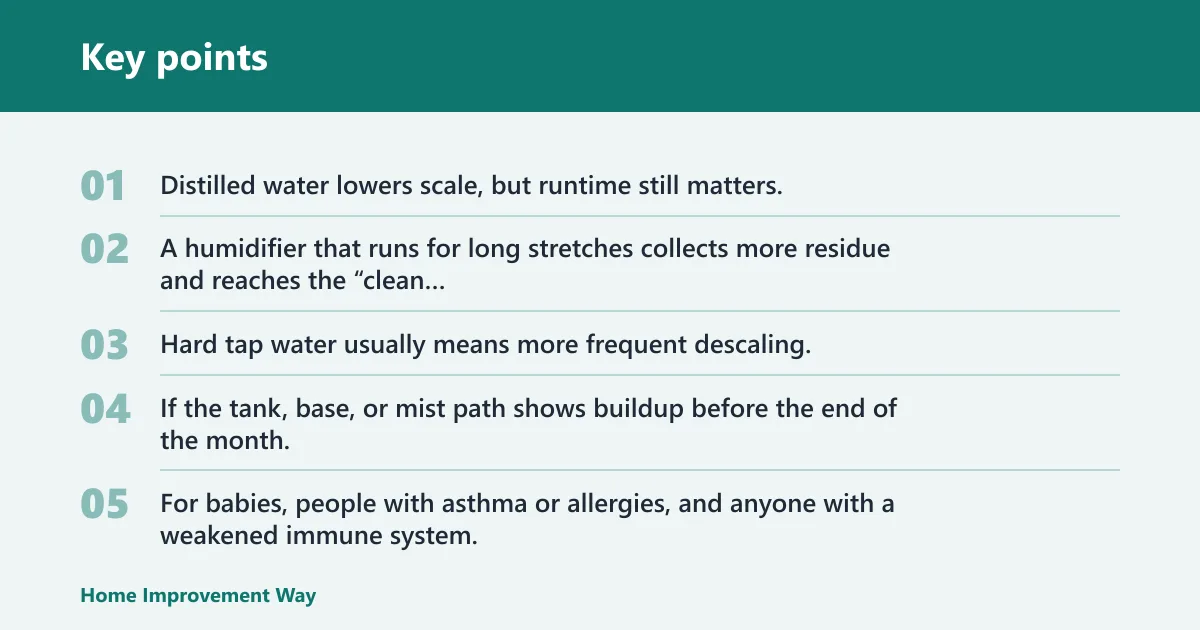
Distilled water lowers scale, but runtime still matters. A humidifier that runs for long stretches collects more residue and reaches the “clean sooner” point faster than a unit used only for a short overnight cycle.
Hard tap water usually means more frequent descaling, especially with ultrasonic units that can turn minerals into visible white dust. If the tank, base, or mist path shows buildup before the end of the month, clean it before waiting for the calendar.
By household risk level
For babies, people with asthma or allergies, and anyone with a weakened immune system, stick closer to the weekly end of the range and do not wait for odor or visible buildup. Shorter intervals are safer than stretching a dirty unit for another few days.
Picture a nursery humidifier that runs every night on tap water. If the room smells musty by midweek, the right move is not to wait for the weekend; empty it, wash it, and check the filter or wick right away.
How often should you clean a humidifier?
For most portable units, empty and wipe the tank daily, wash the full humidifier weekly, and descale about monthly if mineral buildup appears. If the unit runs every day, if the water is hard, or if anyone in the home is high-risk, shorten those intervals. Any odor, slime, or white dust is a clean-now signal.
Daily emptying and refill routine
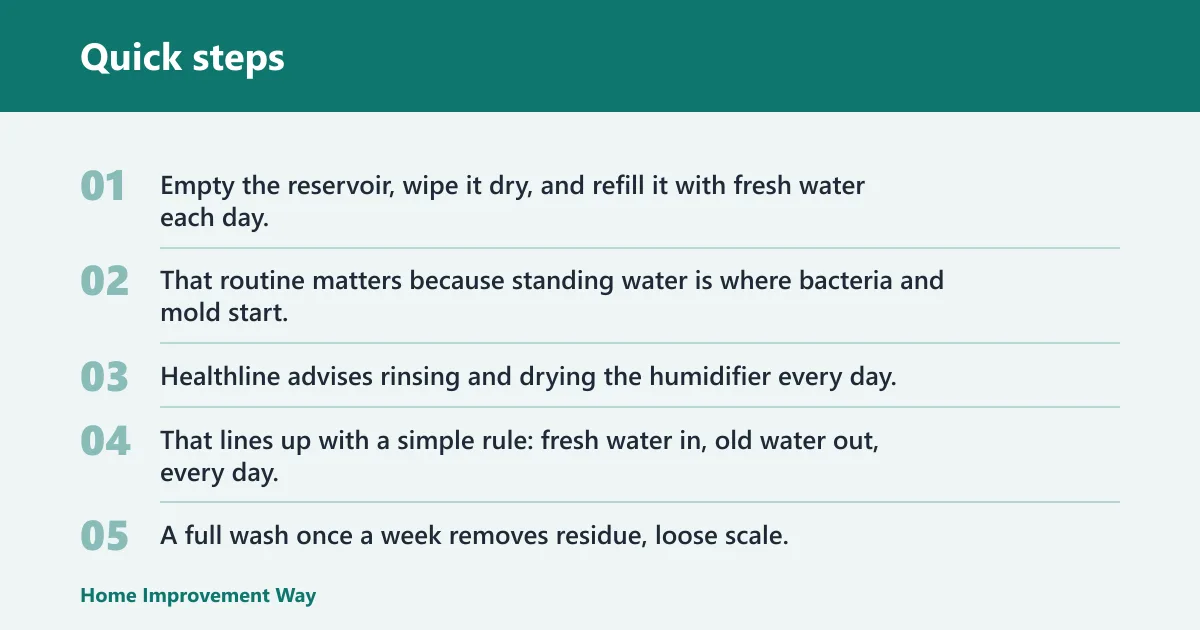
Do not top off old water. Empty the reservoir, wipe it dry, and refill it with fresh water each day. That routine matters because standing water is where bacteria and mold start.
Healthline advises rinsing and drying the humidifier every day, and Greatist says stale tank water should be changed daily. That lines up with a simple rule: fresh water in, old water out, every day.
Weekly washing schedule
Weekly cleaning is the floor, not a perk. A full wash once a week removes residue, loose scale, and film that daily emptying does not reach.
Suppose a tabletop humidifier runs six to eight hours each night with distilled water. If the tank still looks clear, weekly washing is still the baseline, because residue can build in the base, lid, and output path even when the water looks clean.
Monthly descaling schedule
Monthly descaling is a practical rule for many portable units, especially if you see mineral crust. NBC reports that experts advise cleaning at least monthly, while one source recommends weekly cleaning as a minimum and another says bacteria can grow in one to two days, which is why a monthly-only routine is too loose for heavy use.
If your water is hard, the humidifier may need descaling sooner than once a month. If distilled water and light use keep buildup away, the deep clean may stay closer to monthly, but the weekly wash should still happen.
When to disinfect sooner
Disinfect right away if you see slime, smell mildew, or find visible growth. Disinfecting is also reasonable after an illness in the home, after the unit sat with standing water for several days, or after the tank developed a sour odor that washing alone did not remove.
Do not assume every unit can be disinfected the same way. Check the manual first, because some parts and filters should not touch bleach or peroxide.
How often should you clean a humidifier with distilled water?
Distilled water lowers mineral scale, so the humidifier often needs less descaling, but it does not cancel daily emptying or weekly washing. A daily-use unit with distilled water still needs fresh water every day and a weekly wash. If the room is high-risk or the runtime is long, do not stretch the schedule.
Distilled water mainly changes what you will see, not whether cleaning is needed. You may get less white dust and fewer crusty deposits, but biofilm can still form in standing water, on seals, and in the base.
What distilled water changes and what it does not
Distilled water reduces scale and mineral deposits, which helps limit white dust in ultrasonic units. It also makes the monthly descaling step easier when you do need it.
It does not stop bacteria from growing in stale water. A tank that sits with yesterday’s water can still become a problem even if the fill water was distilled.
When distilled water still needs a deeper clean
If you notice odor, cloudy film, or reduced mist, clean sooner no matter what water you use. Distilled water slows mineral buildup, but it does not prevent residue from dust, room air, or old water left in the reservoir.
How often should you clean a humidifier filter?
Check a wick filter often, and follow the manual first. Many filters need replacement every 30 to 60 days, but smell, discoloration, and quick clogging are signs it should go sooner. Some filters should not be cleaned with chemicals at all.
When a wick filter can be rinsed
If the manual allows rinsing, use plain water and let the filter dry fully before reinstalling it. That can remove loose dust and light residue, but it will not restore a filter that is saturated, discolored, or holding a smell.
When a filter should be replaced
Replace the wick filter if it smells musty, looks dark or stiff, sheds debris, or clogs quickly after cleaning. Replacement may also be the better move if the humidifier output drops even after a wash and rinse.
The 30 to 60 day interval is a rule of thumb, not a universal promise. Manufacturer guidance overrides it, and heavy use or hard water can shorten the useful life much faster.
How to clean, descale, and disinfect safely
Start with the mildest step that solves the problem. Washing removes dirt and slime. Vinegar handles mineral buildup. Disinfectants are for the cases that need them, and only if the manual says the materials can handle them.
- Unplug the unit and let warm-mist models cool fully.
- Empty the tank and base.
- Wash removable parts with the cleaner the manual allows.
- Use white vinegar for mineral scale if the parts are compatible.
- Rinse until no smell remains.
- Use bleach or 3 percent hydrogen peroxide only if the manual allows that method.
- Rinse again and let all parts dry fully before reassembly.
White vinegar for scale
White vinegar loosens mineral buildup in tanks, bases, and other removable parts. A common soak time is about 15 to 30 minutes; some guides recommend 15 to 20 minutes, and another says to let vinegar sit for 20 minutes. The same source notes a 30 minute vinegar-and-water soak. Afterward, rinse thoroughly.
Use vinegar for descaling, not for disinfecting. If a part still feels gritty or shows crust after the soak, repeat the wash rather than jumping straight to harsher chemicals.
Bleach or hydrogen peroxide only if allowed by the manual
Bleach disinfection only belongs in a humidifier if the owner’s manual permits it for that exact model and its materials. A commonly cited mixture is about 1 teaspoon per gallon of water, and the parts should be rinsed until the smell is gone. Never mix bleach with vinegar.
Three percent hydrogen peroxide is an alternative disinfectant when bleach is not preferred and the manual allows it. Healthline notes that a 3 percent hydrogen peroxide solution may be useful. Rinse the parts after use, and do not apply it to filters or components the manufacturer says to keep chemical-free.
Rinsing and drying steps
Rinse every contact surface until no cleaner smell remains. Dry the tank, base, and removable parts before reassembly so fresh water does not sit on damp residue.
A common first-timer mistake is putting the humidifier back together while the base still smells like vinegar. That leaves a sharp odor in the room and can make it hard to tell whether the unit is truly clean.
Type-specific cleaning notes
Ultrasonic humidifiers
Ultrasonic units need close attention to the transducer, water path, and tank bottom because mineral residue can turn into white dust. Distilled water helps most here, but weekly washing and regular descaling still matter.
If mist output drops, check for scale first. That symptom often shows up before the tank looks dirty.
Evaporative humidifiers
Evaporative units depend on a wick or filter, so the filter becomes part of the cleaning schedule. Check it for smell and visible buildup often, because a dirty wick can spread odor even when the tank itself looks fine.
These units still need daily emptying and weekly washing. If the wick looks loaded with residue before the replacement window, replace it sooner.
Steam vaporizer and warm mist units
Warm mist units can collect scale in the heating chamber and cap, so descaling matters even when the tank looks clear. Let the unit cool before cleaning, and check the manufacturer’s guidance before using any disinfectant.
Because heat does not prevent mineral deposits, a clean-looking tank does not mean the chamber is clean. If you see a mineral ring or hear slower heating, clean the chamber sooner.
Frequently asked questions
How often should you clean a humidifier if you use distilled water?
With distilled water, many portable humidifiers are often reported to go one to two weeks between deeper cleanings if use is light, but daily emptying still matters. A weekly wash is a safe default for daily use. Distilled water reduces scale, not the need to dump stale water and dry the tank.
How often should you clean a humidifier with vinegar?
Use vinegar whenever mineral scale shows up, often around the monthly mark for many users and sooner with hard water. A 15 to 30 minute soak is common, followed by a thorough rinse. Vinegar is for descaling only, so do not use it with bleach or on parts the manual forbids.
Do you have to clean a humidifier every day?
You do not always need a full wash every day, but you should empty the reservoir, wipe it dry, and refill with fresh water daily. That step matters because standing water can support bacteria and mold fast. Daily care is the best way to keep the weekly wash from turning into a rescue job.
How often to clean humidifier for baby?
For a baby’s room, stay on the strict side: empty daily, wash weekly or sooner, and disinfect only if the manual allows it and the unit actually needs it. Use a hygrometer and keep humidity below 50 percent. Clean sooner if you notice odor, slime, or white dust near the crib.
Sponsored / affiliate links. As an Amazon Associate I earn from qualifying purchases. I may earn additional commission from eligible campaigns.