Do Fireplace Blowers Really Make a Difference?
Yes, a fireplace blower can make a real difference, mainly by moving heat into the room and reducing hot-cold layering. It usually improves comfort more than total heat output. Ignore that, and you may pay for a blower that barely changes the rooms you actually live in. This guide explains what a blower changes, when it is worth the cost, and how to tell if your fireplace or stove is compatible.
What a blower will
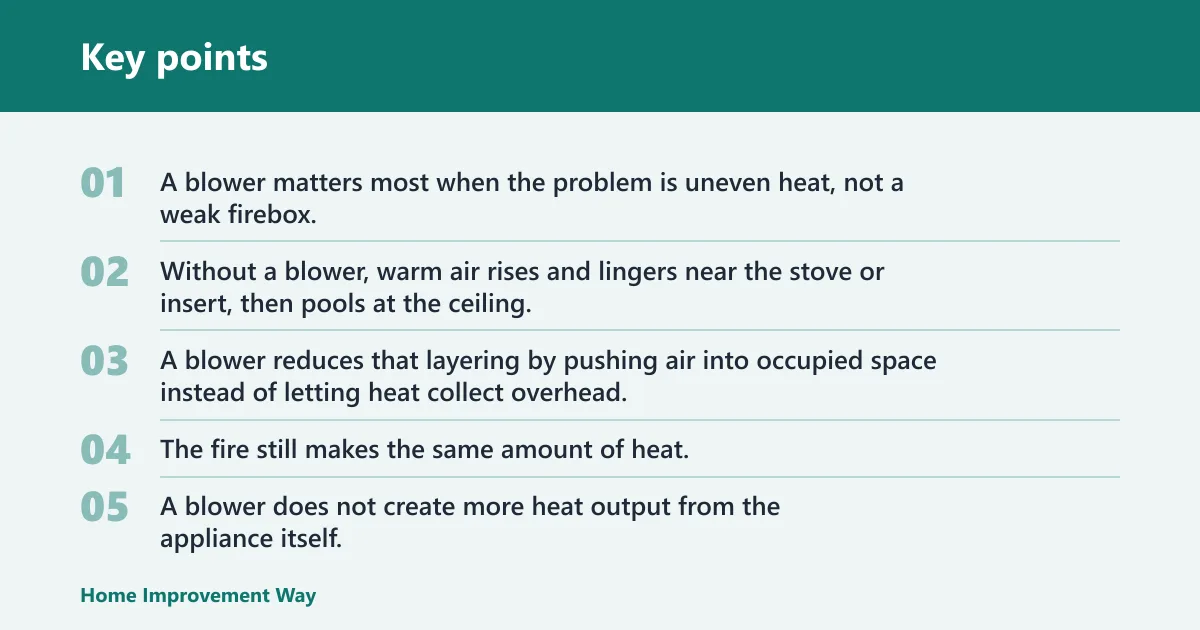


A blower matters most when the problem is uneven heat, not a weak firebox. It moves warm air into the living space, so the room feels more even and nearby rooms can warm up sooner. It does not create more heat output from the appliance itself, and that difference matters.
What changes in the room
Without a blower, warm air rises and lingers near the stove or insert, then pools at the ceiling. That creates room temperature stratification, where one part of the house feels warm while the far side stays cool. A blower reduces that layering by pushing air into occupied space instead of letting heat collect overhead.
The practical gain is usually comfort. In rooms with open doorways or short air paths, the moving air can make the main zone feel more even and help nearby areas warm sooner. Those are distribution gains, not extra appliance output.
What stays the same
The fire still makes the same amount of heat. A blower does not create more heat output from the appliance itself. It changes how quickly and where that heat spreads.
That is why a blower can feel underwhelming in one house and worthwhile in another. If the goal is to warm the room you sit in and the hallway next to it, it may help. If the goal is to turn one fireplace into whole-home heat, that is a different job.
How does a fireplace blower move heat?
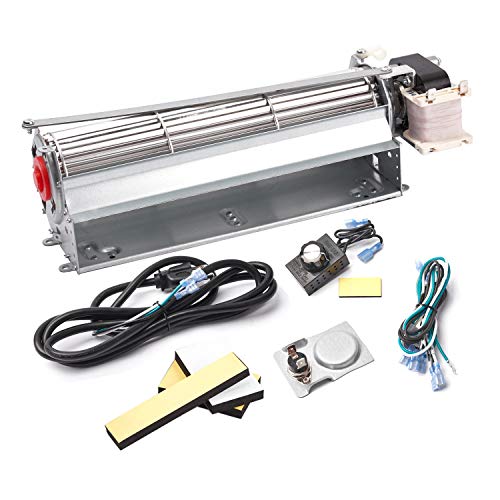
A fireplace blower is an electrically powered fan system that mounts to the back, bottom, or side of a stove or fireplace insert, depending on the model. Its job is to move warm air into the living space. On compatible units, some models offer fan-speed control, which lets you tune airflow and noise.
Forced air vs natural convection
Natural convection depends on hot air rising on its own. That is slow, and it tends to leave hot and cool zones in a room. Forced air from a blower speeds circulation, which can move heated air off the appliance and into the occupied area sooner than natural airflow alone.
Airflow is usually discussed in CFM, or cubic feet per minute. Many blower kits are rated in the low hundreds of CFM, while heat-powered stove fans are generally lower-output devices that work best in small, open spaces. Exact output depends on the appliance, the fit, and the fan design.
What CFM means in plain terms
CFM is not a comfort score by itself. It tells you how much air the fan moves, not how well your floor plan uses that air. A fan that moves plenty of air can still underperform in a closed layout with several doors and a long hallway.
Think of CFM as one part of the decision. Room size, ceiling height, and air path matter just as much.
What is the difference between a fireplace blower and a stove fan?
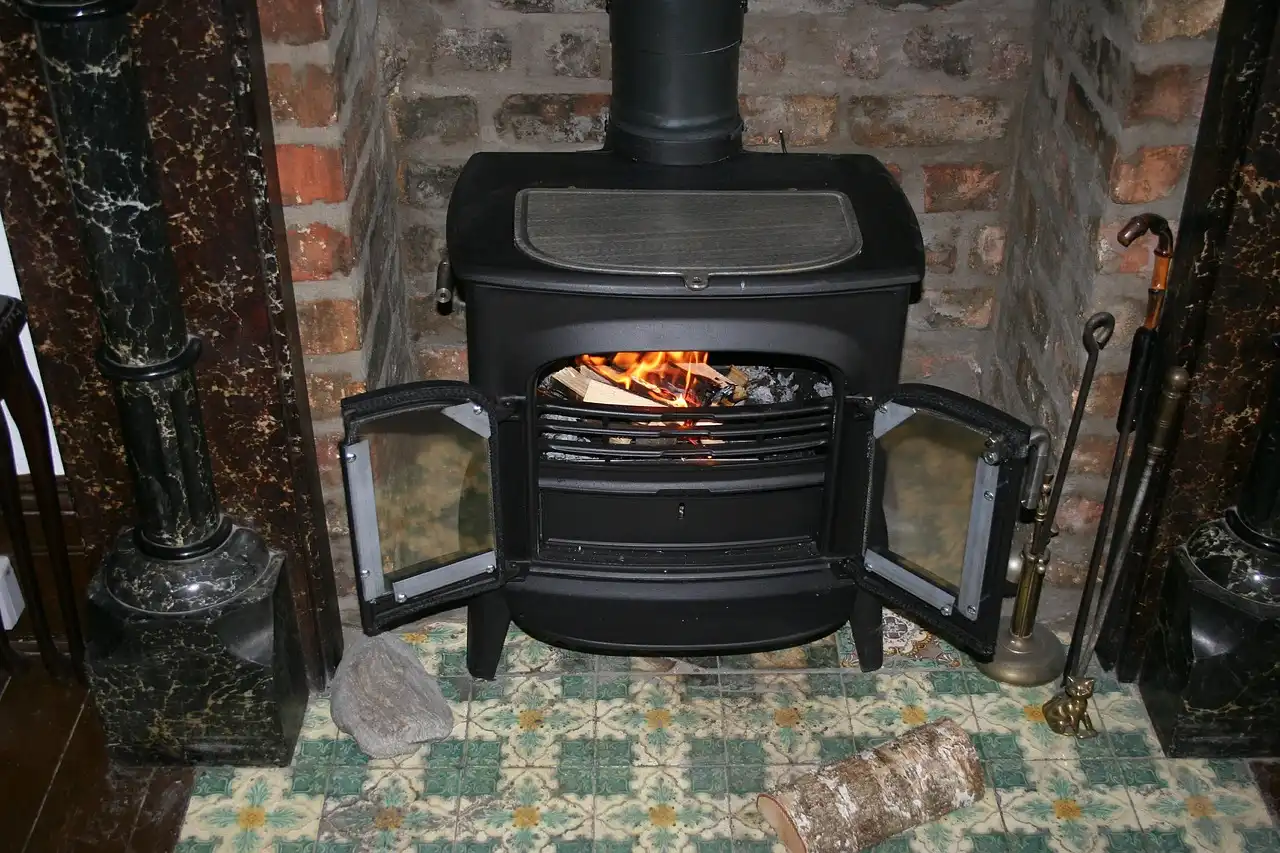
A fireplace blower is an electric fan system. A heat-powered stove fan sits on top of the stove, uses the temperature difference to spin, and needs no electricity. Both move warm air, but they fit different appliances and different expectations.
Electric blower kits
Blower kits are often OEM or factory-designed options for a specific model, or aftermarket upgrades for compatible stoves and inserts. They usually install with mounting points and wiring on units built to accept them. Typical investment is $100-$300, and some models give you fan-speed control.
Because they are powered, blowers can keep moving air regardless of how the stove body is oriented for natural draft. That makes them better suited to pushing heat into an adjacent room or down an open main floor when the appliance and layout support that airflow.
Heat-powered stove fans
Stove fans are simpler. They sit on the appliance top, start spinning when the base gets hot enough, and do not need wiring. That makes them appealing on wood stoves where the top surface gets hot and the layout is small and open.
But their output is limited. They are not a substitute for a blower kit on every model, especially in larger rooms or when heat needs to travel farther than a simple open-plan setup allows.
When is a blower worth it?
A blower is worth considering when you want better comfort in the room with the fireplace and more even temperatures in nearby spaces. It is most useful when the appliance already makes enough heat, but the layout lets too much of that heat sit near the ceiling or around the firebox instead of reaching the rest of the house.
Small rooms and adjacent spaces
In a small living room, a blower can make the sitting area feel less stratified and help the hall or adjoining room warm sooner. This is the best case for a blower when the home has a short air path and only one or two nearby spaces to serve.
For example, if a living room gets warm around the stove but the hallway remains cool, a blower can help move heat farther into the space. It may not make the hallway hot, but it can reduce the difference enough to notice.
Open plans and longer floor plans
Open plans often benefit because air has somewhere to go. Long floor plans are trickier. If heat has to travel through multiple turns, closed doors, or a stairwell, a blower may improve the main zone without doing much for the far end.
A ceiling fan can help some open layouts by mixing air overhead, but it does not replace a blower. The two tools do different jobs. A ceiling fan mixes room air; a blower pushes heat off the appliance and into the room sooner.
Whole-home heating expectations
The U.S. Department of Energy notes that a 60,000 BTU wood stove can heat 2,000 square feet, but distribution still determines comfort. In other words, rated capacity does not guarantee even warmth. A home can still show a noticeable difference between rooms if air movement is poor.
That gap is where a blower can matter. It will not turn a single fireplace into central heat, but it can reduce the unevenness that makes one room too warm and another too cool.
Fireplace blower decision matrix
This matrix helps you judge the accessory by room size, layout, and heating goal. Use it to decide whether a blower kit, a stove fan, or no accessory is the better fit for your space.
| Home type | Heating goal | Expected benefit | Best airflow condition | Likely limitation | Best fit |
|---|---|---|---|---|---|
| Small living room, open doorway to hall | Make the sitting area and nearby hall feel more even | Good chance of reducing hot-and-cold layering by moving existing heat faster | Open doorway and short path to the next room | May still leave distant rooms cooler than the main room | Blower |
| Open-plan main floor, one appliance near the center | Spread warmth across one connected zone | Good distribution gain when air can travel freely | Wide openings and few interior barriers | Less useful if ceilings are very high or the layout has dead ends | Blower |
| Wood stove in a compact cabin | Circulate heat without wiring | Moderate circulation from the stove top with no electricity needed | Small, open room with the stove in a central location | Lower output than many blower kits; depends on stove top temperature | Stove fan |
| Zero-clearance fireplace with factory blower prep | Improve comfort in the room and adjacent space | Good fit if the unit is designed for a kit | Factory cavity and wiring intended for a matched kit | Limited by the fireplace shell, ducting, or fan cavity design | Blower |
| Closed floor plan with several bedrooms far away | Heat multiple rooms from one appliance | Some help near the source | Few barriers and doors left open enough for airflow | Far rooms may stay cool; doorways and long halls block airflow | No accessory |
| Home with frequent outages | Keep heat moving during power loss | Stove fan keeps working if the stove surface is hot enough | No power needed; heat source must stay hot enough to spin the fan | Electric blower stops when power stops | Stove fan |
Will a blower help heat rooms farther from the fireplace?
Sometimes, but not always. A blower can help nearby rooms and open passages more than far rooms that sit behind doors or around corners. The farther the air has to travel, the more layout matters and the less one fan can do on its own.
Room size and layout
In a 1,500-square-foot home, the problem is often not the amount of heat but how unevenly it moves. If the appliance room is already warm and the next room is cool, a blower can narrow that gap. If the distant rooms are separated by closed doors, the result is usually modest.
Picture a 1,900-square-foot ranch with a fireplace in the living room and two bedrooms down a hall. A blower may make the living room and hallway feel more even, yet the bedrooms can still lag unless doors stay open and air can circulate freely.
Ceiling height and air movement
Higher ceilings make stratification worse because hot air rises farther above head level. That can leave the occupied zone cooler even when the room feels warm near the ceiling. A blower helps by putting more heat where people are, not where it collects naturally.
Ceiling fans can help mix the air after a blower starts moving it. They do not replace a blower’s job, but they can support it in tall rooms or open great rooms.
What happens in multi-room homes
Multi-room homes often need more than one airflow strategy. A blower can help the main living area and the room just beyond it, but it does not travel through a maze of closed spaces. If the real goal is whole-home heating, a ducted system or another primary heat source may be a better fit.
Compatibility, cost, and common limits
Compatibility matters as much as airflow. A blower kit may be pre-wired, blower-ready, or retrofit-only depending on the unit. Some fireplaces and stoves were built with a mounting cavity and wiring. Others cannot accept a kit cleanly without the correct factory parts.
How to tell whether your unit supports a kit
- Check the model label. Find the exact model number for the fireplace insert, zero-clearance fireplace, or wood stove. Then look for the manufacturer’s parts list or installation manual that names a blower kit, wiring harness, or fan housing.
- Look for mounting points. A compatible unit often has screw holes, a rear cavity, or a lower fan compartment. If the appliance has no space for airflow or wiring, it may not accept a blower without a factory-designed kit.
- Confirm power and clearance. Make sure the appliance has the electrical hookup the kit needs and enough room for service access. A blower should be installed only on a model designed for it or one with an approved retrofit path.
That check matters more than price. A cheap kit that does not fit the unit is no bargain.
Typical price range
A typical blower investment is $100-$300. That range is useful for comparison, but it does not tell you whether the fan is right for your layout. A more expensive unit may still be the wrong fit if the room is too closed off for the airflow to matter.
Noise, dust, and outage limits
Noise is the most common complaint. A blower can be noticeable, especially at higher fan speed. Dust circulation is another limit, since moving air can lift fine particles from the floor or around the appliance.
Power dependence is the biggest practical tradeoff. An electric blower stops during an outage. If the house relies on the stove during power cuts, that matters. A heat-powered stove fan keeps working without electricity, though it moves less air in many setups than a powered blower kit.
Suppose you want quiet heat for a small den and you lose power several times each winter. A stove fan may be the better fit even if a blower would move more air on paper. The right choice depends on the outage risk, not airflow alone.
Do fireplace blowers save on wood or fuel use?
They can, but only in the right setup and only because heat spreads better. A blower may reduce how long you need to run the fire to feel comfortable in the occupied space, but it is not a guaranteed fuel-saver. If the fire already heats the space evenly, the benefit may be mostly comfort.
Fuel savings are most plausible when a blower lets you heat the occupied area sooner and avoid running the fire longer just to warm distant corners. If you keep the same fire size and simply enjoy better comfort, the payoff may be comfort rather than lower wood use.
Frequently asked questions
Do fireplace blowers really make a difference?
Yes, especially when the problem is uneven heat rather than weak heat output. A blower moves existing warm air into the room and can reduce hot-cold layering near the appliance. It usually improves comfort more than total heating capacity.
How much more heat does a fireplace blower move?
Many blower kits are rated in the low hundreds of CFM, which means they can move air into the room faster than natural convection alone. That improves circulation, but it does not mean the fireplace makes more heat. Results depend on the room and the appliance.
How do I know if my fireplace supports a blower kit?
Check the exact model number, then look for a manufacturer-listed blower kit, wiring harness, or fan cavity in the manual or parts sheet. Pre-wired, blower-ready, and retrofit-only units are not the same. If the unit lacks those features, compatibility may be limited.
Sponsored / affiliate links. As an Amazon Associate I earn from qualifying purchases. I may earn additional commission from eligible campaigns.
 Garvee 14,000 BTU Portable Air Conditioner for Room Up to 750 Sq.Ft, 4 in-1 AC Unit with Cooling, Fan, Dehumidifier & Sleep Mode, Remote Control & Window Kit Included for Home, Office, Apartment,White
 ROVSUN 18000 BTU Mini Split AC/Heating System with Inverter, 20 SEER2 Energy Saving 230V Ductless Split-System Air Conditioner with Pre-Charged Condenser, Heat Pump, Remote Control & Installation Kit